
AI Healthcare Engineer Salary Germany 2026
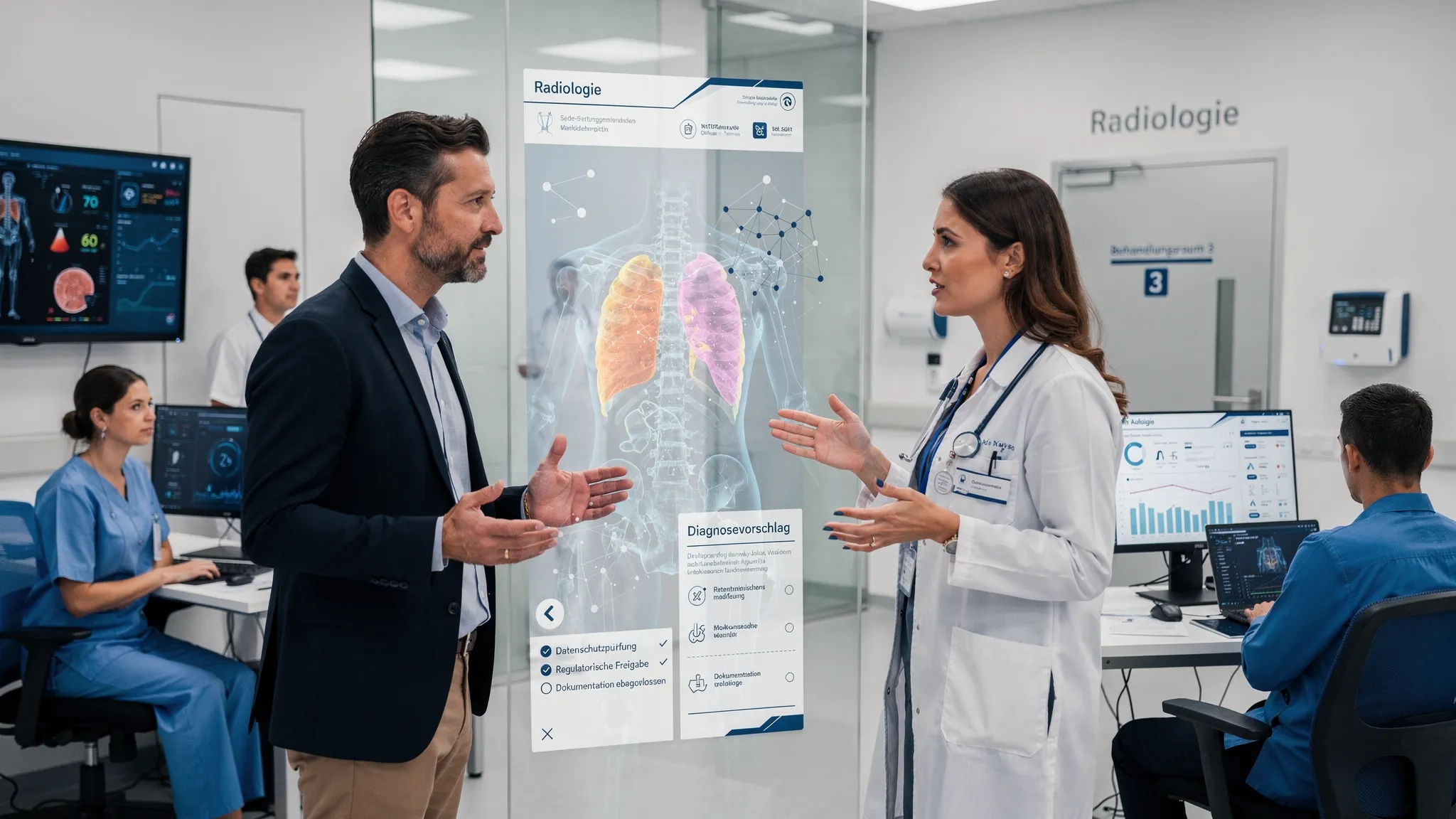
An AI healthcare engineer in Germany sits at the intersection of machine learning, clinical workflow, medical data, software engineering and regulated product development. In 2026, this is no longer a speculative hiring category. German medtech groups, digital health scaleups and AI imaging companies are competing for engineers who can move models from research into safe, auditable and commercially deployable systems.
The salary ranges below reflect gross annual base salary in Germany, excluding employer social contributions, equity, relocation cost and recruitment fees. They are intended for CTOs, HR Directors, COOs, founders and board members planning AI healthcare hiring in Germany in 2026.
Why Germany Is a Key Market for AI Healthcare Engineering Talent
Germany remains one of Europe’s most important markets for medical technology, healthcare software and applied engineering. Its scale matters for hiring: large clinical networks, strong industrial engineering depth and established medtech employers create a serious talent base, but also a highly competitive salary environment. Germany Trade & Invest describes the country as a major European healthcare and medical technology market, which aligns with the salary pressure Optima Search Europe sees across AI diagnostics, digital health and medtech AI teams.
Munich, Berlin and Heidelberg are the primary AI healthcare engineering hubs. Munich benefits from enterprise medtech demand and deep engineering density, including Siemens Healthineers’ influence on compensation expectations. Berlin offers stronger startup and scaleup density across digital health, AI product and health monitoring technology. Heidelberg is particularly relevant for medical imaging, oncology AI and computational pathology, supported by clinical research and university-linked ecosystems.
Germany also has a strong academic pipeline through TU Munich, RWTH Aachen, Heidelberg University and other technical institutions. However, the pipeline alone does not solve the hiring problem. Companies need engineers who understand PyTorch or TensorFlow, but also DICOM, clinical validation, privacy, auditability and regulated deployment.
EU MDR, IVDR and the phased implementation of the EU AI Act are increasing the premium for regulatory-aware AI engineers. Automotive AI talent is also pivoting into healthcare applications, especially around computer vision, sensor data and safety-critical systems, but these candidates usually require domain onboarding before they can work independently in clinical AI.
Summary for hiring leaders: Germany offers one of Europe’s strongest AI healthcare talent pools, but the most valuable candidates combine production ML, clinical context and regulatory awareness. That combination is scarce, and compensation needs to reflect it.
AI Healthcare Engineer Salary Benchmarks in Germany (2026)
The following AI healthcare engineer salary Germany 2026 benchmarks are based on observed hiring ranges for permanent roles in medtech, digital health, AI radiology, computational pathology and regulated healthcare software. Actual offers vary by city, company stage, funding position and role criticality.
- Junior AI Healthcare Engineer: €55,000 to €72,000 gross base salary. Typically 0 to 2 years of experience, often coming from ML, biomedical engineering, data science or research assistant backgrounds.
- Mid-level AI Healthcare Engineer: €72,000 to €98,000. Usually 2 to 5 years of applied ML experience, with some exposure to medical data, model evaluation or production pipelines.
- Senior AI Healthcare Engineer: €98,000 to €130,000. Strong candidates have shipped models, handled messy clinical datasets and can work with DICOM, MONAI, OpenCV, PyTorch or TensorFlow.
- Lead or Principal AI Healthcare Engineer: €125,000 to €165,000. These profiles set architecture, influence validation strategy and mentor ML teams in regulated environments.
- Head of AI or VP Engineering, AI Healthcare: €155,000 to €230,000 base, with total compensation often materially higher through bonus or equity. These are leadership roles, not just senior technical posts.
Freelance and contract AI healthcare engineer day rates in Germany are also rising. Mid-level contractors usually range from €650 to €850 per day. Senior ML engineers in healthcare commonly command €850 to €1,150 per day. Interim Heads of AI, DICOM integration specialists or regulatory-aware ML leads can reach €1,200 to €1,600 per day, especially for urgent delivery or remediation work.
For specific subfields, AI radiology engineer salary Germany benchmarks are usually at the upper end of senior ML ranges, especially where candidates have lung nodule detection, mammography, triage or workflow integration experience. Computational pathology salary expectations are also increasing, particularly for candidates who can combine whole-slide imaging, oncology datasets and clinical validation.
Summary for hiring leaders: For permanent hiring, a realistic 2026 budget is €72,000 to €130,000 for most individual contributors, €125,000 to €165,000 for principal-level talent and €155,000 plus for AI healthcare leadership.
What Factors Influence AI Healthcare Engineer Salaries in Germany
Seniority matters, but healthcare-specific experience matters more. A general machine learning engineer salary Germany healthcare benchmark cannot be lifted directly from SaaS or eCommerce AI. Clinical AI roles require more documentation, more validation discipline and stronger awareness of downstream patient and regulatory risk.
Specialisation creates clear premiums. AI radiology, digital pathology, oncology AI, clinical decision support and hospital workflow automation each require different data fluency. Engineers with DICOM, HL7/FHIR, PACS integration or MONAI experience are harder to replace than general computer vision engineers. In medical imaging, candidates who understand false positive rates, sensitivity, specificity and reader workflow usually negotiate from a stronger position.
Technical stack also influences pay. PyTorch remains highly valued for research-to-production ML. TensorFlow still appears in established enterprise environments. OpenCV, MONAI, Kubernetes, MLflow, cloud deployment, MLOps monitoring and secure data engineering all increase value when tied to healthcare use cases.
Regulatory knowledge is now a salary multiplier. Engineers who can work effectively with EU MDR, IVDR, clinical evaluation, technical documentation, post-market surveillance and EU AI Act readiness are worth more because they reduce execution risk. For many German medtech employers, regulatory-aware engineers shorten the distance between prototype and compliant product.
Location also matters. Munich usually pays the highest base salaries, often 8% to 15% above national median for scarce profiles. Berlin is competitive for startups and internationally funded scaleups, though equity may carry more weight. Heidelberg can pay a premium for imaging and pathology talent. Hamburg, Cologne and Frankfurt are competitive but slightly more role-dependent.
Betriebsrat structures can also shape compensation. In larger German employers, works councils, grading systems and internal equity rules may limit flexibility on base salary. Startups and scaleups can move faster and use equity creatively, but they may struggle to match enterprise benefits and perceived stability.
Summary for hiring leaders: The highest salaries go to candidates who combine senior ML delivery, healthcare domain knowledge, regulated product awareness and location flexibility. General AI capability alone is no longer enough to justify top-tier compensation.
Total Compensation for AI Healthcare Engineers in Germany
Base salary is only one part of total compensation Germany packages. In established medtech companies, bonuses often range from 5% to 15% for individual contributors and 15% to 30% for senior leaders, depending on company performance and role level. Startups may offer lower cash but higher equity upside, although candidates increasingly scrutinise strike price, vesting terms and liquidity prospects.
Benefits matter in Germany. Candidates expect statutory health insurance structures to be handled cleanly, but stronger employers add occupational pension contributions through bAV, learning budgets, home office support, flexible working, conference attendance and high-quality equipment. For international talent, relocation packages can include visa support, temporary accommodation, family support and German language training.
Contractor comparisons are not straightforward. A €1,000 day-rate contractor may look expensive against a €120,000 permanent hire, but the comparison changes when speed, project duration, employer contributions, notice periods, equity and onboarding cost are included. Contractors are effective for defined model validation, architecture recovery or temporary leadership gaps. Permanent hires are better for product ownership, IP continuity and long-term regulatory knowledge.
Candidate experience now influences offer acceptance. Niche candidates expect a curated process with clear fit, timing and trust, a principle also visible in specialist appointment-led service models such as bridalwear consultations in Brabant, where personal fit and confidence drive decisions. In AI healthcare hiring, the equivalent is a fast, evidence-based process with clear role scope and credible technical interviewers.
Betriebsrat involvement can affect bonus structures, grading and offer approvals. Hiring teams should confirm internal bands before starting outreach, not after final interviews.
Summary for hiring leaders: Winning offers combine competitive base salary, credible bonus or equity, relocation support where needed and a hiring process that signals professionalism from the first conversation.
AI Healthcare Engineer Salary: Germany vs. Other European Markets
Germany sits among the highest-paying European markets for AI healthcare engineers, especially in medtech AI, medical imaging and regulated digital health. The UK can match or exceed German salaries in London or for US-backed remote roles, but purchasing power, benefits and employment structures vary significantly. UK offers may look higher on headline cash, while German packages often provide stronger employment stability and statutory protections.
The Netherlands is the closest comparator. Amsterdam, Eindhoven and Utrecht offer competitive AI and medtech compensation, with a strong English-speaking work culture and attractive relocation positioning. However, German enterprise medtech salaries are often stronger at senior and principal levels.
France generally pays below Germany across most seniority levels, particularly outside Paris. France has strong AI research and healthcare innovation, but German medtech salary benchmarks are usually higher for production engineers and AI product leaders.
Eastern Europe creates cost arbitrage for remote hiring. Poland, Romania, Czechia and the Baltics offer strong ML and software talent at lower salary levels, but regulated healthcare roles still require careful assessment. Cost savings can be offset by domain gaps, compliance complexity and integration risk.
Germany remains a top AI healthcare hiring market because it combines market size, engineering culture, clinical relevance, capital availability and regulatory seriousness.
Summary for hiring leaders: Germany is not the cheapest European market, but it is one of the strongest for regulated AI healthcare execution. Salary strategy should reflect competition from the UK, Netherlands and US-backed remote employers.
EU AI Act and EU MDR Impact on AI Healthcare Salaries in Germany
EU MDR is already reshaping AI healthcare hiring. The regulation, supported by European Commission medical device guidance, increases the need for documentation, risk management, clinical evaluation and post-market surveillance. AI engineers who understand these requirements are more valuable because they can design systems that are easier to validate, audit and maintain.
The EU AI Act adds another layer. The European Commission’s AI Act framework classifies many healthcare AI applications as high-risk, especially where they intersect with medical devices or clinical decision support. In 2026, companies are hiring not only for technical model performance, but for traceability, dataset governance, monitoring, human oversight and documentation readiness.
Germany-based medtech companies are particularly sensitive to compliance. This creates a premium above many European markets for engineers who can collaborate with Regulatory Affairs, Quality, Clinical and Product teams. The strongest candidates can explain model behaviour to non-technical stakeholders, document design decisions and anticipate conformity assessment implications.
This is also raising adjacent compensation. Regulatory Affairs specialists with AI, software as a medical device and EU MDR experience are seeing some of the fastest salary growth in the AI healthcare ecosystem. Engineers who bridge AI, EU MDR and EU AI Act readiness can command top packages because they reduce both hiring risk and product risk.
For a broader European view, see Optima Search Europe’s guide on how the EU AI Act impacts AI hiring.
Summary for hiring leaders: Regulation is not a back-office issue in AI healthcare. In Germany, EU MDR and EU AI Act readiness directly affect salary expectations for ML engineers, AI leaders and regulatory-aware technical specialists.
AI Healthcare Hiring Trends in Germany in 2026
The first major trend is talent migration from automotive AI into healthcare. Germany’s automotive sector has produced strong computer vision, sensor fusion, safety engineering and embedded AI talent. Some of these engineers are now open to healthcare, especially where the work has clinical impact. However, hiring teams should budget for domain ramp-up, particularly around medical data and regulated validation.
The second trend is benchmark inflation from established players. Siemens Healthineers and other medtech employers set expectations for seniority, benefits and stability. Startups competing against these brands need sharper equity narratives, faster hiring processes and clearer mission alignment.
The third trend is remote competition. US medical imaging and digital health companies increasingly target German AI healthcare engineers for remote or hybrid roles. Even when candidates stay in Germany, their salary expectations may be shaped by US compensation bands.
The fourth trend is Munich’s premium position. Munich combines enterprise demand, investor-backed startups and a deep engineering base. For scarce senior AI radiology or medtech AI profiles, Munich offers often need to sit above national averages to secure acceptance.
Optima’s 2026 report on the AI medical imaging talent shortage in Europe covers these structural shortages in more depth.
Summary for hiring leaders: Germany’s AI healthcare market is expanding, but the strongest candidates have more options than ever. Speed, compensation accuracy and credible technical evaluation are now decisive.
Case Study Scenario: Munich AI Radiology Scaleup
A representative scenario shows the hiring pressure facing German AI healthcare companies in 2026. The client profile is a Munich-based Series B AI radiology scaleup building a lung nodule detection platform. The business needed three Senior ML Engineers and one Head of AI within 55 days, while competing against enterprise medtech employers and US-backed imaging companies.
The search process began with German AI healthcare talent mapping across Munich, Berlin, Heidelberg and remote-ready European candidates. Outreach focused on passive candidates with medical imaging, DICOM, deep learning and production deployment experience. The process also accounted for Betriebsrat-aware expectations around role documentation, interview consistency and offer governance.
The first placement was completed in 34 days. The remaining roles were closed within the target hiring window and within budget by calibrating compensation early, separating must-have DICOM experience from trainable clinical workflow knowledge and keeping senior technical stakeholders involved throughout assessment.
The outcome was four accepted offers, with all hires retained at 12 months in the scenario model. The key lesson is simple: scarce AI healthcare talent can be hired quickly in Germany, but only when market mapping, compensation benchmarking and process discipline are aligned from the start.
Summary for hiring leaders: For AI radiology, computational pathology and regulated medtech AI hiring, the limiting factor is rarely candidate existence. It is usually access, positioning, compensation precision and process speed.
Frequently Asked Questions
What is the average AI healthcare engineer salary in Germany in 2026? The average AI healthcare engineer salary in Germany in 2026 typically falls between €85,000 and €115,000 gross base for experienced individual contributors. Junior candidates are usually closer to €55,000 to €72,000, while senior engineers with medical imaging, DICOM, MLOps or regulated product experience can reach €98,000 to €130,000. Lead, principal and Head of AI roles sit higher. The practical average depends heavily on whether the role is general digital health engineering, AI radiology, computational pathology or regulated medtech AI.
Which German cities pay AI healthcare engineers the most? Munich usually pays the highest salaries for AI healthcare engineers in Germany, particularly for senior medtech AI, AI radiology and leadership roles. Berlin is highly competitive for startup and scaleup positions, often using equity and mission-driven positioning alongside salary. Heidelberg can command premiums for oncology AI, research-led imaging and computational pathology. Hamburg, Frankfurt, Cologne and Düsseldorf are active but more variable. For hard-to-hire senior profiles, location matters less than specialisation, as remote and hybrid competition increasingly shapes candidate expectations.
How does EU MDR and EU AI Act knowledge affect salary expectations in Germany? EU MDR and EU AI Act knowledge can materially increase salary expectations because it reduces product and compliance risk. Engineers who understand documentation, clinical validation, risk management, dataset governance, human oversight and auditability are more valuable than general ML engineers in regulated healthcare environments. In Germany, this premium is especially visible in medtech AI, software as a medical device, AI radiology and IVDR-adjacent roles. The strongest compensation packages often go to candidates who can work effectively with Engineering, Regulatory Affairs, Quality and Clinical teams.
How do German AI healthcare salaries compare to the UK and Netherlands? Germany is broadly comparable with the Netherlands and often higher than France for AI healthcare engineering roles. The UK can be higher in London, especially for US-backed companies, but headline salary comparisons need to consider benefits, tax, equity, job security and purchasing power. The Netherlands competes strongly for English-speaking AI talent, particularly around Amsterdam and Eindhoven. Germany remains especially strong for enterprise medtech, regulated engineering and senior AI healthcare leadership, where compensation is supported by market size and industrial depth.
Is there a shortage of AI healthcare engineers in Germany? Yes, there is a shortage of AI healthcare engineers in Germany, especially at senior and principal level. The shortage is most acute for candidates who combine production machine learning, medical imaging or clinical AI knowledge, DICOM or healthcare data experience and regulatory awareness. Germany has a strong engineering and university base, but the number of engineers who have shipped regulated AI healthcare products remains limited. This is why passive sourcing, cross-border search, clear compensation benchmarking and faster interview processes are critical for successful hiring in 2026.
Conclusion & Strategic Positioning
AI healthcare engineer compensation in Germany is rising because demand is concentrated around a limited pool of hybrid talent. The most valuable candidates are not just strong machine learning engineers. They understand clinical data, regulated software, EU MDR, EU AI Act readiness, deployment risk and the realities of healthcare product adoption.
For hiring leaders, the message is clear: under-benchmarking these roles extends time-to-hire, increases offer rejection risk and can delay product milestones. The right compensation strategy should account for seniority, city, specialisation, regulatory exposure, contractor alternatives and candidate expectations.
Optima Search Europe supports companies building AI healthcare, medtech, digital health and regulated technology teams across Germany, Europe and global markets. For organisations planning senior or business-critical AI healthcare hires, accurate salary intelligence and targeted market mapping are now essential parts of the hiring strategy, not optional add-ons.

