
AI Recruitment Agency in Europe: Hiring Artificial Intelligence Talent at Scale

AI Recruitment Agency in Europe: Hiring Artificial Intelligence Talent at Scale
Building an AI capability in 2026 is no longer a “nice to have”. It is a board-level priority across software, industrials, healthcare, and regulated financial services. The constraint is rarely ambition or budget, it is talent supply. Europe has world-class research, strong engineering hubs, and growing AI funding, but the market for Artificial Intelligence and Machine Learning practitioners is structurally tight, highly international, and increasingly shaped by regulation.
If you are a CTO, HR Director, COO, Founder, or board sponsor tasked with scaling an AI function, your challenge is not just “find CVs”. It is executing a repeatable hiring system that:
- Reduces time-to-hire for scarce AI roles without lowering quality
- Reaches passive and executive candidates who are not actively applying
- Works across borders (contracts, mobility, payroll structures, local norms)
- Mitigates regulatory and reputational risk (including EU AI Act awareness)
- Provides strategic workforce advisory, not just transactional recruitment
This is where a specialised ai recruitment agency europe partner becomes a leverage point, especially when you need to hire at pace across multiple markets.
What Is AI Recruitment?
AI recruitment is a specialist search and selection discipline focused on hiring talent that can research, build, deploy, operate, and govern machine learning systems in production environments. It is not simply “general tech recruitment with different job titles”. The best AI hires sit at the intersection of software engineering, data, applied mathematics, product thinking, and (increasingly) responsible AI.
What makes AI recruitment a specialism
A specialist in artificial intelligence recruitment Europe should understand the difference between:
- Research capability (papers, novel architectures, evaluation methods) and production capability (MLOps, monitoring, incident response)
- Generalist data roles and AI roles that require advanced modelling, experimentation, and deployment literacy
- “AI-first” companies and enterprises retrofitting AI into legacy platforms, where change management matters as much as modelling
That knowledge changes how you define the role, where you search, how you assess, and how you close.
AI recruitment vs general tech recruitment
Generalist tech recruitment can work well for broad software hiring, but AI introduces extra failure points:
- CVs are harder to compare because titles are inconsistent (ML Engineer, Applied Scientist, Research Engineer, LLM Engineer, Data Scientist)
- Output is context-specific, and projects are often confidential (you need assessment methods beyond portfolio links)
- Candidates optimise for learning, compute resources, publication freedom, and technical leadership credibility, not only salary
- Cross-border competition is more intense, with US firms recruiting heavily across Europe
Executive AI search vs technical AI hiring
AI capability is constrained at two levels:
- AI leadership: CTO, Head of AI, AI Research Director, VP Data/AI, Chief AI Officer, Responsible AI Lead
- Technical delivery: ML engineers, NLP specialists, Computer Vision engineers, MLOps engineers, AI researchers, applied scientists
An ai executive search Europe mandate is closer to leadership advisory. You are hiring someone who will define the roadmap, team topology, governance model, and execution cadence, and they must align with business strategy and risk appetite. Technical hiring, by contrast, is about building depth quickly and ensuring production-grade delivery.
Typical roles covered
Most European AI hiring demand clusters around:
- Machine Learning Engineers (classical ML and deep learning)
- NLP Engineers (including LLM integration and evaluation)
- Computer Vision specialists (edge, manufacturing, medical imaging)
- AI researchers (applied or foundational)
- MLOps Engineers (platform, deployment, monitoring)
- AI product leadership (AI Product Managers, AI platform leaders)
Summary: AI recruitment is a specialist discipline combining deep tech recruitment, candidate assessment, and executive search. It differs from general tech hiring because AI roles are harder to benchmark, more competitive cross-border, and more sensitive to production, governance, and risk.
Why Hiring AI Talent in Europe Is More Complex in 2026
European AI hiring has always been competitive, but 2026 adds layers of complexity that materially affect time-to-hire, compensation, and compliance.
A severe AI talent shortage, especially in “production AI”
The market has plenty of interest in AI, but a shortage of practitioners who can reliably ship models into production, operate them, and improve them safely over time. In practical terms, that means fewer candidates with strong MLOps, monitoring, evaluation, and platform engineering backgrounds.
The shortage is also “multi-dimensional”. It is not only about headcount, it is about seniority mix:
- Too few leaders who have scaled AI teams across multiple products and regions
- Too few engineers who have owned reliability, cost optimisation, and ML observability
- Too few specialists in NLP and Computer Vision who can translate research into performance in real-world constraints
For a deeper view of structural supply constraints, see our analysis of the AI talent shortage in Europe.
Competition from US and global firms is now standard
In 2026, European AI candidates routinely evaluate offers against US-headquartered companies hiring remotely across Europe, as well as global hyperscalers and well-funded deep tech startups. This shifts expectations around:
- Total compensation structure (base, bonus, equity, sign-on)
- Scope and autonomy (greenfield vs maintenance, research freedom)
- Engineering tooling and compute access
- Career trajectory and visibility of AI leadership
This is one reason many teams struggle to hire AI engineers Europe at scale through inbound-only methods.
EU AI Act implications change the talent profile
The EU AI Act introduces obligations that influence hiring plans, particularly for organisations building or deploying higher-risk AI systems. Even when you are not developing “high-risk” systems, the direction of travel is clear: governance, documentation, and oversight are becoming normal expectations.
A recruitment strategy that ignores regulatory reality can create downstream risk. Teams increasingly need leadership and practitioners who understand:
- Data governance and traceability
- Model evaluation, monitoring, and audit readiness
- Human oversight processes and escalation pathways
- Responsible AI and risk controls aligned to product context
For official reference, consult the European Commission’s AI Act resources.
Cross-border hiring is operationally complex
“Cross-border recruitment” is often discussed as a sourcing problem, but the friction typically appears later:
- Contracting structures (local entity, Employer of Record, contractor vs employee)
- Payroll, tax, and benefits comparability
- Right-to-work checks and mobility planning
- Local notice periods that impact start dates
- Works councils and local labour norms in some markets
If you do not plan for these factors upfront, you lose weeks, sometimes months, even after you have identified the right candidate.
Remote AI workforce dynamics are stabilising, but not simple
Remote and hybrid are no longer novelty. They are baseline expectations for many AI candidates, particularly those with scarce MLOps or NLP expertise.
However, remote hiring introduces new challenges:
- You must assess technical depth without relying on in-office “signals”
- Collaboration patterns, documentation discipline, and platform reliability become more important
- Compensation requires a clear philosophy (location-based, banded, or role-based)
Salary inflation in key hubs
In 2026, salary pressure is most acute in major AI clusters such as Germany, the Netherlands, and the UK, where competition spans startups, scale-ups, enterprises, and global firms.
Inflation is not uniform. It is highest for:
- Senior ML Engineers with production ownership
- MLOps Engineers who can build scalable platforms
- AI leaders with proven hiring and governance experience
Summary: AI hiring in Europe is more complex in 2026 due to a persistent talent shortage, intensified global competition, new compliance expectations under the EU AI Act, cross-border execution friction, remote workforce realities, and continued salary inflation in key hubs.

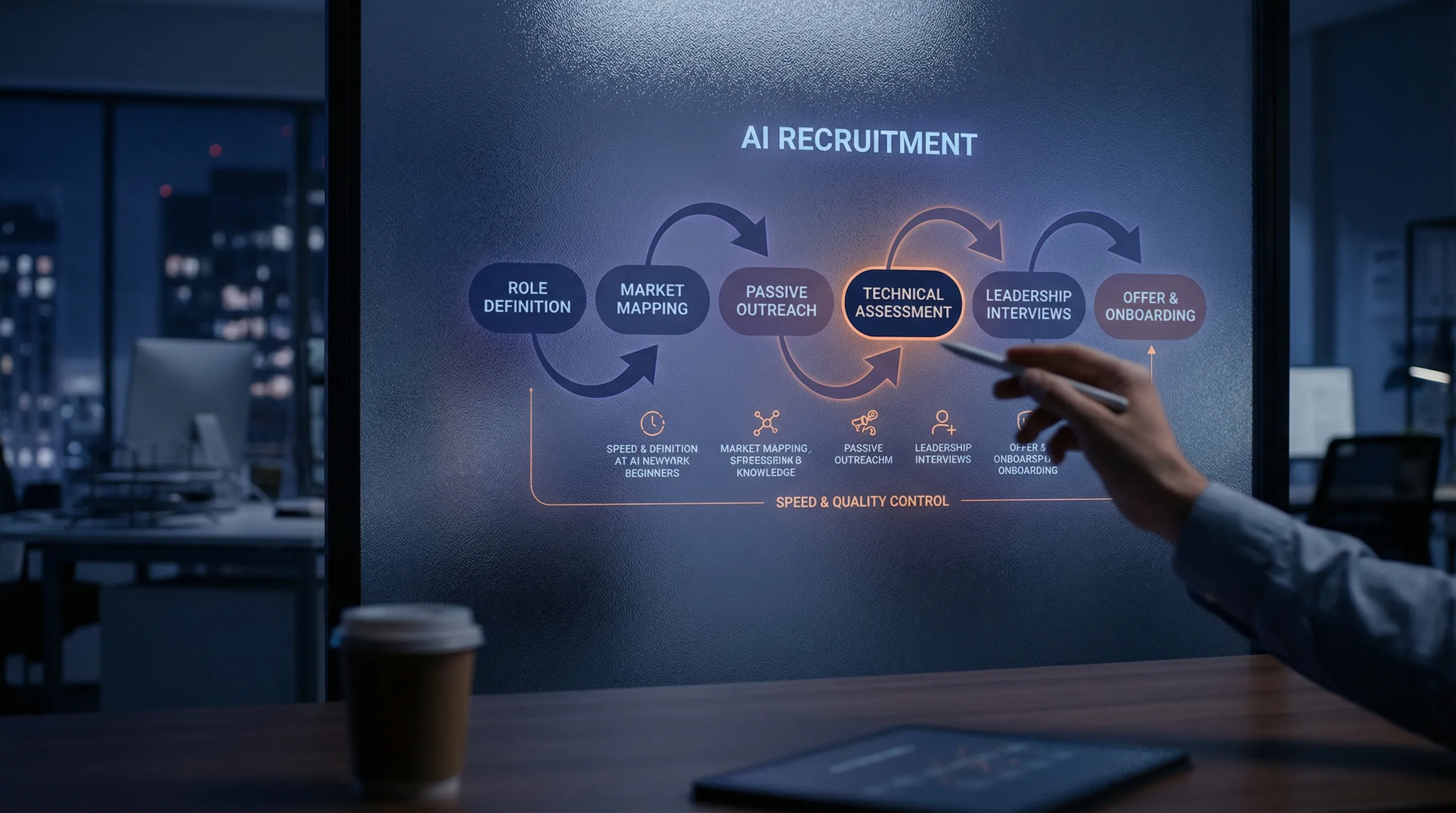
Our Strategic Approach to AI Recruitment
Optima Search Europe was built to support business-critical and senior hiring across Europe and globally. In AI and deep tech, the difference between “search” and “advertising” matters: the majority of high-performing candidates are passive, selective, and driven by mission, technical credibility, and long-term trajectory.
Our approach is designed around five execution pillars that map directly to the outcomes decision-makers care about: speed, access, cross-border delivery, risk control, and workforce strategy.
AI Market Mapping & Talent Intelligence
Market mapping is the foundation of faster and more accurate AI hiring. Instead of relying on applicants, we build a forward-looking view of the talent landscape by function, specialism, and geography.
In practice, this includes:
- Identifying competitor and adjacent talent pools (not just direct-title matches)
- Mapping research and engineering communities (where NLP, Computer Vision, and MLOps talent clusters)
- Tracking mobility signals, team changes, and product cycles that create “high intent” passive candidates
- Building shortlists based on evidence of impact, not keyword matches
The commercial value is tangible: market mapping reduces time-to-hire by narrowing the search to candidates with the right depth and the right “reason to move”.
Executive Search for AI Leadership
AI leadership roles fail when organisations hire for prestige rather than execution. A strong Head of AI or Chief AI Officer is not only a technical expert. They are a system builder who can:
- Translate business strategy into an AI portfolio (use cases, sequencing, ROI)
- Define operating model (centralised platform vs embedded squads)
- Establish Responsible AI governance aligned to the EU AI Act direction
- Recruit and retain senior technical talent
Our executive search process focuses on validated leadership outcomes, stakeholder alignment, and the ability to scale teams across borders.
For organisations evaluating leadership hiring support more broadly, you may also want to review what to expect from an executive search firm in Europe.
Cross-Border AI Hiring & Compliance
Cross-border recruitment is not a “nice extra” in AI. It is often the only way to build teams fast enough.
Execution typically requires decisions on:
- Where the role should legally sit (entity location vs remote hiring)
- Whether to use local employment, an EOR model, or interim contracting
- Notice period planning and start date realism
- Data protection considerations for candidate assessment and storage
Regulatory awareness also matters. EU AI Act obligations do not only affect product teams, they influence who you need to hire (for example, adding Responsible AI leadership, model risk expertise, or stronger governance capability).
AI Salary Benchmarking & Compensation Strategy
In AI hiring, compensation is a strategy tool, not a final negotiation. The fastest way to lose time-to-hire is to benchmark incorrectly, mis-level roles, or rely on outdated data.
We support clients with salary benchmarking that reflects:
- Country and city dynamics (Berlin vs Munich, Amsterdam vs wider Randstad, London vs other UK hubs)
- Seniority and scope (research vs production ownership, platform vs feature delivery)
- Total compensation expectations (bonus, equity, sign-on, allowances)
- Remote compensation adjustments (and candidate perceptions of “fairness”)
If you are building multi-role plans, align this with your wider benchmarking approach, including a Europe tech salary benchmark for 2026.
Technical Candidate Assessment
AI hiring fails when assessment is either too academic or too generic. You need to validate the capabilities that predict production impact.
A robust assessment framework typically evaluates:
- Core ML depth: problem framing, feature engineering (where relevant), evaluation design, bias and variance trade-offs
- Framework fluency: PyTorch or TensorFlow, modern NLP libraries, model training and inference patterns
- Production experience: serving, latency, monitoring, cost, rollback and incident response
- MLOps capability: CI/CD for ML, data/versioning, model registry, observability, governance
- Domain translation: ability to work with product, security, legal, and operations
In senior and executive AI recruitment, assessment also includes how leaders build teams, set standards, and manage risk. This is central to reliable AI delivery at scale.
AI Roles & Specializations We Cover
AI hiring is rarely “one role”. Once you commit to an AI roadmap, you quickly need a portfolio of specialisms to ship and maintain systems across NLP, Computer Vision, MLOps, and product.
We support clients across technical and leadership roles, including:
- Machine Learning Engineers
- NLP Engineers
- Computer Vision Specialists
- AI Researchers
- MLOps Engineers
- Data Scientists (AI-focused)
- AI Product Leaders
- Chief AI Officers
In practice, many hiring plans blend permanent hires with interim specialists to hit milestones, de-risk delivery, and create internal capability transfer.
AI Recruitment Across Key European Markets
Europe is not one AI market. It is a set of interconnected hubs with different talent profiles, salary bands, and mobility patterns. Understanding these differences is central to cross-border recruitment success.
Germany (Berlin, Munich)
Germany remains a cornerstone market for applied AI, industrial AI, automotive-related systems, and enterprise-grade engineering. Berlin is strong for startup and product-driven AI, while Munich is dense with deep engineering talent and large corporates.
Hiring dynamics in 2026:
- Strong competition for MLOps and platform engineering
- Increasing demand for Responsible AI literacy in regulated sectors
- Higher salary expectations in premium hubs and in senior production roles
If Germany is your anchor market, start with realistic benchmarking and levelling, including our guide to AI engineer salary in Germany.
Netherlands (Amsterdam)
Amsterdam and the wider Randstad continue to attract international AI talent due to strong English-speaking work environments and high concentration of SaaS, fintech, and data-driven businesses.
Key considerations:
- Candidates often compare offers internationally, so total compensation clarity matters
- Many teams hire cross-border into the Netherlands, increasing competition
- Strong demand for ML engineers who can ship end-to-end, from experimentation to deployment
UK (London)
London remains one of Europe’s most competitive markets for AI, with high density of fintech, enterprise technology, and global R&D centres.
Common patterns:
- Salary and total compensation competition remains intense for senior ML and MLOps
- Strong candidate expectations around hybrid flexibility
- Fast processes win, slow processes lose, particularly for top-tier candidates
France
France continues to produce strong AI research and engineering talent, supported by world-class education and a growing startup ecosystem.
Hiring realities:
- Research-to-production conversion is a key differentiator in candidate assessment
- Language expectations vary by company, role, and leadership team
- Enterprises investing in AI governance create demand for senior leaders and risk-aware practitioners
Eastern Europe (Poland, Romania)
Poland and Romania remain high-value markets for building AI engineering capacity, particularly when you need strong software engineering fundamentals alongside ML capability.
Strengths:
- Excellent engineering depth and strong delivery culture
- Increasing numbers of candidates with production ML experience
- Often favourable cross-border scalability, provided contracting and compliance are well structured
Nordics
The Nordics offer high-quality engineering, mature enterprise environments, and strong adoption of data-driven operating models.
What matters in 2026:
- High expectations on work quality, autonomy, and organisational clarity
- Competitive packages and strong benefits norms
- Best results come from targeted search, not broad advertising
AI Salary Benchmarks in Europe
Salary benchmarking in AI is difficult because titles are inconsistent, scope varies widely, and total compensation can be structured very differently across startups and enterprises. In 2026, the only reliable approach is to benchmark against scope, seniority, and production responsibility, then adjust for geography and hiring model.
Mid-level vs senior AI roles
A useful rule: the compensation gap between mid-level and senior is often driven less by years of experience and more by ownership.
Mid-level AI practitioners are typically evaluated on:
- Execution capability within defined problems
- Strong framework fluency and solid evaluation habits
- Ability to collaborate with product and data teams
Senior AI practitioners are valued for:
- System design for ML in production (reliability, scalability, monitoring)
- Mentorship and technical leadership
- Ability to reduce risk and accelerate delivery timelines
For leadership roles (Head of AI, AI Research Director, Chief AI Officer), compensation is typically linked to organisational scope, team size, and strategic risk profile.
Geographic salary differences
In general, salary pressure is highest in premium hubs (London, Amsterdam, Munich, Berlin), but the “headline number” is only part of the picture. Candidates compare:
- Base salary vs total compensation
- Equity credibility and liquidity assumptions
- Benefits, flexibility, and work authorisation support
Cross-border recruitment often reveals a practical trade-off: a slightly lower base in a non-premium city can be offset by higher role scope, better autonomy, and stronger growth trajectory.
Startups vs enterprises
Startups often compete on:
- Equity upside and mission
- Fast decision-making and greenfield build opportunities
Enterprises compete on:
- Stability, long-term career ladders, and brand
- Larger datasets, infrastructure, and “enterprise scale” problems
The best compensation strategy is not always “pay top of market”. It is “pay correctly for the scope, then close quickly with clarity”. Slow or ambiguous offers are a major driver of drop-off.
Remote compensation adjustments
Remote AI hiring can expand your talent pool, but it requires policy clarity. Candidates expect consistency on:
- Location-based pay philosophy
- Travel expectations
- Equipment and home-office support
- Performance measurement and promotion pathways
A specialist partner should help you set compensation bands that attract talent without creating internal inequity.
AI Recruitment Agency vs In-House Hiring
In-house teams are essential for employer brand, internal alignment, and long-term capability. The question is when external support becomes the fastest, safest route to outcomes.
Access to passive AI candidates
Top AI candidates often do not apply. They move when approached with the right combination of mission, scope, and leadership credibility. Specialist agencies invest heavily in networks and continuous relationship building, which is difficult to replicate quickly in-house.
Speed advantage and reduced time-to-hire
AI hiring speed is not about rushing interviews. It is about removing avoidable latency:
- Better role definition and levelling upfront
- Faster shortlisting through market mapping and targeted outreach
- Process design that matches candidate expectations
This is one of the clearest commercial benefits of using a specialised partner for AI hiring Europe.
Executive-level search capability
Executive AI search requires different skills than standard recruitment. It includes stakeholder alignment, confidential outreach, narrative positioning, and deeper assessment of leadership outcomes.
Risk mitigation and market intelligence
A specialist partner can reduce risk by:
- Stress-testing compensation and levelling assumptions
- Identifying governance and compliance gaps early (including EU AI Act awareness)
- Providing talent intelligence on competitor hiring patterns
What Differentiates a Specialized AI Recruitment Partner
Not every recruiter operating in AI is a deep tech recruitment agency. The difference is visible in process, assessment discipline, and cross-border execution.
Deep AI industry networks
Specialisation means you can reach:
- Passive candidates in high-performing teams
- AI leaders who are selective and not visible in job boards
- Niche specialists (NLP evaluation, CV edge deployment, MLOps platform engineering)
Understanding of the technical stack
A credible partner should speak precisely about:
- ML lifecycle (data, training, evaluation, deployment, monitoring)
- NLP and Computer Vision workflows and constraints
- MLOps toolchains and cloud platform realities
- The difference between prototypes and production systems
This is essential for accurate candidate assessment and for building trust with senior technical candidates.
Executive AI search and stakeholder alignment
AI leadership hiring fails when stakeholders are misaligned on priorities, governance, and success metrics. A specialised partner should help define the success profile and manage a process that keeps speed without compromising rigour.
Cross-border expertise and workforce mobility
Scaling AI teams often requires hiring across Germany, the UK, the Netherlands, France, Eastern Europe, and the Nordics in parallel. Cross-border recruitment capability is not only sourcing, it is execution, including mobility, contracting models, and local norms.
Strategic advisory, not just delivery
Decision-stage buyers need more than candidate CVs. They need a partner who can advise on:
- Team topology (platform vs squads)
- Hiring sequence (leadership first vs engineering first)
- Build vs buy vs partner decisions
- Compensation strategy and retention risks
Operationally, scaling teams also requires process discipline. Even simple systems, such as a lightweight CRM for multi-entity operations, can reduce friction when hiring across regions. Some SMEs standardise internal workflows with tools like Dr. CRM to keep execution consistent as they scale.
Case Scenario Example
Client: European SaaS company building a new AI division to embed ML features into its core product.
Challenge: Hire 6 AI engineers (mix of ML engineering and MLOps) plus 1 Head of AI, while maintaining delivery milestones and avoiding prolonged vacancy risk.
Process: Talent mapping and targeted outreach across Germany (Berlin and Munich) and Poland. Role definitions were levelled against market compensation expectations, interview loops were designed to validate production experience (MLOps, monitoring, evaluation), and leadership assessment focused on team-building, governance, and roadmap ownership.
Timeline: 8 to 12 weeks from initial scoping to accepted offers, depending on notice periods and final scope adjustments.
Outcome: A balanced AI team was built with both engineering execution and leadership capacity, enabling the client to begin shipping AI features with a scalable operating model.
Frequently Asked Questions
What does an AI recruitment agency do? An AI recruitment agency specialises in finding and assessing Artificial Intelligence talent, including Machine Learning, NLP, Computer Vision, and MLOps professionals. The work goes beyond advertising roles. It involves market mapping, passive candidate outreach, technical screening design, and advising on compensation and hiring strategy. For senior roles, it can also include executive search activities such as confidential outreach, stakeholder alignment on a success profile, and deeper leadership assessment. The goal is to reduce time-to-hire while improving quality and retention, especially in scarce talent markets.
How much does AI recruitment cost in Europe? Cost depends on the hiring model and seniority. For technical roles, some firms operate on contingency fees, while leadership roles are often handled through retained search. In Europe, market norms are commonly expressed as a percentage of first-year compensation, but the real cost discussion should include speed, shortlisting quality, and the opportunity cost of delayed hiring. For AI roles, a specialist partner can be cost-effective if they reduce vacancy time and improve hiring accuracy, particularly when you are competing for passive candidates.
How long does it take to hire AI engineers? Timelines vary by market, seniority, and interview design. In 2026, the limiting factor is often not sourcing, it is decision latency, scheduling, and offer clarity. With a well-defined role, targeted outreach, and a structured technical assessment, many organisations can reach offer stage within weeks, but notice periods and relocation can extend start dates. The fastest hires typically happen when the hiring manager commits to a tight interview loop, compensation bands are pre-approved, and the process is optimised for candidate experience.
Do AI recruitment agencies handle compliance and cross-border hiring? A specialised AI recruitment partner can support cross-border execution by advising on market norms and helping coordinate hiring across countries, including right-to-work checks, contracting approaches, and start-date planning. However, legal responsibility typically sits with the employer and their legal or payroll providers. In 2026, EU AI Act awareness also matters, not because recruiters provide legal advice, but because it shapes which roles you need (for example, Responsible AI leadership) and what governance capabilities to prioritise during assessment.
Which countries have the strongest AI talent pools in Europe? Talent density varies by specialism. The UK (especially London) remains strong for applied AI in fintech and enterprise software. Germany has deep engineering capacity, with Berlin and Munich as major hubs. The Netherlands attracts international talent and has a high concentration of data-driven companies. France continues to produce strong research and engineering profiles. Poland and Romania are increasingly important for scalable engineering capacity and production delivery. The Nordics offer high-quality talent with mature delivery cultures, although hiring can be competitive and process expectations are high.
What is the average salary for AI engineers in Europe? There is no single “average” that is reliably actionable because titles, scope, and total compensation differ widely. In 2026, compensation is driven most strongly by production responsibility, MLOps capability, and seniority. Geography also matters: premium hubs like London, Amsterdam, Berlin, and Munich tend to command higher base salaries, while total compensation for top candidates may include equity and sign-on packages. The best approach is role-specific benchmarking against peer companies and clear levelling, especially if you are hiring across borders.
What should we test for when assessing ML and MLOps candidates? Assessment should mirror real work. For ML engineers, test problem framing, evaluation design, and ability to translate business constraints into modelling choices. For MLOps candidates, test system design for deployment, monitoring, rollback, data and model versioning, and incident response. For NLP and Computer Vision specialists, ensure they can discuss datasets, performance trade-offs, bias and robustness, and how they validate models in production. Senior candidates should demonstrate technical leadership, mentoring, and an ability to improve team-wide engineering standards.
When should we use executive search for AI leadership? Use executive search when the role is business-critical, confidential, or strategically defining, for example Head of AI, AI Research Director, or Chief AI Officer. These hires shape operating model, governance, hiring plans, and stakeholder alignment, and failures are expensive. Executive search also becomes appropriate when you need access to passive leaders who are not applying, or when you are building a new AI division and need a leader with proven experience scaling teams and managing delivery risk across markets.
Conclusion & Strategic Positioning
Hiring AI talent at scale in Europe in 2026 is a multi-variable challenge. The talent shortage is real, global competition is embedded in every hiring process, cross-border recruitment adds operational friction, and the EU AI Act raises the bar on governance and risk awareness.
Teams that win in this environment do a few things consistently: they level roles accurately, benchmark compensation with current market intelligence, run assessment processes that validate production impact (not just theory), and execute hiring across borders without losing momentum.
If you are evaluating a partner to accelerate outcomes, Optima Search Europe can support leadership and technical hiring through a specialist, market-mapped approach to AI talent acquisition Europe, including cross-border execution and workforce advisory. Explore our AI recruitment services to discuss your hiring plan and timelines.

