
European Tech Talent Shortage Report 2026

European Tech Talent Shortage Report 2026: Scale, Causes, and Hiring Strategies
The european tech talent shortage 2026 is no longer a temporary hiring cycle problem. It is a structural constraint created by three forces moving at once: accelerated digital demand across every industry, slow-moving training pipelines, and global competition for the same senior specialists.
For CTOs, HR Directors, COOs, founders and boards, the practical question is not “Will hiring get easier next quarter?” but “How do we build a repeatable talent strategy that works when the market stays tight?” This report summarises the scale of the skills gap, where it is most acute, which roles are hardest to fill, and what hiring leaders are doing differently to compete.

The Scale of the European Tech Talent Shortage in 2026
Two data points frame the scale of the tech workforce shortage in Europe.
First, the EU’s strategic target is explicit: 20 million ICT specialists by 2030 under the Digital Decade agenda. Recent Eurostat reporting has put the current base at roughly 9 to 10 million ICT specialists across the EU, which implies a multi-million shortfall to hit the target even before accounting for replacement hiring and churn. (See Eurostat’s ICT specialist indicators and the European Commission’s Digital Decade policy targets.)
Second, the constraint shows up in employer experience, not only headcount targets. In Eurostat’s annual enterprise surveys, a large share of firms that recruit ICT specialists report difficulty filling vacancies, a signal that the digital skills gap Europe is not limited to a single sector or a single seniority band.
Within that macro shortage, three sub-markets are consistently the fastest tightening:
- AI and ML engineering: demand has moved from experimentation to production, and companies increasingly want engineers who can deploy, monitor, govern and secure models, not only build them.
- Cybersecurity: regulatory pressure and threat volume are rising simultaneously. Directive-driven requirements (including NIS2) are pushing demand for practitioners in security engineering, incident response and governance, risk and compliance (GRC).
- Cloud, platform and DevOps: cloud adoption is mature, but the “second-order” skills (platform engineering, reliability, FinOps, cloud security, data platform operations) are still thin at senior levels.
The shortage is also reshaping compensation. Even when base salaries move gradually, total package inflation is common in hot roles because:
- multiple offers are normal for senior candidates,
- remote employers (including US firms) benchmark against higher-paying markets,
- retention budgets are increasingly used defensively to avoid backfilling.
Geographically, the pressure is most acute in Germany, the UK, the Netherlands and the Nordics, largely because they combine high digital demand with high concentration of scaleups, global tech employers, and heavily digitising regulated industries.
Structured summary: In 2026, the tech talent gap Europe 2026 is best understood as a multi-million shortfall against strategic ICT workforce targets, with the tightest pockets in AI/ML, cybersecurity, and cloud/platform roles. Competition is strongest in Germany, the UK, the Netherlands and the Nordics, and salary inflation is increasingly driven by global remote competition and retention economics.
What Is Driving the Tech Talent Shortage in Europe
The technology skills shortage Europe is demand-led, but it persists because supply cannot respond quickly enough.
Demand is growing faster than training pipelines
Digital transformation is no longer a tech-company agenda. Manufacturing, logistics, financial services, healthcare, energy and the public sector have all shifted towards software-heavy operating models. That means more hiring outside traditional “tech hubs”, with employers competing for the same engineers.
Even when universities expand computer science output, the market bottleneck is often experienced practitioners. Many organisations are not hiring “developers” in general, they are hiring for production-grade skills in specific architectures and toolchains.
AI adoption is creating new job categories
AI has not simply increased demand for data scientists. It has created and expanded roles that did not exist at scale a few years ago, such as:
- MLOps and AI infrastructure engineering
- model validation and model risk
- AI governance and compliance, particularly as the EU AI Act begins to influence how AI is shipped and audited
- responsible AI and safety engineering
These roles draw talent from a small global pool, which is why the IT talent shortage Europe 2026 is often most painful in AI-adjacent infrastructure and governance, not only in model-building.
An ageing workforce and replacement hiring
Europe’s demographic direction matters for the long-term tech workforce shortage Europe. Many countries face a shrinking working-age population over the coming decades, increasing the importance of productivity, automation, and labour mobility. This is not a near-term headline, but it is a structural driver behind why shortages recur.
Tech-first business models are now default
Post-pandemic, customers expect digital delivery, self-serve, real-time service, and integrated data experiences. This shifts IT from “support function” to “product capability”, and increases demand for engineering, security, data and product leadership.
Global competition is now local, via remote work
A key 2026 reality is that European employers do not only compete with firms in the same city. They compete with US and Asian employers who hire remote-first across Europe. This is one reason the european developer shortage 2026 feels worse at senior levels: the same principal engineer can be approached by employers across multiple time zones.
Structured summary: The European shortage is driven by cross-industry digitisation, AI-driven role creation, demographic replacement pressures, and global remote competition. The limiting factor is not interest in tech careers, it is the availability of experienced, production-grade specialists in modern stacks.
The Most Affected Tech Roles in Europe
The following roles show the most persistent scarcity across European markets, and they map closely to business-critical risk and revenue outcomes.
AI and Machine Learning
The tightest part of the AI market is increasingly deployment and operations, not experimentation. Candidates who can build reliable pipelines, manage data quality, secure model endpoints, and support auditability are scarce.
For hiring leaders, a recurring mistake is treating “ML engineer” as a single category. In practice, the difference between research-focused ML and production-grade ML engineering is often the difference between a fast hire and a six-month search.
Cybersecurity (with NIS2-driven pressure)
The NIS2 Directive expands obligations for many organisations, increasing demand for:
- security architecture
- incident response and threat detection
- identity and access management
- GRC leaders who can translate controls into operational change
The result is a regulatory-driven scarcity in markets where security leadership was already thin.
Cloud and DevOps (platform and reliability)
The market has shifted from “move to cloud” to “operate cloud efficiently and safely”. That elevates skills such as platform engineering, SRE, Kubernetes operations, observability, and cloud security.
This is a common driver behind the technology skills shortage Europe narrative, because these skills compound with seniority: the best candidates are typically already employed, and often not actively searching.
Software Engineering (full-stack and backend)
Despite higher overall supply, senior backend and full-stack engineers remain hard to hire when roles require deep systems experience: distributed systems, event-driven architectures, performance, and secure-by-design practices.
Data Engineering and Analytics
As data strategies mature, organisations need engineers who can build reliable data products, not only dashboards. Demand rises for modern data stacks, data governance, and privacy-aware data engineering.
Product Management (senior PMs for scale)
Senior product managers who can operate in regulated environments, align cross-functional stakeholders, and lead platform-level roadmaps are increasingly scarce, particularly in B2B SaaS and infrastructure.
How the Tech Talent Shortage Varies Across European Markets
The shortage is pan-European, but its hiring mechanics change by market.
Germany
Germany often shows the largest absolute demand because of the scale of its economy and the digitisation agenda across automotive, manufacturing, industrial AI and healthtech. Hiring is strongest where software meets regulated, mission-critical environments.
United Kingdom
The UK has a deep talent pool, especially around London, Cambridge, Manchester and Edinburgh, but competition is intense. Post-Brexit friction can add complexity for cross-border mobility, making remote or multi-hub operating models more attractive.
Netherlands
The Netherlands has high demand relative to market size, driven by a concentration of international HQs, fintech, and high-performing tech scaleups. Senior candidates often have multiple options, and process speed becomes a differentiator.
Nordics
Nordic markets frequently combine high technical standards with high compensation expectations. For international employers, success depends on clear levelling, localised benefits, and genuine flexibility.
Eastern Europe
Eastern Europe continues to grow its talent pool, but the best candidates are increasingly targeted by Western European companies remotely. For employers, this region can be an advantage for distributed teams, but it is no longer a “low competition” market.
How Companies Are Responding to the Tech Talent Shortage
The best responses share a theme: treat hiring as a system, not a sequence of requisitions.
Expanding the geographic search
Cross-border hiring and remote work are now standard levers, not exceptions. The operational question becomes: can your organisation support distributed delivery, secure access, and fair compensation alignment across markets?
For AI-heavy teams, this often means building a deliberate remote strategy, not “remote when we cannot hire locally”. Optima has covered practical considerations in Hiring Remote AI Developers in Europe.
Investing in employer branding for passive candidates
In shortage markets, the majority of high-quality candidates are passive. Employer branding here is not social media volume, it is clarity about:
- mission and product impact
- engineering standards and autonomy
- decision-making culture
- growth and learning pathways
Accelerating time-to-hire
When competition is high, slow processes function like compensation cuts. High-performing teams reduce friction by tightening interview stages, aligning stakeholders in advance, and making decision rights explicit.
Upskilling and reskilling
Internal mobility is one of the few scalable responses to a structural shortage. The most effective programmes are tied to a workforce plan and a clear skills taxonomy, not generic training budgets.
Partnering with specialist recruitment firms
When the talent pool is thin, generalist sourcing struggles to reach passive specialists. Specialist search partners add value through market mapping, calibrated outreach, and compensation intelligence.
For leaders building multi-market hiring systems, the companion guide How to Scale Tech Teams in Europe (2026 Guide) goes deeper on operating models and execution.
Structured summary: The strongest company responses to the IT talent shortage Europe 2026 are cross-border hiring, clearer employer positioning for passive candidates, faster decision cycles, structured upskilling, and specialist partner support when roles are scarce and business-critical.
The Role of AI and Automation in the Talent Shortage
AI is changing hiring in two opposing ways.
AI reduces some junior demand, but increases senior scarcity
Automation can absorb certain routine tasks (testing scaffolds, code generation, support triage), which can reduce demand for some junior profiles. At the same time, it increases demand for senior engineers who can design systems, ensure reliability, manage risk, and govern AI use in production.
Automation increases productivity, shifting hiring towards higher-leverage roles
As engineering productivity tools mature, hiring focus shifts from raw headcount to bottleneck roles: staff-plus engineers, platform leaders, security architects, data platform owners and technical product leadership.
AI-assisted recruitment is improving search speed
AI can help with sourcing, screening, and workflow automation. The risk is using AI in ways that damage candidate experience, introduce bias, or create opaque decisioning. In regulated environments, organisations should align recruitment tooling with governance, privacy, and auditability expectations.
For a deeper look at the practical trade-offs, see Navigating AI in Recruitment: Pros and Cons.
Strategies for Hiring in a Talent-Short Market
Most companies do not lose candidates because of one factor. They lose them because multiple small disadvantages compound.
Lead with compensation realism
If the package is not credible for the market and seniority, everything else becomes irrelevant. Benchmark against where your candidates are being hired from, including remote employers. If budget is constrained, consider redesigning the role scope, seniority, or team topology rather than hoping negotiation will fix the gap.
Build passive pipelines before roles open
Treat critical hiring like go-to-market. Maintain a warm network of passive candidates, track motivations, and engage periodically. This reduces the “urgent requisition” trap where speed forces lower-quality decisions.
Reduce interview stages and tighten decision rights
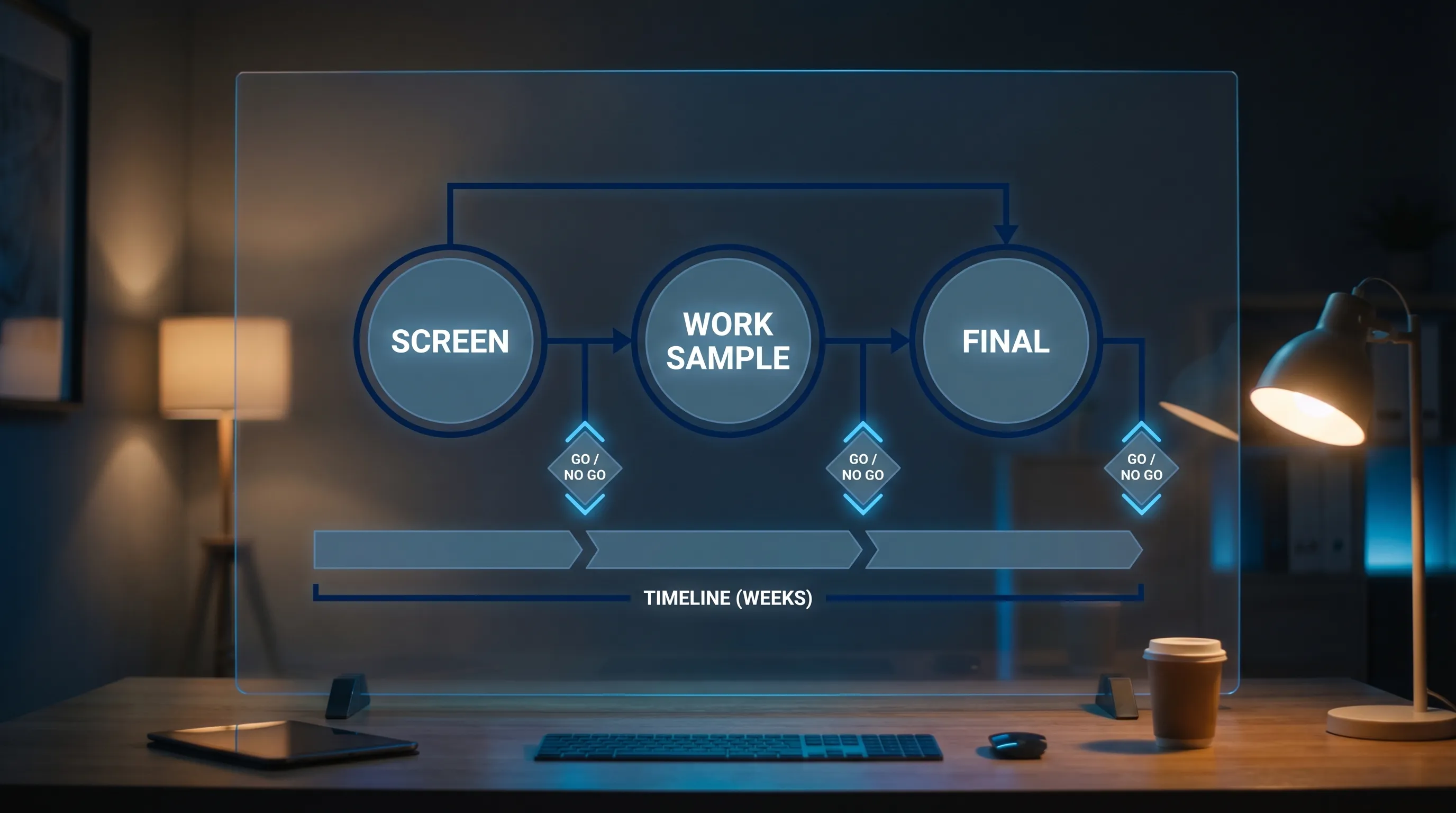
Top candidates withdraw when interview loops are long, repetitive, or politically unclear. A practical 2026 pattern is a three-stage process with strong calibration:
- structured technical and role interview
- practical work sample or scenario
- final leadership and offer decision
Offer genuine flexibility
Flexibility is not a perk, it is a sourcing strategy. Remote, hybrid, asynchronous collaboration and outcome-based performance can materially expand your addressable talent pool.
Use specialist recruiters for scarce talent pools
For roles such as MLOps, AI infrastructure, GRC security leadership, and senior platform engineering, specialist recruiters shorten time-to-hire by running structured market mapping and reaching passive candidates. If you are building AI infrastructure capacity, the guide Engineering Staffing Agencies for AI Infrastructure Hiring outlines where scarcity is sharpest.
Case Study / Scenario
The scenario below is representative of how constrained-market hiring can be executed when speed and quality are both required.
Client profile
Enterprise software company scaling engineering across Germany and the Netherlands.
Hiring challenge
Hire 6 senior engineers across cloud, backend, and AI within 90 days in a constrained market, with competing offers expected for most finalists.
Process
Multi-market passive talent mapping, targeted outreach to pre-qualified profiles, and a redesigned three-stage interview process to reduce time in stage.
Key design choices:
- role scorecards aligned across Germany and the Netherlands to avoid market-by-market drift
- parallel scheduling blocks for interview stages to reduce candidate downtime
- compensation pre-alignment before final interviews to avoid late-stage offer failure
Timeline and outcome
First placement secured in 27 days. All 6 roles closed within 85 days, and the hiring workflow was standardised for future scale hiring.
Frequently Asked Questions
How severe is the tech talent shortage in Europe in 2026? It is severe and persistent, particularly for senior and specialist roles. The EU’s Digital Decade target of 20 million ICT specialists by 2030 highlights the scale of workforce expansion required, and recent Eurostat reporting suggests the current ICT workforce is far below that level. The practical impact for employers is not only unfilled vacancies, but longer time-to-hire, higher drop-out rates during interview processes, and more counteroffers. For leadership teams, the key is to treat the shortage as structural and design hiring and retention systems accordingly.
Which tech roles are hardest to fill across Europe? The hardest roles typically sit where modern infrastructure, regulation, and AI adoption intersect. AI and machine learning roles are scarce when the requirement is production-grade delivery (MLOps, AI infrastructure, model monitoring and governance). Cybersecurity roles are tight, especially in cloud security, incident response, and GRC, partly due to expanding regulatory expectations such as NIS2. Cloud and platform engineering roles remain difficult because the best candidates combine engineering depth with operational maturity. Senior backend engineers and data engineers are also scarce when domain and scale requirements are high.
How is the tech talent shortage affecting salaries in Europe? Salary pressure shows up in several ways. Base salaries rise, but the bigger shift is often in total compensation: sign-on bonuses, retention increases, equity refreshes, and benefits that reduce switching friction. Remote-first competition also matters, European candidates can now access global opportunities without relocating, which changes their reference point for “market rate”. In practice, under-benchmarking compensation tends to increase time-to-hire and offer rejection rates, which can be more expensive than paying competitively, particularly for business-critical roles.
What can companies do to compete for scarce tech talent? Winning in a constrained market requires a coordinated approach. Start with role clarity and compensation realism, because ambiguity forces longer processes and weak offers. Build passive pipelines early rather than hiring only when urgent. Reduce interview stages and align decision rights so candidates do not stall between steps. Offer genuine flexibility, remote and hybrid options expand the talent pool materially when executed with strong operating practices. Finally, use specialist recruitment partners for thin talent pools, particularly when you need passive candidates, cross-border hiring execution, and market mapping to identify where the talent actually is.
Is the European tech talent shortage expected to improve or worsen? The underlying drivers suggest it will remain tight through the medium term, even if specific sub-markets fluctuate. AI adoption continues to create new role categories faster than education and reskilling pipelines can produce experienced practitioners. Cybersecurity demand is reinforced by threat growth and regulatory obligations. Cloud and platform skills remain central as more systems become software-defined and data-driven. Economic cycles can change hiring volume, but they rarely create a surplus of senior specialists. Employers should plan for a structurally competitive market, not a rapid return to “easy hiring”.
Conclusion & Strategic Positioning
The european tech talent shortage 2026 is structural, not cyclical. It reflects a sustained digital skills gap, accelerated by AI adoption, cybersecurity obligations, and cross-border competition enabled by remote work.
For leadership teams, the most effective response is long-term workforce planning backed by execution: a clear talent pipeline, faster and more decisive hiring processes, compensation strategies aligned to global competition, and serious investment in upskilling and retention.
Optima Search Europe works with high-growth and established firms on business-critical technology hiring across European markets, with a focus on senior, scarce profiles and cross-border execution. If you want a market-mapped view of candidate availability, compensation expectations, and realistic time-to-hire for your next critical hires, you can explore Optima’s approach in the Tech Executive Search Firm Europe (2026 Guide) or connect via Optima Search Europe.

