
Executive Recruitment Agencies: When to Use Retained Search

HRTech Recruitment Guide Europe (2026 Guide)
HR technology platforms have moved from “nice-to-have” tooling to business infrastructure. For HR Directors and Chief People Officers, that shift changes the hiring problem in a very practical way: you are no longer hiring only HR practitioners or only engineers. You are hiring hybrid HR plus technology professionals who can implement, integrate, and operate HR software systems inside complex organisations, while keeping pace with a fast-moving European tech ecosystem.
This guide is designed for decision-stage leaders planning hrtech recruitment europe initiatives in 2026. It covers what HRTech is, why demand is accelerating, which roles matter most, how salaries are trending across key hubs, and how to build a hiring strategy that reduces time-to-hire without sacrificing quality.
If you are comparing recruitment partners, it can help to benchmark HRTech hiring against the wider SaaS market. The tactics used in specialist software hiring (market mapping, structured assessment, cross-border execution) transfer directly to HRTech. See Optima’s broader view on the SaaS landscape in the SaaS & Software Recruitment Agency Europe guide.
What Is HR Technology?
HR technology (HRTech) is the category of software and platforms used to run, automate, measure, and improve HR operations. Modern HRTech blends process workflow, data infrastructure, and employee-facing experiences, and it increasingly sits at the intersection of HR, IT, security, and finance.
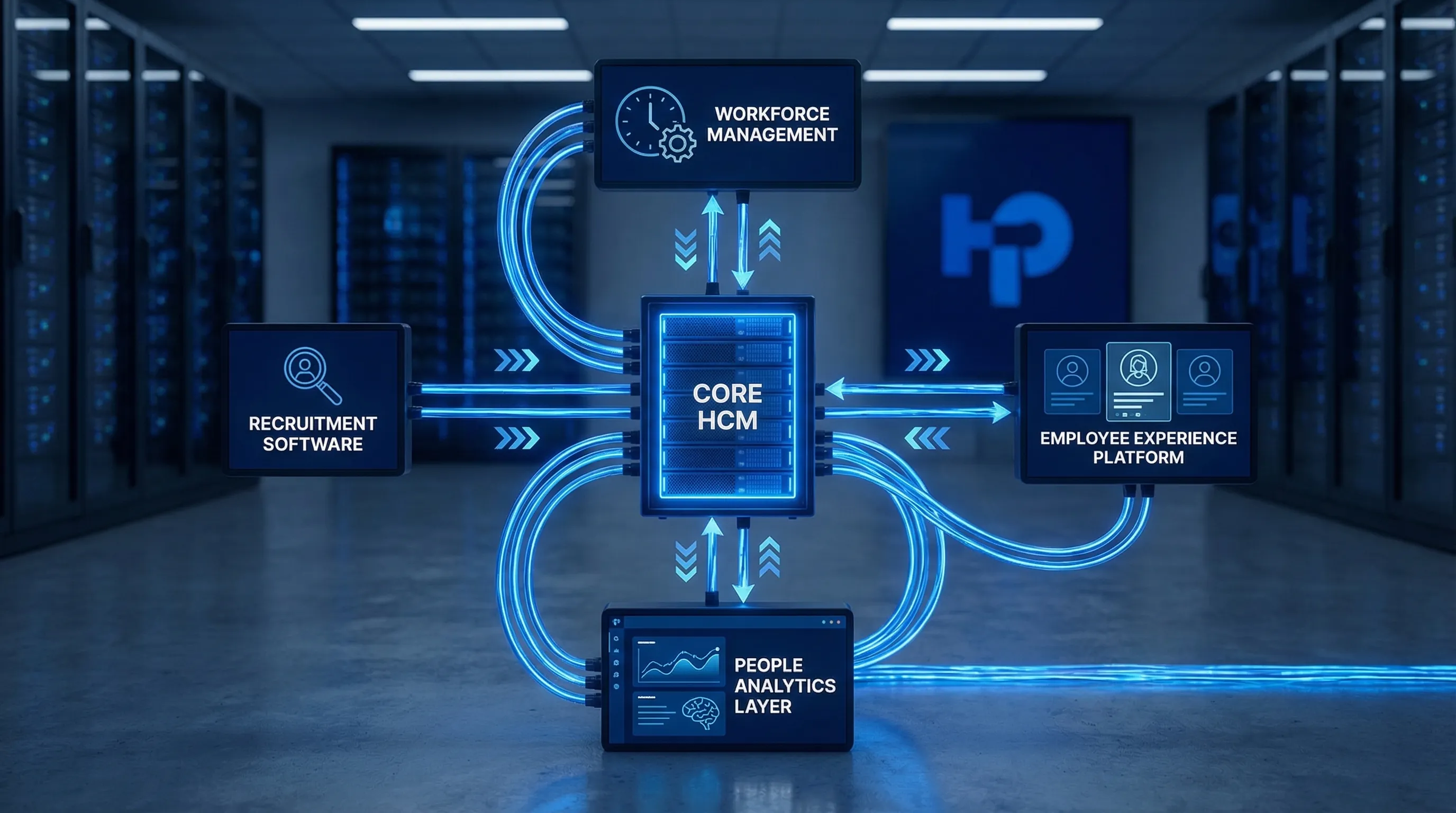
In practical terms, HRTech typically includes:
- Human capital management systems (HCM) for core HR, compensation, performance, and learning.
- Workforce management platforms for scheduling, time tracking, absence, and labour forecasting.
- Recruitment software such as ATS, candidate engagement tools, and recruitment analytics.
- Employee experience platforms that support engagement, communications, onboarding, and feedback loops.
- People analytics and reporting layers that turn HR activity into workforce insights.
- HR automation tools that streamline approvals, case management, and employee self-service.
What has changed is the integration expectation. HR platform talent recruitment now requires people who understand APIs, identity and access, data models, and system governance, as well as HR processes like job architecture, pay bands, performance cycles, and compliance.
In summary, HR technology is not one tool. It is an interconnected set of HR technology platforms and HR software systems that run HR delivery, employee experience, and workforce decision-making, and that integration is why hiring in HRTech is increasingly specialised.
Why HRTech Talent Demand Is Growing
Three forces are pushing HR technology recruitment forward in Europe:
1) The growth of HR SaaS platforms and consolidation of HR stacks. Many organisations are rationalising point solutions into fewer SaaS HR platforms, while vendors expand product suites (for example, adding analytics, automation, or employee experience layers). That creates demand for product, engineering, and go-to-market talent inside HR technology platforms, and also for implementation and systems talent within end-user organisations.
2) Digital transformation of HR departments is now operational, not experimental. HR teams are being measured on time-to-hire, internal mobility, retention, skills development, and workforce cost. HR software systems are becoming the execution layer for these KPIs, which increases demand for HR systems administrators, people technology recruitment specialists, and analytics professionals who can make systems produce decision-grade data.
3) Automation and people analytics are scaling. AI-assisted workflows, case routing, skills inference, and employee service centres are becoming common. Even without “full AI”, HR automation tools and analytics are pushing HR toward an operating model that requires data literacy and technical change management.
A few market insights worth factoring into hiring plans:
- AI and data governance are moving into HR. GDPR expectations and emerging AI governance frameworks raise the bar for privacy, auditability, and vendor risk management. For context on EU privacy requirements, see the UK GDPR overview from the ICO.
- Hybrid work is still shaping workforce management needs. Scheduling, capacity planning, and employee experience tooling continue to drive adoption of workforce management platforms.
- European HRTech growth is increasingly cross-border. Scaleups frequently sell across multiple EU markets early, which increases demand for talent that can operate across languages, labour norms, and customer contexts.
Key HRTech Roles Companies Hire
HRTech hiring works best when you separate roles that build the platform from roles that implement and run it. Below are common positions in hr software recruitment europe projects.
HRTech product managers
These product leaders translate HR domain requirements into prioritised roadmaps. The best HRTech product managers understand HR workflows (recruitment, onboarding, performance, payroll interfaces) and can also work fluently with engineering on platform constraints, integrations, and data models.
HR software engineers
Software engineers in HRTech build SaaS HR platforms and the surrounding integration ecosystem. Depending on the product, this includes API development, workflow engines, front-end experience, analytics pipelines, and security considerations (identity, access control, audit logs).
People analytics specialists
These specialists connect people analytics to business questions like attrition risk, hiring efficiency, DEI metrics, and skills development. They often sit between HR, finance, and data teams, and need strong stakeholder management alongside analytics capability.
HR systems administrators
HR systems administrators configure and maintain human capital management systems, workforce management platforms, and recruitment software. They own workflows, permissions, integrations (often via middleware), data quality, and vendor coordination.
HR technology consultants
Consultants support selection, implementation, and optimisation of HR technology platforms. They need a blend of process design, technical fluency, change management, and the ability to guide cross-functional teams through rollout and adoption.
HRTech Salary Overview in Europe
Salaries in HRTech vary sharply by location, company stage, and whether the role sits in a vendor (HR technology platforms) or in an enterprise HR organisation. In 2026, compensation remains competitive because the same candidates are often targeted by adjacent SaaS categories (FinTech, Cybersecurity, Data, MarTech) and by internal transformation programmes.
The ranges below are indicative base salary bands commonly seen across major European tech hubs for permanent roles. They are intentionally broad because job scope and bonus or equity can significantly change total compensation.
Junior (typically 0 to 2 years in-role): €35,000 to €55,000. Common for HR systems support, junior implementation, and entry-level analytics roles.
Mid-level (typically 3 to 6 years): €55,000 to €85,000. Common for HR systems administrators, implementation leads, HRTech product roles in smaller teams, and people analytics specialists.
Senior (typically 7+ years, lead or manager scope): €85,000 to €140,000+. Common for senior product managers, senior engineers, solutions architects, programme leads, and people analytics leadership.
Key differences to plan for:
- European tech hubs: London, Dublin, Amsterdam, Paris, Berlin, Munich, Stockholm, and Copenhagen often price at the top of local markets, especially for senior talent with platform integration depth.
- Regional and remote markets: Southern and parts of Eastern Europe can offer lower base costs, but top-tier HRTech specialists still benchmark against international SaaS compensation, particularly if they can work remotely.
- Startup vs enterprise compensation: Startups may offer lower base with meaningful equity, while enterprises often pay higher base and benefits but can move slower (which can cost you candidates in offer stage).
Skills Companies Look for in HRTech Professionals
Because HRTech roles sit between functions, the “must-haves” are usually a combination of platform knowledge, data capability, and delivery discipline.
Strong candidates typically show evidence in these areas:
- HR software platforms: familiarity with major SaaS HR platforms, their configuration logic, and the operational realities of running them.
- HR data analytics: ability to define metrics, improve data quality, and align reporting with business questions.
- People analytics tools: comfort with BI layers and statistical thinking, plus the ability to communicate insights to non-technical stakeholders.
- HR system integrations: experience integrating HR software systems with identity providers, finance systems, payroll providers, and data warehouses.
- API and platform architecture: ability to reason about API contracts, middleware, event-based integrations, and security controls.
- Change management: designing adoption plans, training, stakeholder alignment, and operational handover (often the difference between a “working system” and a system that delivers value).
One practical hiring signal: ask candidates to walk through a real HR platform rollout they delivered, including what broke, what adoption looked like after 90 days, and what they would change in hindsight. It reveals technical depth and operational judgement.
Hiring Challenges in HRTech
HR technology recruitment looks straightforward on paper, but several issues repeatedly slow or derail hiring.
Hybrid skill requirements narrow the pool. Many HR professionals lack technical fluency, and many technologists underestimate HR process complexity. HR platform talent recruitment is difficult because you are looking for candidates who can bridge both worlds.
Evaluation is harder than in “pure” HR or “pure” engineering. CVs rarely show integration complexity, governance maturity, or adoption outcomes. Without structured assessment, teams over-index on vendor names or generic project claims.
Competition is not limited to HRTech vendors. HR systems administrators and people analytics specialists are heavily targeted by transformation programmes in enterprise, consultancies, and adjacent SaaS firms.
Cross-functional misalignment is common. HR may sponsor the hire, IT may control access and integration, and finance may approve budget. When those stakeholders are not aligned early, candidates experience slow decision-making and drop out.
Retention risk is real. Once hired, HRTech professionals become key operators of business-critical systems. If governance, roadmap ownership, or progression paths are unclear, attrition can be costly and disruptive.
How to Structure an HRTech Hiring Strategy
A strong hrtech hiring guide is less about “more sourcing” and more about reducing ambiguity. The goal is to create a repeatable system that your cross-functional teams can execute quickly.
Define HR Technology Stack
Start by documenting your current and target HR technology platforms. You do not need a perfect architecture diagram, but you do need clarity on:
- Which HR software systems are in-scope (HCM, ATS, workforce management platforms, employee experience platforms).
- Where data should flow (BI, finance, identity, payroll, data warehouse).
- The most critical integrations (and the pain points today).
This turns hiring conversations from “we need someone senior” into a concrete problem statement tied to systems, data, and outcomes.
Align HR and Engineering Teams
HRTech roles often fail when HR and engineering assume different definitions of success.
Before you interview, align on:
- Who owns technical decisions (APIs, identity, security reviews).
- Who owns process decisions (workflows, policy alignment, stakeholder sign-off).
- How you will prioritise speed vs risk (for example, phased rollout vs big-bang migration).
This alignment also improves candidate experience because interviewers can explain the operating model consistently.
Evaluate Technical and HR Expertise
Use a two-lens assessment approach:
- HR lens: ask for process design examples (performance cycle, onboarding workflow, workforce scheduling constraints), and how they handled compliance, employee experience, and stakeholder resistance.
- Technology lens: validate integrations, data governance, access models, and delivery execution (tickets, environments, testing, release management).
For senior hires, add a “systems narrative” interview: the candidate explains the architecture and operating model they would build for your environment, including risks and trade-offs.
Align Compensation With Market Reality
In HRTech, under-levelling a role is a frequent and expensive mistake. Candidates who can deliver HR systems governance and integration at scale know their market value.
A practical approach:
- Decide whether you are paying for platform operation (admin), platform evolution (optimisation), or platform transformation (migration and integration).
- Benchmark against adjacent SaaS roles, not only against internal HR bands.
- Build an offer that can withstand counteroffers (base, bonus, equity if relevant, flexibility, and a clear scope).
Reduce Time-to-Hire Through Specialized Recruitment
When hiring slows, it is usually not a sourcing problem. It is an execution problem.
Specialised recruitment support helps when you need:
- Market mapping across HR technology platforms, consultancies, and enterprise HR systems teams.
- Access to passive candidates who are not applying to job adverts.
- Structured qualification that tests both HR and technical depth.
- Cross-border recruitment across Europe when local supply is thin.
For business-critical HRTech leadership roles, this is also where retained executive search becomes relevant. Executive recruitment agencies operating on retained search are typically most effective when the role is confidential, scarce, or tied to transformation outcomes, and when you need disciplined governance across stakeholders.
Recruitment Agency vs In-House Hiring for HRTech Roles
In-house teams can absolutely hire HRTech talent, particularly for recurring roles where you already have strong sourcing channels and clear assessment. The decision point is usually about scarcity, speed, and risk.
When in-house works well
If you have a clear success profile, competitive compensation, and an interview process that can move quickly, internal TA can deliver strong outcomes, especially for roles where your employer brand is a real advantage.
When a specialist recruitment partner is often the better option
Agency support tends to add value in HR technology recruitment when:
- You need passive talent with specific HR software system expertise, integration depth, or vendor-side experience.
- The search requires cross-border hiring (language requirements, local market differences, relocation or remote models).
- The role is senior or business-critical, such as Head of HR Systems, HR Transformation Lead, Director of People Analytics, or HRTech Product Leadership.
- You need confidential hiring (replacement hires, sensitive transformation programmes, or pre-announcement builds).
A good partner should be able to explain, in practical terms, how they will map the HRTech talent market, how they validate hybrid HR and technical competence, and how they keep process cadence tight enough to win candidates.
If your HRTech programme touches adjacent stacks (for example, marketing and sales ops systems that share data and identity layers), it can also be useful to benchmark specialist hiring approaches in nearby categories like MarTech. See the Marketing Technology Recruitment Guide.
Frequently Asked Questions (Minimum 6)
What is HRTech recruitment? HRTech recruitment is the hiring of professionals who build, implement, or operate HR technology platforms and HR software systems. It includes vendor-side roles (product, engineering, customer success, implementation) and in-house roles (HR systems administration, HR transformation, people analytics, integrations). In Europe, HRTech recruitment increasingly requires cross-functional assessment because the best candidates combine HR process knowledge with technical capability (data, APIs, security, systems thinking). The key is to hire against measurable outcomes, such as system adoption, data quality, time-to-hire improvement, or workflow automation, rather than relying on tool familiarity alone.
What roles exist in HR technology companies? HR technology platforms typically hire across product, engineering, data, and customer delivery. Common roles include HRTech product managers who own roadmap and market fit, HR software engineers who build SaaS HR platforms, people analytics specialists who develop insight products or customer reporting, and HR technology consultants or implementation managers who deliver rollouts. As firms scale, roles become more specialised, for example solutions architects focused on integrations, security-oriented engineers supporting enterprise compliance, and customer success leaders who drive retention. The most in-demand profiles are often those who can bridge customer HR workflows with technical delivery.
How much do HRTech professionals earn in Europe? HRTech salaries in Europe depend on job family (engineering, product, systems, analytics), location, and company stage. As a broad guide, junior roles often fall around €35,000 to €55,000 base, mid-level roles around €55,000 to €85,000, and senior roles around €85,000 to €140,000+ (with leadership and niche technical integration skills pushing higher). Major hubs such as London, Dublin, Amsterdam, Paris, Berlin, Munich, and the Nordics typically price at the top of local markets. Startups may balance lower base with equity, while enterprises may offer higher base plus benefits.
Why is HRTech hiring difficult? HRTech hiring is difficult because the strongest candidates are hybrid. They understand HR operations and can also operate in technical environments with integrations, data governance, and security constraints. The talent pool is limited, and many candidates with the right blend are passive, already employed, and selective about scope and operating model. Evaluation is also hard because CVs rarely show adoption outcomes or integration complexity. Finally, competition is intense: HRTech candidates are pursued not only by HR software vendors, but also by consultancies, enterprise transformation programmes, and adjacent SaaS categories that offer similar compensation and faster decision cycles.
How long does it take to hire HRTech specialists? Timelines vary by seniority and scarcity, but HRTech hires often take longer than expected because multiple stakeholders need to align (HR, IT, security, finance). A well-run process with a clear success profile and fast interview cadence can complete in several weeks for mid-level roles, but senior hires or niche integration specialists can take materially longer, especially if cross-border recruitment is involved. The practical driver is not just sourcing, it is decision speed: slow feedback loops, unclear ownership, or inconsistent assessment commonly extend time-to-hire and increase the risk of losing candidates to counteroffers.
Should HRTech companies work with recruitment agencies? HRTech companies should consider a specialist recruitment partner when roles are business-critical, scarce, confidential, or cross-border. Agencies add the most value when they can provide market mapping, reach passive candidates, and run structured qualification that tests HR domain depth and technical competence. This is particularly relevant for leadership hires where the impact of a wrong hire is high and where process governance matters. If you are building a wider SaaS organisation around the HR platform, it can also help to align hiring playbooks across product and engineering. For related context, see How to Hire SaaS Developers in Europe and Product Manager Recruitment for SaaS Companies.
Conclusion
HRTech recruitment in Europe is accelerating because HR technology platforms and HR software systems are now core business infrastructure. As HR departments push deeper into automation, workforce intelligence, and employee experience, demand for HRTech professionals will remain high, and salary competitiveness will continue to reflect broader SaaS market dynamics.
The organisations that hire well in 2026 will treat HRTech hiring as a cross-functional system: clear stack definition, aligned stakeholders, structured evaluation across HR and technical dimensions, and compensation that matches market reality. When roles are business-critical, scarce, or cross-border, specialist recruitment and executive search can reduce risk and improve speed, particularly for leadership and transformation hires.
If you are planning hires across HR technology platforms, people analytics, or HR systems leadership within Europe (or scaling a platform team across regions), Optima Search Europe can support tailored search and selection for business-critical roles, with a focus on senior and cross-border recruitment execution.

