
How to Choose Among the UK’s Largest Recruitment Companies

Searching for the biggest recruitment companies UK leaders use can feel like a sensible shortcut. A large brand suggests reach, process, compliance and access to candidates. For volume hiring or established job families, that can be exactly what you need.
For senior, business-critical or cross-border appointments, size alone is a poor selection criterion. The best recruitment partner is not always the one with the largest database or most offices. It is the one that can identify the right market, engage the right people and represent your company accurately when the candidates you want are not actively looking.
If you are a CEO, CRO, COO, VP or talent leader, the decision should start with the hiring outcome rather than the agency league table. This guide explains how to compare the UK’s largest recruitment companies, when to choose a major generalist and when a specialist search partner is the stronger fit.
What largest really means in UK recruitment
Large recruitment companies can be large in different ways. Some have extensive UK branch networks and strong contractor operations. Some are global staffing groups with payroll, managed service and RPO capability. Others are large professional recruitment brands with deep coverage across finance, technology, legal, marketing and commercial roles.
Names that hiring teams often encounter in the UK market include Hays, PageGroup, Robert Walters, Reed, Randstad, Adecco, ManpowerGroup, Robert Half, Morgan McKinley and Korn Ferry. This is not a ranking. It is a reminder that the UK recruitment market includes several different models under the same broad label.
Before you compare firms, define what kind of scale matters for your role. A company with thousands of consultants may still have only one relevant specialist desk for your market. A boutique search firm with a smaller team may have stronger direct access to the specific executives you need in cybersecurity, MarTech SaaS, AI infrastructure, digital health or cloud platform engineering.
The more strategic the hire, the more important this distinction becomes.
Start with the hiring problem, not the agency brand
Large recruitment companies are often built to handle repeatable demand at scale. That can include permanent professional hiring, temporary staffing, contract recruitment, managed services and multi-location campaigns. Those services matter for many employers, especially when internal hiring teams need extra capacity.
Senior hiring is different. A VP Sales, CRO, General Manager, Chief Marketing Officer or regional Managing Director search is not mainly a CV sourcing problem. It is a market intelligence, assessment and persuasion problem. The agency must understand the business plan, the territory, the revenue model, the leadership gap and the kind of candidate who can create the outcome.
A useful first question is: would success come from more candidate flow or from more precise candidate identification? If the answer is candidate flow, one of the UK’s larger agencies may be a strong option. If the answer is precision, confidentiality and market mapping, you may need a specialist or retained search partner.
Optima has explored this distinction in more depth in its guide to choosing a specialist recruitment partner in London, which is especially relevant for companies hiring senior growth or technology leaders.
When a large recruitment company is the right choice
The UK’s largest recruitment companies can be highly effective when the role profile is well understood and there is an active candidate market. They often have established systems, candidate databases, contractor administration, compliance support and recognised employer relationships.
They are typically a good fit when you need:
- Multiple hires with similar profiles across sales, operations, finance, customer service or support functions.
- Temporary, interim or contract hiring where speed, payroll and compliance infrastructure are important.
- Broad market coverage across several common professional disciplines.
- Additional recruitment capacity for an internal talent team during a hiring surge.
- A partner with national or international branch infrastructure for high-volume programmes.
In these situations, the value is partly operational. You are buying reach, infrastructure and process capacity. A large firm may already have active candidates who match the brief or a team that can manage consistent screening across multiple vacancies.
The trade-off is that a large organisation can vary significantly by desk, consultant and location. The brand on the proposal matters less than the individual team assigned to your search. Ask who will actually run the work, how much relevant market experience they have and how they will access candidates beyond those already in their database.
When a specialist search partner is the better choice
A specialist search partner is often the better choice when the hire is senior, confidential, cross-border or difficult to benchmark. This is common for high-growth companies hiring leaders in go-to-market, enterprise sales, marketing, digital, IT or sector-specific technology markets.
Specialist search firms tend to focus more heavily on passive candidates. These are people who are performing well in their current roles and are unlikely to apply to an advert. They may still move for the right opportunity, but only if the approach is credible and the role is positioned with care.
For a business-critical hire, that can be decisive. The search partner must be able to explain your company’s growth story, funding context, market position, operating model, leadership expectations and compensation structure. They also need enough credibility to challenge the brief when the market does not support it.
If you are still deciding between agency models, Optima’s broader guide on how to choose the right recruitment agency sets out useful differences between executive search, industry-specific recruitment and other advisory models.
Build a comparison framework before you invite proposals
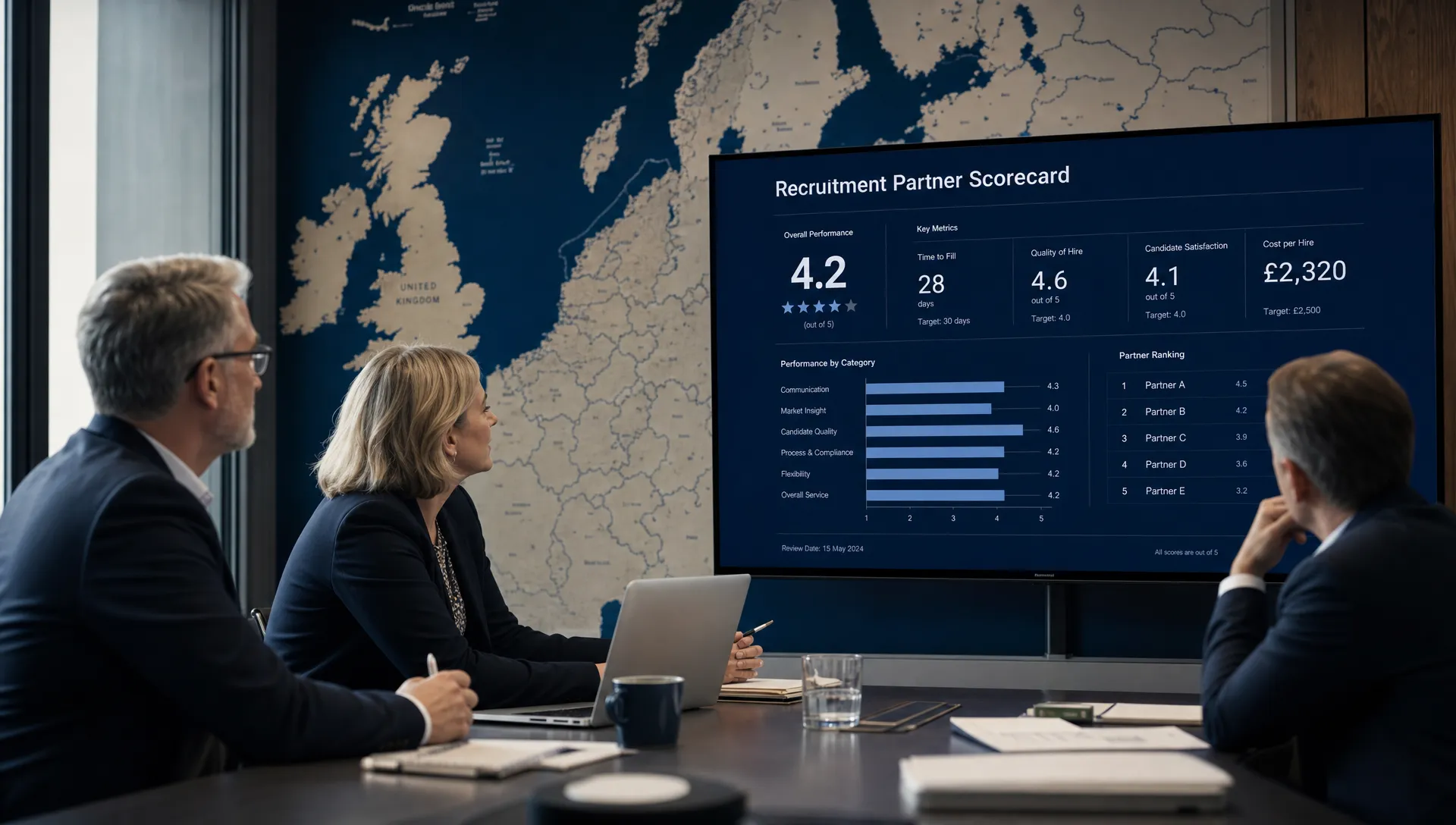
Do not ask five agencies for generic credentials and then choose the one with the best slide deck. Create a scorecard before the conversations start. It should test whether each firm understands your specific hiring challenge, not just whether it has a strong brand.
The best comparison frameworks usually cover six areas: market specialism, search methodology, consultant quality, assessment depth, international reach and commercial alignment.
Market specialism
Ask each firm to describe the market they would search, not just the candidates they already know. For example, a search for a VP Sales in European B2B SaaS should include target company types, sales motions, deal sizes, channel structures, regions and competitor talent pools.
If an agency cannot define the market clearly, it will struggle to search it intelligently. For senior roles, a narrow and well-reasoned search universe is usually more valuable than a large generic database.
Search methodology
A strong methodology should include briefing, market mapping, candidate identification, outreach, qualification, shortlist development, interview management, referencing and offer support. For retained or executive search work, the firm should explain how it will reach candidates who are not active on job boards.
A vague promise to tap into the network is not enough. You want to know how the network was built, how current it is and how the agency will extend beyond it when needed.
Consultant quality
Recruitment outcomes depend heavily on the person leading the assignment. With large recruitment companies, senior leaders may attend the pitch, but junior consultants may run the search. That is not automatically a problem, but it must be transparent.
Ask who owns the brief, who approaches candidates, who assesses them and who manages offer negotiations. For a senior hire, the consultant’s credibility with executives matters. Candidates will judge your company partly through the quality of that first conversation.
Assessment depth
For leadership roles, a CV screen is not enough. The agency should be able to test motivation, leadership style, commercial impact, market relevance, cultural fit and the candidate’s reason for considering a move.
The strongest recruiters do more than pass on profiles. They provide context: why the person is relevant, what risks remain, what the market thinks of them and what conditions would make them accept.
Evidence and data
Good recruitment is not guesswork. Ask for salary benchmarks, market feedback, target company analysis, conversion rates from similar searches and evidence of where candidates are likely to come from.
The same principle applies in other specialist advisory fields. A data-led approach works best when diagnosis comes before prescription, whether that is market mapping in recruitment or data-driven personal training, nutrition and testing in performance and wellness. In hiring, evidence protects you from designing a role the market cannot supply.
International reach
If the role covers Europe or the Americas, UK coverage is only part of the requirement. Hiring in Germany, France, the Netherlands, Spain, the Nordics or the US can involve different notice periods, compensation expectations, candidate behaviours and local competitors.
A large UK recruitment company may have international offices, but you still need to know how joined-up the delivery will be. Will one team manage the search, or will it be handed between local offices? Who owns candidate communication? How is market feedback consolidated?
For UK hiring teams expanding into Europe, Optima’s article on how UK teams choose European recruitment agencies gives a more detailed view of cross-border selection criteria.
Questions to ask the UK’s largest recruitment companies
Once you have a shortlist, use direct questions. The answers will reveal whether a large agency is offering genuine search capability or simply relying on brand recognition.
- Which team, by name, will run this assignment from briefing to offer acceptance?
- What percentage of the shortlist do you expect to come from direct approach rather than active applicants?
- Which companies and talent pools would you target first, and why?
- How will you represent our growth story to passive candidates?
- What evidence do you have from similar searches in our sector, region or seniority level?
- How do you assess leadership impact beyond CV experience?
- What will we receive each week in terms of market feedback and pipeline visibility?
- Where might our brief be unrealistic on compensation, location, seniority or scope?
The strongest partners will welcome these questions. They may challenge your assumptions, but that is a good sign. A recruiter who agrees with every requirement without testing it may be prioritising the win over the outcome.
Red flags when choosing among large recruitment firms
Large agencies are not inherently better or worse than smaller firms. The risk comes from a mismatch between your role and the service model. Watch for signs that the agency is not built for the assignment you need to complete.
Common red flags include:
- A generic pitch that does not reference your sector, competitors or leadership context.
- No clear explanation of how passive candidates will be identified and approached.
- Pressure to work on a contingency basis for a confidential or highly senior role.
- A shortlist made up mainly of active candidates who do not match the business outcome.
- Poor transparency on who is doing the work after the contract is signed.
- Overconfidence on timelines without evidence of candidate availability.
- Limited ability to discuss compensation benchmarks, equity expectations or regional market differences.
These issues can happen in firms of any size, but they are easier to miss when a brand is well known. In senior hiring, brand comfort should never replace due diligence.
Match the agency model to the role type
A practical way to choose is to match the agency model to the hiring scenario.
For high-volume or repeatable professional hiring, a large multi-discipline recruitment company can be efficient. The process is usually about reach, screening speed and consistent delivery.
For temporary, interim or contract hiring, large staffing and specialist contract firms often have the right infrastructure. Compliance, payroll and availability matter as much as search depth.
For senior commercial and executive hiring, especially in growth markets, a specialist search partner is usually more appropriate. The work requires market mapping, discreet outreach and a persuasive narrative that can engage candidates who are not looking.
For cross-border leadership hiring, choose a partner that can manage nuance across markets. International offices are useful, but the real test is whether the firm understands local candidate expectations and can run a coherent search across countries.
For niche technology or sector hires, specialism often beats scale. In areas such as AI infrastructure, responsible AI, cybersecurity governance, digital health, industrial AI or cloud platform engineering, the difference between adjacent talent pools can be significant. A recruiter who understands those distinctions will save time and improve shortlist quality.
How many recruitment companies should you use?
For junior or mid-level roles, some employers use multiple contingency agencies to generate candidate flow. This can work when the role is not confidential and speed matters more than market control.
For senior appointments, using too many agencies can damage the search. Candidates may be approached more than once, messaging can become inconsistent and the role may appear less exclusive. A controlled retained or exclusive search is often better for leadership hiring because one partner owns the market, the narrative and the candidate experience.
If you do use multiple firms, define clear lanes. One might handle UK contractor hiring, another might manage permanent finance roles and a specialist search partner might lead executive or commercial leadership appointments. Blurring those lines usually creates noise rather than value.
Cost should be judged against hiring risk
The cheapest recruitment option is rarely the cheapest business outcome if the role is critical. A weak senior hire can affect revenue, morale, customer confidence, investor trust and strategic execution. A long vacancy can be just as costly, particularly when a company is expanding into a new market or replacing a key leader.
This does not mean you should accept high fees without scrutiny. It means you should judge fees against the complexity and risk of the assignment. For a difficult senior hire, deeper search work, stronger assessment and better candidate management often justify a more consultative model.
Ask each agency what is included in the fee. Does it include market mapping, structured reporting, candidate referencing, offer support and replacement terms? A lower headline fee may come with a thinner process.
The final decision: choose capability, not just category
The right choice among the UK’s largest recruitment companies depends on what you are hiring for. Large firms can be excellent for scale, infrastructure and established candidate markets. Specialist search firms can be better for senior, confidential, niche or international appointments.
For leadership teams, the key is to avoid treating recruitment as a commodity. A VP Sales search is not the same as a volume sales hiring campaign. A European General Manager search is not the same as filling a UK-based account management role. The partner should fit the problem.
A good final test is simple: after the pitch, do you know more about the market than you did before? If the answer is yes, the recruiter is already adding value. If the answer is no, you may only have heard a sales presentation.
Frequently Asked Questions
Who are the biggest recruitment companies in the UK? The UK market includes large brands such as Hays, PageGroup, Reed, Robert Walters, Randstad, Adecco, ManpowerGroup, Robert Half, Morgan McKinley and Korn Ferry. The right choice depends on the role type, sector, seniority and service model you need.
Are the biggest recruitment companies always the best option? No. Large firms can be strong for volume hiring, contractor recruitment and broad professional roles. For senior, confidential or niche appointments, a specialist search partner may offer better market access and a more tailored process.
Should senior executive hiring be retained or contingency? Retained search is often better for senior executive hiring because it supports a structured, discreet and comprehensive market approach. Contingency can work for more active candidate markets, but it may not provide enough depth for business-critical leadership roles.
How should I compare recruitment agencies before choosing one? Compare market expertise, search methodology, consultant quality, assessment depth, international reach and evidence from similar assignments. Ask who will run the search and how they will reach passive candidates.
When should a UK company choose a European recruitment specialist? Choose a European specialist when the role covers multiple countries, requires local market knowledge or targets candidates outside the UK. Cross-border hiring often needs different compensation insight, outreach methods and candidate management.
Need a specialist view on a senior hire?
If you are comparing the UK’s largest recruitment companies but need a more targeted approach for a business-critical appointment, Optima Search Europe can help you assess the market and define the right search strategy.
Optima Search Europe works with fast-growing and established firms on senior executive, GTM, Sales and marketing, Digital and IT recruitment across Europe and globally. For roles where precision, discretion and candidate quality matter more than volume, a specialist search conversation can save time before the search begins.

