
How to Choose Cyber Security Providers for Growth

For a growth company, choosing cyber security providers is no longer an IT purchasing exercise. It is a commercial risk decision that affects enterprise sales, customer trust, investor confidence, regulatory exposure and the ability to operate across borders.
The right provider can help a leadership team move faster, pass security reviews with less friction and respond to incidents without panic. The wrong provider can add cost, create unclear ownership and leave gaps that only become visible when a customer audit, insurance renewal or breach forces the issue.
For CEOs, COOs, CROs, HR leaders and talent teams, the question is not simply “which vendor has the best technology?” It is “which partner can support the next stage of growth without creating hidden operational risk?”
Why cyber security provider selection changes during growth
Security needs look very different once a company moves beyond early traction. A start-up with a small team may need pragmatic tooling, basic policies and customer questionnaire support. A scaling business entering regulated markets, selling to enterprises or expanding internationally needs a more structured security operating model.
Growth creates more exposure. New markets bring new data protection expectations. Larger customers ask tougher due diligence questions. Product teams ship faster. Cloud infrastructure becomes more complex. Hiring increases access risk. M&A, partnerships and channel expansion introduce more third-party dependencies.
This is why provider choice should be aligned with business strategy. If your company is preparing for NIS2 obligations, enterprise procurement demands or more formal governance, your provider selection should connect to a broader operating model. Optima has covered this strategic layer in more detail in its guide to building a cyber security strategy for NIS2 and growth.
A provider that works well for a 40-person SaaS firm may not be the right fit for a 400-person company selling into finance, healthcare or critical infrastructure. The buying process needs to mature with the business.
Start with business outcomes, not vendor categories
Many leadership teams begin by comparing acronyms: MDR, MSSP, SIEM, XDR, IAM, GRC, IR, SOC. That can quickly lead to a crowded shortlist and a technology-led discussion that misses the commercial point.
A better starting point is to define the business outcomes security must support over the next 12 to 24 months. For a growth company, those outcomes often include protecting revenue, improving customer trust, reducing operational downtime and giving the board clearer visibility of risk.
Before approaching cyber security providers, agree on the outcomes that matter most:
- Faster completion of enterprise security questionnaires and customer audits
- Stronger detection and response across cloud, endpoint, identity and email
- Evidence for regulatory, insurance and investor due diligence
- Better protection of product, customer data and intellectual property
- A clearer incident response process with named owners and escalation paths
- Security reporting that the board can understand without technical translation
This framing helps you avoid buying isolated tools that do not change your risk position. It also makes commercial conversations easier. A CRO cares about reducing friction in late-stage enterprise deals. A COO cares about continuity. A CEO cares about resilience, valuation and reputation. A provider should be able to speak to each of those priorities.
Match provider type to company maturity
Not every provider is designed for the same problem. Some are product vendors. Some are consultancies. Some deliver managed services. Some specialise in incident response, compliance or highly technical engineering work. Choosing well means matching provider type to the maturity of your company and the risks attached to your growth plan.
| Provider type | Best suited for | What to assess before selecting |
|---|---|---|
| Managed security service provider or MDR provider | Companies needing continuous monitoring, alert triage and threat response | Response times, escalation process, coverage hours, visibility across your systems and quality of reporting |
| Incident response specialist | Businesses that need readiness for breach, ransomware or major outage scenarios | Retainer terms, forensic capability, legal coordination, crisis communications support and availability |
| GRC and compliance adviser | Firms preparing for NIS2, ISO 27001, SOC 2, customer audits or sector-specific controls | Evidence of work in your sector, practical documentation style and ability to turn compliance into operational habits |
| Cloud and application security provider | SaaS, AI, data analytics and platform companies with complex development environments | Developer workflow integration, cloud architecture expertise and ability to support secure scaling |
| Penetration testing or red team provider | Organisations validating controls, products or infrastructure before customer review or launch | Scope quality, methodology, remediation guidance and whether findings are prioritised by business impact |
| Identity and access management specialist | Companies growing headcount, using many SaaS tools or managing distributed teams | Joiner, mover and leaver processes, privileged access controls and integration with HR systems |
| OT or industrial security specialist | Smart manufacturing, medtech, logistics or industrial AI businesses | Knowledge of operational technology, production continuity and safety-critical environments |
This table is not a procurement shortcut. It is a way to avoid a common mistake: asking one provider to solve every problem, then discovering they are strong in one domain and thin in another.
Use an executive scorecard, not a feature checklist
Feature comparisons are useful, but they rarely reveal whether a provider will support growth. A security tool can be technically capable yet poorly aligned with your commercial model, reporting needs or internal capacity.
Provider diligence is not unique to technology. A board would not approve a major office or property transformation without checking scope, materials, workmanship and accountability, whether the partner is a security firm or a specialist in luxury renovation and commercial upgrades. Cyber security deserves the same supplier discipline because poor delivery can affect revenue, reputation and continuity.
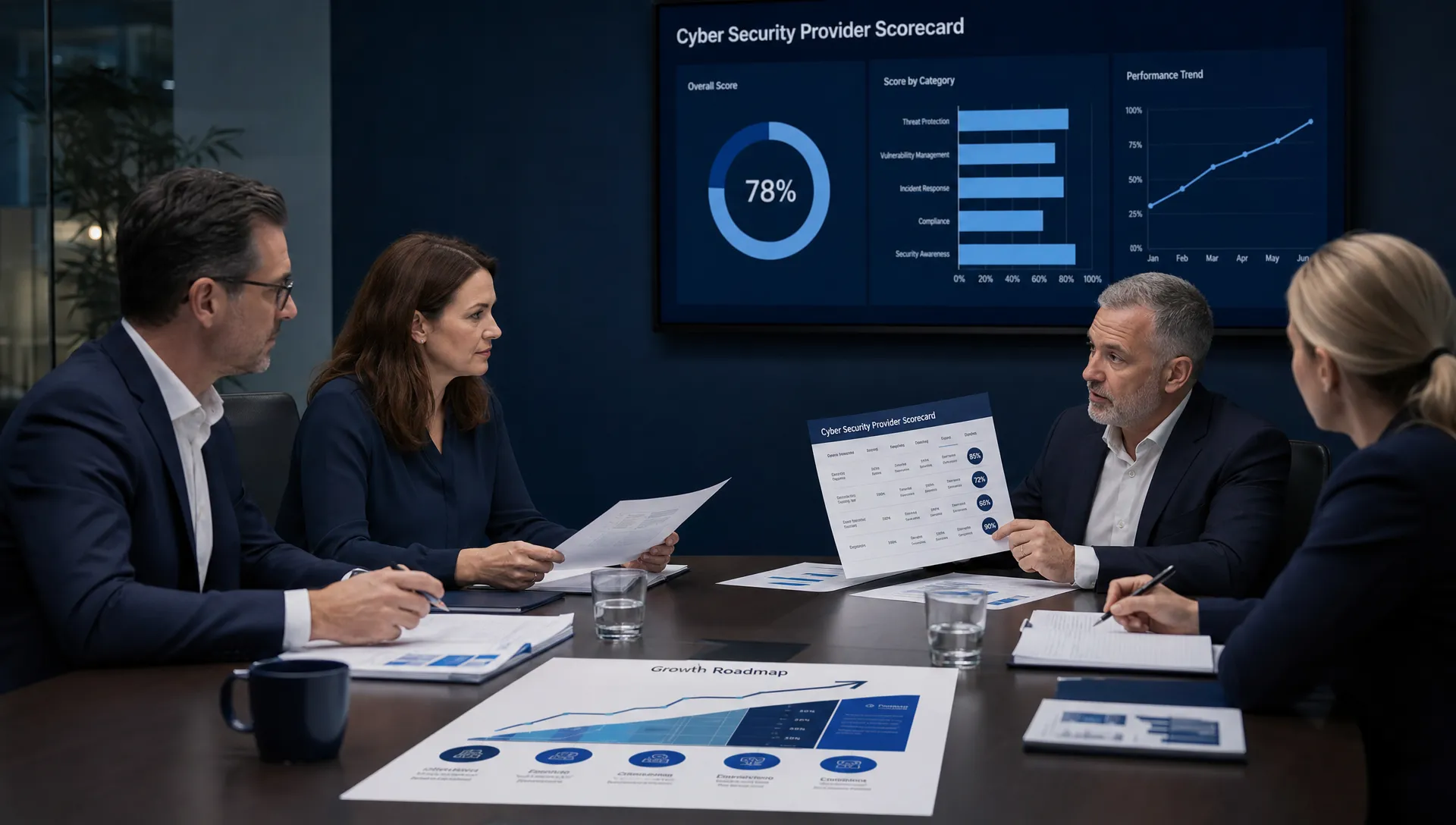
A practical executive scorecard should assess how the provider will operate in your business, not just what they sell.
| Evaluation area | Strong signal | Warning signal |
|---|---|---|
| Sector understanding | The provider understands your customers, sales cycle, regulatory exposure and operating model | They rely on generic templates and cannot explain how your risks differ from other clients |
| Growth fit | They can support new markets, headcount growth, cloud expansion or enterprise customer demands | Their service is designed for a much smaller or much larger organisation |
| Reporting quality | They translate technical findings into risk, cost, priority and board-level decisions | Reports are dense, tool-led or hard for non-technical leaders to act on |
| Operating model | Roles, responsibilities, escalation paths and response times are clear | Ownership is vague and every issue requires internal teams to interpret next steps |
| Commercial flexibility | Contract terms match your growth stage and likely changes over the next year | The contract locks you into scope that may not fit six months later |
| Talent support | They complement your internal team and help define what should remain in-house | They position outsourcing as a replacement for internal accountability |
| Evidence and assurance | They can provide relevant examples, references and measurable outcomes | They talk mainly about brand claims, tooling or certifications without practical proof |
Ask questions that reveal delivery quality
The best provider conversations are specific. Avoid letting the sales process become a polished demo with little operational detail. Growth companies need to understand what happens after the contract is signed, who does the work and how quickly the provider can act when risk changes.
Useful questions include:
- Which risks would you prioritise in our first 90 days and why?
- How do you separate urgent threats from routine alerts?
- What will our board or executive reporting look like each month?
- How do you support customer security reviews and enterprise procurement processes?
- What internal roles do we still need to own, even if we work with you?
- How do you handle incidents outside standard business hours?
- Which parts of your service are delivered by senior specialists and which are automated or junior-led?
- How do you help us reduce risk without slowing product releases or sales cycles?
The answers should be clear enough for a non-technical executive to understand. If a provider cannot explain impact, priority and accountability in business language, the relationship may become difficult when pressure increases.
Check the operating model before signing
Cyber security providers often sell capability, but clients experience operating models. A service that looks strong during procurement can underperform if there is confusion about ownership, response or communication.
The operating model should answer practical questions. Who receives alerts? Who decides whether an incident is escalated? Who contacts legal counsel, customers or insurers if required? Who owns remediation if a penetration test finds a critical weakness? Who turns lessons learned into better controls?
For growth companies, this matters because internal teams are often stretched. Engineering, IT, legal, HR and revenue teams may all touch security in different ways. A provider must reduce ambiguity, not add another coordination burden.
Pay close attention to handoff points. If an MDR provider detects suspicious activity but your IT team owns remediation, the process must be tested before a real incident. If a GRC adviser writes policies but nobody owns implementation, the work may satisfy a document request without reducing risk. If a penetration testing provider delivers findings without helping prioritise remediation, engineering teams may struggle to balance security and product commitments.
Decide what to outsource and what to hire internally
Outsourcing can accelerate maturity, especially when specialist skills are scarce. It can provide access to detection, response, testing, compliance and advisory expertise that would be expensive or unrealistic to build immediately in-house.
However, cyber security providers cannot replace internal ownership. A growing company still needs accountable leadership that understands the business, influences priorities and makes trade-offs. The more security becomes tied to enterprise revenue, regulation and customer trust, the more important internal capability becomes.
At a minimum, internal ownership should cover risk appetite, budget decisions, governance, supplier management and communication with the board. Depending on size and sector, that ownership may sit with a CISO, Head of Security, VP Engineering, CIO, COO or another senior leader with the authority to act.
This is where talent strategy and provider strategy should connect. If you are deciding whether to outsource, hire or build a hybrid model, Optima’s perspective on cybersecurity recruitment in Europe may help leadership teams understand why security hiring requires a different approach from general technology recruitment.
For venture-backed companies, timing is especially important. Hiring too late can leave the business dependent on external suppliers without enough internal direction. Hiring too early can create senior cost before the scope is clear. Optima’s guide for Series A cybersecurity companies in Europe explores how funding stage changes the order and urgency of key hires.
Watch for red flags in the selection process
A provider does not need to be perfect to be valuable, but certain behaviours should make leadership teams pause.
Red flags include:
- They recommend tools before understanding your business model, customers or growth plan
- They cannot describe how success will be measured in commercial or operational terms
- They rely heavily on fear rather than clear risk prioritisation
- They avoid direct answers about response times, staffing or escalation paths
- Their reports are designed for technicians only, with little board-level interpretation
- They promise full compliance without explaining your internal responsibilities
- They position their service as a substitute for governance, leadership or ownership
- They cannot provide relevant examples from companies at a similar stage or complexity
The strongest providers are comfortable discussing limits. They will explain what they do well, where another specialist may be needed and which responsibilities should remain inside your organisation.
Build a 90-day selection and onboarding plan
A structured process reduces the risk of choosing a provider based on brand, urgency or a persuasive sales meeting. It also helps cross-functional leaders align before procurement reaches contract stage.
| Phase | Leadership focus | Output |
|---|---|---|
| Days 1 to 15 | Define growth risks, regulatory drivers, customer requirements and internal ownership | Provider brief and executive success criteria |
| Days 16 to 35 | Shortlist providers by capability, sector fit and maturity match | Focused shortlist with clear reasons for inclusion |
| Days 36 to 55 | Run structured discovery, compare operating models and test reporting quality | Scorecard across commercial, technical and operational criteria |
| Days 56 to 70 | Conduct references, legal review and contract negotiation | Confirmed provider, scope, service levels and escalation process |
| Days 71 to 90 | Onboard, test communication flows and agree first risk priorities | Working operating model and first executive report |
Do not skip onboarding discipline. Many provider relationships fail because the buying team assumes the contract creates the operating model. It does not. The first 90 days should turn the contract into habits, evidence and decision rhythms.
Make cyber security provider selection part of growth planning
The best time to choose cyber security providers is before pressure forces the decision. Waiting until a major customer audit, incident or regulatory deadline often leads to rushed buying, unclear ownership and higher cost.
For growth companies, provider selection should sit alongside hiring plans, market expansion, enterprise sales strategy and board risk management. Security is now part of how companies win trust. It affects how quickly deals close, how confidently customers share data and how resilient the organisation is when something goes wrong.
The goal is not to buy the most complex security stack. The goal is to build a model that protects the business you are becoming.
Frequently Asked Questions
What should growth companies look for in cyber security providers? Growth companies should look for providers that understand their sector, customer expectations, regulatory exposure and operating model. The provider should offer clear reporting, defined escalation paths, practical remediation advice and services that can scale as the business grows.
Should we choose one provider or several specialist providers? It depends on maturity and risk profile. One provider can simplify coordination, but several specialists may be better for areas such as incident response, cloud security, compliance or penetration testing. The key is to maintain clear internal ownership so multiple providers do not create confusion.
Can cyber security providers replace an internal security leader? No. Providers can deliver specialist capability, but they should not replace internal accountability. A company still needs someone senior enough to set priorities, own risk decisions, manage suppliers and communicate with the board.
How often should we review our cyber security provider relationships? Growth companies should review provider performance at least annually, and sooner after major changes such as new funding, international expansion, acquisition, major customer wins or regulatory shifts. Reviews should cover risk reduction, reporting quality, service levels and commercial fit.
What is the biggest mistake companies make when selecting a provider? The most common mistake is buying technology before defining the business outcome. A provider should be selected because they reduce specific risks, support growth and improve decision-making, not simply because their tools appear comprehensive.
Strengthen the team behind your security strategy
Choosing the right provider is only one part of cyber security maturity. Growth also depends on the leaders who set direction, manage risk and connect security to commercial priorities.
Optima Search Europe supports high-growth and established firms with business-critical and senior executive hiring across cyber security governance and risk, AI infrastructure, data analytics, cloud platform engineering, digital health, smart manufacturing and related markets. If your organisation is reviewing its provider model and needs to strengthen internal leadership, Optima can help you identify the talent required for the next stage of growth.

