
AI Talent Shortage in Europe: 2026 Market Analysis

AI Talent Shortage in Europe: 2026 Market Analysis
The AI talent shortage in Europe has moved from an HR problem to an execution risk. In 2026, organisations scaling Artificial Intelligence programmes are competing for a limited pool of AI engineers, data scientists, and MLOps specialists, while regulation and security expectations continue to rise.
For leadership teams in the consideration phase, the key question is no longer “can we hire?”, it is “can we hire fast enough, in the right markets, with the right governance?”. This is where structured search and cross-border recruitment become material levers, including support from specialist partners such as an AI recruitment agency in Europe.
The Scale of the AI Talent Shortage in Europe
AI hiring demand has broadened in 2026. What began as pockets of Machine Learning hiring in digital-native firms is now enterprise-wide: product, risk, operations, customer service, and cyber teams all want AI capabilities embedded. That creates a multi-role “pull” for the same profiles, particularly applied ML engineers, platform-oriented MLOps, and data scientists who can productionise models.
The imbalance is reinforced by two structural forces:
- Acceleration of AI adoption across industries, including regulated sectors where delivery requires higher seniority and documentation.
- Competition from US firms and well-funded Deep Tech scale-ups that can offer global compensation, remote roles, and faster decision cycles.
Summary (2026 reality): demand for AI engineers is growing faster than credible supply; the scarcest candidates are those who can ship models reliably (MLOps, platform ML); and employers face an increasingly international, high-velocity market.
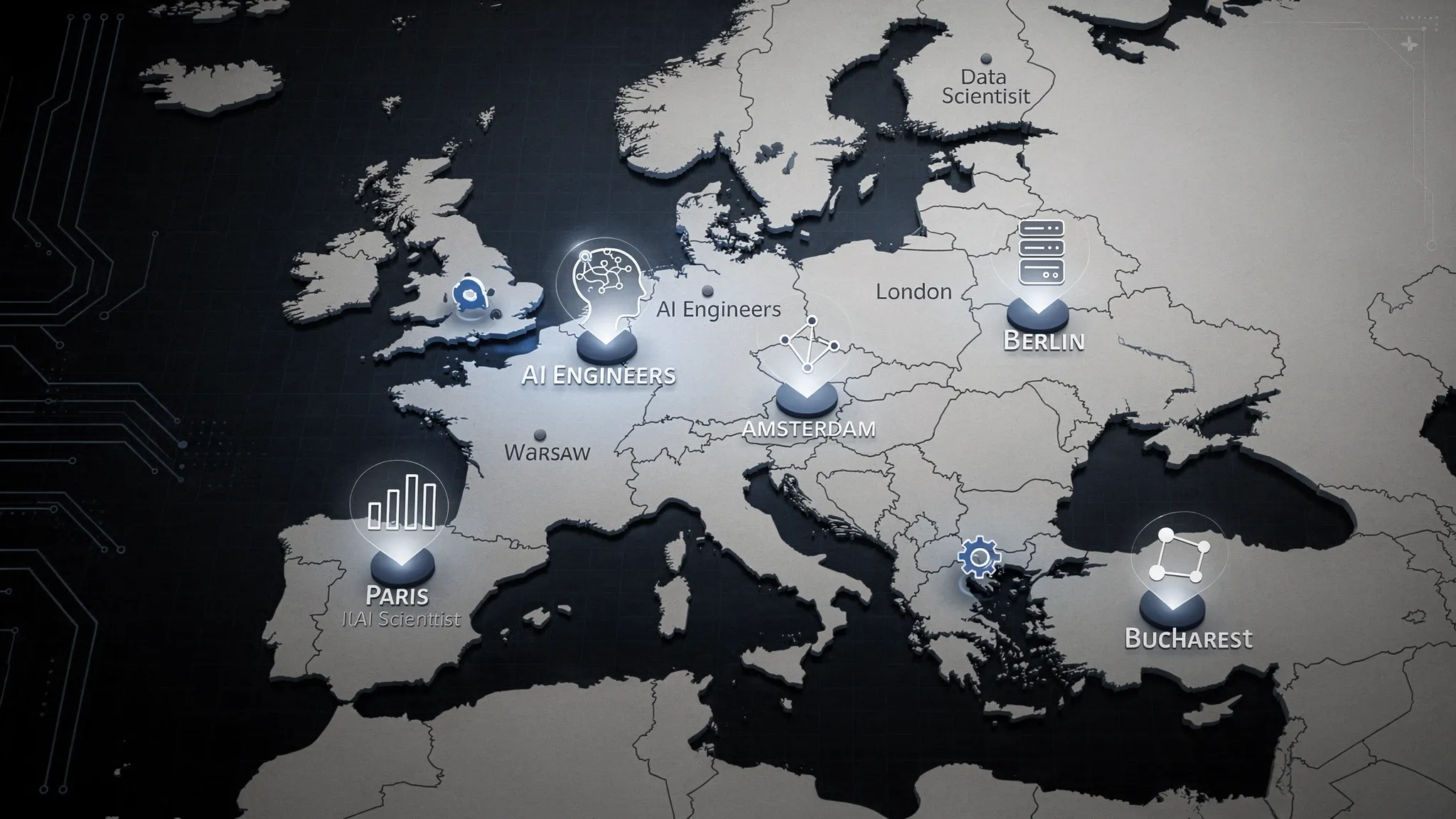
Which European Countries Face the Greatest AI Talent Gaps?
Europe’s AI skills shortage is not uniform. It varies by ecosystem maturity, availability of senior practitioners, and how aggressively local employers (and international entrants) are hiring.
Germany
Germany AI hiring remains intense, especially in and around the Berlin AI ecosystem, Munich, and Hamburg. Industrial AI, automotive, and manufacturing modernisation continue to compete with software-first firms for the same ML and data talent. Energy-intensive sectors also face cost pressure, which makes productivity-focused AI initiatives more urgent, German organisations working with bodies such as BVGE, the association for commercial energy users often link operational efficiency with digital transformation priorities.
United Kingdom
The UK AI market is strongly influenced by London’s concentration of product-led companies, fintech, and global HQ functions. The market is relatively liquid, but senior applied ML and AI security profiles are still scarce, and hiring cycles tighten quickly when multiple offers land in parallel.
Netherlands
The Netherlands shows sustained pressure in Amsterdam and Eindhoven, particularly for ML engineers who can operate across data platforms, cloud, and deployment. Many teams are international by default, which increases candidate mobility but also increases competitive benchmarking.
France
France continues to produce high-quality technical graduates and research talent, but 2026 hiring friction often appears at the “translation layer”: candidates who combine strong ML with product thinking, stakeholder management, and production delivery.
Eastern Europe
Eastern Europe remains a critical supply region for senior engineers and ML practitioners, especially where companies can offer strong project scope and stable engagement models. Talent mobility and remote readiness are generally high, but competition is rising as more Western European employers adopt cross-border hiring by design.
Why AI Hiring Has Become More Competitive in 2026
Four dynamics explain why AI hiring challenges in Europe feel sharper in 2026 than even a year or two ago.
First, enterprise AI transformation is no longer experimentation. Boards expect measurable outcomes, which pushes companies to hire “delivery-grade” talent rather than purely exploratory profiles.
Second, capital concentration in AI means more venture-backed firms are hiring with urgency, especially in data infrastructure, AI security, and vertical AI.
Third, remote hiring normalisation widened the candidate market, but it also widened the competitor set. A Berlin-based engineer now receives offers from London, Zurich, Dublin, and US-based employers.
Finally, salary inflation is being driven by scarcity in MLOps, applied research, and senior engineering leadership, particularly where organisations want end-to-end ownership.
Roles Most Affected by the AI Talent Shortage
The artificial intelligence talent gap in Europe is most visible in roles that sit closest to production risk, regulated deployment, and platform complexity.
Machine Learning Engineers: high demand because they bridge modelling with software engineering, including feature pipelines, evaluation, and deployment patterns.
NLP Engineers: demand remains strong due to enterprise adoption of LLM-driven workflows, but the bar is higher for prompt safety, retrieval design, evaluation, and data governance.
Computer Vision Specialists: still scarce in industrial AI, smart manufacturing, robotics, and digital health, especially where edge constraints and safety requirements apply.
MLOps Engineers: among the hardest roles to fill because they require a blend of cloud, CI/CD, monitoring, and model lifecycle control, and they often define whether AI programmes scale.
AI Research Scientists: competition is strongest for researchers who can translate research into product, not just publish.
Head of AI / AI Director roles: executive AI leadership is increasingly scarce as more organisations require leaders who can build teams, define governance, and align AI roadmaps with commercial outcomes.
Business Impact of AI Talent Shortages
Unfilled AI roles create compounding costs because AI programmes are interdependent. A missing MLOps hire can stall multiple model teams; a missing AI leader can slow hiring decisions and architecture choices.
Common business impacts include:
- Slower product development and delayed releases of AI-enabled features.
- Delayed AI transformation, leaving legacy processes and higher operating costs in place longer.
- Increased hiring costs, including agency reliance, interview load, and repeated search cycles.
- Talent poaching risk, especially in teams without clear growth paths and retention levers.
- Competitive disadvantage as faster-moving competitors ship and learn more quickly.
How Companies Are Responding to the AI Talent Gap
The most effective 2026 responses combine market realism with process discipline.
Many firms are adopting cross-border hiring and remote EU hiring strategies to decouple delivery from a single local market. Others are repositioning salary and total reward, not simply raising pay, but clarifying scope, learning, and progression to win candidates who have multiple options.
Operationally, companies are tightening their hiring system:
- clearer success profiles (what “good” looks like in 90 and 180 days)
- shorter decision cycles and fewer interview loops
- stronger technical validation, including practical assessments
Finally, many organisations are working with specialist AI recruitment partners to expand access to off-market candidates and improve speed without sacrificing assessment quality.
Can Cross-Border Recruitment Solve the AI Talent Shortage?
Cross-border recruitment is not a silver bullet, but it is one of the few levers that can materially reduce the AI workforce demand gap in Europe, especially for scarce roles like MLOps and senior ML engineering.
The upside is straightforward: access to wider talent pools, particularly in Eastern Europe, and the ability to build distributed delivery teams aligned to product outcomes rather than office locations. This also supports resilience, as hiring does not stall when one city overheats.
The constraint is governance. In 2026, employers need to align cross-border hiring with compliance and risk, including GDPR, security expectations, and emerging regulatory pressure such as the EU AI Act (see the European Parliament’s overview). That increases the value of structured assessment and consistent documentation.
For organisations building teams in Germany, it can also help to benchmark locally, for example with guidance on how to hire machine learning engineers in Germany and current AI engineer salary expectations in Germany. For executive-level hiring, partnering with an executive search firm in Europe can strengthen market reach and candidate validation across borders.
Frequently Asked Questions
Why is there an AI talent shortage in Europe? The shortage is driven by demand growing faster than supply for production-ready AI capability. Many organisations are simultaneously hiring AI engineers, data scientists, and MLOps to operationalise Artificial Intelligence across functions, while the number of candidates with end-to-end delivery experience remains limited. Competition also became global: remote work enables US and non-EU employers to recruit from European hubs. Finally, regulated deployment increases the seniority required, which tightens the market further.
Which country has the strongest AI workforce? There is no single “best” country, because strength depends on the profile you need. The UK has a dense commercial market in London with strong product and applied AI exposure. Germany combines industrial scale with strong engineering, and the Berlin AI ecosystem attracts international candidates. France has notable research and technical education strengths. Eastern Europe often offers high-quality engineering depth and strong remote readiness. The strongest approach is usually multi-country sourcing.
Are AI salaries increasing in 2026? In many European hubs, AI compensation has continued to trend upward in 2026, particularly for candidates who reduce delivery risk: senior ML engineers, MLOps engineers, and applied research talent with production impact. However, “salary inflation” is not uniform. Employers with clear scope, modern stacks, strong leadership, and fast processes can still win without always being the highest payer. In practice, the biggest cost driver is often vacancy time and delayed execution.
How long does it take to hire AI engineers in Europe? Time-to-hire varies heavily by role definition and decision speed. Well-calibrated processes for mid-level hires can complete in weeks, but senior ML, MLOps, and Head of AI searches frequently take longer due to scarcity, multiple-offer dynamics, and the need for robust technical validation. Delays often come from unclear success criteria, too many interview steps, or slow feedback loops. Organisations that treat hiring as a structured pipeline typically shorten cycle time materially.
Is remote hiring helping solve the AI skills shortage in Europe? Remote hiring helps, but it changes the problem rather than eliminating it. It expands access to talent beyond local hubs and improves talent mobility, particularly for hard-to-find engineering profiles. At the same time, it exposes employers to more competition because candidates can accept offers from multiple countries without relocating. Remote hiring works best when paired with strong operational design: clear interfaces, documentation, secure environments, and consistent performance management for distributed teams.
How can recruitment agencies help address AI talent gaps? Specialist agencies can add value where the market is thin and time matters. They can map talent across multiple countries, reach passive candidates, and validate capability beyond the CV, for example by checking evidence of production delivery and stakeholder impact. They also help manage process discipline: calibrating the brief, keeping interview stages tight, and maintaining candidate engagement when competing offers appear. For cross-border hiring, a partner can also reduce friction by coordinating multi-market search execution.
Conclusion
The ai talent shortage Europe is a 2026 operating constraint, not a temporary spike. AI workforce demand continues to rise as enterprises and Deep Tech firms compete for the same AI engineers, data scientists, and MLOps specialists, while executive AI leadership remains particularly scarce.
Winning in this market requires a structured recruitment strategy, realistic benchmarking, and the ability to hire beyond a single city or country. For many organisations, cross-border recruitment and disciplined search execution are now core advantages, especially when hiring must keep pace with delivery commitments and regulatory expectations.

