
Cybersecurity Companies in Germany: Hiring Market Overview
The German Cybersecurity Hiring Market in 2026: Key Dynamics
Germany is one of Europe's largest and most structurally complex cybersecurity hiring markets in 2026, combining world-leading industrial demand for OT security expertise, NIS2-driven compliance hiring across thousands of organisations, and structural employment norms that make the market significantly harder to navigate than the UK or Netherlands.
The German Cybersecurity Market is one of Europe's largest and most structurally complex cybersecurity hiring markets, driven by a world-class industrial base, a major financial services sector, and NIS2 compliance obligations affecting thousands of German organisations. Germany has approximately 30,000 organisations classified as NIS2 essential or important entities, one of the highest concentrations in the EU.
The NIS2 Directive, the EU regulation effective from October 2024, requires German organisations in critical and important sectors to appoint qualified cybersecurity personnel and implement formal security governance. This has moved security hiring from a technical backlog issue to an executive risk, audit and board accountability issue.
BSI, the Bundesamt für Sicherheit in der Informationstechnik, is Germany's Federal Office for Information Security and the national authority setting cybersecurity standards and influencing hiring requirements across German organisations. Its guidance creates a high baseline for competence across public sector, regulated industry, cloud infrastructure security, incident response and supplier risk management.
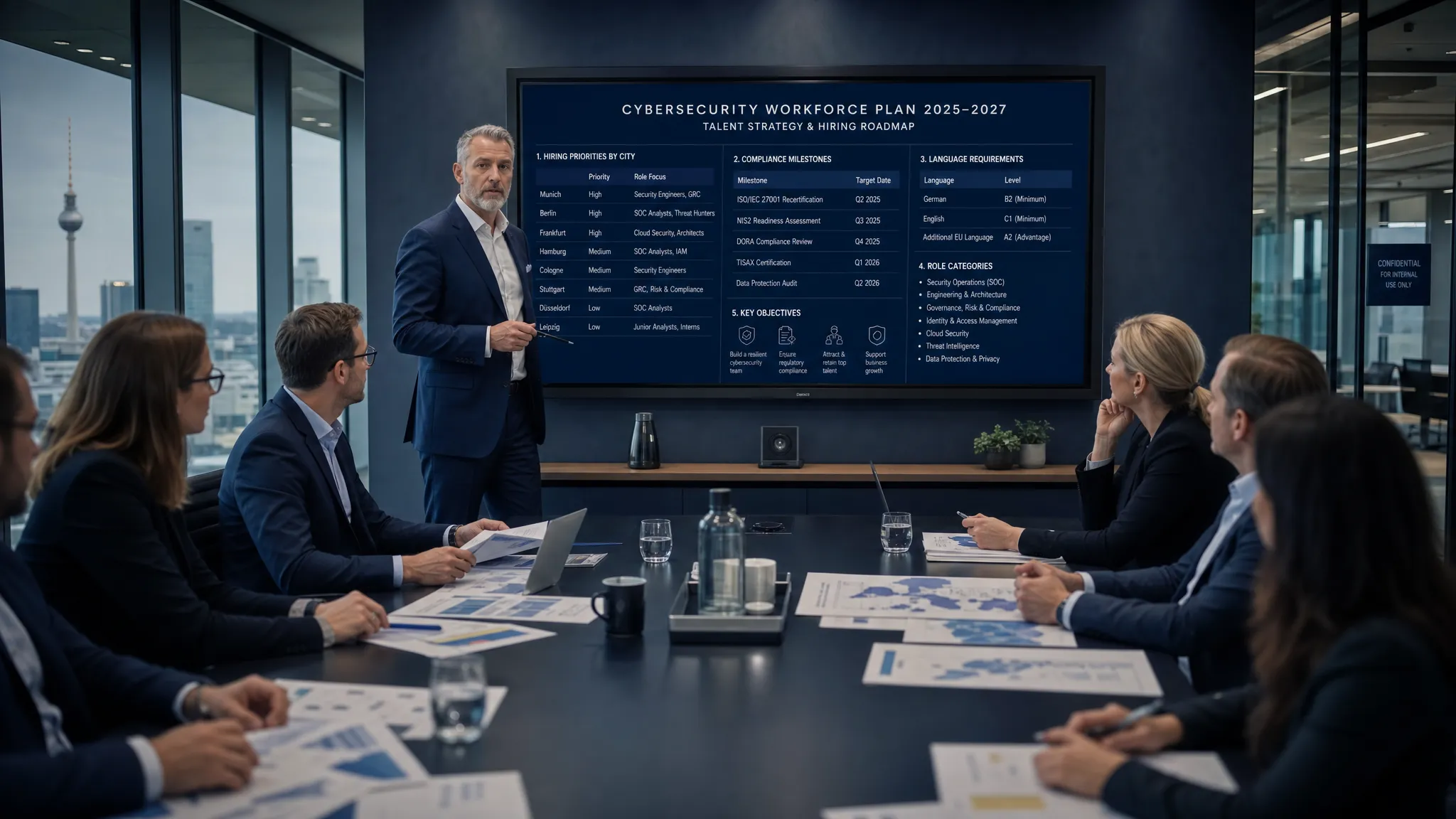
Germany has three distinct cybersecurity hiring markets. Berlin is Germany's primary technology and startup hub, with the highest concentration of SaaS scale-ups and cybersecurity companies, and the most internationally accessible talent market. Munich is the enterprise technology and financial services hub, with higher salary premiums and strong demand for senior CISO and governance profiles. Frankfurt is Germany's financial capital, where BaFin-regulated institutions drive compliance, SOC and operational resilience hiring. BaFin, the Bundesanstalt für Finanzdienstleistungsaufsicht, is Germany's federal financial supervisory authority.
German proficiency is still expected by the majority of employers, particularly in regulated, industrial and public-sector-facing roles. That language requirement restricts cross-border talent flow and compounds the talent shortage, Germany's acute cybersecurity workforce gap created by scarce senior specialists, long notice periods and high retention pressure.
Summary: The cybersecurity hiring market Germany 2026 is shaped by NIS2, BSI expectations, city-level salary divergence, German-language constraints and a structurally limited senior talent pool. Employers entering Germany need local market intelligence before launching searches.
Which Types of Companies Are Hiring Cybersecurity Professionals in Germany?
Cybersecurity professionals in Germany are being hired across six main employer groups: industrial giants, financial services firms, SaaS scale-ups, critical infrastructure operators, consultancies and cybersecurity vendors.
Automotive & Manufacturing Giants
BMW, Mercedes-Benz, Volkswagen, Siemens and Bosch are among the largest cybersecurity employers in Germany because they operate complex production environments, connected products and global supplier networks. Their hiring is concentrated in OT Security, Product Security, embedded systems security, supplier assurance and cyber governance. These employers often require German fluency, regulated engineering experience and the ability to work with manufacturing, legal and product teams.
Financial Services
Deutsche Bank, Commerzbank, Allianz and Munich Re hire heavily under BaFin supervision, NIS2 obligations and operational resilience requirements. Demand is strongest for CISOs, SOC leaders, cloud security engineers, identity specialists, incident response managers and compliance profiles. Frankfurt carries the highest concentration of finance-led hiring, while Munich remains significant for insurance, risk and enterprise technology leadership roles.
Technology & SaaS Scale-ups
Berlin's scale-up ecosystem, including companies such as Zalando, N26 and Celonis, drives demand for Cloud Security, DevSecOps, application security and security engineering profiles. These employers are more likely to operate in English than traditional German enterprises, but competition is intense because candidates often compare offers against global SaaS employers, remote-first security vendors and venture-backed technology firms.
Critical Infrastructure Operators
Energy, transport, telecoms and healthcare infrastructure operators are accelerating governance, incident response and OT security hiring under NIS2 Essential Entity obligations. Many roles require knowledge of German regulatory expectations, supplier security and operational continuity. Hiring is often slower than in SaaS because stakeholders include legal, risk, operations, engineering, procurement and, in larger organisations, employee representation bodies.
Management Consulting & Big Four
Deloitte, PwC, KPMG and McKinsey operate significant cybersecurity practices from Frankfurt and Munich, hiring governance, risk, compliance, cloud transformation and cyber strategy consultants. Their demand is driven by NIS2 readiness programmes, security operating model redesign, cloud migration and board-level cyber advisory. Candidates with both technical credibility and executive communication skills are particularly sought after.
Cybersecurity Vendors
German operations of CrowdStrike, Palo Alto Networks and domestic vendors hire across Sales Engineering, Professional Services, Customer Success, Threat Intelligence and Technical Account Management. These roles combine commercial capability with deep product and security knowledge. Vendors often seek candidates who can explain complex security architectures to German enterprise buyers, which makes local language and sector credibility commercially valuable.
Summary: The top cybersecurity employers Germany 2026 are not limited to security vendors. Automotive, manufacturing, finance, SaaS, critical infrastructure and consulting firms are all competing for the same senior security talent, often with different salary expectations and language requirements.
Cybersecurity Salary Benchmarks: Germany 2026 by City
Cybersecurity salaries in Germany vary materially by city, with Munich and Frankfurt paying the strongest premiums for senior security, governance and financial services roles.
The following indicative gross annual base salary benchmarks reflect senior permanent roles in 2026. They exclude bonus, equity, pension contributions, car allowance, relocation and sign-on incentives. For broader European context, see Optima Search Europe's Tech Salary Benchmark Report Europe 2026.
Role                              Berlin           Munich           Frankfurt        Hamburg
SOC Analyst (Senior)              €65,000-€88,000  €72,000-€96,000  €70,000-€94,000 €64,000-€86,000
Cloud Security Engineer (Senior)  €96,000-€130,000 €105,000-€142,000 €102,000-€138,000 €94,000-€128,000
OT Security Engineer (Senior)     €90,000-€122,000 €98,000-€132,000 €95,000-€128,000 €88,000-€120,000
NIS2 Compliance Officer (Senior)  €82,000-€112,000 €90,000-€122,000 €88,000-€118,000 €80,000-€110,000
CISO                              €138,000-€178,000 €152,000-€198,000 €148,000-€192,000 €135,000-€175,000
Munich typically commands an 8-12% salary premium over Berlin for equivalent senior roles. Frankfurt can exceed Berlin by a similar margin where the employer is a regulated financial institution. Financial services employers often pay 15-20% above technology sector levels for CISO and senior compliance profiles because accountability, audit exposure and regulatory expectations are higher.
Summary: Salary benchmarking in Germany must be city-specific and sector-specific. Using Berlin compensation ranges for Munich or Frankfurt searches is one of the most common causes of offer-stage failure in cybersecurity recruitment Germany market activity.
OT and Industrial Cybersecurity: Germany's Unique Demand Profile
Germany's world-leading position in automotive, engineering and manufacturing creates a unique cybersecurity demand profile not found at this scale in any other European market, with OT security and Product Security Engineering among the most actively hired and hardest-to-fill specialisms in the country.
OT Security, or Operational Technology Security, means protecting industrial control systems and manufacturing infrastructure. This is uniquely important in Germany because automotive, engineering, chemicals, logistics and industrial automation employers operate large estates of machinery, connected plants and supplier-integrated production environments. SCADA, or Supervisory Control and Data Acquisition, refers to systems used to monitor and control industrial processes.
German manufacturers increasingly reference IEC 62443, the primary international OT security standard for industrial automation and control systems, in hiring requirements. Senior candidates are expected to understand segmentation, asset discovery, vulnerability management, safety constraints and the practical differences between enterprise IT security and plant-floor security.
Product Security is also accelerating. It means securing connected products such as vehicles, industrial IoT devices, embedded systems and software-defined manufacturing equipment. UN R155, the UNECE automotive cybersecurity regulation requiring cybersecurity management systems for vehicle manufacturers, is driving Product Security Engineer demand at BMW, Mercedes-Benz, Volkswagen and their suppliers.
The supply constraint is severe. OT security engineers are scarce across Europe, but Germany's demand is disproportionately high because industrial employers compete simultaneously with consultancies, vendors, energy operators and automotive suppliers. Candidates with both security engineering and production-environment experience can move quickly, even in conservative hiring markets.
Summary: Germany's cybersecurity workforce 2026 challenge is not only about SOC, cloud or compliance hiring. Industrial and product security create a deeper scarcity layer that international employers often underestimate when entering the German market.
Structural Hiring Challenges in the German Cybersecurity Market
Cybersecurity recruitment in Germany is slower and more complex than many neighbouring markets because employment norms, language requirements and retention dynamics narrow the effective candidate pool.
- 3-month notice periods: A notice period is the contractual time between resignation and employment end date. Three months is standard for senior roles in Germany, meaning hiring timelines must accommodate a 6-9 month total process from search launch to start date.
- Language requirements: German proficiency is expected by most employers, especially in regulated, industrial and customer-facing roles. This halves or doubles the available talent pool depending on whether the role is German-speaking or English-only.
- Works council involvement: A Works Council, or Betriebsrat, is an elected employee representation body present in many German companies. In larger organisations, the Betriebsrat may need to be consulted on hiring decisions, employment terms or process changes.
- Conservative hiring culture: German hiring processes often involve more interview stages than UK or Netherlands equivalents. Structured assessment is valuable, but lengthy multi-stage processes can lose passive senior candidates to faster competitors.
- Strong counter-offer culture: German employers frequently match or exceed competing offers during notice periods, especially for security-critical roles. Retention management and candidate commitment must be handled before resignation, not after.
- Relocation reluctance: German professionals show lower geographic mobility than UK or Netherlands peers. Local market sourcing in Berlin, Munich, Frankfurt, Hamburg and regional industrial hubs is more reliable than assuming candidates will relocate.
Summary: The Germany cybersecurity talent market overview is defined as much by structure as by demand. Employers who fail to plan for notice periods, language, works councils and counter-offers often misread slow hiring as poor candidate interest.
How to Hire Cybersecurity Professionals in Germany: Step-by-Step
Successful cybersecurity hiring in Germany requires early workforce planning, precise role design, city-level compensation benchmarking and proactive access to passive candidates.
- Account for notice periods from day one: Plan for 3-month notice periods at senior level and assume the total time from search launch to start date is typically 6-9 months. This changes workforce planning, especially for CISOs, OT security leaders and NIS2 compliance hires. Start the search before internal capacity is exhausted, not when audit deadlines or transformation milestones are already at risk.
- Define language requirements clearly: Decide whether German proficiency is essential, preferred or unnecessary before launching the search. German-speaking roles access a more trusted local pool but exclude many international specialists. English-only roles broaden the cross-border market, especially in Berlin SaaS and vendor environments, but may create friction in regulated, industrial or stakeholder-heavy organisations where documentation and governance meetings are conducted in German.
- Set Munich and Frankfurt premium budgets where applicable: City-level salary variance is significant, particularly for CISO, compliance, cloud security and financial services roles. Using Berlin benchmarks for Munich or Frankfurt searches creates avoidable offer-stage risk. Employers should benchmark by city, sector, seniority and scarcity premium, then align internal compensation bands before approaching candidates rather than adjusting late in the process.
- Engage passive candidates: The strongest German cybersecurity professionals are usually employed, retained and not browsing job boards. Effective search requires market mapping, targeted outreach, credible role positioning and confidentiality. For senior or business-critical roles, passive engagement matters more than advert reach because the visible candidate market rarely contains enough qualified OT, CISO, GRC or cloud security specialists.
- Streamline the interview process: German candidates expect structured hiring, but senior profiles disengage when processes exceed five rounds or repeat the same assessment. Build a clear scorecard, define decision rights and consolidate stakeholder feedback. A strong process can still be rigorous with fewer stages if technical, behavioural, regulatory and leadership evidence is gathered deliberately rather than through duplicated interviews.
- Prepare for counter-offers: Communicate the full package value early, including base salary, bonus, flexibility, leadership mandate, development path and strategic visibility. Candidates who resign from German employers often receive strong counter-offers during their notice period. Employers need a clear retention-resistant proposition, not just a marginal salary increase, to keep senior security candidates committed through start date.
- Use a specialist recruiter with German market knowledge: Generalist recruiters unfamiliar with German employment norms, BSI expectations, city salary premiums and passive security communities consistently underperform in this market. A specialist partner can map domestic and cross-border candidates, test compensation assumptions, advise on process design and reduce failed approaches. This is particularly important for confidential, senior, NIS2-critical or OT security searches.
Summary: Hiring cybersecurity professionals in Germany is a structured market-entry exercise, not a job-posting exercise. The employers that win combine early planning, local salary intelligence, passive candidate access and a disciplined assessment process.
Frequently Asked Questions
These are the five questions hiring leaders most often ask when assessing cybersecurity companies Germany hiring conditions in 2026.
Which cybersecurity roles are most in demand in Germany in 2026? The highest-demand roles are CISO, Cloud Security Engineer, OT Security Engineer, Product Security Engineer, SOC Analyst, Incident Response Lead, NIS2 Compliance Officer and GRC Manager. Demand is strongest where regulation and operational risk overlap, particularly in finance, automotive, manufacturing, energy, telecoms and enterprise SaaS. OT security and Product Security are especially scarce because candidates need both security knowledge and industrial or embedded systems experience. NIS2 has also increased demand for governance profiles who can translate regulation into operating models, controls and board-level reporting.
What is the average cybersecurity salary in Germany by city? Senior cybersecurity salaries in Germany vary by role and city. In 2026, senior SOC Analysts typically earn €65,000-€96,000 depending on location, while senior Cloud Security Engineers range from about €94,000 to €142,000. Senior OT Security Engineers commonly fall between €88,000 and €132,000. CISOs range from approximately €135,000 in Hamburg to nearly €198,000 in Munich. Munich usually pays the highest premium, followed by Frankfurt for finance-led roles. Berlin remains competitive but often offers stronger startup equity or international work environments instead of the highest base salaries.
How long does it take to hire a cybersecurity professional in Germany? For senior cybersecurity roles in Germany, employers should plan for 6-9 months from search launch to start date. The search and interview phase may take 8-14 weeks for a well-run process, but the standard 3-month notice period extends the total timeline materially. CISO, OT security and NIS2 compliance roles can take longer if compensation bands, language requirements or stakeholder alignment are unclear. International companies often underestimate the timeline because they compare Germany with the UK, where notice periods and process norms can be shorter.
Do cybersecurity professionals need to speak German to work in Germany? Not always, but German proficiency remains a major advantage. English-only roles are more common in Berlin SaaS companies, international cybersecurity vendors and some cloud-native technology teams. German is still expected in many finance, manufacturing, critical infrastructure, public-sector-facing and governance roles because documentation, works council interactions, audits and executive meetings may take place in German. Making German mandatory narrows the candidate pool but improves stakeholder integration. Making the role English-only expands sourcing options, especially for cross-border and internationally mobile security talent.
What makes OT security hiring in Germany different from the rest of Europe? Germany has unusually high OT security demand because its automotive, engineering and manufacturing sectors operate large industrial control environments, connected production lines and global supplier networks. Employers need candidates who understand both cybersecurity and operational constraints such as uptime, safety, legacy systems, SCADA environments and IEC 62443. This is a smaller pool than general IT security. Product Security demand from connected vehicles and industrial IoT, reinforced by UN R155, further tightens supply. As a result, OT security hiring in Germany often requires direct passive search and highly specific assessment.
Summary: German cybersecurity hiring decisions depend on role scarcity, city salary premiums, language requirements, notice periods and sector context. Generic European cybersecurity benchmarks are rarely sufficient for German hiring plans.
Conclusion & Strategic Positioning
Germany is one of Europe's most important cybersecurity hiring markets in 2026, but it is also one of the most structurally demanding for international entrants and domestic employers scaling security functions.
The market is being reshaped by NIS2, BSI expectations, BaFin oversight, industrial OT security demand and a persistent senior talent shortage. Berlin, Munich, Frankfurt and Hamburg each behave differently, with different salary levels, candidate motivations, language expectations and employer competition. For hiring leaders, the risk is not simply failing to find candidates. It is mispricing roles, underestimating timelines, losing passive candidates through slow processes or treating Germany like a generic European market.
Optima Search Europe supports business-critical and senior executive hiring across Europe and globally, including cybersecurity, digital and technology roles. For German cybersecurity hiring, the value of a specialist partner lies in market mapping, access to passive candidates, salary calibration, cross-border search capability and practical understanding of German employment norms.
If you are building a German security function, replacing a senior cybersecurity leader or entering the market under NIS2 and BSI pressure, Optima Europe can discuss the hiring landscape, likely talent pools and the search strategy required to reach the right candidates confidentially and efficiently. For wider context, explore our guide to cybersecurity recruitment in Europe or our analysis of the NIS2 Directive's impact on cybersecurity hiring.

