
NIS2 Directive Impact on Cybersecurity Hiring (2026 Guide)

NIS2 Directive Impact on Cybersecurity Hiring in Europe (2026 Guide)
For CISOs, CIOs, compliance leaders and boards, the NIS2 Directive is no longer a “future” regulatory topic. By 2026, most EU Member States have moved from transposition planning to active supervisory posture, and organisations in scope are being pushed to evidence risk management controls, incident readiness, and executive oversight.
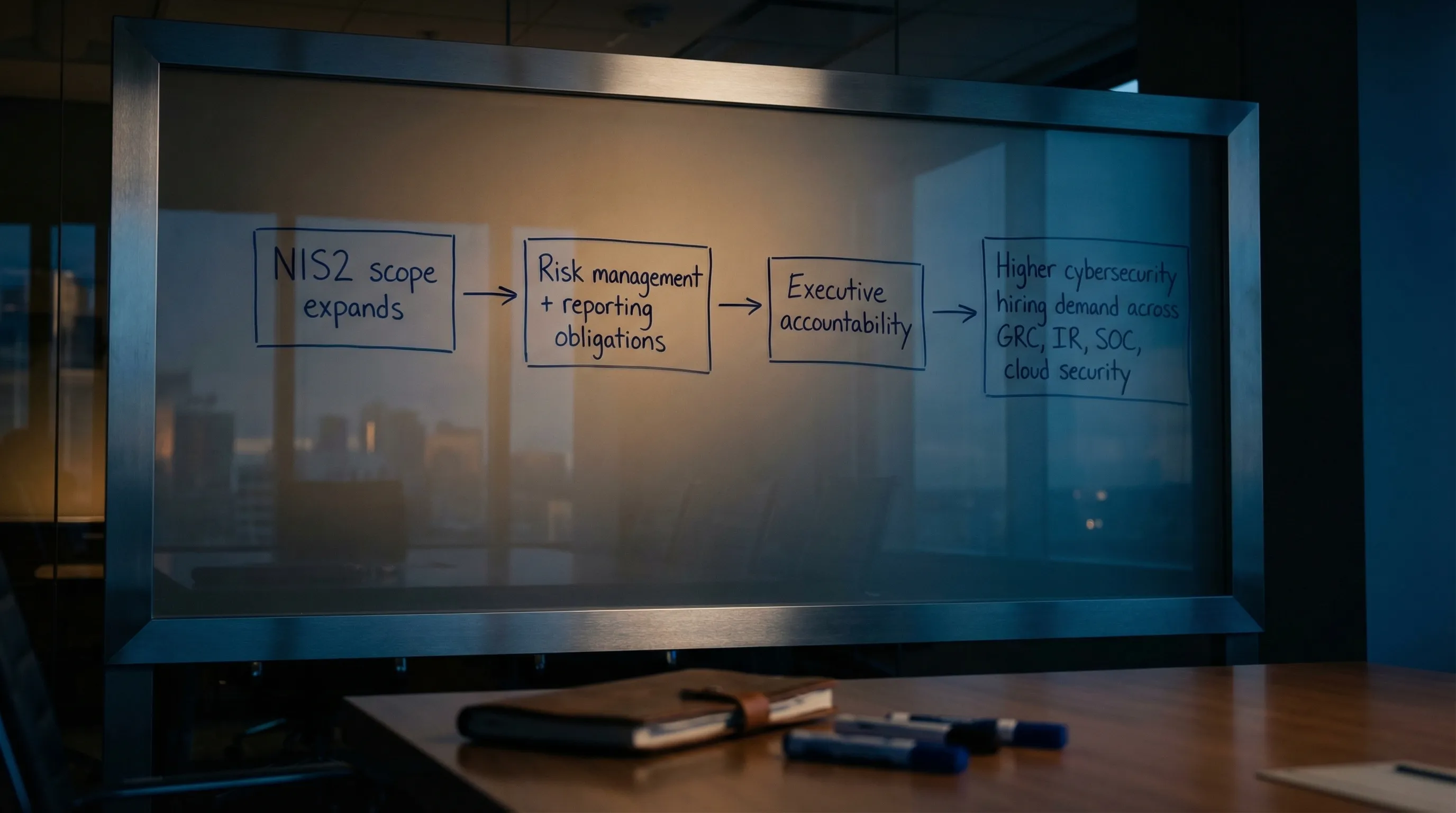
That shift is creating a very specific hiring pattern: compliance-driven cybersecurity hiring that prioritises governance, reporting capability, and operational resilience, not only technical engineering depth. In other words, the NIS2 Directive impact on cybersecurity hiring is showing up as urgency (shorter deadlines), scarcity (limited senior talent), and a move toward more structured recruitment.
If you are building a NIS2-ready team and need a market view of what is hiring-critical in 2026, start with this broader context on Cybersecurity Recruitment Agency in Europe (Optima Search Europe’s pillar guide).
This article is for information only and does not constitute legal advice. Always confirm obligations with your legal and compliance advisers in the relevant Member State(s).
What Is the NIS2 Directive?
The NIS2 Directive (Directive (EU) 2022/2555) is the European Union’s updated cybersecurity framework designed to raise baseline security and resilience across critical sectors. It replaces and expands the earlier NIS Directive, with stronger supervisory powers, clearer organisational accountability, and more detailed requirements around incident reporting and security measures.
A useful starting point is the EU’s policy overview of the NIS2 Directive, as well as the primary legal text on EUR-Lex.
Difference between NIS and NIS2
NIS2 is not a minor refresh. Compared with NIS, it:
- Expands the range of regulated sectors and the types of organisations captured.
- Introduces stronger, more standardised supervisory and enforcement mechanisms.
- Tightens incident reporting obligations with short reporting timeframes.
- Elevates governance expectations, explicitly linking cybersecurity measures to the “management body” (board or equivalent).
Essential vs Important entities
A key structural change is the split between essential entities and important entities, with different supervision intensity but broadly similar security expectations.
- Essential entities generally include sectors such as energy, transport, banking, financial market infrastructures, health, drinking water, wastewater, digital infrastructure, certain ICT service management, public administration, and space.
- Important entities include additional sectors such as postal and courier services, waste management, chemicals, food, manufacturing (for certain categories), digital providers, and research.
In practice, this classification affects how regulators supervise you, and how quickly security leadership is expected to demonstrate control maturity.
Timeline and enforcement reality in 2026
NIS2 required Member States to transpose the Directive into national law by 17 October 2024. Because enforcement mechanisms are national, the practical impact has varied by country. By 2026, many organisations are experiencing:
- Greater scrutiny of incident readiness and reporting processes.
- More demand for evidence (policies, controls, testing results, supplier assessments).
- A shift from “security as IT” to “security as regulated operational risk”.
Why NIS2 Significantly Increases Cybersecurity Hiring Demand
NIS2 increases demand because it expands who must comply and because it makes “paper compliance” hard to sustain without real operational capability.
Expanded scope of regulated industries
More organisations fall into scope, including many mid-market firms that previously did not build enterprise-grade security functions. This is one driver behind NIS2 cybersecurity talent demand, especially for security generalists with regulated-industry experience.
Mandatory risk management frameworks (and evidence)
NIS2 requires risk management measures that, in hiring terms, translate into roles that can build and run security programmes: security policies, access control, vulnerability management, secure development practices, logging and monitoring, business continuity, and supplier risk management.
Many organisations use recognised frameworks to operationalise these requirements, even though NIS2 does not mandate a single certification. Common reference points include ISO 27001 (information security management systems) and assurance approaches such as SOC 2 reporting for relevant services.
Stricter incident reporting obligations
NIS2 strengthens incident reporting expectations, including short reporting windows (for example, an early warning within 24 hours of becoming aware of a significant incident, followed by additional reporting milestones). Hiring demand rises because reporting deadlines are operational, not theoretical: you need people who can detect incidents quickly, triage them, preserve evidence, coordinate communications, and meet regulator expectations.
Board-level accountability
NIS2 explicitly ties cybersecurity governance to senior management oversight. Boards, audit committees, and executive teams increasingly expect security leadership that can quantify risk, document decisions, and show control effectiveness.
Summary (why hiring demand rises): NIS2 expands regulated scope, increases the amount of demonstrable security work (risk management plus assurance), compresses reporting timelines, and raises accountability. Together, these forces shift cybersecurity resourcing from “nice to have” to “regulatory operating requirement”, which is why EU cybersecurity regulation hiring is accelerating across Europe.
Roles Most Impacted by NIS2
While almost every security role benefits from NIS2-driven budgets, several positions are disproportionately affected because they map directly to NIS2 hiring requirements (governance, risk management, and incident readiness).
- CISO / Security Leadership: NIS2 creates a stronger need for leaders who can build a defensible security programme, translate cyber risk to the board, and coordinate legal, compliance, IT, and operations. This is not only a technical leadership hire; it is a governance hire.
- GRC & Compliance Officers: The Directive’s emphasis on risk management measures, policies, and demonstrable controls increases demand for GRC professionals who can run audits, maintain evidence, manage third-party risk, and align operations with frameworks like ISO 27001.
- Risk Analysts: Many regulated organisations need dedicated cyber risk capability, including risk quantification, risk acceptance processes, and tracking of remediation plans across business units.
- Incident Response (IR) Specialists: Incident reporting obligations raise the value of leaders who can run playbooks, coordinate stakeholders, manage forensic readiness, and ensure consistent incident classification and reporting.
- SOC Analysts / Detection Engineers: Faster reporting depends on earlier detection. SOC capability, log coverage, and alert quality directly affect whether a company can meet NIS2 expectations under pressure.
- Cloud Security Engineers: As regulated workloads move to cloud, NIS2 compliance recruitment in Europe increasingly includes cloud control design (identity, configuration baselines, monitoring, encryption, and cloud vendor oversight). This aligns closely with critical infrastructure cybersecurity hiring patterns.
For many organisations, the hiring challenge is not defining these jobs. It is finding candidates who have done them under regulatory constraints, at pace, and with credible evidence of outcomes.
NIS2 and Executive Accountability
NIS2 materially changes the “who owns cybersecurity” conversation. The Directive places explicit responsibility on the organisation’s management body for approving cybersecurity risk management measures and overseeing their implementation.
From a talent perspective, this drives two outcomes:
- Security leaders must be board-effective. The CISO is expected to provide structured risk reporting, demonstrate readiness, and support decision-making under regulatory scrutiny. This is why demand for executive-grade CISOs has grown, particularly in essential and important entities.
- Governance structures become hiring triggers. Organisations are adding security governance committees, formalising risk acceptance, and strengthening internal audit interfaces, all of which expand hiring needs in GRC, risk, and assurance.
Where security leadership is a board-level risk, many organisations move from contingency recruitment to more structured executive search. See Optima’s guide on CISO Executive Search in Europe.
Talent Shortage and Salary Inflation Due to NIS2
NIS2 is landing on top of an already constrained talent market. Multiple industry studies continue to highlight a global cybersecurity workforce gap, and in Europe the situation is intensified by cross-border demand for bilingual, compliance-literate candidates.
In practical terms, NIS2-driven hiring creates salary pressure in three areas:
- GRC and compliance-heavy profiles: Candidates who can operationalise controls, manage audits, and produce regulator-grade evidence are in high demand.
- Incident readiness and SOC leadership: Short reporting windows reward organisations with mature detection and response capability.
- Cloud security and supplier assurance: The intersection of cloud, identity, and vendor management is a frequent bottleneck.
Germany is a good example of this inflation dynamic. For budgeting and benchmarking, see the Cybersecurity Salary Guide Germany 2026.
Retention risk rises as competitors “buy” compliance capability through counteroffers. If your plan assumes standard notice periods and slow interview loops, NIS2 will expose it.
How Companies Should Adapt Their Hiring Strategy
Treat NIS2 as a workforce planning problem, not only a security programme problem. The organisations that hire well in 2026 tend to run a structured, compliance-aware recruitment process with clear role outcomes and faster decision cycles.
Map Regulatory Exposure
Start by mapping where NIS2 applies (entity classification, jurisdictions, and operational footprint). Cross-border groups should identify which subsidiaries fall under which national implementations and where centralised vs local security ownership is realistic.
Your hiring plan should follow the exposure map, not the org chart.
Identify Compliance-Driven Roles
Translate obligations into capabilities, then into roles. For many essential and important entities, the first hires are not “more engineers”, but roles that close compliance gaps:
- Evidence-ready GRC capability
- Incident reporting readiness (process plus people)
- Third-party and supply chain assurance
- Cloud governance and control ownership
This approach reduces duplicate hiring and avoids building a team that is strong technically but weak on auditability and reporting.
Align Compensation to Market Reality
Assume you are competing with other in-scope organisations, including highly acquisitive cyber security companies and critical infrastructure operators with regulatory pressure.
Use current benchmarks, set bands that reflect scarcity for senior profiles, and consider total package design (remote policy, learning budget, and role scope clarity). Under NIS2, “under-banding” commonly leads to prolonged vacancy risk, which becomes a compliance risk.
Accelerate Hiring Timelines
NIS2 does not wait for your quarterly hiring cycle. If you need a credible NIS2 posture, reduce time-to-hire by removing avoidable process friction:
- Tighten interview loops (fewer rounds, clearer decision rights)
- Use consistent, role-relevant casework (for example, incident reporting scenario walkthroughs)
- Schedule debriefs in advance, not after the fact
Speed here is not about lowering standards. It is about preventing attrition and counteroffers.
Engage Specialized Cybersecurity Recruiters
NIS2 compliance recruitment in Europe often fails when organisations treat these roles as generic IT hiring. Specialised recruiters can help by market mapping scarce profiles, validating regulatory-relevant experience, and managing cross-border constraints (language, time zones, background checks, and confidentiality).
For cloud-heavy programmes, Optima’s Cloud Security Hiring Trends in Europe is a helpful companion read.
Cross-Border Recruitment as a Compliance Strategy
Cross-border recruitment is increasingly a NIS2 response, not only a growth tactic. When local markets cannot supply senior GRC, IR leadership, or cloud security talent fast enough, hiring across borders can stabilise compliance timelines.
In 2026, several patterns are common:
- Accessing broader EU talent pools: Especially for multilingual GRC and security leadership.
- Eastern European cybersecurity talent: Strong engineering and SOC capability in hubs such as Poland, Romania, and the Baltics, often with experience supporting pan-European operations.
- Remote compliance roles: Some GRC and risk functions can be effective remotely if evidence management, stakeholder cadence, and audit participation are well designed.
- Multi-country execution: Cross-border hiring needs consistent assessment, clear employment models, and alignment on data security expectations.
Done well, cross-border hiring reduces time-to-capability. Done poorly, it adds operational risk. This is where structured search and selection becomes a compliance enabler.
Frequently Asked Questions
What is the NIS2 Directive? NIS2 is the European Union’s updated cybersecurity directive (Directive (EU) 2022/2555) that expands and strengthens obligations for organisations in critical and high-impact sectors. It introduces clearer requirements for risk management measures, stronger incident reporting obligations, and more explicit governance expectations for senior management. NIS2 also broadens the scope of regulated industries and classifies organisations as essential or important entities, which affects supervisory approach. Because it is implemented through national laws, exact enforcement details can vary by Member State.
Does NIS2 require additional cybersecurity hiring? Often, yes, particularly where an organisation is newly in scope or has relied on a lean security model. NIS2 increases the need for roles that can operationalise risk management, maintain audit-ready evidence, and deliver incident readiness under compressed reporting timelines. The biggest headcount impact is frequently in GRC, incident response, SOC capability, and cloud security governance. Even when organisations do not increase overall headcount, they commonly rebalance towards compliance-literate profiles and add senior oversight.
Which roles are most affected by NIS2? The roles most impacted are those directly tied to NIS2 obligations: CISO and security leadership (governance and risk ownership), GRC and compliance officers (controls, evidence, third-party assurance), risk analysts (risk quantification and tracking), incident response specialists (playbooks and regulator-ready reporting), SOC analysts (detection to meet timelines), and cloud security engineers (control implementation in cloud environments). Demand rises further in cross-border organisations where consistent reporting, supplier assurance, and audit coordination are required.
When does NIS2 come into force and what matters in 2026? NIS2 entered the EU legal framework in 2023 and required Member States to transpose it by 17 October 2024. What matters in 2026 is the operational reality: national regulators are increasingly expecting evidence of implemented controls, tested incident processes, and accountable governance. Because timelines, supervisory practice, and penalties are applied nationally, companies operating across multiple EU countries need to monitor each jurisdiction’s implementation while aligning on a group-wide security operating model.
How does NIS2 impact CISOs and security leaders? NIS2 increases expectations that CISOs can run a security programme that is both technically effective and defensible under regulatory scrutiny. Security leaders need to demonstrate risk management measures, ensure incident reporting readiness, and communicate risk clearly to the board and senior stakeholders. The Directive also reinforces executive oversight responsibilities, which pushes CISOs toward stronger governance, metrics, and evidence management. In hiring, this increases demand for CISOs with regulated-sector experience and for deputies covering GRC and incident readiness.
Is there a cybersecurity talent shortage due to NIS2? NIS2 amplifies an existing cybersecurity talent shortage by expanding the number of organisations that must meet higher security and reporting standards. The scarcity is especially pronounced for senior GRC leaders, incident response managers, SOC leadership, and cloud security specialists who have delivered programmes under audit or regulatory constraints. As more essential and important entities hire simultaneously, salary inflation and counteroffers become more common. This is one reason many organisations turn to cross-border recruitment and more structured search to secure talent fast.
Conclusion
NIS2 expands cybersecurity obligations across Europe, raises the bar for risk management and incident reporting, and makes governance a first-order requirement. The result in 2026 is clear: higher cybersecurity talent demand, more competition for compliance-literate professionals, and greater executive accountability driving security leadership hires.
If your organisation is building a NIS2-ready team, the key advantage is not only budget, but hiring structure: clear role outcomes, fast decision cycles, and access to scarce cross-border talent. For a deeper view of security hiring execution, see Optima’s Cybersecurity Recruitment Agency in Europe.

