
How to Hire Digital Pathology AI Engineers in Europe
How to Hire Digital Pathology AI Engineers in Europe: A 2026 Hiring Guide
Digital pathology is moving from pilots to production across Europe, driven by whole slide imaging (WSI) adoption, foundation-model progress, and hospital pressure to improve turnaround times and diagnostic consistency. The commercial reality is simple: if you cannot hire (and retain) the right engineering talent, your clinical validation and product roadmap will slip.
This guide is written for CTOs, HR Directors, COOs and founders who need to hire digital pathology engineers in Europe in 2026, particularly for computational pathology and deep learning roles that sit at the intersection of ML engineering, medical imaging, and EU regulatory constraints.
What Does a Digital Pathology AI Engineer Do?
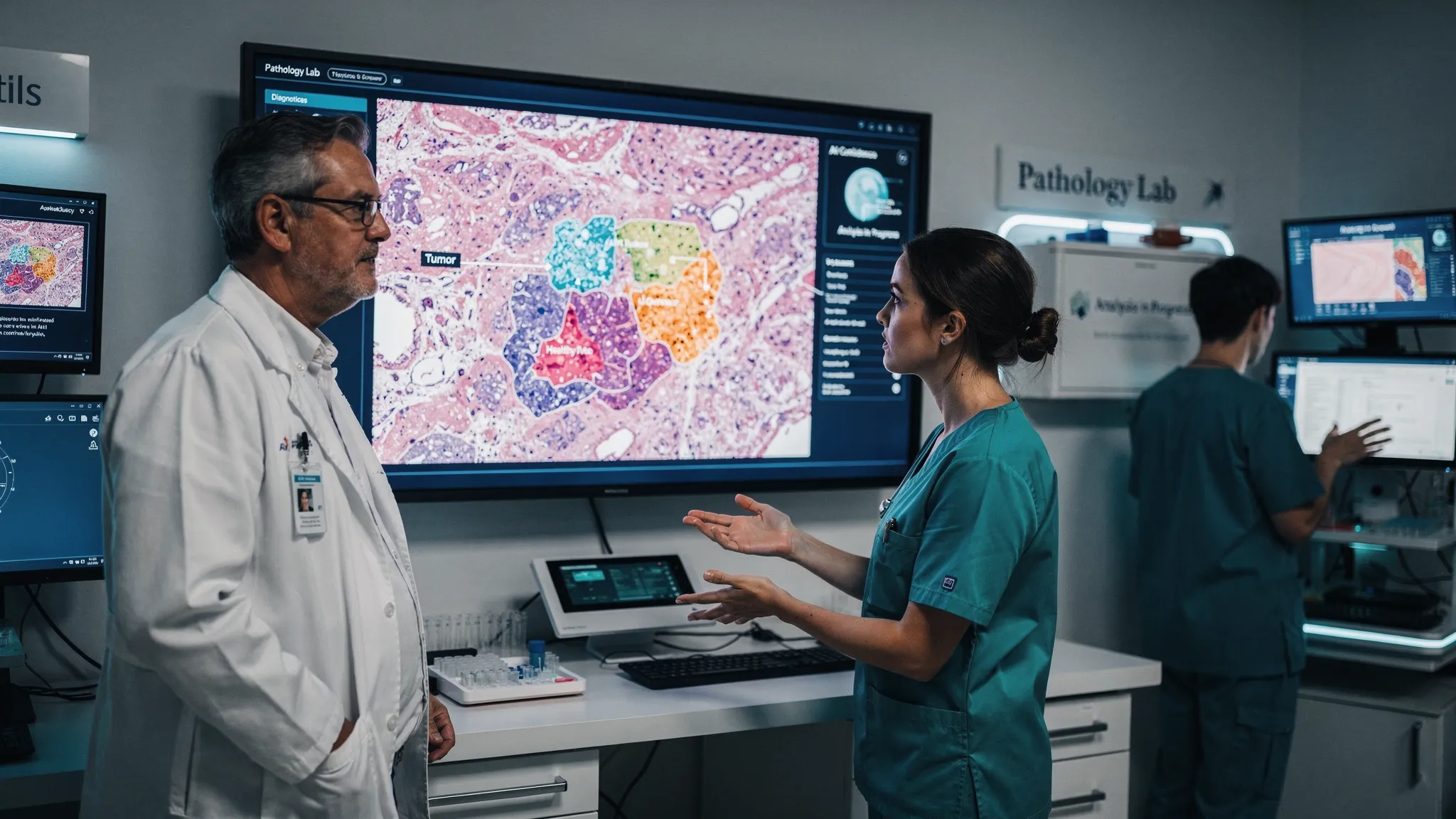
A Digital Pathology AI Engineer builds, validates, and deploys machine learning models that analyse histopathology data, typically whole slide images (WSIs) scanned at high magnification. The day-to-day work is less about generic “computer vision”, and more about engineering reliable pipelines around extremely large images, noisy clinical labels, and clinically meaningful outputs.
Common responsibilities include:
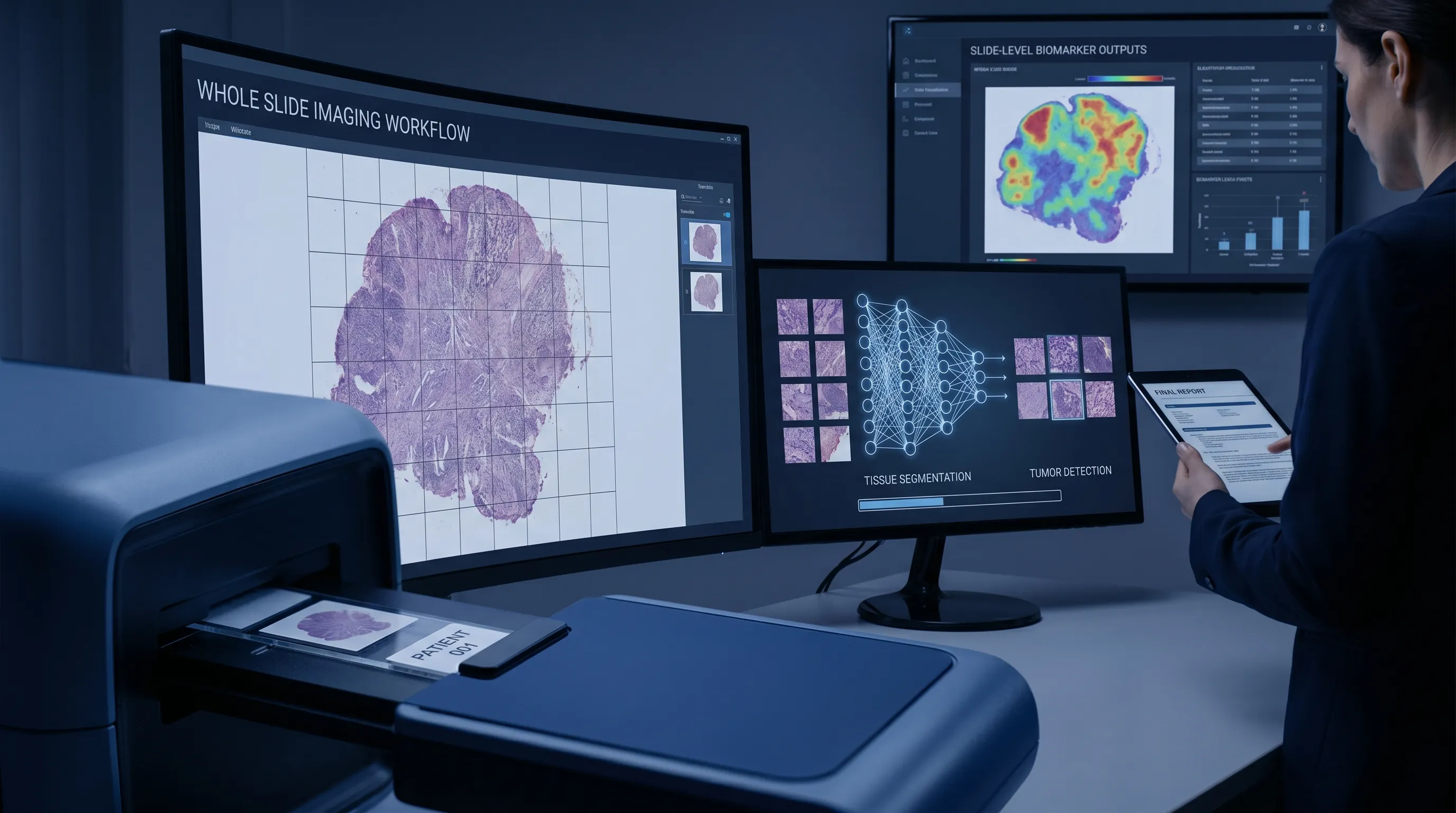
- Developing deep learning models for tissue segmentation, tumour detection, grading support, and biomarker quantification.
- Building training and inference pipelines for gigapixel WSI data, including tiling strategies, stain variation handling, and slide-level aggregation.
- Creating evaluation frameworks that reflect clinical reality (site variability, scanner differences, staining protocols), not just benchmark metrics.
- Working with pathology stakeholders to define acceptance criteria and failure modes, then translating them into model and data requirements.
- Supporting documentation and traceability expectations that arise when the product touches regulated clinical workflows (for example, EU MDR and IVD considerations).
Digital Pathology AI Engineer vs Computational Pathology Scientist vs Clinical AI Specialist
These titles are often used interchangeably in job adverts, which creates predictable hiring friction.
A practical distinction:
- Digital Pathology AI Engineer: engineering-led, responsible for production-grade pipelines, robust model training and validation, deployment constraints, and cross-functional delivery.
- Computational Pathology Scientist: research-led, often closer to methodology development, weak supervision approaches, novel architectures, and publication-quality experimentation.
- Clinical AI Specialist: workflow-led, focused on clinical implementation, stakeholder adoption, data governance, and bridging product teams with clinical environments.
In early-stage companies, one senior person may cover two of these areas. At scale, the separation becomes non-negotiable.
Why the role is mission-critical for scaling in Europe
For digital pathology businesses in Europe, the engineering function is inseparable from clinical credibility. You need models that generalise across sites, and a team that can navigate data heterogeneity, explainability expectations, and the practicalities of deployment into clinical environments.
Summary: A Digital Pathology AI Engineer builds WSI-focused ML systems (not generic CV models), typically spanning model development, validation design, and production pipeline delivery. Clarity on whether you need engineering, research, clinical implementation, or a hybrid profile is the first lever to reduce time-to-hire.
Why Digital Pathology AI Engineers Are So Hard to Find in Europe
The talent shortage is not just “AI hiring is hard”. Digital pathology has its own structural constraints that narrow the funnel dramatically.
The talent pool is genuinely narrow
Top candidates tend to be rare hybrids:
- Strong deep learning and computer vision foundations.
- Practical experience with WSI data (tiling, multi-instance learning, slide-level labels, artefacts).
- Enough histopathology context to avoid building technically impressive models that miss clinical utility.
Most ML engineers have never touched WSI. Most pathologists and wet-lab researchers are not ML engineers. The overlap is small.
There is no mature university-to-industry pipeline
Europe has excellent research groups in medical imaging and machine learning, but few programmes produce “ready-to-deploy” computational pathology engineers. Hiring managers therefore compete for candidates who learned WSI on the job, through PhDs, or through a small number of specialist teams.
Many strong ML engineers come from other domains
A high-performing CV engineer from autonomous vehicles or consumer vision can be outstanding, but will still need time to absorb:
- Histology staining variation (H&E, IHC) and lab-to-lab variability.
- Label noise and inter-observer variability.
- Clinical validation constraints and dataset governance.
If your roadmap assumes immediate pathology fluency, you will filter out the very candidates you need.
Regulation adds a second scarcity layer
In 2026, regulated health tech teams increasingly need engineers who can operate in environments shaped by EU MDR, IVD regulation, and AI governance. Even if the engineer is not “Regulatory”, they must understand what traceability, validation planning, and post-market expectations mean for model development and MLOps.
Useful starting points for internal alignment include the European Commission’s overview of the EU AI Act and the Medical Device Regulation (EU MDR).
Competition clusters in a few hubs
Cambridge, Paris, and Amsterdam attract a disproportionate share of relevant talent, and the passive candidate pool in these cities is heavily contested. If your process is slow or compensation is unclear, top candidates simply disengage.
Summary: Digital pathology AI hiring is constrained by a small hybrid talent pool, limited training pipelines, and an added regulatory knowledge burden. Competition concentrates in a few European hubs, so process speed and role clarity become decisive.
Key Skills to Look for When Hiring
A good hiring scorecard distinguishes “must-have for the first 6 months” from “nice-to-have later”. Over-specifying the role is a common reason why digital pathology AI engineer recruitment in Europe stalls.
Core ML and computer vision skills (WSI-specific)
In pathology, CV competence must show up in WSI realities:
- Patch extraction and sampling strategies for gigapixel images.
- Tissue segmentation and artefact detection (folds, blur, pen marks).
- Cell detection, nuclei segmentation, and feature extraction where relevant.
- Slide-level learning approaches (for example, multi-instance learning) and calibration.
- Robust validation design (site splits, scanner splits, stain variation, external validation).
Domain knowledge that actually matters
You do not need every candidate to be a histopathology expert, but you do need enough shared language to prevent rework.
Look for:
- Understanding of histopathology workflows (from specimen to slide to report).
- Familiarity with H&E staining and IHC staining at a conceptual level.
- Comfort collaborating with pathologists, and translating clinical objectives into model objectives.
Framework and tooling familiarity
Candidates do not need every library, but they should demonstrate an ability to work with the typical pathology stack:
- PyTorch or TensorFlow.
- WSI tooling such as OpenSlide and annotation/analysis tools like QuPath.
- Awareness of medical imaging frameworks (for example MONAI) where relevant.
- DICOM awareness, including pathology-adjacent DICOM concepts (even if the pipeline is not yet fully DICOM-native).
Regulatory and quality awareness (pragmatic, not legal)
In Europe, “regulatory awareness” in engineering often means:
- Understanding why dataset provenance, traceability, and versioning matter.
- Knowing that clinical evaluation and risk management affect model changes.
- Appreciation for documentation discipline in a regulated product lifecycle.
Collaboration and communication
The best computational pathology engineer hiring outcomes tend to come from candidates who can:
- Explain model behaviour to clinical stakeholders.
- Negotiate scope trade-offs with product teams.
- Document assumptions and limitations clearly.
Summary: Prioritise WSI-specific ML capability, practical domain fluency (not textbook pathology), and engineering discipline that supports validation and traceability. Treat regulatory awareness as a workflow requirement, not as a legal specialism.
How to Structure the Hiring Process for Digital Pathology AI Engineers
A strong process signals seriousness to senior candidates, and reduces false negatives caused by irrelevant assessments. It also materially improves your odds when you need to hire digital pathology ML engineer Europe wide, not just in one city.
Define the Role, Computational Pathology Scientist vs ML Engineer vs Software Engineer
Start by writing a one-page “success profile” that includes:
- The first 2 to 3 deliverables expected in 90 days.
- Where the role sits: research, product engineering, or platform.
- The interface map: pathologists, data engineering, MLOps, regulatory/QA.
A common failure mode in computational pathology engineer hiring Europe is to ask one person to simultaneously be: (1) research lead, (2) production ML engineer, (3) platform engineer, and (4) clinical implementation manager. If you need that hybrid, price and level it accordingly, or split it into two roles.
Technical Assessment: Whole Slide Image Processing and Model Validation
Generic LeetCode-style interviews are weak predictors here. Better options are work-sample assessments that resemble the real job.
Effective assessment patterns include:
- A short take-home or live session on WSI tiling, sampling bias, and memory constraints.
- A discussion of validation design, for example how to avoid leakage between slides, patients, and sites.
- A review of a candidate’s past project, focusing on failure modes, generalisation, and reproducibility.
If you want to move fast, use a pre-agreed scoring rubric. Avoid “panel taste tests” where every interviewer asks different questions and you cannot reconcile feedback.
Domain Knowledge Screening, How Much Pathology Do They Need to Know?
Screen for applied understanding, not memorised detail.
A practical approach is to assess:
- Whether the candidate understands the gap between slide-level labels and patch-level inference.
- How they would handle staining variability and site effects.
- How they work with clinicians when labels are ambiguous.
If a candidate is strong in ML but light on pathology, decide upfront whether you can support ramp-up through pairing with a pathology stakeholder. Many teams can, and should, if the engineering fundamentals are exceptional.
Compensation Benchmarking Before Going to Market
Do compensation alignment before posting the role or starting outreach. In this niche, candidates will ask early:
- Base range and total compensation philosophy.
- Remote or hybrid expectations.
- Relocation support and cross-border employment model.
When ranges are vague, senior candidates disengage, particularly in high-competition hubs.
Moving Fast, Why Top Candidates Withdraw from Slow Processes
In 2026, digital pathology engineers with real WSI experience often run multiple processes in parallel. The pattern behind withdrawals is usually predictable:
- Too many interview stages with unclear purpose.
- Long gaps between steps.
- Late-stage surprises on scope, seniority, or compensation.
A well-run process typically compresses decision-making into 2 to 3 weeks once first interview starts, with a clear technical work-sample and a final cross-functional round.
Summary: Structure hiring around role clarity, WSI-relevant work samples, and a fast, rubric-driven process. Align compensation and employment model before outreach, because in this market speed and clarity are part of the offer.
Digital Pathology AI Engineer Salary Benchmarks in Europe (2026)
Salary varies heavily by seniority, clinical exposure, and whether you are hiring an engineer who can own validation strategy and regulated delivery. The ranges below are indicative 2026 base salaries for permanent hires, excluding bonus and equity, and assume strong ML capability with some healthcare exposure.
Junior Digital Pathology AI Engineer
Typical base ranges:
- UK (London/Cambridge): £55k to £75k
- Eurozone hubs (Paris, Amsterdam, Munich): €55k to €80k
Junior candidates rarely bring deep WSI experience. Your differentiator is mentorship quality and a credible learning environment.
Mid-level Digital Pathology AI Engineer
Typical base ranges:
- UK: £75k to £105k
- Eurozone hubs: €80k to €120k
At this level, look for evidence of end-to-end delivery (data to model to evaluation), not just experimentation.
Senior Digital Pathology AI Engineer
Typical base ranges:
- UK: £105k to £140k
- Eurozone hubs: €120k to €160k
Senior hires are often competing offers from broader ML domains. Your ability to articulate technical ownership and clinical impact matters as much as money.
Lead / Principal level
Typical base ranges:
- UK: £140k to £190k+
- Eurozone hubs: €160k to €220k+
Lead-level talent is scarce because it blends technical authority, stakeholder management, and delivery under validation constraints.
Geographic differences (UK vs France vs Germany vs Netherlands)
- UK: strong competition for senior ML, particularly around Cambridge.
- France (Paris): demand lifted by foundation-model and research ecosystems, which can pull candidates away from applied health tech.
- Germany (Heidelberg/Munich): strong clinical and regulatory adjacency in certain teams, often with higher expectations for documentation and process.
- Netherlands (Amsterdam/Nijmegen): competitive for ML, with a strong AI imaging cross-over market.
Contractor and freelance day rates
For contract hires with relevant ML experience:
- Mid-level: €600 to €850 per day (or £550 to £800 per day)
- Senior/Lead: €850 to €1,200+ per day (or £800 to £1,100+ per day)
Rates depend on on-site requirements, data access constraints, and whether the work touches regulated deliverables.
Summary: In 2026, salary for digital pathology AI engineers in Europe is driven by scarcity at senior levels, WSI-specific experience, and regulated delivery expectations. Benchmark by seniority and hub, then align total compensation and speed of process to avoid losing candidates to adjacent ML markets.
Where to Find Digital Pathology AI Engineers in Europe
Sourcing in this niche is less about job boards and more about targeted mapping of the small set of teams where WSI work is actually happening. If you rely solely on inbound applicants, you will mostly see general ML profiles rather than true computational pathology specialists.
UK: Cambridge and London
Cambridge remains a high-density cluster for health tech innovative teams, clinical research adjacency, and ML talent. London broadens the pool with platform and applied ML engineers willing to move into pathology.
Companies and ecosystems commonly associated with talent concentration include Cyted Health, Histofy, and Spotlight Pathology (among others in the wider digital pathology landscape). For hiring leaders, the implication is that passive outreach is essential because many relevant engineers are not actively searching.
France: Paris
Paris continues to attract top ML talent, and the foundation-model ecosystem has increased competition for strong deep learning engineers. The Bioptimus H-Optimus-0 ecosystem is part of what draws senior candidates into high-end ML work, which can be positive for sourcing, but also raises compensation expectations.
Germany: Heidelberg and Munich
Germany is valuable for teams that need a blend of engineering quality, clinical validation mindset, and regulatory discipline. Heidelberg benefits from proximity to research and clinical environments; Munich offers broader AI engineering depth and strong competition from non-health sectors.
Netherlands: Amsterdam and Nijmegen
Amsterdam is a strong ML market with a crossover between radiology AI and pathology-adjacent imaging. Nijmegen is relevant due to computational pathology research activity and spinout potential. For employers, this market can work well for cross-border hiring if you can offer remote-friendly structures and clear growth scope.
Belgium: Leuven
Leuven benefits from KU Leuven’s academic output and a spinout pipeline. The pool is not large, but it can produce high-quality candidates with the right research-to-product trajectory.
Additional channels that work (if used precisely)
Beyond city clusters, strong sources include:
- Open-source and tooling communities connected to WSI workflows (for example OpenSlide and QuPath contributors).
- Medical imaging and computational pathology conferences (used for mapping, not just event attendance).
- Targeted searches of teams publishing or competing on pathology challenges and benchmarks.
Summary: The most reliable way to hire digital pathology engineers Europe-wide is targeted market mapping across a small number of real WSI teams, then calibrated outreach to passive candidates. Hubs like Cambridge, Paris, Amsterdam, Heidelberg/Munich, and Leuven remain the most efficient starting points.
Case Study / Scenario
Consider this representative (anonymised) scenario based on how specialist searches typically run in 2026.
A Paris-based digital pathology company (Series A) building an oncology biomarker platform needed to hire:
- 2 Senior Computational Pathology Engineers
- 1 ML Lead
The constraint was time: the team had committed to a validation and product milestone, and slip would cascade into commercial timelines.
The search approach was structured:
First, a European talent map was created across Paris, Cambridge/London, Amsterdam, Heidelberg, Munich, and Leuven, prioritising candidates with evidence of WSI work (not just medical imaging broadly). Second, passive outreach focused on engineers already delivering tissue segmentation, biomarker quantification, or slide-level classification in production or late-stage research environments. Third, a short work-sample assessment tested WSI pipeline thinking, validation design, and practical collaboration with clinical stakeholders.
Timeline and outcome:
- First placement achieved in 33 days.
- Both senior roles closed, and the ML Lead placed within 48 days.
- The company maintained its roadmap by avoiding prolonged interview cycles and late-stage misalignment on scope and compensation.
Summary: When the brief is tightly defined and the assessment is WSI-relevant, specialist market mapping plus passive outreach can materially compress hiring timelines, even for senior computational pathology roles under competitive Paris market conditions.
Frequently Asked Questions
What skills does a digital pathology AI engineer need in Europe in 2026? A strong candidate typically combines deep learning and computer vision foundations with WSI-specific experience. That includes patch extraction and sampling strategies, tissue segmentation, slide-level aggregation (often via multi-instance learning), and validation design that accounts for site, scanner, and staining variability. In Europe, you should also value practical regulatory awareness, meaning disciplined documentation, dataset provenance, and an understanding of why changes must be traceable under EU MDR and evolving AI governance. Finally, collaboration skills matter because engineers must align outputs with pathologists and clinical teams.
How is hiring a digital pathology AI engineer different from hiring a general ML engineer? The biggest difference is the data and the failure modes. Whole slide images are gigapixel-scale, labels are often noisy or weakly supervised, and generalisation across labs is a core technical risk. A general ML engineer may be excellent, but without WSI exposure they can underestimate stain variability, leakage risks, and the complexity of clinical validation. Hiring should therefore include WSI-relevant work samples and structured discussions about evaluation strategy, not only model architectures. You are also hiring for clinical stakeholder alignment, not just offline metrics.
How long does it take to hire a digital pathology AI engineer in Europe? For a well-run process, a realistic range is 6 to 12 weeks end-to-end for senior talent, depending on location, remote constraints, and how specialised the brief is. The largest delays usually come from unclear role design, slow interview scheduling, and late-stage compensation surprises. If you need multiple hires quickly (for example building a computational pathology pod), time-to-hire improves when you run searches in parallel with a consistent scorecard and a single WSI-focused technical assessment that all candidates go through.
What salary should I offer a digital pathology AI engineer in Europe? In 2026, indicative base salary depends on seniority and hub. Junior roles often sit around £55k to £75k in the UK or €55k to €80k in major eurozone hubs. Senior roles frequently land in the £105k to £140k or €120k to €160k range, with lead/principal compensation higher when the person owns validation strategy or regulated delivery. Total compensation also depends on equity, bonus, remote flexibility, and whether you require on-site work due to data access constraints.
Which European cities have the most digital pathology AI engineering talent? The most efficient starting points are usually Cambridge and London in the UK, Paris in France, Amsterdam and Nijmegen in the Netherlands, Heidelberg and Munich in Germany, and Leuven in Belgium. These hubs combine (1) ML talent depth and (2) proximity to clinical or research environments where computational pathology work actually occurs. That said, the best hires are often passive and not concentrated in one city, so cross-border hiring and remote-ready employment models can materially expand the addressable talent pool.
Conclusion & Strategic Positioning
Digital pathology engineering talent is scarce in Europe because it demands hybrid capability: WSI-scale computer vision, clinical collaboration, and delivery discipline shaped by EU MDR and AI governance. In 2026, the market is competitive in a handful of hubs, and slow or generic hiring processes disproportionately lose the exact candidates you need.
If you are building or scaling a computational pathology team, the most reliable approach is to treat hiring as a strategic programme: define the role precisely, benchmark compensation before outreach, assess using WSI-relevant work samples, and execute cross-border searches with a clear timeline.
Optima Search Europe supports business-critical and senior hiring across Europe, including specialist digital health and AI infrastructure markets. If you need help mapping the market and accessing passive candidates for digital pathology AI engineering roles, you can explore Optima’s approach at Optima Search Europe and related insights on the EU AI Act’s impact on AI hiring and the AI medical imaging talent shortage in Europe (2026 report).

