
Germany AI Medical Imaging Companies: Hiring Landscape
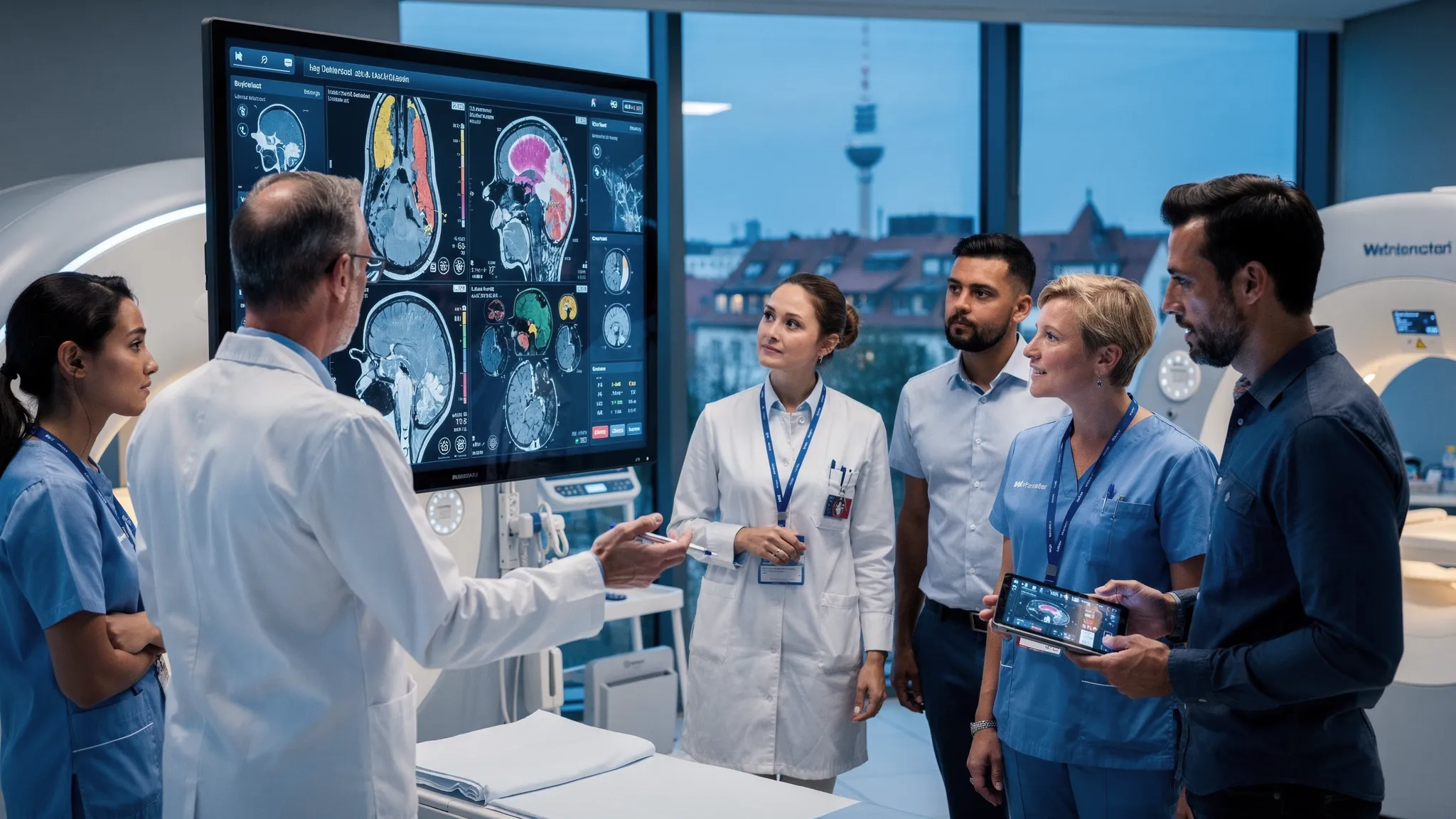
Germany AI Medical Imaging Companies: Hiring Landscape 2026
Germany has become one of Europe’s most competitive markets for AI medical imaging companies hiring, not only because of demand for diagnostic efficiency and clinical workflow automation, but because the country combines deep engineering capability with a mature medtech and regulatory environment.
For CTOs, HR Directors, and operators scaling product and clinical deployment teams, “Germany” is rarely a single hiring market. It is a set of distinct hubs (Munich, Berlin, Heidelberg, Hamburg, and the broader Siemens ecosystem around Erlangen) plus a labour framework where works councils (Betriebsrat) can materially shape timelines, organisational design, and change management.
This guide focuses on the 2026 talent landscape: where the AI medical imaging talent sits, which companies compete for it, what compensation looks like, and how to run a Germany-ready hiring process for production-grade computer vision, MRI reconstruction, and EU MDR compliance roles.
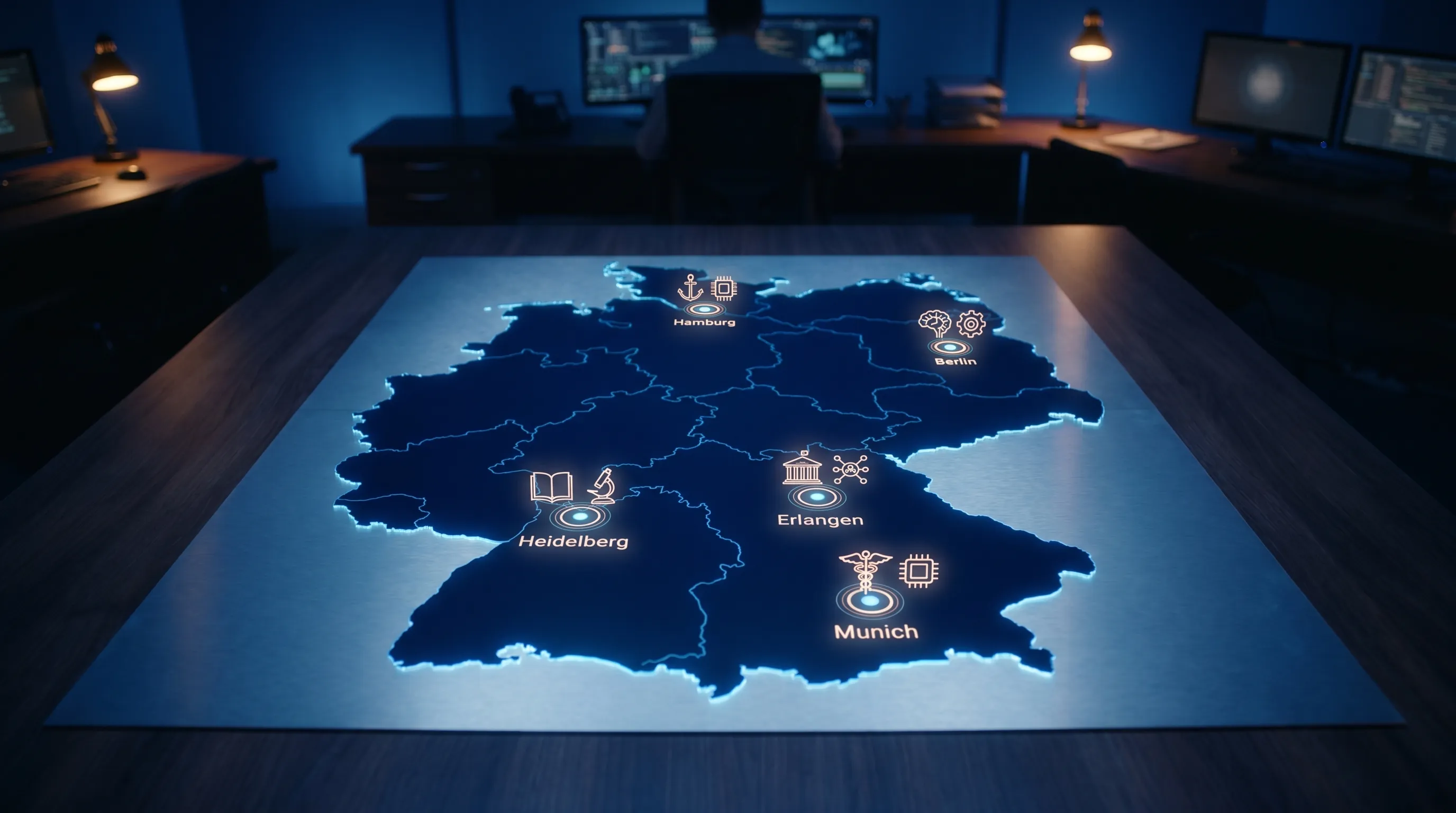
Why Germany Is a Key AI Medical Imaging Market in Europe
Germany remains the anchor market for European medtech by revenue and installed base, which matters because AI imaging products typically scale through hospital networks, OEM partnerships, and procurement-heavy sales cycles, not just bottom-up SaaS adoption. Several structural factors keep Germany central in 2026:
First, Germany’s industrial and engineering depth is unusually relevant to medical imaging AI. Many of the skills needed for robust imaging pipelines (signal processing, embedded optimisation, systems engineering, safety culture) are common in German advanced manufacturing and automotive, and increasingly portable to regulated healthcare.
Second, Germany’s AI medical imaging ecosystem spans both large incumbents and specialist ventures. Siemens Healthineers provides an enterprise-grade gravity well, while Berlin and Munich continue to attract AI founders building radiology workflow, diagnostics, and reconstruction products.
Third, Germany’s talent pipeline is reinforced by world-class technical universities and research institutions that feed ML, computer vision, and medical physics capabilities into industry. In practice, teams hiring “AI for radiology” in Germany are recruiting from a blended pool of ML engineers, imaging specialists, MLOps/platform engineers, and regulatory professionals who understand EU MDR and increasingly the EU AI Act.
Finally, regulatory and clinical infrastructure is a competitive advantage. Companies building software as a medical device (SaMD) for imaging rely on mature quality systems, clinical evaluation capability, and documentation discipline. Germany’s ecosystem has comparatively strong coverage in these areas, supported by a long-standing medical device industry and dense hospital landscape.
For market context and investment positioning, Germany Trade & Invest provides a useful overview of the medical technology sector and why it attracts international entrants (GTAI medical technology overview). For regulatory baselines, the European Commission’s references for EU MDR and IVDR remain the core starting point.
Summary: Germany is a high-signal market where technology improving healthcare is backed by scale buyers, engineering depth, and regulatory maturity. The upside is meaningful if you can hire scarce hybrid talent. The constraint is operational complexity, particularly around labour structure and compliance.
Key AI Medical Imaging Companies in Germany
Germany’s competitive hiring environment is shaped by a mix of global medtech, venture-backed AI studios, and specialist software companies with deep hospital integration footprints. The following organisations are commonly referenced when mapping AI medical imaging talent competition.
Siemens Healthineers (Erlangen)
Siemens Healthineers operates at enterprise scale across imaging hardware, software, and clinical workflows, and has developed AI-enabled applications such as its AI-Rad Companion suite. For hiring dynamics, Siemens functions as both a competitor and a training ground: engineers and product leaders with “real hospital deployment scar tissue” often have some connection to large OEM environments.
Merantix Healthcare (Berlin)
Merantix Healthcare is part of Berlin’s AI venture ecosystem, building and supporting AI solutions in healthcare, including radiology-focused products. In hiring terms, Berlin-based platforms often compete on mission, speed, and product ownership, while still needing to match the German market’s expectations on stability, benefits, and process quality.
mint Medical (Heidelberg)
mint Medical (Heidelberg) is known for oncology-focused imaging software and treatment planning workflows, which are adjacent to, and often overlapping with, imaging AI product roadmaps. Heidelberg’s life sciences cluster makes it a natural magnet for clinical-facing product talent and regulatory-aware engineers.
Smart Reporting (Munich)
Smart Reporting (Munich) is associated with structured radiology reporting and workflow enablement. Teams building structured reporting or AI-assisted reporting compete heavily for clinical product managers, integration engineers (DICOM, HL7/FHIR), and solutions architects with hospital deployment experience.
DeepSpin (Munich)
DeepSpin (Munich) focuses on MRI reconstruction AI, a niche where talent requirements skew toward advanced ML, medical imaging physics intuition, optimisation, and production constraints around inference speed and model robustness.
Precisis (Heidelberg)
Precisis operates in radiation therapy planning and related AI applications, where the interface between imaging, dosimetry, and clinical safety is particularly tight. Hiring tends to require candidates who can navigate both algorithms and regulated delivery.
Jung Diagnostics (Hamburg)
Hamburg-based Jung Diagnostics is part of the northern cluster of digital health and diagnostics initiatives. Hamburg can be attractive for candidates who want impact without Munich-level cost-of-living pressure, though senior ML talent density is typically lower than Munich or Berlin.
What this ecosystem means for hiring: senior candidates are not only choosing between “companies”, they are choosing between risk profiles (startup vs incumbent), product maturity (research vs production), and regulatory load (prototype vs certified SaMD). As a result, ai medical imaging recruitment Germany in 2026 is less about posting roles and more about targeted market mapping and outreach to passive candidates.
German AI Medical Imaging Talent Landscape in 2026
In 2026, the German market remains attractive for building imaging AI teams, but it is not “deep” in the profiles that matter most: people who can take models from research to validated clinical product under EU MDR constraints.
Strong engineering supply, but hybrid scarcity
Germany produces strong engineering talent through institutions such as TU Munich, RWTH Aachen, and Heidelberg University. This supply shows up in solid fundamentals: software engineering discipline, systems thinking, and a culture of reliability.
The challenge is that AI medical imaging teams need hybrid capability:
- Computer vision and deep learning plus strong software engineering
- Medical imaging context (DICOM, modality constraints, acquisition artefacts)
- MLOps and observability to support clinical-grade deployment
- Documentation, traceability, and validation discipline aligned with EU MDR and, increasingly, the EU AI Act
This combination is rare, which is why germany medical imaging ai engineer jobs often stay open longer than comparable “generic ML” roles.
Automotive and industrial AI talent pivoting to healthcare
A visible trend across Germany is experienced AI talent from automotive and industrial automation exploring healthcare applications. The move is logical: computer vision, sensor fusion, safety constraints, and quality systems have meaningful overlap.
However, hiring managers should not assume immediate readiness. The transition typically requires onboarding in clinical context (who signs off, what “clinical evidence” means, how post-market surveillance changes engineering priorities). The best converts are candidates who are curious, documentation-comfortable, and willing to work cross-functionally with clinical and regulatory colleagues.
EU MDR and IVDR enforcement drives regulatory demand
EU MDR and IVDR are fully in force, and they continue to create acute demand for regulatory professionals and regulatory-aware engineering leaders. Regulatory roles are not “paperwork”, they shape architecture and release management. In practice, a high-quality Regulatory Affairs Manager can accelerate product readiness by preventing avoidable rework and aligning clinical, quality, and engineering early.
Works council (Betriebsrat) implications for scaling
Germany’s works council structures can materially affect hiring and org changes: job levelling, role changes, reorganisations, and certain policy decisions can require consultation or agreement. For international companies used to US or UK operating models, this is often the biggest process surprise.
The practical implication is that talent acquisition planning in Germany needs earlier coordination with HR, legal counsel, and (where applicable) employee representation. For scale-ups entering Germany, a “fast hiring” plan that ignores Betriebsrat realities typically becomes a “slow onboarding” outcome.
Salary expectations are high
Germany remains one of the highest-compensation markets in continental Europe for senior AI and engineering talent, especially in Munich. This interacts with cost-of-living and with global remote competition, where German candidates can access non-German employers.
Summary: Germany’s base engineering supply is strong, but the bottleneck is hybrid talent that combines production ML, imaging domain depth, and EU MDR discipline. Automotive-to-healthcare transitions expand the pool, but require structured onboarding. Works council dynamics and high compensation expectations need to be designed into the hiring plan from day one.
Hiring Challenges Specific to Germany
The German labour market is predictable, but it is procedural. For AI medical imaging companies, that combination is both a risk-control advantage and a speed constraint.
Works council and Betriebsrat requirements
Where a works council exists, hiring and organisational changes can require formal steps that do not exist in many other markets. This can affect:
- Role definition and grading
- Internal transfers and reorganisation plans
- Policy changes that influence working time, performance management, and tooling
It does not make hiring “impossible”, but it makes it less improv-friendly. It also increases the value of Germany-experienced HR leadership.
Strict labour law and notice periods
German employment contracts and notice periods often create longer lead times for senior hires, particularly those leaving established employers. In practice, you can identify and select the candidate quickly, but your start date may still be months away. This matters for scale-ups trying to hit product and regulatory milestones.
German language requirements for specific roles
Not every role requires German, but some do. Clinical-facing roles, hospital implementation, certain regulatory or documentation-heavy positions, and functions interacting with German hospital stakeholders may strongly prefer (or require) professional German fluency.
A recurring mistake is treating German as “nice to have” and then discovering late that implementation success depends on it.
EU MDR and IVDR expertise remains scarce
Regulatory capability is a constrained resource across Europe. In Germany, it is still scarce relative to demand, and candidates who have shipped certified products are heavily competed for. This affects Regulatory Affairs, Quality, Clinical Affairs, and technical leaders who can operate under Design Controls.
International entrants face extra compliance layers
For US or non-EU companies opening a German subsidiary, the complexity stacks up quickly: entity setup, employment law, works council considerations (where applicable), and the operational reality of EU MDR-aligned development.
The result is that cross-border hiring execution is not a “nice add-on”. It becomes a core capability if you want to hire fast without creating compliance or retention risk.
Summary: Germany-specific constraints are mainly procedural, not talent-quality related. Works council and notice periods slow time-to-start more than time-to-select. EU MDR and German-language requirements can narrow the pool late if they are not designed into the hiring brief.
AI Medical Imaging Salary Benchmarks in Germany (2026)
Public salary data for niche medtech AI roles is limited, and compensation varies sharply by company stage, certification maturity, and equity participation. The ranges below are practical, indicative gross annual base salary bands seen in the German market for 2026 hiring conversations, designed for benchmarking, not as fixed rules.
Senior ML and computer vision engineers (permanent)
Mid-level (roughly 3 to 6 years, production exposure) often benchmarks:
- Berlin: EUR 75k to 100k base
- Munich: EUR 85k to 115k base
- Heidelberg/Hamburg: EUR 75k to 105k base
Senior (roughly 6 to 10+ years, owns model delivery and deployment) often benchmarks:
- Berlin: EUR 95k to 130k base
- Munich: EUR 110k to 150k base
- Heidelberg/Hamburg: EUR 95k to 135k base
Principal/Staff (technical leadership, architecture, validation, mentoring) frequently moves beyond EUR 150k in Munich for the right profile, especially where regulated delivery experience is proven.
Regulatory Affairs and EU MDR specialist compensation
For EU MDR-heavy teams (SaMD, imaging workflows, clinical evaluation), typical bands are:
- EU MDR Specialist / Senior RA Associate: EUR 80k to 110k
- Regulatory Affairs Manager (EU MDR/IVDR exposure): EUR 100k to 140k
- Head of Regulatory/Quality leadership roles: often EUR 140k+, depending on scope and prior certification outcomes
City differences: Munich vs Berlin vs Heidelberg vs Hamburg
Munich remains the highest-cost hub and typically commands the highest salaries, particularly for senior engineering and leadership roles. Berlin offers a large candidate base, but senior regulated imaging profiles are still scarce. Heidelberg tends to index higher for specialised medtech profiles relative to its size due to the life sciences cluster. Hamburg often sits between Berlin and Heidelberg for pay, with fewer “pure imaging AI” candidates but good generalist engineering and health tech presence.
Contractor rates vs permanent compensation
Contracting is used for speed, specialised short-term deliverables, or bridging gaps during certification milestones. Typical contractor day rates for experienced profiles:
- Senior ML/CV Engineer: EUR 700 to 1,000 per day
- MLOps / Platform for ML in regulated settings: EUR 750 to 1,100 per day
- Regulatory / Quality consulting (highly variable): often EUR 800+ per day for proven EU MDR delivery experience
Misclassification and compliance risk should be assessed carefully when using contractors, especially for long-running, manager-led work.
Germany vs UK and Netherlands (directional comparison)
In 2026, Germany’s senior AI compensation is generally comparable with the UK outside London, and often slightly below top-of-market London packages for elite profiles, but Germany can be more competitive on stability and benefits. Compared with the Netherlands, German base salaries for senior AI roles are often similar or somewhat higher in Munich, while Amsterdam can compete for certain profiles. The more decisive differences are usually tax, equity norms, and time-to-start.
How to Hire AI Medical Imaging Talent in Germany
A high-performing Germany hiring plan balances speed with governance. The teams that win in 2026 are rarely the ones with the most interviews, they are the ones with the clearest success profile, fastest decision cadence, and strongest credibility with passive candidates.
Navigating Works Council and Betriebsrat Requirements
If a works council exists (in your organisation or your target employer), assume that process discipline is part of the hiring strategy.
Practical steps:
- Align role scope, title, and levelling early with HR and legal
- Pre-define what can change post-hire (responsibilities, reporting lines, pay band) without creating friction
- Build realistic time-to-start assumptions (notice periods, internal approvals)
This is especially important for leadership roles and roles that will drive organisational change (VP Engineering, Head of AI, Head of Product).
Accessing the Munich and Berlin Talent Ecosystems
Munich and Berlin behave like different markets.
Munich is the medtech and deep engineering hub, with strong candidates in medical imaging, MRI reconstruction, and safety-minded engineering. The trade-off is fierce competition and higher compensation expectations.
Berlin is the startup and AI cluster, where you can find ML talent and product builders, but you often need to screen more carefully for regulated-delivery experience and for willingness to operate inside documentation-heavy environments.
For both cities, the most effective route to senior talent is targeted market mapping and direct outreach. This is where retained search and specialist networks outperform generic advertising, because many high-fit candidates are not applying to roles.
EU MDR Regulatory Talent, where to find it
EU MDR capability clusters around:
- Established medtech and diagnostics companies
- Notified-body-adjacent networks and consultants
- Product teams that have already shipped certified software
When hiring regulatory talent, do not over-index on “years of experience”. Prioritise evidence of outcomes: submissions supported, audits navigated, quality systems implemented, and cross-functional influence.
If you want a deeper view of the structural scarcity behind these profiles, Optima’s market report on the shortage is a relevant reference point: AI medical imaging talent shortage in Europe (2026 report).
Compensation strategy for the German market
Two common failure modes in Germany are:
- Under-pricing the role and assuming “mission” will compensate
- Over-complicating the package, then losing candidates to simpler, faster offers
A practical German compensation strategy includes:
- Clear base salary bands and levelling before first interview
- A defined position on remote/hybrid expectations (Germany is not uniform here)
- A credible story on regulatory maturity and product roadmap (candidates screen for delivery reality)
- Offer speed: pre-scheduled decision meetings and pre-approved comp envelopes
For role-specific evaluation design (especially DICOM-aware and production-grade assessment), see Optima’s technical hiring guide: Hiring computer vision engineers for medical imaging.
Case Study / Scenario
A US-based medical imaging company decided to establish a German subsidiary in Munich to accelerate European partnerships and build an EU MDR-ready product and engineering footprint.
The hiring mandate was four business-critical roles:
- VP Engineering (site and delivery leadership)
- 2 Senior ML Engineers (computer vision and production delivery)
- Regulatory Affairs Manager (EU MDR-focused)
The constraint was speed with compliance: all roles needed to be closed within 65 days, while building a hiring process aligned with German labour requirements and realistic notice-period expectations.
Optima’s approach followed a Germany-specific execution plan:
First, we ran a targeted German AI medical imaging talent mapping exercise across Munich and adjacent hubs, identifying passive candidates with demonstrated experience in production ML, imaging domain depth, and regulated delivery.
Second, we executed confidential outreach and calibrated the shortlist against a practical evidence standard (delivery outcomes, DICOM and integration exposure, cross-functional behaviour with clinical and regulatory stakeholders).
Third, we ensured the process design was works council-aware (where applicable) and that offer mechanics and start dates reflected German contractual norms.
Timeline and outcome:
- First placement completed in 37 days
- All four roles closed inside the 65-day window
- The client maintained full alignment with German labour requirements and onboarding readiness, reducing downstream risk during the first 90 days
Frequently Asked Questions
Which German cities have the strongest AI medical imaging talent pools? Munich and the broader Bavaria ecosystem are typically strongest for deep engineering, medtech adjacency, and imaging-specialist profiles (including MRI reconstruction and enterprise deployment experience). Berlin has a large AI startup cluster and a broader ML talent base, but you often need more rigorous screening for regulated medical device delivery. Heidelberg over-indexes for life sciences, oncology workflow, and medtech product talent relative to its size. Hamburg can be effective for diagnostics and digital health profiles, though the “pure imaging AI” pool is usually smaller.
How does the Betriebsrat affect AI medical imaging hiring in Germany? A Betriebsrat (works council) can influence the pace and structure of hiring indirectly by shaping job levelling, internal policy, and organisational change processes. It is most relevant when you are building or scaling a German entity, changing job scopes post-hire, or implementing policies that affect working conditions. For hiring leaders, it means you need earlier alignment between HR, legal, and business stakeholders, plus more disciplined role definitions and offer mechanics. It rarely blocks hiring outright, but it can slow time-to-start if ignored.
How does EU MDR affect the demand for regulatory talent in Germany? EU MDR increases demand because it forces medical imaging AI teams to build quality systems, clinical evaluation evidence, traceability, and post-market surveillance into the operating model. That elevates the importance of Regulatory Affairs, Quality, and Clinical Affairs roles, and creates demand for regulatory-aware engineering and product leaders. In Germany, this demand is amplified by the density of medtech companies and hospital deployment activity. Candidates who have supported successful certification outcomes, audits, and cross-functional delivery are particularly scarce.
How do German AI medical imaging salaries compare to the UK and Netherlands? In 2026, Germany is among the highest-paying markets in continental Europe for senior AI and ML roles, with Munich often pricing at or near top-of-market levels. UK compensation can exceed German levels for elite profiles in London, but outside London the gap narrows and Germany can be more competitive on stability and benefits. The Netherlands, particularly Amsterdam, competes well for international talent, but Munich frequently benchmarks higher for senior engineering and leadership roles. In all three markets, the biggest variance is often equity norms and time-to-start, not just base salary.
Which AI medical imaging companies are based in Germany? Germany hosts a broad mix of global medtech and specialist AI companies in medical imaging. Notable names include Siemens Healthineers (Erlangen), Merantix Healthcare (Berlin), mint Medical (Heidelberg), Smart Reporting (Munich), DeepSpin (Munich), Precisis (Heidelberg), and Jung Diagnostics (Hamburg). Beyond these, there is a wider ecosystem of digital health and imaging-adjacent ventures, plus research spin-outs. For hiring leaders, this density increases competition for the same hybrid profiles, especially those with proven delivery in regulated environments.
Conclusion & Strategic Positioning
Germany is Europe’s largest medtech market and one of its most operationally complex hiring environments for AI medical imaging. The opportunity is clear: dense clinical buyers, strong engineering supply, and an ecosystem where regulated delivery is a realistic path. The constraint is equally clear: hybrid talent scarcity, high compensation expectations, and procedural realities such as notice periods and works council dynamics.
For companies scaling teams in Munich, Berlin, Heidelberg, or Hamburg, the fastest path to predictable hiring outcomes in 2026 is to treat recruitment as a market-mapping and execution problem, not a posting problem. That means targeting passive candidates, benchmarking compensation early, and running a Germany-ready process that anticipates EU MDR and labour requirements.
Optima Search Europe supports AI medical imaging companies hiring in Germany through specialist search, market mapping, and cross-border hiring execution, particularly for senior and business-critical roles where process speed and regulatory credibility matter. To discuss a specific hiring plan or benchmark a role, you can start at Optima Search Europe.

