
Hiring Computer Vision Engineers for Medical Imaging
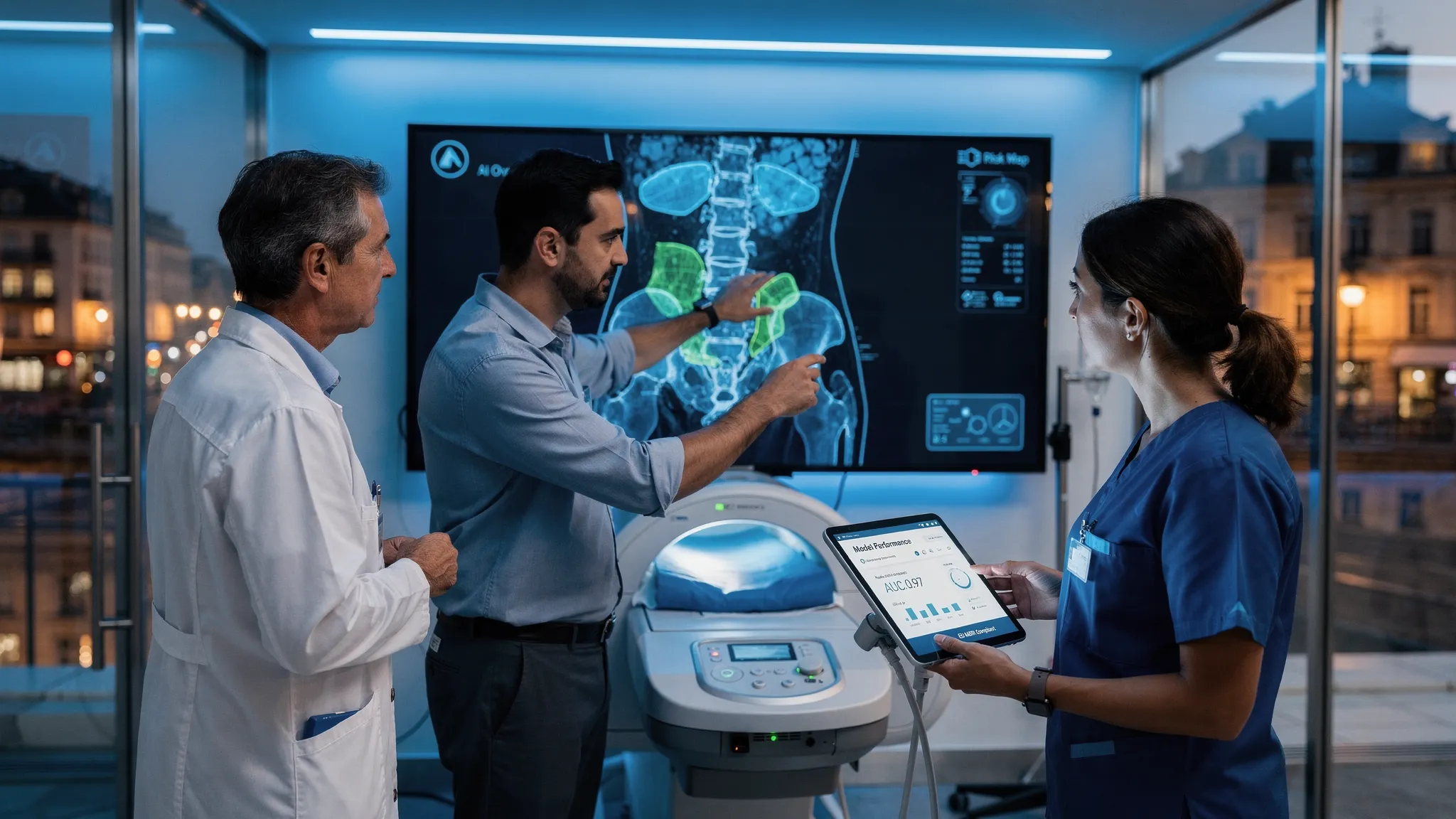
Hiring Computer Vision Engineers for Medical Imaging: Europe 2026 Guide
Medical imaging AI has moved from “promising prototype” to regulated product roadmaps. In 2026, many medtech teams are now hiring against two hard constraints at once: a genuine computer vision talent shortage, and a regulatory environment (including the EU AI Act) that demands stronger validation, documentation, and post market monitoring for high risk systems.
That combination changes the brief. Computer vision engineer medical imaging recruitment is no longer only about finding someone who can train a segmentation model. It is about building a team that can ship clinically credible performance, handle DICOM pipelines safely, work with radiologists and pathologists, and stand up to audit scrutiny.
This guide is written for CTOs, HR Directors, COOs, founders, and board stakeholders at companies building innovative health technologies across Europe. It explains what to hire for, how to assess, where to source, and what compensation looks like across key European hubs.
What Does a Computer Vision Engineer Do in Medical Imaging?
A computer vision engineer in medical imaging builds, validates, and deploys machine learning models that interpret clinical images. The “image” might be a CT series, a mammogram, an ultrasound clip, a retinal scan, or a whole slide image in digital pathology. The goal can range from triage and workflow acceleration to assisting diagnosis, quantification, and treatment planning.
In practice, the role sits at the intersection of deep learning and clinical reality. It requires strong applied ML engineering plus an understanding of the imaging modality, ground truth creation, and the downstream constraints of healthcare delivery.
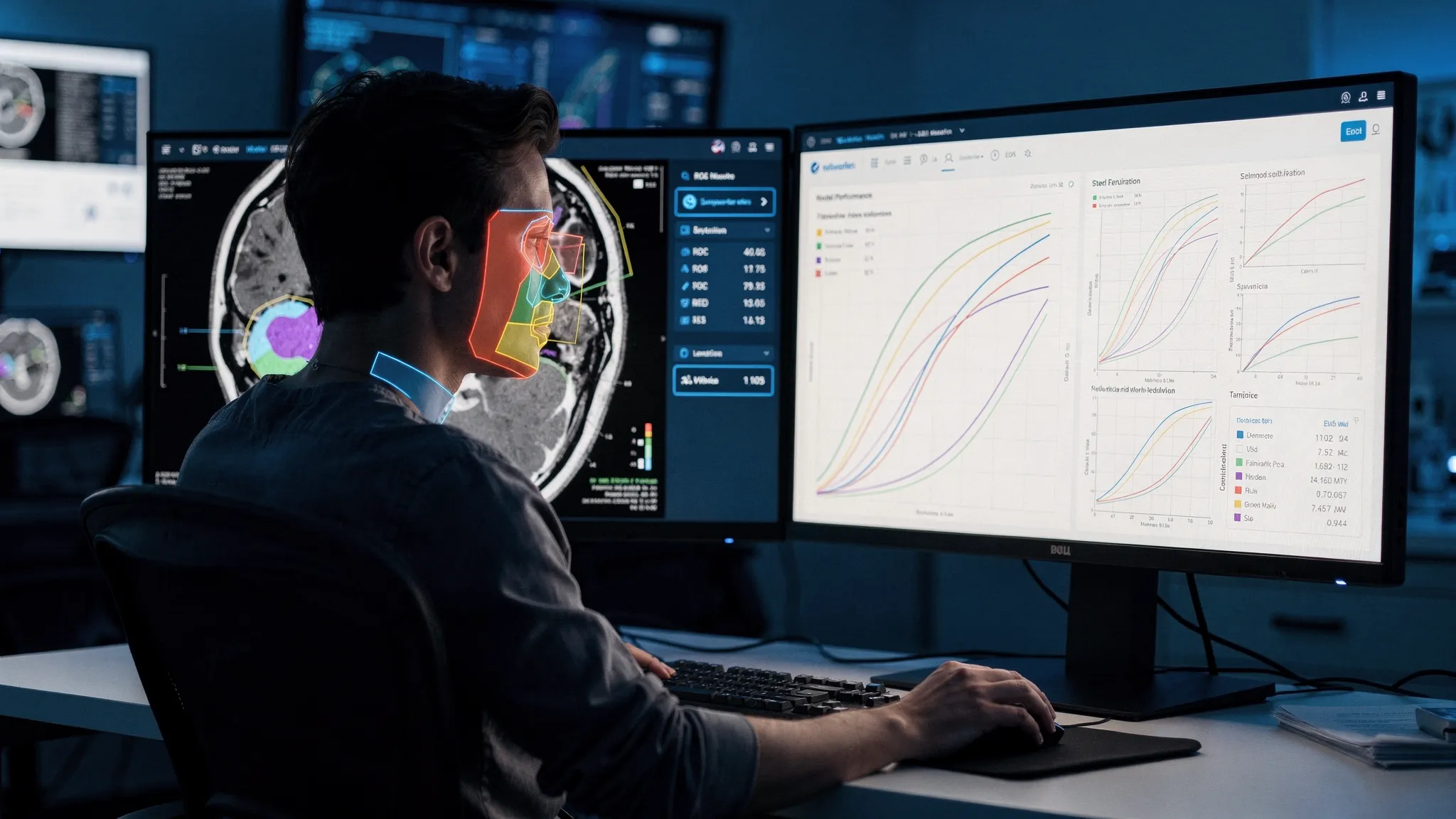
Typical problem areas (by clinical domain)
- Radiology (AI radiology): CT and MRI lesion detection, organ segmentation, triage classification, volumetrics, follow up comparison.
- Digital pathology: tumour detection, grading assistance, cell instance segmentation, slide level classification with very large images.
- Ophthalmology: retinal disease detection from fundus images or OCT.
- Oncology diagnostics: multi modality workflows, response assessment, quantitative biomarkers.
Key responsibilities you should expect
Most medical imaging computer vision specialists spend time across four categories:
- Data and pipeline engineering: ingesting and cleaning imaging data, handling annotation workflows, building reproducible training sets.
- Model development: segmentation, object detection, anomaly detection, classification, and sometimes self supervised learning.
- Clinical validation: designing evaluation protocols, addressing bias and generalisability, working with clinical stakeholders.
- Deployment and monitoring: productionising models, establishing drift monitoring, supporting QA, documenting model changes.
Common technical stack in 2026
The tooling is broadly ML standard, but with healthcare specific components:
- Deep learning: PyTorch, TensorFlow
- CV tooling: OpenCV, augmentation libraries, experiment tracking
- Medical imaging libraries: MONAI, SimpleITK, NiBabel
- Standards and interoperability: DICOM standards (see DICOM), HL7, FHIR (see HL7 FHIR)
- Data security and governance: access control, audit logs, privacy by design, GDPR aligned handling
Computer Vision Engineer vs AI Research Scientist vs Medical Imaging Engineer
Misalignment here is a common cause of failed searches.
A computer vision engineer is typically accountable for building working systems, owning performance in real data, and contributing to deployment readiness. They translate research into robust pipelines.
An AI Research Scientist is often measured on novelty and exploration. In med imaging, this can be valuable for cutting edge architectures, but it can also stall delivery if the company really needs a production oriented builder.
A Medical Imaging Engineer may skew toward imaging physics, reconstruction, acquisition systems, PACS integration, or workflow tooling. They can be critical in product delivery, but they are not necessarily the person training and validating deep learning models.
Medical imaging companies often need a blend. The hiring decision is about which gap is most business critical right now.
Summary: A computer vision engineer in medical imaging ships applied deep learning into clinical workflows. The role combines model development with DICOM aware pipelines, clinical validation discipline, and deployment readiness, and it differs meaningfully from pure research or imaging systems engineering.
Why Computer Vision Engineers for Medical Imaging Are So Hard to Find
This market is tight even before you add the healthcare constraint. In Europe, demand has expanded across medical devices, providers, pharma adjacent diagnostics, and platform companies. At the same time, senior CV talent is heavily competed for by autonomous driving, robotics, industrial AI, and consumer platforms.
The talent pool is genuinely narrow
The strongest candidates usually sit in one of these buckets:
- CV engineers who have already shipped in healthcare and understand clinical validation.
- CV engineers from adjacent sectors (automotive, robotics, industrial inspection) with strong fundamentals who can ramp on domain.
- Academic profiles (PhD or post doc) with medical imaging publications, but sometimes less production experience.
The first bucket is small, the second requires careful assessment and onboarding, and the third can be brilliant but needs role clarity.
Domain knowledge is not optional
Medical imaging AI is high consequence. Data is messy, labels are expensive, and “accuracy” alone is not a sufficient metric. You need people who can reason about:
- What constitutes ground truth (and how uncertain it is)
- Sensitivity, specificity, calibration, and subgroup performance
- Clinical workflow constraints and failure modes
This is why computer vision engineer healthcare recruitment tends to be slower than general CV hiring.
Regulation adds a new layer (EU AI Act plus medical device regimes)
Many medical imaging solutions fall under medical device regulation, and AI systems used in healthcare are frequently treated as high risk under the EU AI Act’s risk based framework (see the European Commission’s AI Act overview).
Even when a CV engineer is not writing regulatory submissions, they increasingly need to build with auditability in mind: traceable datasets, reproducible training runs, model cards style documentation, and risk controls.
For a deeper hiring specific angle, Optima has covered this in How the EU AI Act impacts AI hiring.
Competition and compensation have shifted
Many medtech businesses still benchmark pay against traditional medical device engineering. Candidates benchmark against global ML markets. This is a key reason that teams struggle to hire computer vision engineers medical imaging Europe even with strong missions.
It also drives retention risk when offers do not reflect market reality.
Summary: Hiring is hard because few candidates combine production grade CV skill with clinical validation instincts and DICOM fluency. Regulation (EU AI Act and medical device requirements) increases the bar, while compensation expectations increasingly track the wider tech market.
Key Skills to Look for When Hiring
The best hires are not defined by one framework or one publication. They are defined by evidence that they can build reliable models under healthcare constraints.
Core computer vision and deep learning skills
For medical imaging, prioritise depth in the specific tasks your product depends on:
- Image segmentation: U Net variants, transformer based segmentation, uncertainty estimation, annotation noise handling
- Classification and detection: class imbalance strategies, hard negative mining, robust evaluation
- 3D volumetric analysis: 3D CNNs, patch based training, memory optimisation, multi slice context
- Anomaly detection: when labels are sparse or ambiguous
Ask for proof of trade offs made in real projects, not only a list of architectures.
Healthcare specific capabilities that separate “good” from “hire”
A medical imaging computer vision specialist in Europe typically needs some combination of:
- DICOM processing: series handling, metadata awareness, modality quirks, de identification workflows
- Clinical evaluation discipline: reader study awareness, dataset shift reasoning, external validation planning
- Experience supporting regulated development: documentation habits, traceability, change control
If the candidate has shipped into PACS, RIS, or hospital IT environments, that is a strong signal, even if they were not the integration owner.
Framework and tooling expertise that matters in practice
It is reasonable to expect comfort with:
- PyTorch (often dominant in research to product pipelines)
- TensorFlow (still common in some production stacks)
- MONAI for medical imaging workflows
- SimpleITK for preprocessing and image IO pipelines
- OpenCV for classical CV utilities and augmentation
The skill is less “knowing the library” and more “building reproducible pipelines with versioned data and clear evaluation”.
Regulatory awareness (not necessarily regulatory ownership)
Most CV engineers will not be regulatory leads, but in 2026 they should be able to collaborate with QA/RA and product on:
- EU MDR concepts and the practical meaning of evidence and intended use (see EU MDR overview)
- EU AI Act concepts for high risk systems (risk management, documentation, transparency)
- US pathway awareness for global companies (for example the FDA 510(k) process, see FDA 510(k))
Collaboration skills (clinicians are stakeholders, not “users”)
Strong candidates can explain model behaviour to non ML stakeholders and can work constructively with:
- Radiologists, pathologists, and clinical researchers
- Data annotation teams
- Product and engineering leadership
Look for candidates who can translate clinical questions into measurable modelling tasks.
Summary: The hiring bar is a combination of core CV depth (segmentation, detection, 3D), healthcare specifics (DICOM, validation methods), and practical engineering habits (reproducibility, monitoring). Regulatory awareness and clinician collaboration increasingly determine success.
How to Structure the Hiring Process for Computer Vision Engineers
In this niche, process design is not HR admin. It is a competitive advantage.
A strong computer vision ml engineer medtech hiring process reduces time to hire without lowering the bar. It also increases acceptance rates because senior candidates expect a high signal evaluation.
Define the Role Precisely, CV Generalist vs. Medical Imaging Specialist
Start by deciding which of these you are truly hiring:
A CV generalist who can ramp into healthcare, typically stronger if you have an internal domain expert and a mature dataset.
A medical imaging specialist who has already worked with DICOM and clinical validation, typically required when regulatory timelines are tight or the team is small.
Clarify the core outputs in the first 90 days. For example:
- Deliver a segmentation baseline with a defined evaluation protocol
- Build a DICOM ingestion and de identification pipeline
- Establish model monitoring and drift detection assumptions
When the deliverable is vague, you attract broad applicants and disappoint the shortlist.
Technical Assessment: What to Test and How
A good assessment reflects the actual work. For senior candidates, avoid puzzle style interviews.
In medical imaging CV hiring, a pragmatic assessment mix is:
- Portfolio deep dive: one project, one dataset, one failure mode, one lesson. Ask for decisions made under constraints.
- Work sample: a bounded task like designing an evaluation protocol, reviewing a flawed training pipeline, or proposing a segmentation approach for a specified modality.
- Systems thinking interview: how they would productionise, monitor drift, and manage model updates.
If you use a take home task, keep it time bounded and avoid requiring access to real clinical data.
Regulatory and Domain Knowledge Screening
You are not testing whether they can write a technical file. You are screening for the right instincts.
Good prompts include:
- How would you validate generalisability across hospitals or scanners?
- What would you document to support auditability of a training run?
- How do you handle label uncertainty or inter reader variability?
Candidates who have shipped in healthcare can usually answer with concrete examples. Candidates who have not can still perform well if they reason clearly.
Compensation Benchmarking Before Going to Market
Do this before publishing the job or starting outbound.
If your comp is anchored to traditional medtech, you will lose senior CV profiles to non healthcare offers. This is especially true for candidates in hubs like London, Munich, Amsterdam, and Paris, where they can also interview with AI infrastructure and platform companies.
If you need guidance beyond base salary, also benchmark bonus, equity, remote policy, and research time allowances.
Moving Fast, Why Top CV Candidates Withdraw from Slow Processes
Senior candidates often run multiple processes in parallel. The pattern that kills searches is:
- Long gaps between stages
- Unclear decision ownership
- Late compensation surprises
If you want to hire computer vision talent healthcare Europe, treat speed as part of quality. The strongest candidates interpret slow hiring as a signal of internal misalignment.
Summary: The best hiring processes are role specific, assessment led, and fast. Define whether you need a ramping generalist or a medical imaging specialist, test real work (including validation thinking), screen for regulatory instincts, align compensation early, and remove time gaps that trigger candidate drop off.
Computer Vision Engineer Salary Benchmarks in Medical Imaging (2026)
Compensation varies widely by seniority, domain depth, and whether the candidate is closer to research or production. Medical imaging experience and regulated product exposure typically command a premium.
The ranges below are indicative 2026 base salary benchmarks seen across European hiring markets for medical imaging focused CV engineers. They should be adjusted for total compensation (bonus, equity), remote policy, and scarcity in your exact niche.
- Junior CV Engineer (0 to 2 years): UK typically £45k to £65k, EU typically €45k to €70k.
- Mid level CV Engineer (2 to 5 years): UK typically £65k to £95k, EU typically €70k to €105k.
- Senior CV Engineer (5 to 8+ years): UK typically £95k to £135k, EU typically €105k to €150k.
- Lead or Principal CV Engineer: UK typically £125k to £175k+, EU typically €140k to €200k+.
Geographic differences (high level)
UK, Germany, and the Netherlands often price closer to “tech market” levels for senior talent, especially in top hubs.
France can be slightly more conservative on base in some markets, but strong candidates with medical imaging depth still command top of band offers.
Eastern Europe can be cost effective for strong ML engineering, but senior medical imaging specialists with regulated product exposure are increasingly rare and internationally competed for.
Contractor and freelance day rates
For short term delivery (for example data pipeline stabilisation, segmentation baselines, or audit documentation), contractor hiring is common.
In 2026, typical European day rates for CV engineers in medical imaging often land in the following broad bands:
- Mid level contractors: €450 to €700 per day
- Senior contractors: €700 to €1,000+ per day
Rates rise when the scope includes production deployment, clinical validation design, or regulated documentation support.
Summary: Medical imaging CV compensation has converged toward the wider ML market. Expect mid to senior roles to price like tech, especially in UK, Germany, and the Netherlands. Medical imaging and regulatory exposure adds a premium, and contractor rates can be attractive for targeted delivery.
Where to Find Computer Vision Engineers for Medical Imaging in Europe
Sourcing is not only about geography. It is also about adjacent talent pools. Many strong candidates sit in automotive CV, industrial inspection, or robotics, and can pivot into healthcare when the mission, data maturity, and role design are credible.
A specialist approach to computer vision engineer executive search Europe typically combines hub based targeting with passive candidate outreach.

UK (Oxford, Cambridge, London)
The UK remains a strong ecosystem for academic to commercial translation. Oxford and Cambridge feed talent into imaging startups and health AI ventures. London provides access to broader ML engineering and platform talent, including candidates who can bring production maturity into medtech.
If you are hiring in the UK and selling into EU markets, plan early for cross border regulatory context and customer readiness.
Germany (Munich, Berlin)
Germany offers a large applied CV talent base, historically influenced by automotive and industrial automation. Munich is particularly strong for computer vision, while Berlin adds startup density and international hiring. There is an opportunity to attract candidates who want to pivot from autonomous systems to healthcare impact.
Netherlands (Amsterdam, Nijmegen)
The Netherlands has an established AI radiology ecosystem and strong engineering density. Amsterdam provides broad tech competition, while Nijmegen is notable for health and imaging adjacent networks.
France (Paris, Grenoble)
France offers deep research capability, and Grenoble in particular has strong technical roots in imaging adjacent fields. Paris provides startup and enterprise pull, but the hiring process often benefits from clear role framing and fast decision cycles.
Eastern Europe
Eastern Europe continues to produce strong ML engineering talent with experience in remote first teams. For medical imaging, the key is to validate healthcare specific competence and ensure secure data access models. Increasingly, European medical imaging companies use Eastern Europe for engineering capacity, but still source the most domain specific specialists from Western hubs.
Summary: The strongest sourcing strategy is hub led and adjacent sector aware. UK, Germany, the Netherlands, and France provide dense pipelines, while Eastern Europe supports scaling and remote delivery. Passive outreach is often required because many qualified candidates are not actively applying.
Case Study / Scenario
The scenario below is representative of how specialist search is often executed in this niche. Details are anonymised and simplified, but the timeline and constraints reflect real market dynamics.
Client profile
An Oxford based digital pathology company (Series A) building a cancer detection platform. The company had strong clinical advisors and early traction, but needed to accelerate model delivery to maintain a funding linked roadmap.
Hiring challenge
Hire two Senior Computer Vision Engineers with:
- Segmentation depth
- DICOM familiarity (including ingestion and preprocessing constraints)
- Comfort collaborating with clinical stakeholders
Target timeline: both hires within 50 days.
Search and selection approach
The execution plan combined three tracks:
- European CV talent mapping focused on digital pathology, radiology adjacent CV, and medical imaging research groups.
- Passive outreach to senior candidates not actively applying, with a message anchored on scope, data maturity, and clinical access.
- Assessment calibration aligning the CTO, product lead, and a clinical stakeholder on what “good” looks like (segmentation evidence, validation thinking, reproducibility habits).
Timeline
- Role calibration and market map: week 1
- Passive outreach and screening: weeks 1 to 3
- Technical and domain assessment: weeks 2 to 6
- First placement in 34 days
- Second hire completed within the 50 day target window
Outcome
Both roles were closed within the roadmap window, reducing delivery risk on the next clinical milestone and avoiding the need to pause model development while the market search continued.
Summary: When the brief is narrow (segmentation plus DICOM plus clinical collaboration), success depends on upfront calibration, passive candidate access, and an assessment process that tests medical imaging reality, not generic ML trivia.
Frequently Asked Questions
What skills should a computer vision engineer have for medical imaging roles? A strong candidate combines core CV capability (segmentation, detection, classification, and often 3D volumetric analysis) with healthcare specific competence. In practice, that means comfort working with DICOM data, handling messy clinical labels, and designing validation that reflects real clinical workflows. Look for evidence of reproducible pipelines, dataset versioning, and awareness of bias and generalisability across sites or scanners. The best hires can communicate clearly with radiologists or pathologists, and they understand that clinical performance and auditability matter as much as model architecture.
How is hiring a CV engineer for medical imaging different from hiring for other industries? The biggest difference is that performance is judged under clinical constraints, not only benchmark datasets. Data access, privacy, annotation uncertainty, and multi site generalisation are daily realities. The role also intersects more directly with regulation, including EU MDR and, increasingly, EU AI Act expectations for high risk systems. That changes what “good engineering” looks like: traceability, documentation, and validation discipline become part of the job. Finally, stakeholder management is different because clinicians are not just end users, they shape requirements and validation.
How long does it take to hire a computer vision engineer for a medical imaging company? For mid to senior roles in Europe, a realistic end to end timeline is often 6 to 12 weeks, depending on seniority, compensation alignment, and how niche the domain requirements are. Searches tend to run longer when companies require prior regulated medical imaging experience but benchmark pay against non tech medtech roles. You can shorten timelines by defining the role precisely, using work sample assessments, and keeping stage gaps minimal. Many teams also need passive candidate outreach, because qualified medical imaging specialists are frequently employed and not applying.
What salary should I offer a computer vision engineer in European medtech? Salary depends on seniority, location, and whether you require proven medical imaging delivery. In 2026, mid level CV engineers in Europe often sit around €70k to €105k base (or £65k to £95k in the UK), while senior profiles commonly move into €105k to €150k (or £95k to £135k). Principal level candidates can exceed these bands, particularly in strong hubs and when regulatory or clinical validation experience is required. Benchmark total compensation, not only base, and align your offer before going to market.
How does the EU AI Act affect computer vision roles in medical imaging? Medical imaging AI is frequently treated as high risk, which increases the emphasis on risk management, documentation, transparency, and post market monitoring. Practically, that means CV engineers are more involved in building auditable workflows: data provenance, reproducible training runs, documented evaluation protocols, and structured approaches to model updates. It also increases cross functional collaboration with QA/RA, security, and product teams. Companies that ignore this shift often struggle later with rework, delayed validation, or friction in regulatory readiness, so hiring for “governance capable engineers” is becoming a competitive advantage.
Conclusion & Strategic Positioning
In 2026, medical imaging companies are competing in a market where strong engineers can choose between sectors. The hardest profiles to secure are those who combine deep computer vision capability with real medical imaging delivery experience, DICOM fluency, and an instinct for clinical validation. Regulation reinforces that trend, because EU AI Act and medical device expectations pull engineering teams into higher standards of documentation, traceability, and monitoring.
For leadership teams, the practical takeaway is clear: hiring success comes from precision. Define whether you need a CV generalist who can ramp or a medical imaging specialist, assess on realistic work, benchmark compensation against the tech market, and move fast enough to keep senior candidates engaged.
If you are building an AI radiology or digital pathology team and need to hire computer vision engineers medical imaging Europe, a specialist partner can materially reduce time to hire by accessing passive candidate pools and running a search process that reflects both engineering and healthcare realities. Optima Search Europe supports cross border, business critical searches in digital health and AI, with tailored search and selection approaches for niche technical roles. To explore a scoped search, you can start at Optima Search Europe or review their perspective on governance driven hiring in How the EU AI Act impacts AI hiring.

