
eCommerce Technology Hiring Trends Europe

eCommerce Technology Hiring Trends Europe (2026 Guide)
European commerce teams are building far more than online shops. In 2026, competitive advantage increasingly comes from digital commerce platforms, resilient online retail infrastructure, and the engineering capability to iterate quickly across channels, markets, and payment methods.
For CTOs, Heads of eCommerce, and Digital Commerce Directors, that shift is changing hiring priorities. Demand is moving away from generalist “web developers” and towards specialists who understand headless commerce, cloud-first architecture, payment systems, product data, and the analytics layer that ties customer experience to revenue.
This guide breaks down the most important ecommerce technology hiring trends Europe leaders should factor into workforce planning, from role definitions and salary competitiveness to the practical realities of cross-border hiring. If your stack overlaps with modern SaaS applications, you may also find it useful to benchmark against the broader software talent market in Optima’s SaaS & Software Recruitment Agency Europe guide.
Why eCommerce Technology Talent Demand Is Growing
Rapid growth of online commerce
Even when consumer demand fluctuates, digital commerce remains a core revenue channel. More categories have shifted online, and customer expectations for speed, personalisation, and reliability keep rising. That puts sustained pressure on engineering teams responsible for availability, conversion performance, checkout reliability, and post-purchase journeys.
Expansion of digital marketplaces
Brands increasingly sell via marketplaces (in addition to their own storefronts), and marketplaces themselves are becoming more sophisticated. This creates hiring demand for engineers who can manage complex integrations, catalogue synchronisation, pricing rules, and multi-channel order flows.
Omnichannel retail strategies
Omnichannel is now an operational requirement, not a marketing initiative. “Buy online, pick up in store”, real-time inventory, unified customer profiles, and consistent promotion logic all require robust systems design, integration engineering, and data quality discipline.
Cloud-based commerce infrastructure
Commerce infrastructure has become more cloud-native and API-driven. Teams need skills across cloud infrastructure, observability, security, and scalability, plus the ability to operate vendor-heavy ecosystems (commerce engine, PIM, CMS, CDP, search, payments).
Summary (what this means for hiring): In 2026, eCommerce technology hiring is rising because growth is driven by platform capability, not just marketing spend. Marketplace expansion and omnichannel delivery increase integration load, and cloud-native expectations raise the bar for reliability, security, and performance engineering.
Key Drivers Behind eCommerce Technology Hiring
Shift to headless commerce
Headless architectures separate the storefront from the commerce backend, enabling faster iteration and multi-touchpoint experiences (web, app, in-store, kiosks, social). The hiring implication is clear: you need stronger frontend engineering, API design, and integration skills, plus engineers comfortable working across multiple services.
Growth of SaaS commerce platforms
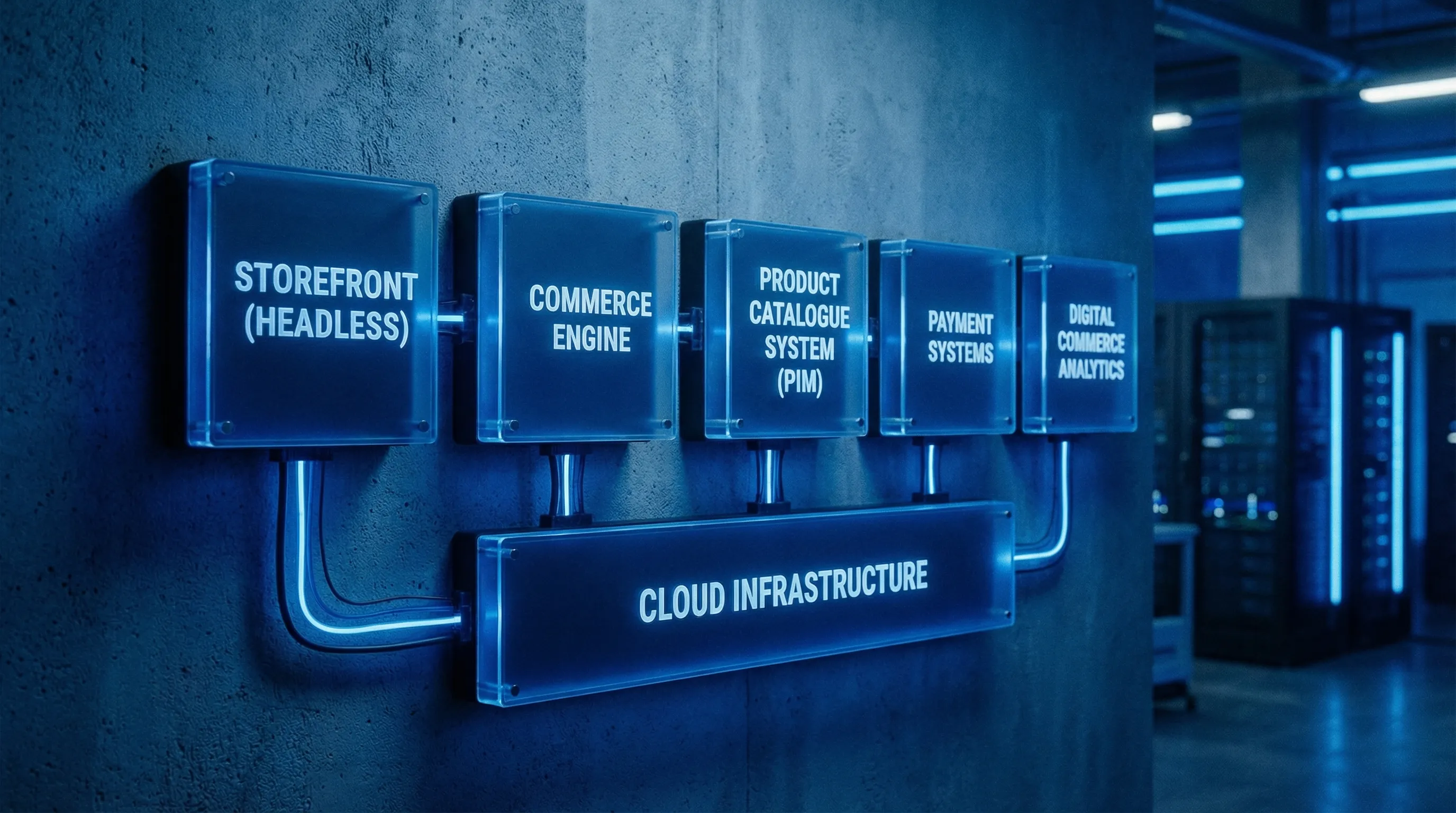
Many organisations now run a “composable” stack of SaaS platforms rather than a single monolith. Typical components include customer experience platforms, product catalogue systems (often PIM), search and merchandising, payments, fraud tooling, and analytics.
This creates ecommerce technology recruitment demand for engineers who can evaluate vendors, integrate reliably, and avoid building brittle point-to-point connections.
Demand for scalable digital infrastructure
Traffic spikes (campaigns, seasonal events, major drops) still break poorly designed systems. Hiring is increasingly driven by resilience: caching strategies, queueing, rate limiting, incident response, and cost-aware scaling. That is pushing more commerce teams to hire platform engineers and SRE-influenced profiles.
Personalised shopping experiences
Personalisation depends on event tracking, data pipelines, experimentation, and the ability to activate insights inside CX and marketing tools. As a result, commerce teams are hiring more analytics and data talent directly into eCommerce engineering.
Market insights to track in 2026 (practical signals, not hype):
- Integration capability is becoming a core differentiator. The fastest teams treat payments, tax, inventory, and fulfilment integrations as “product-grade” assets with monitoring and clear ownership.
- Checkout reliability is a board-level KPI. As payment options fragment (local methods, wallets, BNPL), payment specialists are getting pulled into product discussions earlier.
- Commerce and data are converging. Digital commerce analytics is no longer an afterthought, it increasingly influences roadmap prioritisation and merchandising decisions.
Key eCommerce Technology Roles Companies Hire
Below is a practical role map you can use when planning ecommerce engineering hiring. Titles vary across companies, so focus on outcomes and skill boundaries.
- eCommerce developers: Generalists who build and maintain core commerce functionality across frontend and backend. In 2026, the most effective profiles understand APIs, performance, and at least one major commerce platform ecosystem.
- Frontend commerce engineers: Specialists in storefront performance, UX, and conversion-critical journeys (PDP, PLP, cart, checkout). Often strong in modern frameworks and headless storefront tooling.
- Backend commerce developers: Engineers focused on commerce services, APIs, order management flows, promotions, and integrations to PIM, ERP, CRM, and fulfilment systems.
- Platform engineers: Own cloud infrastructure, CI/CD, observability, security posture, and scaling. Critical for reliable releases during peak periods.
- Payment system specialists: Engineers who manage payment orchestration, local payment methods, fraud tooling, chargeback logic, and checkout resilience.
- Commerce data analysts: Analysts who connect behavioural data to commercial outcomes, enabling experimentation, funnel analysis, cohort work, and customer segmentation tied to revenue.
Salary Overview for eCommerce Technology Roles
Salary competitiveness is now one of the biggest constraints in hire ecommerce developers Europe projects, especially for candidates who combine platform expertise with modern architecture skills.
The ranges below are indicative 2026 base salaries seen across Europe for permanent hires. They vary significantly by location, company maturity, and whether the role is platform-specific (for example, deep experience in a particular commerce or payment ecosystem).
Junior developer salaries
Junior commerce engineers are typically hired for implementation work, bug fixing, and incremental feature delivery under strong senior guidance. In many Western European markets, junior base salaries commonly sit in the €35k to €55k range, with higher figures in top-tier cities and better-funded teams.
Mid-level engineer compensation
Mid-level engineers are expected to own features end-to-end, ship reliably, and contribute to architectural decisions. Across major hubs, mid-level commerce engineering salaries often fall around €55k to €90k, with London frequently benchmarking higher when roles demand strong platform experience and stakeholder management.
Senior commerce engineer salaries
Senior commerce engineers are paid for leverage: system design, reliability, mentoring, and delivery under uncertainty. In 2026, senior-level bases commonly land in the €90k to €130k+ band in Western Europe, with the upper end typically tied to high growth firms, platform scale, and leadership expectations.
Differences across European markets
A useful rule: Western European hubs pay for proximity to product and commercial leadership, while several Eastern European markets offer strong engineering depth with different cost structures. However, for scarce profiles (headless architects, payments specialists, platform engineers), cross-border competition is narrowing the gap.
Startup vs enterprise compensation
Enterprises may offer more predictable total packages (pension, allowances, stability), while startups and scaleups often compete with equity and accelerated scope. For candidates, the decision frequently hinges on delivery autonomy, tech debt reality, and the credibility of the growth story.
Major European Hubs for eCommerce Technology Talent
Where you hire changes what you can hire. The European tech ecosystem is not one market, it is a portfolio of local ecosystems with different talent densities, compensation norms, and candidate motivations.
Germany
Germany offers strong engineering depth and a large base of commerce and industrial software talent. Berlin is often attractive for product-minded engineers, while Munich tends to skew towards enterprise-grade engineering and higher compensation. For commerce stacks tied to payments, logistics, or compliance-heavy industries, Germany is often a strategic sourcing market.
Netherlands
The Netherlands is consistently strong for international, English-speaking product teams, particularly around Amsterdam and Utrecht. Many candidates have experience operating cross-border commerce, making the market valuable for roles that require multi-market rollouts, localisation, and complex stakeholder coordination.
United Kingdom
London remains a premium market for senior commerce engineering, architecture, and digital leadership. It is also a competitive hiring environment where speed and clarity matter. Employers that win here typically offer a crisp mandate, a modern stack, and a realistic compensation plan.
Eastern Europe
Eastern Europe remains a key region for engineering capacity, including strong backend and platform skills. For organisations willing to build cross-border teams, it can be an effective lever for scaling delivery, particularly when paired with strong architecture standards and clear ownership models.
Nordics
Nordic markets often offer mature engineering practices, strong product orientation, and high standards around reliability and security. They can be excellent for platform engineering and data-centric commerce roles, though compensation expectations can be correspondingly high.
Hiring Challenges in eCommerce Technology
The hiring story in 2026 is not just “talent shortage”. It is a specificity problem.
Specialised platform experience
Teams often need candidates who understand a particular ecosystem (a commerce engine, a PIM, a payment gateway, a search tool). But the best engineers do not always brand themselves by platform, they brand themselves by outcomes. Hiring processes that screen too narrowly can miss high performers who can ramp quickly.
Competition for experienced engineers
Commerce engineers are being hired not only by retailers, but also by payment providers, logistics platforms, and SaaS vendors supporting retail. That increases counteroffers and increases time-to-close.
Rapid technology evolution
Headless, composable, and API-first patterns are still maturing. Many companies are simultaneously modernising legacy systems while expanding features. Candidates who have done this before are rare, and they typically expect senior compensation and strong influence on architecture.
Integration complexity
The stack is bigger and more interconnected, which creates failure modes that are hard to diagnose. Integration-heavy commerce environments need engineers who can think in systems and design for observability, not just “make the API call work”.
Candidate evaluation difficulty
Generic coding tests rarely predict success in commerce engineering. The best assessments are scenario-based: checkout failure analysis, integration design, catalogue change propagation, or incident response simulations.
How to Structure an eCommerce Technology Hiring Strategy
A strong hiring strategy is a product decision. It starts with architecture clarity and ends with offer acceptance.
Define Commerce Platform Architecture
Start by writing down your actual architecture, including:
- Your digital commerce platforms (commerce engine, CMS, PIM, CDP if relevant)
- Core integrations (ERP, fulfilment, tax, payments)
- Data flow (events, analytics, experimentation)
This is the foundation for role design. Without it, you will recruit for “full-stack” but evaluate for “integration architect”, and mis-hires will follow.
Evaluate Technical Stack Experience
For ecommerce platform developers Europe hiring, define what “stack experience” means.
If a candidate has not used your exact platform, decide what you will accept as adjacent experience (similar headless patterns, API-first platforms, comparable payment orchestration). The best teams make this explicit, which widens the pool while keeping standards.
For organisations hiring across software roles beyond commerce, Optima’s How to Hire SaaS Developers in Europe can help calibrate what “transferable platform experience” looks like across modern SaaS environments.
Assess Platform Integration Skills
Integration skill is often the make-or-break capability in 2026. Build an assessment that tests:
- Designing robust integrations (retries, idempotency, monitoring)
- Data quality and reconciliation thinking (catalogue and order data)
- Security and compliance awareness (payments, customer data)
Avoid long take-home projects. Use a 60 to 90 minute architecture scenario with clear success criteria.
Align Compensation With Market Reality
If you want senior candidates who can handle headless migrations, payment reliability, and cloud scaling, budget accordingly.
A practical approach is to benchmark two roles, not one:
- The role you wrote (what you hope to hire)
- The role you actually need (what will break if it goes wrong)
When those differ, compensation must follow the second role.
Reduce Time-to-Hire Through Specialized Recruitment
In commerce engineering, speed is not about rushing assessment, it is about removing delays between stages.
Set a weekly cadence, pre-book interview slots, and decide who owns decisions. A specialist partner in ecommerce developer recruitment Europe can also accelerate access to passive candidates, particularly for platform-heavy profiles.
Recruitment vs In-House Hiring for eCommerce Technology Teams
In-house TA teams can hire well in commerce, especially when roles are repeatable and the employer brand is strong. However, many commerce engineering hires are not repeatable. They are “needle” hires, where the candidate pool is small and already employed.
Here is where external ecommerce technology recruitment support tends to add value:
Access to passive commerce engineers
Top performers often do not apply to job adverts. They respond to credible outreach that demonstrates an informed understanding of the stack, the mandate, and the engineering constraints.
Cross-border talent sourcing
Cross-border recruitment is increasingly normal for commerce teams, especially when you need a specific mix (payments plus cloud, headless plus data). A search-led approach can map talent across hubs and engage candidates where you do not yet have a brand presence.
Faster hiring processes
A specialised recruiter can reduce time-to-hire by pre-qualifying against real technical criteria, not keyword matches. That is particularly useful when engineering leaders are stretched across delivery and incident management.
Executive-level digital commerce leadership
As stacks become more complex, leadership roles (Head of Engineering for Commerce, Director of Platform, VP Digital) increasingly require blended capability across product, architecture, and commercial outcomes. Executive search methods are often better suited to these hires than standard pipelines.
For teams hiring across commerce-adjacent functions like product, it can also help to align your evaluation approach with broader product hiring best practice, see Optima’s Product Manager Recruitment for SaaS Companies.
Frequently Asked Questions
What is eCommerce technology recruitment? eCommerce technology recruitment is the process of sourcing and hiring engineers and specialists who build, integrate, and operate digital commerce platforms. It goes beyond hiring “website developers” and focuses on platform capability: headless storefronts, commerce engines, payment systems, product catalogue systems, cloud infrastructure, and analytics. In 2026, the role is increasingly cross-functional because commerce stacks are composable and vendor-heavy. Strong recruitment in this space means defining clear success outcomes, assessing integration and reliability skills, and building a hiring process that matches the scarcity of experienced candidates.
What skills do eCommerce developers need? The skills depend on your architecture, but most modern eCommerce developers need strong API literacy, data modelling discipline (products, orders, customers), and an understanding of performance and availability. For headless commerce, frontend engineers should be strong in modern frameworks, performance optimisation, and experimentation. Backend commerce developers benefit from integration patterns (idempotency, retries, observability), and familiarity with product and order lifecycle complexity. Increasingly, employers also value security awareness (especially around payments and customer data) and the ability to collaborate with product, marketing, and operations.
How much do eCommerce engineers earn in Europe? Compensation varies by country, city, and the scarcity of the skill mix. As a directional guide for 2026, junior roles often benchmark around €35k to €55k base, mid-level roles around €55k to €90k, and senior roles around €90k to €130k+ in many Western European markets. London, Amsterdam, Munich, and some Nordic hubs can sit above these bands for high-impact roles, particularly payments, platform engineering, and headless architecture. Eastern European markets can be more cost-efficient, but top candidates still command premium packages.
Why is hiring commerce developers difficult? Hiring is difficult because commerce engineering is specialised. Many candidates can build features, but fewer have experience operating complex online retail infrastructure under peak load, handling payment failures, or managing integrations across PIM, ERP, fulfilment, and CX platforms. The stack also changes quickly, so “years of experience” is less predictive than having shipped similar migrations or solved similar reliability problems. Finally, competition comes from multiple directions: retailers, marketplaces, payment providers, and SaaS vendors all target the same scarce profiles.
How long does it take to hire eCommerce engineers? Timelines depend on seniority and specificity. For common profiles with a clear brief, a well-run process can close in 4 to 8 weeks. For scarce profiles (payments specialists, headless architects, platform engineers), it is common for searches to take longer, particularly if stakeholders are not aligned or interview loops are slow. The biggest controllable factor is time between stages. Teams that pre-book interviews, use structured assessments, and make decisions quickly tend to win more offers, even when they are not the highest-paying employer.
Should companies use recruitment agencies to hire eCommerce technology talent? It depends on role criticality and market scarcity. If you are hiring repeatable roles and have a strong inbound pipeline, in-house hiring may be sufficient. If you need niche platform experience, must hire confidentially, or are building a cross-border team, a specialist recruiter can help by mapping the market, engaging passive candidates, and validating technical fit earlier. The most effective partnerships are outcome-led: the recruiter understands your stack, your constraints, and your success metrics, then builds a targeted search rather than relying on generic applicant flow.
Conclusion
In 2026, the direction of travel is consistent across Europe: eCommerce technology stacks are becoming more composable, more integration-heavy, and more dependent on cloud reliability and data quality. That raises the value of specialised engineers, especially those who can operate headless commerce, build resilient payment systems, manage product catalog systems, and translate digital commerce analytics into platform improvements.
For leaders, the strategic takeaway is simple. If digital commerce is a growth engine, then recruitment is a platform decision. Teams that define architecture clearly, assess integration capability, and align compensation to market reality will hire faster and reduce delivery risk.
If you are planning eCommerce engineering hires across Europe and want a market-informed view of availability, compensation expectations, and cross-border options, Optima Search Europe publishes sector-specific insights, including a broader Marketing Technology Recruitment Guide that complements commerce hiring where MarTech and CX platforms overlap.

