
European AI Healthcare Diagnostics Market 2026
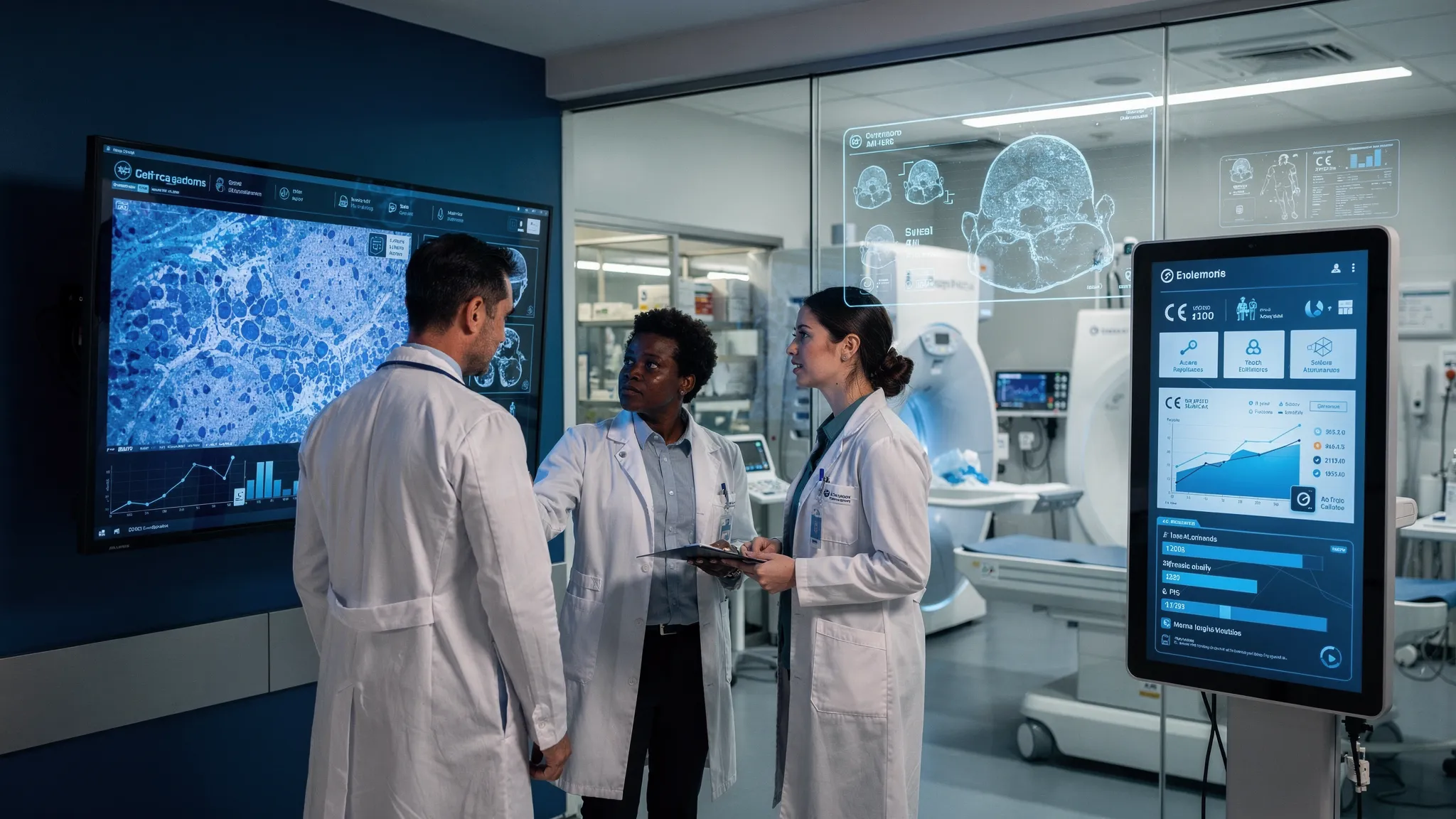
AI healthcare diagnostics has moved from experimental deployment into a commercial, regulatory and hiring battleground. For founders, CTOs, COOs and HR leaders, the European AI healthcare diagnostics market in 2026 is no longer defined only by model performance. It is defined by CE marking readiness, clinical validation, data access, hospital adoption, reimbursement pathways, and the ability to hire scarce talent across borders before competitors do.
In this report, AI healthcare diagnostics refers to software, platforms and models that support the detection, classification, triage or prediction of disease using clinical data. That includes AI radiology, digital pathology, computational pathology, oncology AI diagnostics, molecular diagnostics with AI, liquid biopsy analytics and companion diagnostics linked to treatment selection.
The opportunity is large, but the market is becoming more selective. European diagnostics companies are competing for the same machine learning engineers, clinical AI specialists, regulatory affairs leaders and scientific executives while navigating EU MDR, IVDR, EUDAMED requirements and the EU AI Act. Hiring strategy is now part of market strategy.
Overview of the European AI Healthcare Diagnostics Market
The European AI healthcare diagnostics market in 2026 is concentrated, well-funded and increasingly specialised. Optima Search Europe’s 2026 market mapping identifies 45+ early-stage AI diagnostics companies founded from 2020 onwards across Europe, with additional established players expanding into adjacent diagnostic categories.
The UK remains the leading European market, with 20+ qualifying companies and Cambridge emerging as the most important AI diagnostics hub. Cambridge benefits from proximity to research hospitals, the University of Cambridge, the Cancer Research UK ecosystem, genomics infrastructure, and a deep pool of technical and clinical talent. London remains important for capital, commercial leadership and NHS partnerships, but Cambridge is where many of the highest-value scientific and computational pathology conversations are happening.
France is the clearest challenger. Paris has developed a strong AI-first healthcare ecosystem, with companies such as Bioptimus and Raidium attracting attention across foundation models, medical imaging and diagnostic AI infrastructure. France is also becoming more attractive for scientific leadership because of its public research base, hospital data networks and state-backed AI ambition.
Spain’s AI diagnostics market is smaller but strategically important. Barcelona is developing a focused oncology diagnostics cluster, particularly around non-invasive diagnostics, liquid biopsy and tumour classification. Belgium, led by Leuven, is building depth in brain imaging and oncology AI. The Netherlands has fewer early-stage companies in this specific 2020 onwards cohort, but its AI radiology base, especially around Nijmegen and Amsterdam, remains one of the most mature in Europe.
The capital environment is also relevant. Global digital health investment reached approximately $29.7B in 2025, and European diagnostics companies captured a meaningful share where they could demonstrate clinical utility, regulatory readiness and a credible path into hospital workflows.
Structured summary: The ai healthcare diagnostics Europe market overview is defined by 45+ early-stage companies, UK and Cambridge leadership, rapid French momentum, Barcelona’s oncology focus, and growing ecosystems in Belgium and the Netherlands. Commercial winners in 2026 are those combining clinical evidence, regulatory execution and specialist hiring capacity.
Key Sub-Sectors Driving Growth and Hiring Demand
Digital pathology and computational pathology
Digital pathology is the fastest-growing sub-sector in Europe because pathology departments face capacity pressure, digitisation is accelerating, and oncology workflows increasingly depend on image-rich tissue analysis. Computational pathology companies need rare hybrid profiles: machine learning engineers who understand whole-slide imaging, pathologists who can work with product teams, and regulatory specialists who can document model performance for clinical use.
Hiring demand is strongest for Head of Computational Pathology, Senior ML Engineer, Clinical Validation Lead and Digital Pathology Scientist roles. The pipeline is thin because digital pathology has not yet produced a large senior labour market in the way radiology AI has.
AI radiology
AI radiology is the largest established sub-sector in the European AI medical imaging market 2026. It has clearer buyer familiarity, more hospital pilots, and more mature workflows around triage, detection and reporting support. The UK, Netherlands and France are particularly active, with demand for DICOM-aware engineers, MLOps specialists, clinical product managers and regulatory-aware ML leaders.
Radiology AI companies are now moving from single-use-case tools to broader platforms. That shift increases demand for scalable infrastructure, integrations, cybersecurity, post-market monitoring and product leaders who understand hospital procurement.
Oncology AI diagnostics
Oncology AI diagnostics is becoming a strategic centre of gravity for Cambridge, Barcelona and Paris. The strongest companies are not simply building classifiers; they are connecting pathology, radiology, genomics, treatment response and patient stratification. That creates demand for scientific leaders who understand cancer biology, AI model development, biomarker validation and clinical trial environments.
Molecular diagnostics with AI
The UK and Spain are especially strong in molecular diagnostics with AI, including liquid biopsy, genomics-driven diagnostics and early detection. IVDR implementation is a major hiring driver here because companion diagnostics and molecular tests face demanding evidence and conformity requirements.
AI-powered drug discovery with companion diagnostics
AI drug discovery platforms are increasingly intersecting with diagnostics through patient selection, biomarker discovery and companion diagnostics. This is a cross-cutting opportunity rather than a standalone hiring category. Companies need leaders who can speak to pharma partners, diagnostic validation, data science and regulatory affairs simultaneously.
Structured summary: Digital pathology is the fastest-growing hiring market, AI radiology is the most established, oncology AI diagnostics is clustering around Cambridge, Barcelona and Paris, and AI-enabled molecular diagnostics is increasingly shaped by IVDR and liquid biopsy growth.
European AI Diagnostics Market by Country
United Kingdom
The UK leads with 20+ qualifying AI diagnostics companies in Optima’s 2026 mapping. Cambridge is dominant because it combines oncology research, AI talent, academic credibility and access to clinical collaborators. London remains essential for investors, commercial teams and NHS engagement. The NHS can be complex to sell into, but partnerships with NHS trusts continue to matter for validation and adoption.
France
France has 9 qualifying companies and is moving quickly toward AI-first diagnostics. Paris is the centre of gravity, with Bioptimus and Raidium illustrating the market’s ambition in foundation models and radiology AI. French companies benefit from strong engineering schools, national AI investment and access to research hospitals, but senior go-to-market and regulatory talent remains competitive.
Belgium
Belgium has 6 qualifying companies, with Leuven acting as the key cluster. The country’s strength lies in brain imaging, oncology AI and university-linked research. Belgium is attractive for companies needing access to multilingual scientific talent and cross-border Benelux hiring, but the absolute size of the talent pool is limited.
Spain
Spain has 5 qualifying companies, with Barcelona clearly dominant. Its specialisation is non-invasive oncology diagnostics, molecular diagnostics and liquid biopsy-adjacent platforms. Spain can offer strong scientific talent and competitive employment economics, but senior AI diagnostics executives are still more likely to be sourced cross-border.
Netherlands
The Netherlands has 3 qualifying companies in the early-stage cohort, but a stronger established AI radiology base than the number suggests. Nijmegen and Amsterdam are the main hubs, supported by medical imaging research, hospital networks and a pragmatic commercial culture. The Netherlands is also a frequent target for UK and US companies building European regulatory or clinical operations.
Italy
Italy has 2 qualifying companies, with Milan and Bologna showing activity in cardiac and vascular imaging AI. The Italian market is earlier-stage than the UK, France or Netherlands, but it offers strong clinical research capability and specialist engineering pockets. Cross-border leadership hiring is often required for scaling.
Structured summary: The UK has the deepest ecosystem, France is scaling fastest, Belgium and the Netherlands offer specialist imaging depth, Spain is building an oncology diagnostics cluster, and Italy remains selective but clinically credible. No single country has enough talent depth to support the whole market alone.
EU Regulatory Landscape Shaping the Market in 2026
Regulation is now one of the defining forces in the digital health diagnostics market Europe. The EU MDR and IVDR framework has changed how diagnostic software, companion diagnostics and in vitro diagnostic platforms prepare for CE marking, clinical evidence, quality management and post-market surveillance.
For AI diagnostics companies, EU MDR enforcement is creating compliance-driven demand for regulatory affairs leaders, quality managers, clinical evaluation specialists and technical documentation experts. Companies that treated regulation as a late-stage activity are now exposed to product delays and investor concern.
IVDR implementation is particularly important for molecular diagnostics, liquid biopsy and companion diagnostics. These companies need leaders who understand analytical performance, clinical performance, notified body engagement and evidence generation. The gap between a strong scientific platform and a market-ready diagnostic product is often a regulatory gap.
The EU AI Act is adding another layer. Diagnostic AI systems that influence patient care are generally treated as high-risk. From August 2026, the Act becomes an operational hiring issue, including risk management, data governance, human oversight, logging, transparency and technical documentation. Medical device AI teams also need to track the interaction between AI Act obligations and MDR or IVDR conformity routes.
EUDAMED requirements add further operational burden. The EUDAMED database increases the need for accurate registration, traceability and ongoing regulatory maintenance. This creates a form of regulatory Darwinism: companies with compliance infrastructure scale; companies without it lose time, capital and commercial credibility.
Structured summary: EU MDR, IVDR, the EU AI Act and EUDAMED are converting regulatory readiness into a hiring priority. The most resilient AI diagnostics companies are building regulatory capability early, not waiting until clinical validation or commercial launch.
Talent Landscape Across the European AI Diagnostics Ecosystem
The talent shortage diagnostics companies face in 2026 is acute because the most important roles sit between disciplines. A general machine learning engineer is not enough. A hospital-experienced radiology AI engineer, pathology-aware ML scientist or IVDR-literate regulatory leader is materially harder to find.
The scarcest profiles are ML engineers with healthcare domain knowledge. These candidates need to understand model development, clinical datasets, bias, validation, privacy, interoperability and deployment constraints. In medical imaging, knowledge of DICOM, PACS workflows and annotation quality is a major differentiator.
Regulatory affairs talent is even scarcer relative to demand. EU MDR, IVDR and the EU AI Act are creating an acute gap for people who can translate regulation into product, engineering and quality systems. The most valuable candidates are not simply regulatory administrators; they are strategic operators who can protect CE marking timelines.
Digital pathology scientists are emerging as a new critical role. There is no established pipeline at scale because the market is young. Companies often need to source from pathology research groups, computational biology, image analysis teams or adjacent medical imaging environments.
Clinical AI specialists are structurally scarce. These are the people who can bridge clinicians, engineers, product teams and regulators. Cambridge, Paris, Amsterdam and Barcelona are competing for the same small pool, and US companies are increasingly entering that competition with remote-first packages.
For a deeper role-level view of this shortage, see Optima’s report on the AI medical imaging talent shortage in Europe.
Structured summary: The European healthtech diagnostics landscape 2026 is constrained by hybrid talent scarcity. ML, regulatory, pathology, clinical AI and validation expertise are all in short supply, and cross-border hiring is no longer optional for serious scale-ups.
Hiring Trends Across European AI Diagnostics Companies
Series A and Series B AI diagnostics companies are scaling at the same time. Many raised during the 2024 to 2025 funding cycle and are now converting capital into product, regulatory, clinical and commercial hires. That has created a perfect storm for talent competition.
Executive search for CSOs, CTOs and VP Regulatory Affairs is increasingly moving to retained search. These roles are business-critical, confidential and too specialised for advert-led hiring. Passive candidates are often already employed by competitors, research hospitals, medtech companies or pharma-linked diagnostics groups.
Cross-border hiring is becoming standard. A UK company may source regulatory leadership from the Netherlands, computational pathology talent from France, ML engineering from Germany, and commercial leadership from the US or Switzerland. The practical challenge is not only finding candidates, but aligning compensation, notice periods, relocation, remote models and employment compliance.
Compensation inflation is accelerating. For senior profiles in AI diagnostics, Optima is seeing 15% to 25% year-on-year increases in competitive packages where candidates combine AI, healthcare and regulatory experience. Salary benchmarking must now be done by sub-sector and role type, not only by country.
US AI diagnostics companies are also poaching European talent with remote-first packages. This affects CTO, VP Engineering, Principal ML Engineer and Regulatory Affairs leadership searches. European companies that benchmark only against local salaries risk losing candidates late in process.
For related regulatory hiring implications, see Optima’s guide on how the EU AI Act impacts AI hiring.
Structured summary: AI diagnostics Europe hiring trends 2026 are defined by simultaneous scale-up demand, retained executive search, cross-border hiring, compensation inflation and US remote competition. Hiring strategy must be market-led, fast and evidence-based.
Our Strategic Approach to AI Diagnostics Recruitment in Europe
Optima Search Europe works with high-growth and established firms hiring business-critical leaders across digital health, medtech, biotech, AI infrastructure and specialist technology markets. In AI diagnostics, the recruitment challenge is not candidate volume. It is finding the small number of people who can operate at the intersection of science, software, regulation and commercial execution.
Market Mapping Across All Key European Diagnostics Hubs
We begin with market intelligence. That means mapping Cambridge, London, Paris, Barcelona, Amsterdam, Nijmegen, Leuven, Milan and Bologna against the client’s diagnostic focus, stage, funding position and regulatory timeline. A strong market map shows where realistic candidates sit, who is likely movable, and where compensation expectations differ.
Executive Search for Regulated and Scientific Leadership Roles
For CTO, CSO, VP Regulatory Affairs, Head of Computational Pathology and clinical AI leadership roles, retained executive search is often the most effective model. These hires require confidential outreach, technical calibration, stakeholder alignment and a process designed for passive candidates.
Cross-Border Compliance and Hiring Execution
Cross-border hiring creates practical complexity: employment model, notice period, relocation, tax exposure, right-to-work, remote expectations and interview logistics. We support clients in structuring searches that widen access without losing process control.
Salary Benchmarking Across AI Diagnostics Sub-Sectors
AI radiology, digital pathology, oncology diagnostics and molecular diagnostics do not price talent in the same way. Salary benchmarking must reflect sub-sector scarcity, seniority, regulatory exposure and international competition. This is especially important for offers involving equity, bonus, relocation or remote-first arrangements.
Candidate Vetting for Regulatory and Clinical Expertise
Candidate vetting must test more than technical ability. For AI diagnostics, evidence should include clinical validation experience, documentation discipline, regulatory awareness, stakeholder communication and ability to work with clinicians. For engineering roles, our related guide on hiring computer vision engineers for medical imaging explains why healthcare-specific assessment matters.
Structured summary: Optima’s approach combines market mapping, executive search, cross-border execution, salary benchmarking and evidence-based vetting. The objective is to protect hiring timelines for roles where a poor hire can delay product, CE marking or market entry.
What Differentiates a Specialist AI Diagnostics Recruitment Partner
A specialist partner must understand the market behind the job title. In AI diagnostics, “Senior ML Engineer” could mean radiology deployment, pathology image analysis, molecular diagnostics modelling, clinical validation tooling or AI infrastructure. The sourcing strategy changes depending on that distinction.
Deep sector knowledge is essential because EU MDR, IVDR and the EU AI Act affect role design. A regulatory affairs hire for a companion diagnostics company is different from a regulatory hire for a radiology AI triage product. A CTO for a clinical AI platform needs different evidence from a CTO for a general SaaS company.
The second differentiator is access to passive candidates. The strongest candidates across Cambridge, Paris, Amsterdam, Barcelona and Leuven are rarely active applicants. They must be approached with credible market context, a precise role narrative and a compensation proposition that reflects real alternatives.
Third, the partner must execute across countries. A single-market search is often too narrow for AI diagnostics. Multi-country search requires process discipline, consistent assessment and a clear view of salary expectations.
Finally, a specialist partner should act as a strategic advisor, not only a CV supplier. That means providing real-time salary benchmarking, search feasibility, talent market feedback and workforce planning input before hiring deadlines become critical.
Structured summary: A credible AI diagnostics recruitment partner combines sector fluency, regulatory understanding, passive candidate access, multi-country execution and advisory capability. In 2026, this is a risk-management function as much as a hiring service.
Case Study / Scenario
A representative scenario: a Series B AI oncology diagnostics platform planned cross-border expansion from the UK into France and the Netherlands. The company needed to maintain its CE marking timeline while building leadership and engineering capacity across three markets.
The hiring requirement covered five roles: VP Engineering, Head of Computational Pathology, two Senior ML Engineers and a Regulatory Affairs Manager. The target timeline was 70 days, with limited tolerance for sequential hiring because product development, validation and regulatory preparation were running in parallel.
The process began with multi-market AI diagnostics talent mapping across Cambridge, London, Paris, Amsterdam, Nijmegen and Leuven. Passive outreach was prioritised because the required candidates were unlikely to be active applicants. Interview tracks were run in parallel, with separate evidence criteria for leadership, computational pathology, ML engineering and regulatory capability.
The first placement was completed in 34 days. All five roles were closed across three markets within the 70-day window. The client maintained its CE marking timeline because regulatory hiring was not treated as an afterthought and engineering interviews were calibrated around healthcare-specific evidence rather than generic AI capability.
Structured summary: The scenario illustrates the core hiring reality in European AI diagnostics: cross-border execution, parallel process management and specialist vetting are required when scientific, engineering and regulatory timelines are interdependent.
Frequently Asked Questions
Which European country has the strongest AI healthcare diagnostics ecosystem? The UK currently has the strongest ecosystem by company count, capital access and depth of specialist talent, with Cambridge as the leading hub for oncology, pathology and clinically linked AI diagnostics. London adds investor access, commercial leadership and NHS proximity. That said, France is gaining momentum quickly, especially in Paris, and the Netherlands remains highly credible in AI radiology. For hiring leaders, the practical answer is that the UK is the deepest starting point, but a serious search should not be UK-only. The best candidates may sit in France, the Netherlands, Belgium or Spain depending on the sub-sector.
How is EU AI Act affecting AI diagnostics companies and their hiring strategies? The EU AI Act is pushing AI diagnostics companies to hire earlier for governance, risk management, documentation, model validation and human oversight. Diagnostic AI systems that influence clinical decisions are treated as high-risk, which means companies need people who can connect technical workflows with regulatory obligations. This affects ML engineering, product, quality, regulatory affairs and executive leadership. Hiring strategies are shifting from pure speed to compliance-aware scaling. Companies that delay regulatory and governance hiring risk slower CE marking preparation, weaker investor confidence and greater difficulty selling into hospitals or strategic partners.
What are the most in-demand roles across European AI healthcare diagnostics companies? The most in-demand roles are Senior ML Engineers with healthcare domain knowledge, Head of Computational Pathology, Digital Pathology Scientist, Clinical AI Specialist, VP Regulatory Affairs, Regulatory Affairs Manager, Clinical Validation Lead, CTO and CSO. In AI radiology, DICOM-aware engineers and MLOps specialists are especially valuable. In oncology and molecular diagnostics, companies need leaders who understand biomarkers, liquid biopsy, companion diagnostics and IVDR evidence requirements. The hardest roles to fill are those combining more than one discipline, for example AI plus clinical workflows, or regulatory affairs plus software as a medical device experience.
How competitive is the talent market for AI diagnostics roles in Europe in 2026? The market is highly competitive because Series A and Series B companies are scaling simultaneously while established medtech, pharma, hospital innovation groups and US AI diagnostics companies target the same profiles. Senior candidates with AI diagnostics experience often receive multiple approaches, particularly in Cambridge, Paris, Amsterdam, Barcelona and Leuven. Compensation for senior profiles has increased by 15% to 25% year on year in the most competitive searches. Employers with slow interview processes, unclear equity narratives or local-only salary benchmarks are at a disadvantage. Speed, credibility and precise role definition materially affect outcomes.
How should AI diagnostics startups structure their hiring strategy for European expansion? Startups should begin with workforce planning tied to product, regulatory and commercial milestones. The first question is not “who can we hire?” but “which hires protect the next value inflection point?” For European expansion, companies should map talent across several countries, benchmark compensation by sub-sector, and sequence regulatory, clinical and engineering roles together. Leadership hires such as CTO, CSO or VP Regulatory Affairs should usually run through structured executive search. Companies should also decide early whether roles are hub-based, remote, hybrid or relocation-led, because that affects candidate access and offer competitiveness.
Conclusion and Strategic Positioning
The European AI healthcare diagnostics market 2026 is a high-growth, high-complexity environment. The opportunity is significant across digital pathology, AI radiology, oncology diagnostics, molecular diagnostics and companion diagnostics, but the companies most likely to scale are those that combine clinical evidence, regulatory infrastructure and specialist hiring execution.
For boards, founders, CTOs, COOs and HR leaders, recruitment is now a strategic lever. The limiting factor is rarely ambition. It is access to scarce people who can build, validate, regulate and commercialise diagnostic AI in Europe.
Optima Search Europe supports AI diagnostics companies with executive search, business-critical hiring, market intelligence, cross-border recruitment and salary benchmarking across key European hubs. For organisations entering or scaling in this market, the right hiring strategy can protect timelines, reduce regulatory risk and improve the probability of commercial execution.

