
Executive Staffing Firms: Pricing Models and What You Get

Hiring a senior leader is one of the few decisions that can change a company’s trajectory in a single quarter. It is also one of the hardest to price, because the fee from an executive staffing firm is only a small part of the true cost of getting it wrong (lost revenue, missed launches, team attrition, reputational risk).
This guide breaks down the most common pricing models used by executive staffing firms, what you should expect to receive at each price point, and the questions that protect you from surprises once a search is underway.
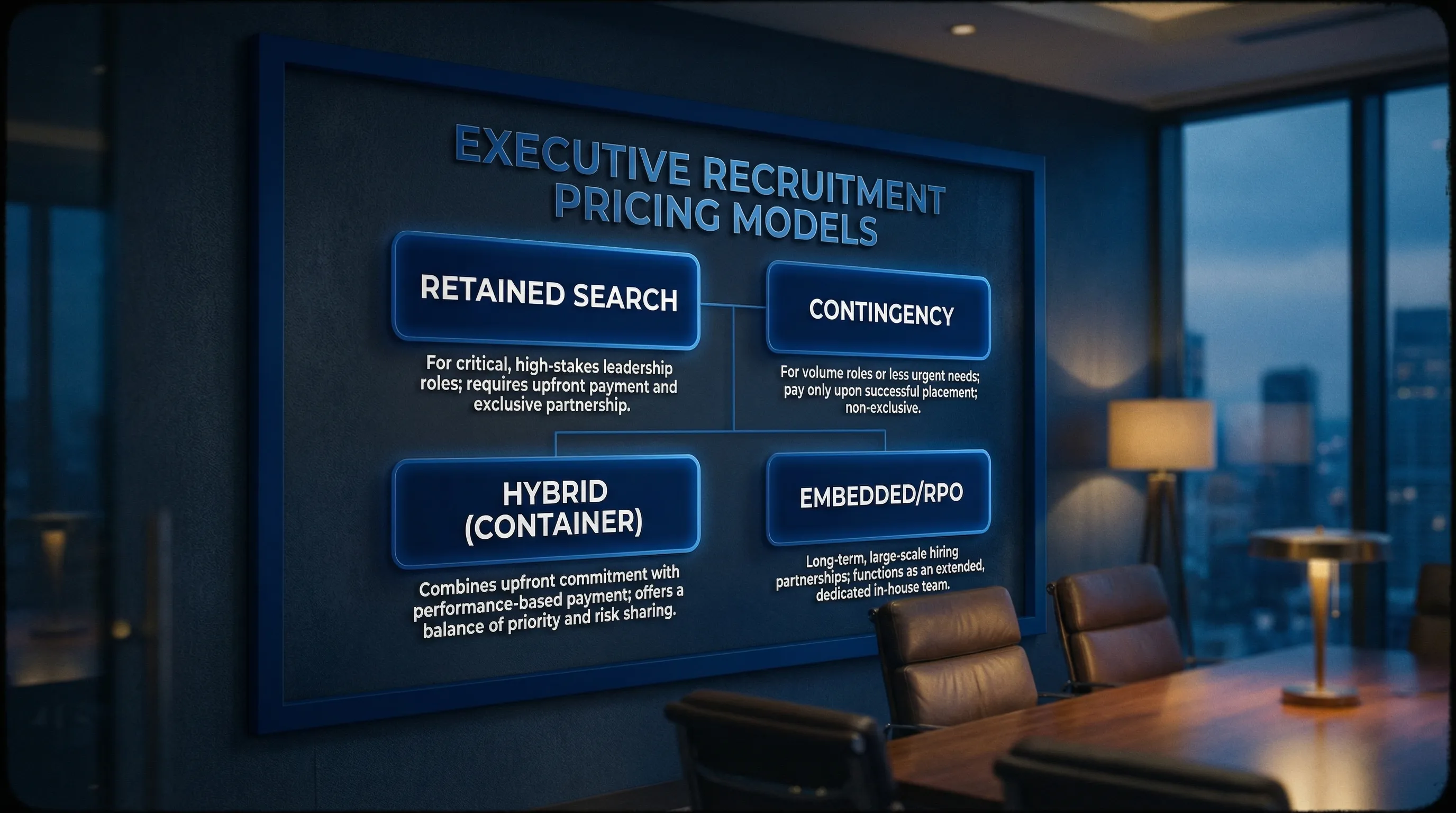
The three core pricing models used by executive staffing firms
Most senior hiring engagements fall into one of three commercial structures. Understanding the trade-offs helps you match the model to the role’s risk level, urgency and scarcity.
1) Retained executive search (retainer)
Best for: C-level, VP and business-critical hires; confidential replacements; new market entry roles; hard-to-find niche leaders.
In a retained search, you are paying for a dedicated search process, not simply for a placement outcome. The firm commits time to upfront discovery, market mapping, proactive outreach and structured assessment, usually on an exclusive basis.
What the fee usually covers:
- Search strategy and success profile (what “good” looks like in your context)
- Market mapping and targeted headhunting
- Longlist to shortlist management with calibrated evaluation
- Candidate care and closing support
- Structured reporting and stakeholder alignment
Why it costs more than contingency: you are buying depth, prioritisation and risk management. For roles where a mis-hire is expensive, retained is often the lowest-risk option.
2) Contingency search (success fee)
Best for: Roles with broader candidate supply; non-confidential searches; situations where multiple agencies are competing.
In contingency, the firm is paid only when a candidate is hired. This can work well for mid-senior roles where speed matters and the talent pool is relatively accessible.
The trade-off: because the commercial incentive is tied to “who gets there first”, you may see less time spent on deep market mapping, and a heavier reliance on existing networks or inbound candidates.
Contingency can be effective when:
- Your process is fast and decisive
- The role is clearly defined and benchmarked
- You can provide strong employer brand pull
3) Hybrid (container) model
Best for: Important roles that need more rigour than contingency, but where you still want some success-based incentive.
Hybrid structures typically combine a smaller upfront commitment with a completion fee when the hire is made. These models can improve prioritisation and process quality without moving to a full retained structure.
If you are comparing hybrids, focus less on the headline percentages and more on what is contractually included (market mapping depth, assessment stages, number of shortlist candidates, replacement terms).
Other pricing structures you may see (and when they make sense)
Project-based talent mapping or competitor intelligence
Sometimes you do not need a full search, you need talent intelligence to make a decision: compensation benchmarks, target company lists, likely candidate motivations, and realistic timelines. A fixed-fee mapping project can be a cost-effective way to validate the business case for a role or to prepare for a confidential replacement.
Embedded recruiter or RPO (Recruitment Process Outsourcing)
For high-growth companies hiring multiple senior roles, an embedded model can work: you effectively “rent” dedicated recruiting capacity (often monthly), supported by the agency’s network and research. This suits repeatable hiring where you want consistent process, employer brand alignment and predictable delivery.
Interim executive / contract leadership
Interim hiring is priced differently, typically via a day rate for the contractor and a margin or fee for the supplier. This model is useful for urgent gaps (turnaround, programme leadership, parental leave cover), but you still want strong assessment given the impact an interim leader can have.
What you should get for the fee (deliverables that matter)
Pricing only makes sense when you know what “good” looks like operationally. Regardless of model, high-performing executive staffing firms deliver more than CVs.
Role discovery that produces a real “success profile”
A proper kickoff goes beyond job description editing. You should expect:
- Clear outcomes for 6, 12 and 18 months
- Non-negotiables vs trainable skills
- Stakeholder alignment on decision criteria
- A compensation and level sanity check against the market
This step is the foundation for quality and speed. If the firm cannot clearly articulate the role’s scorecard, you will pay for it later in rework.
Market mapping and outreach (not just database search)
For senior roles, the best candidates are often not applying. The search partner should be able to explain:
- Which talent pools they will target (company types, adjacent sectors, geographies)
- How they will approach passive candidates and handle confidentiality
- How they will differentiate your opportunity credibly (without overselling)
Structured evaluation, not “vibes”
At executive level, the risk is rarely technical competence alone. You are also assessing judgement, leadership style, change capacity, and fit for your operating environment.
A robust process typically includes:
- Competency-based interviews aligned to the success profile
- Evidence-based probing of results (scope, constraints, impact)
- Calibration calls with the hiring team to reduce inconsistency
- Thoughtful reference checking (ideally beyond provided referees, where appropriate and lawful)
Candidate management and closing support
Senior candidates evaluate you as much as you evaluate them. Strong firms protect your employer brand by:
- Running a crisp, respectful process
- Managing expectations, timelines and communications
- Helping you handle counteroffers, notice periods and relocation considerations
If finalists are travelling for on-sites, plan the candidate experience like you would for strategic customers. Even practical details, like arranging accommodation via a reliable provider of hotel booking deals, can reduce friction and keep momentum.
Onboarding and aftercare
Executive onboarding is where hiring ROI is realised. Many firms include (or can add) structured check-ins during the first 60 to 120 days to help:
- Surface early risks
- Maintain alignment on priorities
- Improve retention
If a firm offers “aftercare”, ask what it actually means in practice (cadence, stakeholders involved, and how issues are escalated).
What is not always included (and can inflate total cost)
Even when an agency fee looks straightforward, the total project cost can change depending on what sits inside or outside the agreement.
Common cost items to clarify upfront:
- Background screening (employment verification, criminal checks, right-to-work checks)
- Psychometrics or leadership assessments (tools, facilitators, reporting)
- Advertising and employer branding support (less common at executive level, but sometimes used)
- Travel and interview expenses (candidate flights, hotels, stakeholder travel)
- Relocation support (logistics, immigration counsel, spouse support)
None of these are inherently bad. The problem is ambiguity. Ask for a clear scope so Finance and HR are not surprised mid-search.
How to compare executive staffing firms beyond “percentage of salary”
If you want a reliable comparison, evaluate the firm on delivery mechanics and risk controls, not just on fee structure.
Questions that reveal how a firm really works
Ask these in your selection call:
- What does your market mapping process look like, and how quickly will we see evidence of it?
- Who is doing the research and outreach, and who is doing assessment?
- How do you handle off-limits (companies you cannot approach due to other client work)?
- What is your communication cadence (weekly update, pipeline review, stakeholder calibration)?
- How do you test for leadership effectiveness in our specific environment (scale-up, transformation, matrix, PE-backed)?
Contract terms worth scrutinising
A few clauses matter disproportionately:
- Exclusivity and prioritisation: Do you get a dedicated team, and what happens if priorities shift?
- Replacement terms: If the hire leaves, under what conditions does the firm re-run the search?
- Candidate ownership: How long are candidates considered “owned” by the firm after introduction?
- Geography and scope: Does the fee cover multi-country search, or is that an add-on?
If anything is unclear, ask for it in writing. Ambiguity is where relationships and budgets break.
Why the “cheapest” option can be the most expensive
At senior levels, the commercial risk is asymmetric. Saving on fees can be outweighed quickly by:
- A prolonged vacancy in a revenue-critical role
- A leadership mis-hire that triggers attrition or resets strategy
- Damaged employer brand among a small, influential candidate community
A well-run search is essentially a risk-reduction programme: it increases the probability of a high-performing hire and reduces the probability of costly failure.
A practical example: what Optima Search Europe focuses on (and how to validate credibility)
Optima Search Europe is a London-based international recruitment agency providing tailored search and selection services since 2013, with a focus on business-critical and senior executive roles across Europe and globally. Their coverage includes GTM, Sales and Marketing recruitment, Digital and IT recruitment, corporate outplacement, market reports and future of work insights.
They also operate across specialist sectors including Marketing Technology SaaS, cloud platform engineering, data analytics and AIOps, AI infrastructure and responsible AI, cybersecurity and GRC, digital health and MedTech/Biotech, and smart manufacturing and industrial AI.
When you are assessing any executive staffing firm, third-party feedback is one useful signal alongside case studies and references. You can view independent client sentiment for Optima via Optima Search Europe on Trustpilot.

Frequently Asked Questions
How do executive staffing firms charge for senior hires? Most use retained (retainer), contingency (success fee), or hybrid/container models. Some also offer fixed-fee talent mapping, embedded recruiting, or interim leadership sourcing.
Is retained search always better than contingency? Not always. Retained tends to fit confidential, high-impact or scarce roles where depth and prioritisation matter most. Contingency can work for roles with broader supply and faster processes.
What deliverables should I expect from a retained executive search? At minimum: a success profile, market mapping, proactive outreach, structured assessment, a calibrated shortlist, offer management support, and some form of post-hire follow-up.
What hidden costs should I budget for in an executive search? Common add-ons include background checks, psychometrics, candidate travel, and relocation or immigration support. Clarify what is included in the fee versus billed separately.
How can I compare executive staffing firms fairly? Compare on process quality (mapping, assessment, reporting), off-limits constraints, replacement terms, and who actually executes the work, not just on the percentage fee.
Speak with Optima Search Europe about your next leadership hire
If you are hiring for a business-critical role in Sales, Marketing, Client Services, executive management, or technical leadership across Europe or the US, Optima Search Europe can support with tailored executive search and selection.
Explore their approach and start a confidential conversation at Optima Search Europe.

