
France Cybersecurity Companies: Recruitment Trends 2026
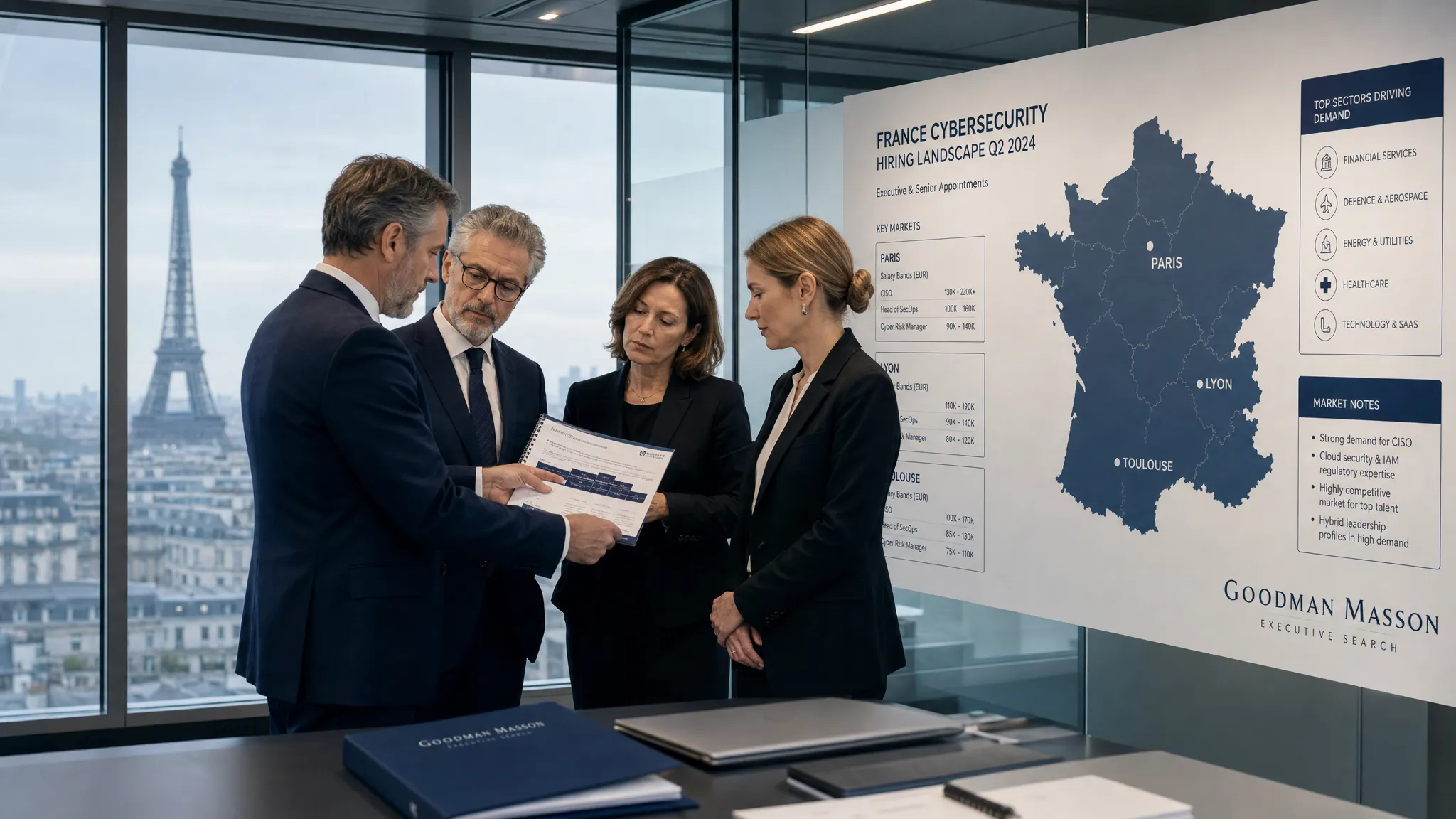
The French Cybersecurity Hiring Market in 2026
France is one of Western Europe's most significant cybersecurity hiring markets in 2026 - driven by a large CAC 40 corporate base, France's benchmark group of leading listed companies, a world-class defence and aerospace sector, and NIS2 Directive compliance obligations across thousands of French essential and important entities; the NIS2 Directive is the EU regulation effective from October 2024 requiring French organisations in critical and important sectors to appoint qualified cybersecurity personnel.
The French Cybersecurity Market, one of Western Europe's most significant cybersecurity hiring markets, is shaped by large enterprise security programmes, sovereign defence priorities, regulated infrastructure and fast-growing technology firms. Boards are treating cyber risks as business risks, which has increased demand for leaders who can combine technical credibility, regulatory literacy and executive communication.
ANSSI, Agence Nationale de la Sécurité des Systèmes d'Information, is France's national cybersecurity agency; it sets national security standards and influences hiring expectations across public and private sectors. Even commercial employers increasingly value candidates who understand ANSSI-aligned security principles, incident response expectations and governance discipline.
Paris, France's primary tech and cybersecurity hub, is home to the highest concentration of cybersecurity employers and talent in the country. Lyon, France's second technology hub, is seeing growing cybersecurity demand from financial services and industrial companies. Toulouse, an aerospace and defence technology cluster, has significant cybersecurity demand driven by Airbus and the French defence supply chain.
The Talent Shortage in France is a significant deficit of qualified cybersecurity professionals, compounded by a strong preference for French-speaking candidates. French proficiency is expected by most employers, limiting cross-border talent flow. At the same time, the growing international tech presence in Paris is creating more English-language cybersecurity hiring, particularly in cloud security, DevSecOps and product security.
Summary: Cybersecurity recruitment in France in 2026 is deep but structurally constrained. Paris offers the largest candidate density, Lyon and Toulouse provide sector-specific talent pools, ANSSI shapes competence expectations, and NIS2 has raised the urgency of hiring. International employers should not assume that French hiring behaves like the UK, Germany or the Netherlands.
Which Sectors Are Hiring Cybersecurity Professionals in France?
The sectors hiring cybersecurity professionals in France in 2026 are those facing regulated operational risk, critical infrastructure exposure, sensitive data obligations and board-level accountability for cyber resilience.
- Defence & Aerospace: Defence and aerospace hiring is concentrated around Airbus, Thales, Dassault and the French defence supply chain. These employers require Security Architects, operational technology security specialists and cleared cybersecurity professionals. Habilitation, French security clearance for sensitive roles, can materially reduce the available talent pool and increase compensation expectations for qualified candidates.
- Financial Services: BNP Paribas, Société Générale, AXA and the wider Paris financial ecosystem are driving demand for CISOs, SOC leaders, security operations analysts, cloud security engineers and compliance specialists. Hiring is shaped by high regulatory scrutiny, third-party risk, fraud exposure and the need to protect large-scale customer, payment and insurance data environments.
- Energy & Utilities: EDF and the broader French energy sector are under NIS2 Essential Entity obligations, making cybersecurity hiring a resilience priority. OT/ICS security, the protection of operational technology and industrial control systems, is especially important where cyber incidents could affect physical infrastructure, energy production, grid stability or safety-critical operations.
- Technology & SaaS: The Paris Station F ecosystem and the broader scale-up base are increasing demand for Cloud Security Engineers, DevSecOps specialists, Product Security Engineers and security leaders who can support international expansion. These companies are more likely to hire in English, but still value French capability for customer, legal and regulatory engagement.
- Healthcare: French healthcare organisations are scaling security functions under NIS2 and GDPR compliance pressure. Demand is rising for data protection, identity access management, incident response and security governance professionals who understand clinical workflows, sensitive patient data, supplier risk and the operational realities of hospitals, medtech providers and digital health platforms.
Summary: France's cybersecurity demand is not concentrated in one sector. Defence, aerospace, finance, energy, SaaS and healthcare each require different candidate profiles, assessment methods and compensation strategies. Employers should define whether they need enterprise security leadership, regulated compliance depth, cloud-native engineering or OT/ICS security before launching a search.
Cybersecurity Salary Benchmarks: France 2026
Cybersecurity salary benchmarks in France in 2026 show clear premiums for cloud security, NIS2 compliance, cleared defence roles and senior leadership, with Paris typically paying more than Lyon and Toulouse for equivalent roles.
The following benchmarks are indicative gross annual base salary ranges for France in 2026, excluding bonus, equity, employer social charges and relocation support.
Role                    | Mid-Level       | Senior            | Lead / Head
SOC Analyst             | €42,000-€60,000 | €60,000-€85,000   | €85,000-€108,000
Cloud Security Engineer | €70,000-€92,000 | €92,000-€125,000  | €125,000-€158,000
Penetration Tester      | €52,000-€74,000 | €74,000-€105,000  | €105,000-€138,000
NIS2 Compliance Officer | €60,000-€85,000 | €85,000-€115,000  | €115,000-€148,000
CISO | N/A | €135,000-€175,000 | €175,000-€235,000Defence sector roles requiring Habilitation attract a significant compensation premium because the candidate pool is smaller, mobility is lower and employers often need experience with sensitive environments. Candidates with ANSSI-recognised qualifications, prior regulated-sector exposure or proven incident response leadership also command stronger offers.
Summary: Salary benchmarking must be localised to the French market. Importing UK, US or German assumptions can lead to weak offers, slow processes and declined final-stage candidates. For senior and scarce cybersecurity hires, base salary is only one part of the offer; role scope, employer stability, language expectations, remote policy and regulatory exposure all affect candidate decisions.
Hiring Cybersecurity Talent in France: Key Considerations
Hiring cybersecurity professionals in France requires understanding a distinct set of employment norms, language expectations, and regulatory dynamics that significantly affect candidate sourcing, offer construction, and hiring timelines.
CDI, Contrat à Durée Indéterminée, is the standard permanent employment contract in France; strong employee protections make termination complex. Senior cybersecurity candidates often prefer CDI roles over contract or freelance arrangements, especially when moving from large corporates, banks, defence employers or regulated infrastructure businesses. International employers entering France should align job architecture and offer terms with this expectation.
Language requirements are a major filter in the French cybersecurity hiring landscape. French proficiency is expected in most organisations because security work often involves internal training, executive reporting, incident coordination, regulator communication and supplier governance. International candidates without French can succeed in some Paris-based tech environments, but they face significant barriers in defence, finance, energy, healthcare and public-sector-adjacent roles.
Notice Period, the contractual period an employee must serve before leaving a role, is a key planning factor. Senior cybersecurity professionals in France typically serve 2-3 month notice periods, which means hiring timelines need to account for long candidate availability windows. Employers that delay feedback or add unnecessary interview stages risk losing candidates to faster-moving competitors.
ANSSI certification and ANSSI-aligned experience are highly regarded. Employers value candidates who can operate within high-assurance environments, understand French security expectations and translate compliance into practical controls. This is especially relevant for NIS2, public-sector suppliers, critical infrastructure and companies handling sensitive data.
In larger French organisations, the Comité Social et Économique, or CSE, is the employee representative works council that may be involved in workforce matters, organisational change and employee consultation. While it does not usually select candidates, it can influence restructuring, security operating model changes and internal communication around new leadership roles.
Summary: To hire cybersecurity professionals in France, employers need more than a job description. Successful searches account for CDI expectations, French-language requirements, 2-3 month notice periods, ANSSI influence, CSE context and salary benchmarks specific to Paris, Lyon and Toulouse. Passive candidate access is often decisive because the strongest professionals are rarely active applicants.
Frequently Asked Questions
The five questions below address the practical issues hiring leaders most often face when planning cybersecurity recruitment in France in 2026.
Which cybersecurity roles are most in demand in France in 2026? The most in-demand roles are Cloud Security Engineers, DevSecOps Engineers, Security Architects, SOC Analysts, Incident Response specialists, NIS2 Compliance Officers, GRC leaders and OT/ICS security professionals. Demand is strongest where regulation and operational resilience intersect: financial services, energy, defence, healthcare and SaaS. Senior CISOs and deputies are also scarce because companies need leaders who can brief boards, translate cyber risks into business exposure, manage suppliers and build security teams. Candidates who combine French fluency with cloud, compliance and incident response experience are particularly competitive.
What is the average cybersecurity salary in France? There is no single average because role, city, clearance and sector change compensation significantly. As a practical benchmark, mid-level SOC Analysts typically sit at €42,000-€60,000, while mid-level Cloud Security Engineers are more often €70,000-€92,000. Senior specialist roles commonly range from €74,000 to €125,000 depending on discipline, and French CISOs generally sit between €135,000 and €235,000. Paris usually carries a 10-15% premium over Lyon and Toulouse, and defence roles requiring Habilitation can exceed standard market ranges.
Do cybersecurity professionals need to speak French to work in France? In most French organisations, yes. French proficiency is expected for roles involving regulators, internal stakeholders, works council discussions, incident reporting, supplier management or security awareness across the business. English-only hiring is more common in international technology companies, SaaS firms, cloud vendors and some Paris scale-ups, particularly for technical roles with global engineering teams. However, non-French speakers face a smaller addressable market and may be filtered out of regulated-sector searches. For senior cybersecurity leadership, French fluency is often a decisive factor because board, legal and operational communication must be precise.
How has NIS2 changed cybersecurity hiring in France? NIS2 has turned cybersecurity hiring from a discretionary capability decision into a compliance and resilience requirement for many French organisations. Essential and important entities need stronger governance, incident reporting, supply-chain risk management and accountable security leadership. This has increased demand for CISOs, GRC specialists, NIS2 Compliance Officers, SOC leaders and security architects who can translate regulation into operating controls. It has also raised the bar in interviews: employers now test regulatory understanding, evidence of implementation and stakeholder management, not only technical depth. Hiring managers are therefore competing for a narrower pool of regulation-literate security professionals.
How long does it take to hire a cybersecurity professional in France? Mid-level cybersecurity hires in France can often be completed in 8-12 weeks when the brief, compensation and interview process are clear. Senior or leadership searches usually take 3-5 months because many candidates are passive and already employed on CDI contracts with 2-3 month notice periods. Searches involving Habilitation, ANSSI-aligned experience, niche OT/ICS skills or bilingual leadership requirements may take longer. Employers reduce risk by mapping the market early, benchmarking salary before launch, pre-closing candidates and avoiding unnecessary interview stages.
Conclusion & Strategic Positioning
France is one of Europe's most important but structurally distinct cybersecurity hiring markets, with strong demand, high regulatory pressure and a talent pool shaped by language, CDI employment norms, ANSSI standards and sector-specific security requirements.
For international organisations entering France, and for French companies scaling under NIS2 pressure, hiring success depends on accurate market mapping, credible salary benchmarking and access to passive candidates across Paris, Lyon and Toulouse. The best candidates are often already employed, well-compensated and selective about role scope, employer reputation and process quality.
Optima Search Europe supports business-critical and senior cybersecurity hiring across Europe and globally, combining specialist market knowledge with targeted search and selection. If your organisation is planning cybersecurity hiring in France, a focused discussion on role priorities, salary position and candidate availability can help reduce time-to-hire and improve offer acceptance without compromising quality.

