
International Recruitment Agency for SaaS Companies in Europe
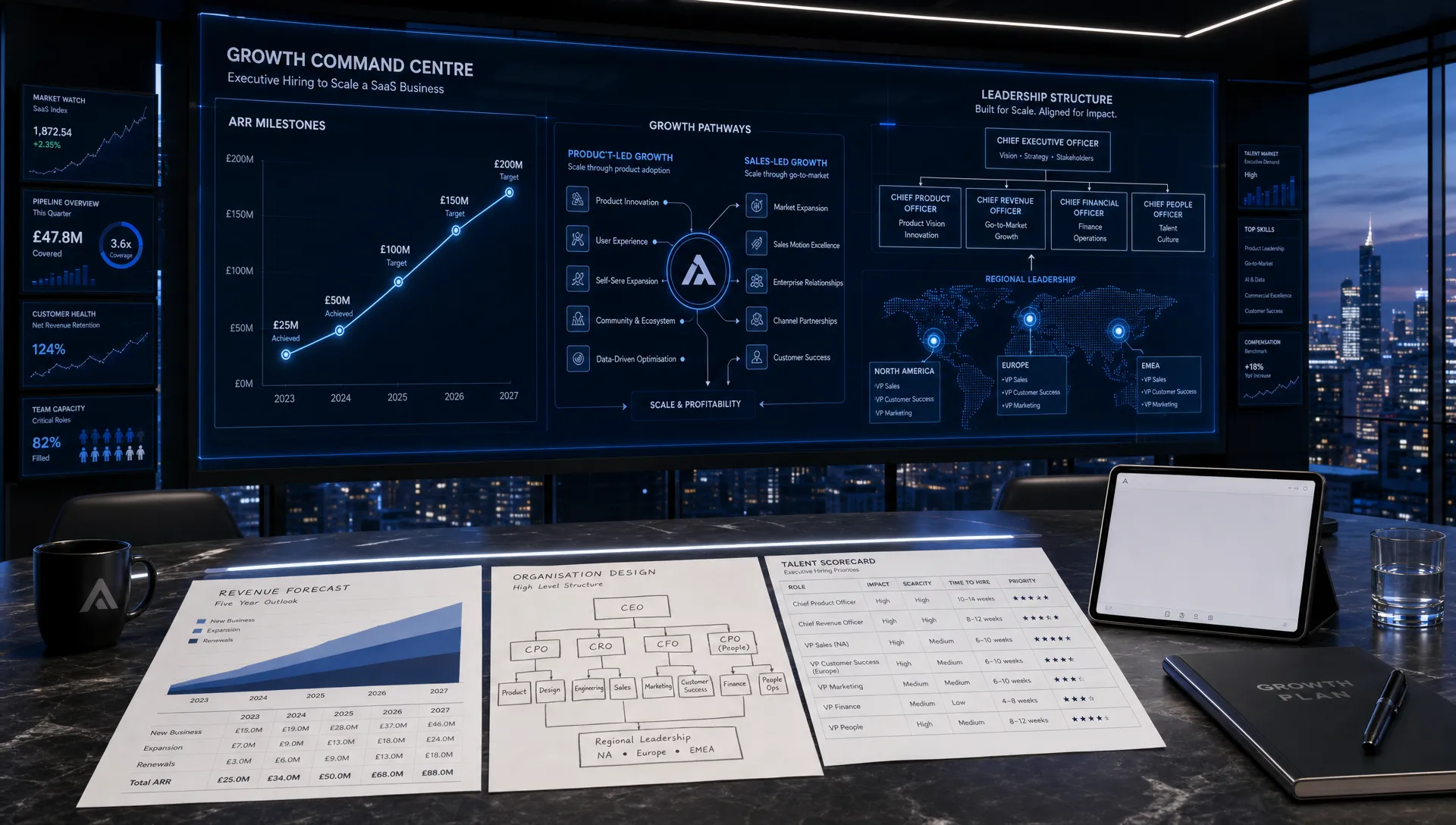
International Recruitment Agency for SaaS Companies in Europe: Hiring Guide 2026
Why SaaS Companies Need a Specialist Recruitment Agency
B2B SaaS companies, Business-to-Business Software-as-a-Service firms built on recurring revenue and selling to other companies, need a specialist recruitment agency because the leadership profiles they require, VP Sales with proven SaaS ARR experience, Marketing Directors with PLG or sales-led GTM expertise, and VP Engineering with cloud-native architecture background, are not found through generalist channels.
SaaS hiring is not the same as general technology hiring. A general software company may prioritise product delivery, technical domain expertise or enterprise account experience. A B2B SaaS company needs leaders who understand recurring revenue economics, customer acquisition cost, expansion revenue, churn, sales cycle discipline and board-level metrics. ARR, meaning Annual Recurring Revenue, is the key SaaS metric used to assess company stage and determine hiring readiness for senior leadership roles.
That distinction matters most in leadership searches. A VP Sales who performed well in a services business may not understand pipeline coverage, annual contract value, conversion by stage, sales velocity or the structure of an enterprise SaaS sales organisation. A Marketing Director from a broad technology background may not know how to align product positioning, demand generation, partner channels and revenue operations under one Go-to-Market Motion. GTM Motion, or Go-to-Market Motion, is the commercial strategy defining how a SaaS company acquires customers and therefore determines which sales and marketing leadership profiles are appropriate.
The specialist gap becomes even clearer when comparing PLG and sales-led models. PLG, or Product-Led Growth, is a GTM motion where the product drives user acquisition and expansion. It often requires marketing and growth leaders who understand activation, usage data, lifecycle conversion and self-serve revenue. Sales-led growth is a GTM motion where the sales team drives customer acquisition through outbound and inbound pipeline management, and remains the dominant model for enterprise B2B SaaS. Hiring the wrong leader for the wrong GTM motion can create 12 months of organisational drift.
Generalist agencies often underperform in SaaS leadership searches because they search by job title rather than stage context. They may present candidates with impressive logos but limited relevance to the company’s ARR band, funding stage, sales cycle, buyer type or product complexity. SaaS scale-ups need leaders who have already solved comparable problems, not simply leaders who have worked in technology.
At VP and Director level, the strongest profiles are usually passive candidates. A passive candidate is a high-performing SaaS leader not actively seeking a new role and therefore only reachable through direct outreach, credibility-led engagement and a precise opportunity narrative. These leaders are rarely applying to adverts, and they are often already delivering against revenue, retention or product milestones elsewhere.
Structured summary: SaaS companies need specialist recruitment support because leadership suitability depends on ARR stage, GTM motion, SaaS metrics and access to passive candidates. Generalist hiring channels can identify technology leaders, but they rarely distinguish between PLG, sales-led growth, enterprise ARR experience and stage-specific leadership capability.
SaaS Leadership Hiring by ARR Stage
The right SaaS leadership team is different at €1M ARR than at €10M ARR or €50M ARR, and the most common SaaS hiring mistakes come from importing a leadership profile from the wrong stage.
Series A, Series B and Series C are venture capital funding rounds used to define company stage, and each stage typically triggers specific leadership hiring needs. These labels are useful, but ARR is often the more practical guide because it reflects commercial maturity, repeatability and organisational complexity. A company that has raised a large round but has not yet proven repeatable revenue needs different leadership from a capital-efficient SaaS firm with strong ARR growth.
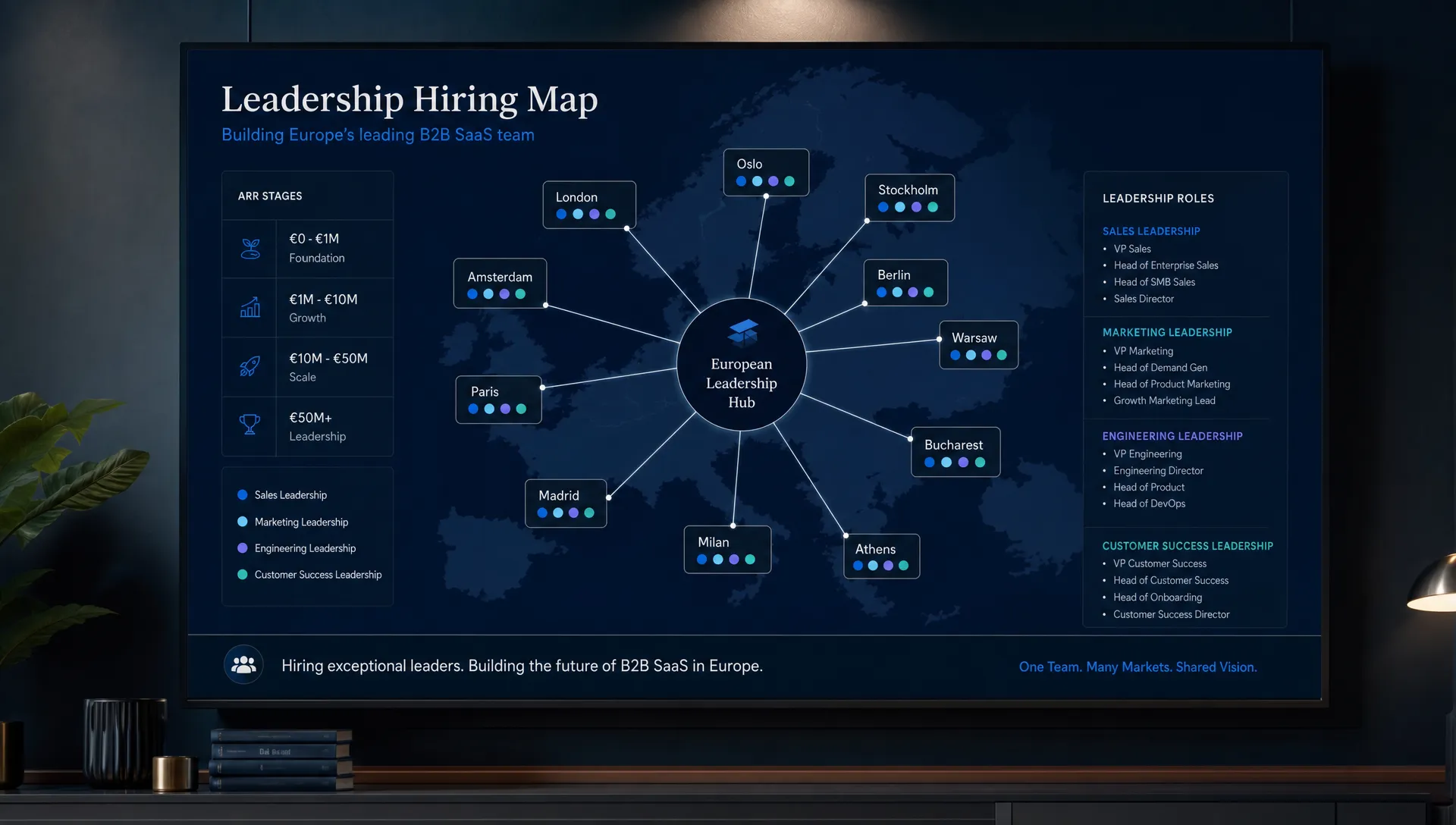
The following stage breakdown is a practical guide for European B2B SaaS companies planning senior hiring in 2026:
- €0-2M ARR, Seed or Pre-Series A: Sales is usually founder-led, with the founder or CEO still closing lighthouse customers and learning the market directly. The first marketing hire is usually a demand generation specialist, content and growth marketer, or product marketer rather than a Marketing Director. VP-level hiring is usually premature because the company has not yet proven enough repeatability for a senior operator to scale.
- €2-8M ARR, Series A: This is the usual window for a first VP Sales or Head of Sales hire, especially where founder-led selling has produced repeatable deal patterns. A Marketing Director can be appropriate if the GTM motion is established and pipeline creation is a constraint. A VP Engineering may also be required if product reliability, platform scalability or technical debt has become a growth risk.
- €8-25M ARR, Series B: The company normally needs a full commercial leadership layer, including VP Sales, Marketing Director and VP Customer Success. Customer Success is the post-sales function responsible for onboarding, retention and expansion revenue, and it becomes a distinct leadership hire as ARR scales beyond €5M. This is also the stage where a Head of Finance becomes important for forecasting, investor reporting and commercial planning.
- €25-75M ARR, Series C: Leadership hiring shifts towards senior executives who can manage multi-function scale. CRO, CMO and CTO appointments become more common, particularly where the business is entering multiple European markets or moving upmarket into enterprise accounts. Regional leadership, country managers and a VP People may also be required as headcount and cross-border complexity increase.
- €75M+ ARR, Growth or Pre-IPO: C-suite professionalisation becomes the priority. CFO, CLO and Chief People Officer appointments become more relevant as governance, compliance, acquisitions, board reporting and public-market readiness increase. At this stage, the business needs executives who can manage scale, risk and operating cadence, not only growth.
The most expensive mistake is hiring too senior too early. A CRO from a €100M ARR company may not want to build the first outbound process or personally inspect pipeline hygiene. Equally, a scrappy first Head of Sales may not be the right person to manage regional VPs, enterprise forecasting and board-level revenue strategy at €50M ARR.
Structured summary: SaaS leadership hiring should be sequenced by ARR, not just funding round or ambition. Seed businesses need founder-led validation, Series A companies need first functional leaders, Series B companies need a complete commercial layer, and Series C plus companies need executives who can scale systems, teams and governance.
SaaS Leadership Salary Benchmarks Europe 2026
SaaS leadership compensation in Europe is stage-dependent, with Series B VP Sales OTE typically 40-60% higher than Series A equivalents, reflecting both company scale and the seniority of profile required.
OTE means On-Target Earnings, the total expected annual compensation for sales roles if agreed revenue targets are achieved. For VP Sales and CRO searches, OTE is usually the most relevant benchmark because the base salary alone does not reflect the commercial risk and reward attached to the role. The figures below are indicative 2026 European benchmarks for B2B SaaS leadership hiring and should be adjusted for market, funding quality, equity value, role scope and remote or hybrid location strategy.
2026 European SaaS leadership compensation matrix
- VP Sales, OTE: Series A: €180,000-€260,000. Series B: €240,000-€340,000. Series C+: €300,000-€450,000.
- Marketing Director: Series A: €110,000-€155,000. Series B: €135,000-€185,000. Series C+: €165,000-€230,000.
- VP Engineering: Series A: €140,000-€185,000. Series B: €168,000-€225,000. Series C+: €205,000-€275,000.
- VP Customer Success: Series A: €110,000-€148,000. Series B: €135,000-€178,000. Series C+: €165,000-€215,000.
- CRO: Series A: N/A. Series B: €280,000-€400,000. Series C+: €360,000-€520,000.
Equity is standard at all SaaS stages, although its perceived value depends heavily on funding quality, strike price, dilution expectations, investor base and exit probability. Vesting schedules typically run for four years with a one-year cliff. For senior leadership candidates, equity is not simply a retention mechanism. It is part of the risk calculation, particularly when moving from an established company into a Series A or Series B scale-up.
OTE splits for VP Sales roles in European SaaS markets are typically 50/50 or 60/40 base to variable. A 50/50 split is more common when the role is heavily revenue-accountable and the company has a mature pipeline engine. A 60/40 split is more common where the VP Sales is also building process, hiring the team, improving sales operations and creating repeatability.
Benchmarks also vary by hub. London, Dublin, Amsterdam, Berlin, Paris, Stockholm and Copenhagen tend to command higher packages for proven enterprise SaaS leadership. Cross-border remote hiring can widen the candidate pool, but it does not automatically reduce compensation for top performers. Passive SaaS leaders with a strong ARR scaling record will usually compare opportunities across Europe rather than only within their domestic market.
Structured summary: SaaS leadership compensation in Europe should be benchmarked by ARR stage, role scope and GTM maturity. Series B and Series C hiring requires materially higher packages than Series A, and equity, OTE structure and candidate risk perception all influence acceptance rates.
The Most In-Demand SaaS Leadership Roles in Europe 2026
The hardest SaaS leadership roles to fill in Europe in 2026 are VP Sales with proven enterprise ARR track record, VP Engineering with cloud-native and AI-integration experience, and CRO-level profiles who have scaled revenue from €10M to €50M+ ARR.
Demand is highest where three factors overlap: measurable SaaS scale experience, leadership maturity and direct relevance to the company’s GTM motion. The best candidates are not merely functional specialists. They have operated at the right ARR stage, managed the right customer segment and made decisions under similar investor expectations.
- VP Sales, enterprise SaaS: This profile requires proven €1M+ ACV, meaning Annual Contract Value, deal experience combined with team-building capability. The strongest candidates have hired account executives, built sales management layers, improved forecast accuracy and managed enterprise pipeline discipline. They become scarce once a company needs someone who has scaled beyond €5M ARR rather than simply closed early founder-led deals.
- CRO: A Chief Revenue Officer requires a revenue track record at a comparable stage, usually across sales, marketing, customer success and revenue operations. The European talent pool is small because many CROs have scaled in one narrow context but not across multiple markets, segments or GTM models. A Series C SaaS company usually needs a CRO who has already managed the journey from €10M to €50M+ ARR.
- VP Engineering, AI-native: This role combines cloud-native architecture, engineering leadership and AI or machine learning integration experience. Demand is outpacing supply significantly as SaaS companies embed AI into products, automate workflows and modernise platforms. The strongest candidates can balance delivery speed, platform reliability, security and technical architecture without turning engineering into a bottleneck.
- VP Customer Success: This hire owns retention, expansion and Net Revenue Retention, often abbreviated as NRR. The role is frequently undervalued until churn becomes a board-level issue. In SaaS companies with complex onboarding, enterprise customers or usage-based pricing, VP Customer Success can be as commercially consequential as VP Sales because expansion revenue compounds growth.
- Marketing Director, demand generation and product: Full-stack marketing leaders who can own both pipeline and positioning remain rare. Many are strong in brand, content, product marketing or paid acquisition, but fewer can connect positioning, demand generation, lifecycle conversion and revenue accountability. As outbound becomes more data-led, tools such as AI-driven B2B prospecting platforms are also changing how marketing and sales leaders coordinate account targeting, signal detection and multichannel engagement.
A further complication is that successful SaaS leadership profiles are usually context-specific. A VP Sales from a PLG business may not be right for an enterprise sales-led platform. A VP Engineering from a mature infrastructure vendor may not be right for a Series A company still balancing technical debt and customer-led roadmap pressure. A Customer Success leader from a low-touch SMB model may struggle in a high-touch enterprise environment.
Structured summary: The most in-demand SaaS leadership roles in Europe combine functional depth with stage and GTM relevance. VP Sales, CRO, VP Engineering, VP Customer Success and Marketing Director searches require precise market mapping because the strongest candidates are scarce, passive and selective.
How Optima Europe Recruits SaaS Leadership Teams
Optima Europe’s SaaS recruitment model combines sector-specific candidate networks, retained search methodology and stage-aware briefing to deliver shortlists of passive SaaS leaders who are not accessible through standard hiring channels.
Optima Europe works as a specialist international recruitment agency for business-critical and senior executive roles across Europe and global markets. For SaaS companies, the value is not simply candidate introduction. It is the ability to define the leadership problem correctly, calibrate the market, identify stage-relevant profiles and engage passive candidates with a credible, investor-aware narrative.
Sector specialisation improves candidate identification
SaaS leadership search starts with understanding the difference between a title match and a context match. A candidate may be a VP Sales, but the relevant questions are more specific: What ARR stage did they join? What ARR stage did they leave? Was the GTM motion PLG, sales-led or hybrid? Did they build the first sales management layer or inherit a mature organisation? Did they sell to mid-market buyers, enterprise CIOs or technical users?
This is where a specialist B2B SaaS recruitment agency in Europe differs from a broad technology recruiter. Optima Europe’s search process is designed to map candidates by SaaS operating context, not only by company name. For companies also building technical teams beneath the leadership layer, Optima’s guide to SaaS and software recruitment in Europe provides a broader view of the talent market.
Retained search creates commitment and market control
Senior SaaS hiring rarely benefits from a multi-agency race. It can create duplicated outreach, inconsistent messaging and poor candidate experience. A retained model gives the search partner accountability for mapping the full market, engaging passive candidates confidentially and managing the process with discipline.
For board-level and VP-level roles, this matters because candidates assess the quality of the hiring process as a signal of company maturity. A poorly briefed or fragmented process can deter the exact leaders a SaaS company wants to attract. Optima Europe’s retained approach is built around structured briefing, market calibration, targeted outreach, shortlist management and candidate engagement through to offer.
Stage-aware briefing reduces mis-hires
A stage-aware brief defines the role around ARR, GTM motion, funding stage, sales cycle, customer profile, product complexity and organisational maturity. It also distinguishes between must-have and attractive experience. For example, a Series A VP Sales brief may prioritise hands-on team building and founder partnership, while a Series C CRO brief may prioritise regional scaling, revenue operations and board management.
This upfront precision improves both speed and quality. It prevents companies from overpaying for a profile that is too senior, under-scoping a role that needs executive maturity or hiring a leader from a mismatched GTM model. It also helps candidates understand why the opportunity is relevant to their own stage of career.
Cross-border capability matters for European SaaS
European SaaS companies often sell across borders before their leadership teams are fully international. A German SaaS company may need a UK-based VP Sales for enterprise expansion. A French platform may need a Benelux or Nordics leader. A UK scale-up may need a DACH country manager or a European VP Customer Success with multilingual enterprise experience.
Cross-border hiring requires more than translating a job description. It requires knowledge of local compensation expectations, notice periods, employment norms, language requirements, relocation appetite and remote leadership patterns. For CEOs and CHROs assessing whether to run a search internally or externally, Optima’s comparison of an international recruitment agency versus internal hiring in Europe sets out the trade-offs clearly.
Placement success depends on process depth
Optima Europe’s model is built to deliver an 85-90% placement success rate, compared with the roughly 30% success rate often associated with contingent, low-commitment recruitment processes. The difference comes from search depth, candidate qualification, role calibration and consistent process ownership.
At senior level, the objective is not to generate volume. It is to deliver a shortlist of candidates who can credibly solve the company’s next-stage problem. For a SaaS CEO, that may mean a VP Sales who can build repeatable enterprise pipeline. For a CHRO, it may mean a VP Engineering who can scale distributed engineering teams. For a board, it may mean a CRO who can professionalise revenue before Series C or pre-IPO readiness.
Structured summary: Optima Europe recruits SaaS leadership teams through retained search, sector-specialist mapping, passive candidate engagement and ARR-stage briefing. The model is designed for senior B2B SaaS hires where stage fit, GTM relevance and cross-border talent access determine hiring success.
Frequently Asked Questions
The most common SaaS recruitment questions in Europe concern timing, ARR triggers, compensation, search duration and the difference between SaaS leadership hiring and broader technology recruitment.
When should a SaaS company use a specialist recruitment agency in Europe? A SaaS company should use a specialist recruitment agency when the role is senior, business-critical, cross-border or dependent on passive candidates. This usually includes VP Sales, Marketing Director, VP Engineering, VP Customer Success, CRO and country leadership roles. Internal teams can often manage active applicants and mid-level hiring, but senior SaaS leaders rarely apply through public channels. A specialist agency is most valuable when the company needs market mapping, salary benchmarking, discreet outreach and stage-specific candidate assessment across European markets.
What ARR stage triggers the need for a VP Sales in Europe? The usual trigger for a VP Sales hire is €2-8M ARR, when founder-led sales has produced enough repeatability to scale. Before that point, a VP Sales may lack the data, process or product-market clarity needed to succeed. The right timing depends on sales cycle, deal size and GTM motion. If the founder is still personally closing most deals, the company may first need a Head of Sales or senior sales lead rather than a full VP Sales.
How long does it take to hire a VP Sales for a SaaS company in Europe? A well-run VP Sales search in Europe usually takes 8-12 weeks from briefing to accepted offer, although notice periods can extend the start date. The timeline depends on role clarity, compensation competitiveness, funding profile, decision speed and candidate availability. Passive candidates often need several conversations before engaging seriously. Searches move faster when the company has a clear ARR story, realistic OTE range, defined sales motion and aligned CEO, board and HR stakeholders.
What OTE should a VP Sales expect at a Series B SaaS company in Europe? A Series B VP Sales in European B2B SaaS should typically expect OTE of €240,000-€340,000, with the exact level depending on ARR, market, team size, quota responsibility and enterprise sales complexity. The most common split is 50/50 or 60/40 base to variable. Equity is also expected, usually with a four-year vesting schedule and one-year cliff. Candidates with proven enterprise ARR scaling experience may command packages above the midpoint, particularly in London, Dublin, Amsterdam, Berlin or Paris.
How is SaaS leadership recruitment different from general technology recruitment? SaaS leadership recruitment assesses candidates through ARR stage, recurring revenue metrics, GTM motion, retention, expansion and sales velocity, not only technical or sector experience. A general technology recruiter may identify leaders from software companies, but SaaS hiring requires deeper judgement about whether the candidate has scaled a comparable recurring revenue model. The difference is especially important for VP Sales, CRO, Marketing Director and VP Customer Success roles, where success depends on stage fit and measurable commercial outcomes.
Conclusion & Strategic Positioning
SaaS leadership recruitment in Europe should be treated as an ARR-stage decision with direct commercial consequences, because the wrong executive profile can slow revenue growth, weaken GTM execution and create expensive leadership churn.
For founders, CEOs, CROs, CHROs and boards, the central question is not simply whether a candidate is impressive. It is whether they have solved the same stage-specific problem before. At €2M ARR, the company may need a hands-on builder. At €15M ARR, it may need a full commercial leadership layer. At €50M ARR, it may need executives who can scale systems, manage regions and prepare the organisation for institutional maturity.
Optima Europe is positioned for this exact category of search: senior, business-critical SaaS leadership hiring across European and international markets. The combination of SaaS sector depth, passive candidate access, compensation benchmarking and retained search discipline is designed to help companies hire leaders who match their ARR stage, GTM motion and next phase of growth.
If your next SaaS leadership hire will influence revenue, product scale or international expansion, the search should begin with a precise market view and a stage-aware brief. Optima Europe can help define that brief, benchmark the role and access the senior SaaS talent market beyond active applicants.

