
SaaS & Software Recruitment Agency Europe (2026 Guide)

SaaS & Software Recruitment Agency Europe: Hiring Tech Talent in 2026
Choosing a SaaS recruitment agency Europe in 2026 is less about “filling vacancies” and more about protecting delivery, roadmap, and reliability. If you are scaling a SaaS company, you are hiring into systems, not standalone roles: microservices architecture, cloud infrastructure, DevOps maturity, product management cadence, and an agile development rhythm that cannot stall every time a key engineer resigns.
This guide is written for CTOs, VPs of Engineering, founders, HR Directors, and product leaders who need to:
- Reduce time-to-hire without lowering the hiring bar
- Reach passive engineering and product talent that does not apply to adverts
- Execute cross-border recruitment across Europe with fewer compliance and onboarding surprises
- Build credible salary benchmarking for software roles, not guesswork
- Turn hiring into a repeatable scaling capability for your SaaS organisation
Optima Search Europe is an international recruitment agency headquartered in London, operating across Europe and globally, focused on business-critical and senior roles for fast-growing and established firms.
What Is SaaS & Software Recruitment?
SaaS recruitment is the specialist search and selection of talent for software companies that build and sell subscription software. It covers engineering, product, commercial, and executive leadership roles, with hiring decisions tied directly to product delivery, uptime, security posture, and revenue execution.
SaaS recruitment vs general tech recruitment
General tech recruitment often treats roles as interchangeable across industries: “hire a backend engineer”, “hire a PM”, “hire a DevOps person”. SaaS hiring is more contextual:
- Your engineers are building a live product with continuous releases, incident response, and long-lived services
- Your product management team is balancing roadmap, customer signals, commercial targets, and platform constraints
- Your delivery model is usually agile, with heavy cross-functional dependency between engineering, product, design, and go-to-market
This means a CV match is rarely enough. You are screening for how people work in product-led environments, and how they make decisions under ambiguity.
Product-driven vs service-driven tech teams
SaaS companies tend to run product-driven technology organisations: long-term ownership, platform thinking, and deep attention to reliability, security, and operability. Service-driven teams (common in agencies, systems integrators, and some consultancies) can produce excellent engineers, but the work patterns can differ:
- Product-driven teams optimise for maintainability, scalability, and customer experience over time
- Service-driven teams often optimise for project delivery, handover, and time-boxed outcomes
In 2026, many strong candidates have crossed between these worlds. The point is not to exclude, it is to assess for fit against your operating model.
Executive search vs software staffing
Two terms are often mixed:
- Executive search (retained or exclusive) is best when you need leadership, confidentiality, or a high-scarcity profile (CTO, VP Engineering, Head of Product, senior platform leader).
- Software staffing (often more contingent) is best when you need multiple hires at pace, clear role definitions, and a strong process for consistent evaluation.
Many scale-ups need both: leadership hires that shape systems and teams, plus repeatable hiring for software engineering teams as the product scales.
Summary: SaaS & software recruitment is specialised because it hires into product operating systems: engineering delivery, product management cadence, DevOps and cloud infrastructure maturity, and leadership decision-making. It differs from general tech recruitment by prioritising product-led context and evidence-based assessment. It also spans two modes, executive search for high-impact leadership and staffing-style delivery for repeatable engineering and product hiring.
Why Hiring for SaaS Companies Is More Complex in 2026
SaaS hiring has always been competitive, but 2026 adds structural complexity. The “best available candidate” is often employed, well-compensated, and sceptical of switching unless the role is unusually clear and compelling.
Intense competition for engineers
Software engineering talent remains scarce in many European markets, particularly for senior backend, platform, and security-adjacent roles. Competition is not just local. US firms and global SaaS companies continue to recruit across European tech hubs with increasingly standardised remote and hybrid models.
Product-led growth changes what “good” looks like
Product-led growth (PLG) and usage-based revenue models push engineering and product closer to commercial outcomes. You are not only hiring for coding or execution, you are hiring for:
- Customer empathy and product thinking
- Instrumentation, experimentation, and data-informed delivery
- Reliability and performance as part of the user experience
This is why “SaaS hiring Europe” often fails when it copies enterprise IT job specs.
Global remote talent competition
Remote hiring has expanded access to talent, but it has also increased competition and complexity:
- More counteroffers and multi-offer situations
- Higher expectation of interview speed and clarity
- Greater scrutiny of leadership, culture, and career narrative
Salary pressure across Europe
European compensation has moved upward in many roles, especially where AI, platform engineering, and security overlap. Companies that benchmark only against last year’s hires often under-budget and lose candidates late.
AI-driven software development demand
AI-assisted development is now mainstream, but it has not eliminated the need for strong engineers. It has increased demand for people who can:
- Architect systems and manage complexity
- Review and secure AI-assisted code
- Build reliable data pipelines and production-grade services
- Integrate AI features responsibly into customer-facing products
Summary: Hiring for SaaS companies in 2026 is harder because engineering and product talent is scarce, globally competed for, and increasingly assessed on product impact, not just skills. PLG models, remote competition, and salary inflation raise the bar on speed, clarity, and compensation strategy. AI increases the premium on senior judgement, architecture, and operational excellence.
The Talent Shortage in the European SaaS Ecosystem
The European tech ecosystem continues to mature, with more SaaS startups moving into scale-up stages and more established software firms modernising stacks toward cloud-native architectures.
Three market dynamics matter for decision-makers.
1) Digital skills targets vs supply reality
The EU’s Digital Decade agenda set a headline target of 20 million ICT specialists by 2030 (with a focus on inclusion and advanced skills). Regardless of the exact trajectory, the direction is clear: demand for software, cloud, data, and security skills is structurally high, and supply is not catching up quickly enough.
A practical implication: the best hiring teams build cross-border pipelines early, rather than “going international” only after local searches fail.
2) Senior engineer demand is outpacing mid-level supply
Many organisations can attract junior and mid-level applicants, but struggle to hire senior engineers who can lead technical decisions, own services, mentor teams, and raise engineering standards. In SaaS, seniority is often defined by operating responsibility (availability, incident handling, release quality), not just years of experience.
3) Product leadership scarcity is a hidden constraint
Shortage is not limited to engineering. Experienced product managers and Heads of Product who can balance discovery, delivery, stakeholder alignment, and commercial outcomes are heavily competed for, particularly in B2B SaaS with complex buyers.
Two additional forces amplify the problem:
- Competition with US tech firms: attractive packages, remote-first norms, and strong brand pull.
- Funding-driven hiring spikes: even in cautious markets, specific segments (AI infrastructure, cybersecurity, vertical SaaS) can ramp quickly after funding, creating short, intense bursts of hiring demand.
Our Strategic Approach to SaaS Recruitment
A high-performing software recruitment agency Europe should not behave like an inbox for CVs. It should operate like an extension of your leadership team: mapping the market, testing assumptions, advising on compensation, and running a disciplined search process that converts passive candidates.
Below is the approach Optima Search Europe uses for business-critical SaaS and software hiring.
Market Mapping & Talent Intelligence
Market mapping is the foundation for faster time-to-hire because it replaces guesswork with coverage.
In practice, this means:
- Defining the addressable talent pool by geography, seniority, and domain fit (SaaS, platform engineering, DevOps, product management)
- Identifying competitor and adjacent talent sources (scale-ups, hyperscalers, consultancies with product transitions, enterprise teams building SaaS units)
- Stress-testing the brief against market reality (compensation, role scope, remote policy, on-call expectations)
This is also where “passive talent” becomes accessible. Most strong candidates are not searching, but they will respond to a clear proposition, a credible process, and respectful outreach.
If you want a deeper view of how specialist search uncovers off-market profiles, Optima covers the mechanics in its guide on how recruiters find hidden talent.
Executive Search for SaaS Leadership
SaaS executive search Europe is usually required when the role changes your trajectory, not just your org chart. Typical triggers:
- First VP Engineering hire after founder-led engineering
- Head of Product to stabilise discovery-to-delivery and roadmap governance
- CTO hire as you move from early product to scalable platform and multi-team delivery
Executive search should be outcome-led. For example:
- Reduce release cycle time while improving reliability
- Build a platform roadmap that supports multiple product squads
- Professionalise hiring, performance expectations, and engineering management
Optima supports leadership searches with structured role definition, market mapping, candidate engagement, and evidence-based assessment.
Cross-Border Hiring Across Europe
Cross-border recruitment is not just sourcing from another country. It is execution.
Key considerations for SaaS companies hiring across Europe include:
- Employment model (local entity, Employer of Record, contracting), aligned to risk and time-to-start
- Right-to-work and local labour rules
- Data protection and candidate data handling (GDPR considerations)
- Relocation reality, not just willingness
Relocation can become a hidden bottleneck in software engineer recruitment Europe, especially when you need a specific location for leadership, security constraints, or customer proximity. Some companies reduce drop-off by supporting candidates with practical relocation services such as Movely’s long-term rental and home services platform, particularly when hires are moving cross-border and need housing and set-up support quickly.
Salary Benchmarking & Compensation Strategy
Salary benchmarking is a conversion lever. In 2026, many hiring failures are not caused by a lack of candidates, but by misaligned expectations:
- Under-scoped budgets for seniority required
- Inconsistent levelling (a “Senior” in one company is a “Mid” in another)
- Unclear equity story (especially in startup hiring and scale-up recruitment)
Optima provides market insight and benchmarking to help clients align:
- Base salary ranges by country and city
- Total compensation structure (bonus, equity, benefits)
- Offer strategy to reduce late-stage renegotiation
For a country-specific reference point, see Optima’s guide on SaaS developer salary benchmarks in Germany.
Candidate Vetting for Product-Led Teams
SaaS hiring breaks when assessment is unstructured. For product-led teams, vetting should test real outcomes:
- Engineering: architecture trade-offs, code quality, debugging under constraints, ability to design for reliability
- DevOps and cloud infrastructure: CI/CD maturity, Kubernetes and infrastructure-as-code patterns, incident response thinking
- Product management: problem framing, discovery depth, experimentation, stakeholder management, commercial reasoning
A robust process also protects candidate experience. Strong candidates expect speed and clarity. A disciplined search process reduces time-to-hire by preventing rework and late-stage misalignment.
SaaS Roles We Help Companies Hire
SaaS organisations scale through balanced teams: engineering delivery, product governance, and commercial execution. Optima supports business-critical hiring across these categories.
Engineering roles
- Software engineers
- Backend developers
- Frontend developers
- DevOps engineers
Product roles
- Product managers
- Product owners
- Technical product leaders
For role design, assessment, and market specifics, you may also want Optima’s resource on product manager recruitment for SaaS companies.
Commercial roles
- Revenue leaders
- Growth marketers
- Sales engineers
If you are hiring in adjacent SaaS categories (for example MarTech), see the Marketing Technology recruitment guide for domain-specific hiring considerations.
Leadership roles
- CTO
- VP Engineering
- Head of Product
SaaS Recruitment Across Key European Markets
Europe is not one hiring market. Interview expectations, compensation norms, notice periods, and mobility vary significantly. A capable tech recruitment agency Europe will advise on these differences and adapt the search plan.
Germany, strong enterprise SaaS ecosystem
Germany combines strong enterprise buying power with a growing SaaS and platform landscape, particularly around Berlin, Munich, Hamburg, and Frankfurt.
Hiring considerations:
- Candidates often prioritise stability, engineering quality, and clear career paths
- Notice periods can be longer than some founders expect
- Works councils and structured HR practices are more common in larger organisations
Germany is also a market where precise salary benchmarking and levelling clarity can make or break offer acceptance.
Netherlands, scale-up and startup hub
The Netherlands is dense with international scale-ups and regional HQ functions, with strong English usage in many tech workplaces.
Hiring considerations:
- High competition for senior backend, platform, and product leadership
- Candidates often compare offers across international employers, including remote roles
- Clear mission and technical challenge can materially improve conversion
United Kingdom, global SaaS headquarters
The UK remains a major SaaS hub, particularly London, with a strong talent pool across engineering, product, and commercial roles.
Hiring considerations:
- Fast-moving interview cycles are common for in-demand profiles
- Compensation can be competitive, especially for senior engineers and leaders
- Hybrid expectations vary widely by company and candidate segment
Nordics, high-innovation SaaS companies
Nordic markets tend to value autonomy, quality, and engineering craft. Many organisations run modern cloud stacks and maintain strong product cultures.
Hiring considerations:
- Strong preference for purpose, team quality, and sustainable pace
- High baseline expectations around documentation, testing, and clean delivery
- Some roles may require local language for customer-facing or leadership positions
Eastern Europe, engineering talent hub
Eastern Europe continues to be a major source of engineering talent, including backend, frontend, and DevOps.
Hiring considerations:
- Strong technical depth, especially in distributed systems and infrastructure
- Employment model choices matter (local entities vs EOR vs contracting)
- You need clarity on timezone expectations, security requirements, and IP handling
For SaaS companies selling into retail and commerce, hiring patterns can also vary by country due to domain concentration. Optima tracks these shifts in its eCommerce technology hiring trends in Europe.
SaaS Salary Benchmarks Across Europe
Salary benchmarking in SaaS is not one number. It depends on seniority, scope, and operating context, especially when teams own production services and participate in on-call.
Below are practical benchmarking principles and indicative ranges to support budgeting. Treat these as directional and validate with role-specific benchmarking by market, city, and company stage.
Software engineer salary ranges (indicative base, permanent roles)
Common 2026 patterns across major European markets:
- UK (London): mid-level roughly £60k to £90k, senior often £85k to £130k+ depending on scope and domain
- Germany (major hubs): mid-level roughly €60k to €85k, senior often €80k to €120k+
- Netherlands (Randstad): mid-level roughly €60k to €90k, senior often €85k to €125k+
- Nordics (major cities): mid-level often €60k to €90k equivalent, senior frequently €80k to €120k equivalent
- Eastern Europe (varies widely): mid-level often €35k to €65k equivalent, senior often €55k to €95k equivalent
Ranges widen significantly for platform engineering, cloud infrastructure, and security-adjacent roles.
Senior vs mid-level differences
In SaaS, the seniority premium is driven by operational responsibility:
- Mid-level engineers deliver features with guidance
- Senior engineers own systems, handle ambiguity, and make architectural trade-offs that reduce risk
If you are hiring to stabilise reliability or scale microservices, you are usually buying senior judgement, not additional hands.
Startup vs enterprise compensation
Stage matters:
- Startups may offer slightly lower base in exchange for equity upside, faster scope growth, and strategic impact
- Enterprise SaaS firms may offer higher base, broader benefits, and perceived stability
To compete as a startup or scale-up, you need a credible equity story and a clear narrative about mission, product trajectory, and learning curve.
Equity structures in SaaS companies
Equity is often the least understood part of SaaS hiring Europe. Candidates evaluate:
- The size of the grant (and what it means at different outcomes)
- Vesting schedule and cliff
- Option strike price, tax treatment, and liquidity reality
A good recruitment partner will help you explain equity clearly and consistently. Confusion at offer stage increases drop-off.
Hiring cost considerations
Budgeting should include more than base salary:
- Employer costs (taxes and social contributions vary by country)
- Tooling and cloud spend per engineer (especially for DevOps and platform teams)
- Opportunity cost of delays (roadmap slippage, reliability risk, slower revenue execution)
The decision-stage question is usually: what is the cost of an unfilled role to product delivery and revenue, and what hiring system reduces that risk?
In-House Hiring vs Specialised SaaS Recruitment
Most SaaS companies use a mix. The question is where specialist support creates a meaningful advantage.
Speed of hiring
In-house teams can be excellent, but speed often breaks due to bandwidth and market coverage. A specialist partner accelerates time-to-hire by:
- Running parallel outreach while internal teams handle process stages
- Maintaining continuous candidate engagement and feedback loops
- Advising on brief changes early rather than after weeks of low response
Access to passive candidates
High performers in engineering, product management, and leadership rarely apply to adverts. A specialist saas executive search europe approach uses market mapping, targeted outreach, and networks to reach passive talent.
Cross-border talent sourcing
Cross-border recruitment adds operational work: aligning employment models, managing expectations on relocation or remote, and navigating country-specific norms. Specialist support reduces execution risk.
Executive hiring capability
Leadership roles require confidentiality, rigorous assessment, and careful candidate handling. A generalist process often fails because it cannot test leadership outcomes, stakeholder management, and scaling capability in a structured way.
Risk mitigation
A poor senior hire costs more than fees. It disrupts delivery, creates attrition risk, and slows scaling. Specialist processes reduce risk through clearer role definition, structured assessment, and compensation alignment.
What Differentiates a SaaS-Focused Recruitment Partner
Not every software recruitment agency is equipped for SaaS. When you evaluate partners, look for evidence across five areas.
Deep SaaS specialisation
A SaaS-focused partner should speak your language: product operating models, microservices architecture, cloud infrastructure patterns, DevOps maturity, and the realities of scaling software engineering teams.
Understanding product-led companies
SaaS hiring success depends on hiring for how people build products:
- How engineers collaborate with product management
- How teams handle trade-offs, reliability, and technical debt
- How leaders create alignment across squads and functions
Executive search capability
If you are hiring a CTO, VP Engineering, or Head of Product, you need a partner who can run executive search with:
- Market mapping and confidential outreach
- Calibrated assessment against measurable outcomes
- Strong candidate engagement and offer strategy
Multi-country recruitment and execution
Cross-border recruitment is increasingly normal. A strong partner will help you choose the right approach by country and role type, rather than defaulting to one model.
Strategic advisory for scaling teams
Decision-stage buyers should expect more than candidate delivery:
- Hiring strategy and prioritisation by product roadmap
- Salary benchmarking and levelling support
- Interview process design that improves conversion and reduces time-to-hire
If you are comparing agencies, Optima’s guide on working with software recruiting companies provides a useful evaluation framework.
Case Study or Hiring Scenario
Below is a realistic hiring scenario (illustrative) that reflects common scale-up constraints in 2026.
Client type: Series B B2B SaaS company with a product-led model, scaling from 40 to 80 engineers across two European locations.
Hiring challenge: The company needed to hire a VP Engineering plus a small cluster of platform and backend engineers to reduce incident frequency, improve release confidence, and support a move toward more modular microservices.
Process:
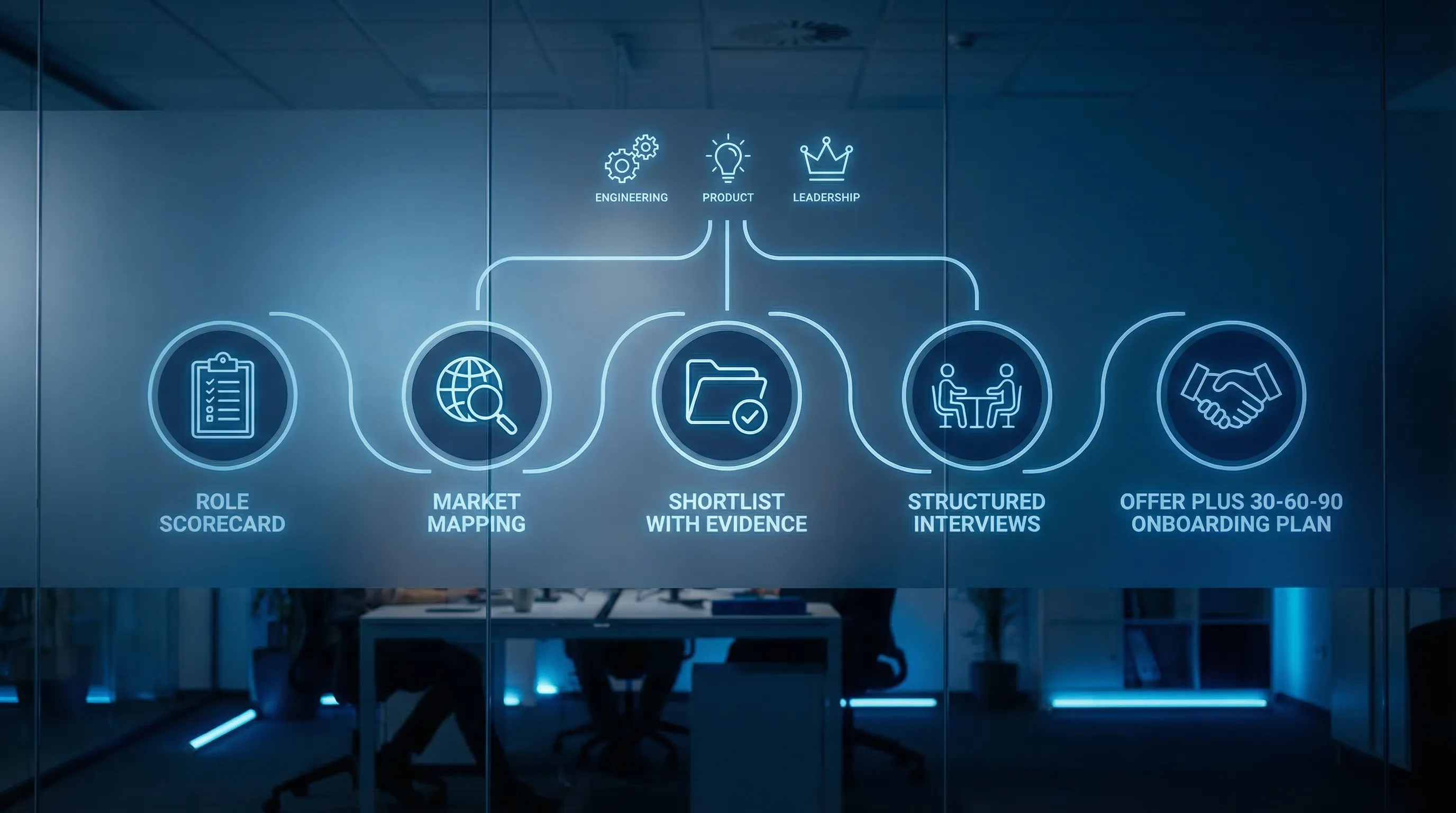
- Role scorecards built with CTO and product leadership (outcomes, operating cadence, team interfaces)
- Market mapping across target hubs plus cross-border outreach to passive candidates
- Shortlist presented with evidence (scope match, delivery signals, leadership behaviours, and technical depth)
- Structured interview plan with consistent evaluation and fast debrief cycles
- Offer strategy aligned to market benchmarks, including clarity on equity and on-call expectations
Timeline: A phased delivery plan, leadership first, then engineering hires in waves, with weekly calibration to maintain interview speed.
Outcome: Leadership hire established clearer engineering management cadence and hiring bar, supporting faster follow-on hiring and reducing late-stage offer drop-off through better compensation alignment.
Frequently Asked Questions (6–8)
What does a SaaS recruitment agency do? A SaaS recruitment agency helps SaaS companies hire engineering, product, commercial, and leadership talent with a process designed for product-led environments. Instead of relying only on job adverts, a specialist partner typically runs market mapping, targets passive candidates, and validates fit against how SaaS teams actually operate (agile development, cloud infrastructure, DevOps, incident response, and cross-functional delivery). The best agencies also advise on levelling, salary benchmarking, and interview design to reduce drop-off and improve time-to-hire.
How long does it take to hire SaaS engineers in Europe? Timelines vary by market, seniority, and clarity of the role. For many mid-level hires, you can see offers within 4 to 8 weeks if the process is disciplined and compensation is aligned. Senior and highly specialised profiles (platform engineering, DevOps, staff-level backend) often take longer, especially if your interview cycle is slow or stakeholders are misaligned. The biggest controllable factor is process speed: clear scorecards, fast feedback, and a consistent assessment plan.
What roles are hardest to hire in SaaS in 2026? The toughest roles tend to combine scarcity with operational accountability. Common examples include senior backend engineers who can scale distributed systems, DevOps and platform engineers who can raise reliability, and product leaders who can balance discovery with delivery in PLG models. Leadership roles such as VP Engineering and Head of Product can be particularly challenging because the candidate pool is smaller and evaluation must be evidence-based. Cross-border searches can expand the pool, but execution must be strong.
How much do software engineers earn in Europe? Compensation depends on country, city, seniority, and company stage. In major hubs, mid-level engineers often sit in a wide band that reflects both local norms and global competition, while senior engineers can command significantly higher packages, especially for platform, cloud, and security-adjacent roles. Beyond base pay, candidates also assess equity, bonus, benefits, remote flexibility, and on-call expectations. Because levelling differs by company, salary benchmarking should be role-specific and calibrated to your precise scope.
Do SaaS companies hire remotely across Europe? Yes, but successful remote hiring requires more than allowing remote work. You need clarity on timezone expectations, collaboration cadence, data security constraints, and how engineering and product management make decisions across distributed teams. Employment model choice also matters, local entity, Employer of Record, or contracting, depending on risk tolerance and speed. Remote expands access to talent, but it also increases competition and offer complexity, so candidate engagement and fast decision-making become more important.
Should startups use recruitment agencies for engineering and product hires? Startups often benefit from specialist support when the role is business-critical, the timeline is tight, or the local talent pool is limited. Agencies can add leverage by accessing passive candidates, running cross-border searches, and advising on compensation and role design. The key is choosing a partner who understands startup and scale-up recruitment realities: changing scope, the importance of cultural fit, equity communication, and the need for speed. For non-critical roles, in-house can work well if you have sufficient bandwidth.
What is the difference between executive search and standard software recruitment? Executive search is typically used for leadership hires where confidentiality, scarcity, and risk are higher, for example CTO, VP Engineering, or Head of Product. It is more structured: deeper role definition, market mapping, targeted outreach, and multi-method assessment. Standard software recruitment can be effective for repeatable hiring at scale, especially when job scope and evaluation criteria are consistent. Many SaaS companies use a hybrid approach: executive search for key leaders and a staffing-style delivery model for engineering and product hiring waves.
How do you reduce time-to-hire without lowering quality? Start with a measurable scorecard, not a generic job description. Align stakeholders on must-haves vs trainables, then run a structured process with fast feedback loops. Use work-relevant assessments (architecture discussion, debugging, product case) rather than long generic interviews. Ensure compensation is benchmarked to market reality before you start, not after you find a favourite candidate. Finally, keep candidate experience tight: clear timelines, one point of contact, and decisive debriefs. Speed comes from discipline, not shortcuts.
Conclusion & Strategic Positioning
SaaS hiring in Europe in 2026 is a strategic constraint for many organisations because the market rewards speed, clarity, and credible offers. The best candidates are often passive, the hardest roles blend engineering depth with operational responsibility, and cross-border recruitment is increasingly essential to build resilient software engineering teams.
A specialist recruitment partner should help you execute the full system: market mapping, executive search, cross-border delivery, salary benchmarking, and candidate vetting designed for product-led teams. If you are building or scaling engineering, product management, and leadership capability across Europe, Optima Search Europe can support with tailored search and selection services for business-critical roles.
To discuss a specific hiring plan, see Optima Search Europe’s recruitment services.

