
Executive Search Agency Europe: How to Hire Senior Leaders

What Is an Executive Search Agency and How Does It Work?
An executive search agency proactively identifies and approaches senior leaders who are not actively looking for new roles, using direct research, talent mapping, and candidate outreach to access the passive talent pool that job advertising cannot reach.
An executive search agency is a specialist firm that places senior leaders at VP, Director, and C-suite level. The C-suite is the group of most senior executives in an organisation, including roles such as CEO, CTO, CFO, CMO, CISO and CPO. These appointments carry strategic, financial and governance risk, so the search process is more rigorous than standard recruitment.
The main difference between executive search and standard recruitment is access. Standard recruitment is typically built around active applicants, job boards, inbound CVs and database matching. Executive search is built around the passive candidate, a highly qualified senior professional who is not actively job-seeking and is often performing well in a current role. At VP and above, the strongest candidates usually need to be identified, approached and engaged directly.
Retained search is the exclusive engagement model used for most executive appointments. It involves a partial upfront fee and a structured search mandate, which allows the search partner to invest in research, market mapping, discreet outreach, assessment and offer management. This differs from contingency recruitment, where agencies are paid only on success and may prioritise faster, lower-risk roles. For C-suite recruitment in Europe, retained search is usually the more appropriate model because the candidate pool is smaller, confidentiality matters and the cost of a poor appointment is materially higher.
A good executive search engagement should include a detailed briefing process, a written role scorecard, candidate market intelligence, regular progress reporting, structured assessment and support through offer negotiation. It should also include an off-limits agreement, meaning the search firm commits not to approach candidates it has placed within the client organisation for a defined period. This protects the client relationship and is standard practice in retained executive search.
For boards and founders comparing an executive search firm in Europe in 2026, the practical question is not whether the firm has a large database. It is whether the firm can map the right market, access passive senior leaders, assess sector-specific performance and manage the process with discretion. For a broader explanation of cross-border senior hiring models, Optima Europe’s guide to international job agencies for senior roles is a useful companion resource.
Summary: Executive search is a proactive, research-led hiring model for senior appointments. It is most effective when delivered on a retained basis, focused on passive candidates and supported by market mapping, structured assessment, confidentiality controls and clear off-limits protections.
The Executive Search Process: From Brief to Placement
A rigorous executive search in Europe follows a structured 8-stage process, from mandate definition to onboarding support, designed to deliver a qualified shortlist within 4-6 weeks and a placement within 10-14 weeks.
- Mandate definition: The search begins with role scope, reporting line, decision rights, success measures, compensation parameters and cultural requirements. For senior leadership recruitment in Europe, this stage should produce a written scorecard covering functional expertise, leadership behaviours, market background, language requirements and deal-breakers. Weak briefs create weak shortlists, especially where multiple stakeholders have different expectations.
- Market mapping: Talent mapping is the research process of identifying all qualified senior candidates in a defined market before outreach begins. A credible map covers target companies, adjacent sectors, relevant geographies, known performers, reporting structures and likely compensation levels. This stage prevents over-reliance on obvious candidates and gives the client real visibility of the available leadership market.
- Confidential outreach: Most senior searches are conducted without advertising because discretion protects both the client and the candidate. Outreach must be personalised, credible and led by consultants who understand the role and sector. Passive candidates rarely respond to generic messages. They engage when the opportunity, mandate, reporting line and strategic context are presented clearly.
- Qualification interviews: Candidates are assessed through structured interviews covering technical depth, commercial track record, leadership maturity, organisational scale, cultural fit and motivation. For VP and C-suite roles, assessment should distinguish between people who have inherited strong conditions and those who have built teams, systems, revenue engines or technology functions through uncertainty.
- Shortlist presentation: A retained executive headhunter in Europe should normally present 4-6 qualified candidates within 4-6 weeks, depending on complexity and market constraints. Each profile should include career evidence, compensation expectations, mobility considerations, availability, risk factors and a clear rationale for inclusion. A shortlist is not a CV bundle; it is an assessed recommendation set.
- Interview process management: The search partner coordinates stakeholder interviews, prepares candidates, collects structured feedback and keeps momentum across time zones, travel schedules and board availability. This stage is particularly important in cross-border searches where delays can cause candidate disengagement or counter-offer risk. Strong process management protects both candidate experience and client decision quality.
- Offer negotiation: Senior offers often include base salary, bonus, equity, relocation support, notice period management and contractual protections. A search partner should benchmark the package, test candidate motivation and manage counter-offer risk before final negotiation. In Europe, long notice periods can make offer timing as important as headline compensation.
- Onboarding support: The process should not stop at signature. A placement guarantee is a contractual commitment to replace a senior hire at no additional cost if the appointment does not work within a defined period, typically 3-6 months. Search partners should also support a 90-day integration plan covering stakeholder alignment, priorities and early performance indicators.
A disciplined process also improves internal decision-making. Boards, CEOs and HR Directors can compare candidates against the agreed scorecard rather than personal preference. That matters in VP, Director and C-suite recruitment because the wrong appointment often leads to delayed revenue, missed product milestones, investor concern or leadership churn.
Summary: The executive search process is not a linear CV sourcing exercise. It is an 8-stage operating model covering mandate definition, market mapping, confidential outreach, assessment, shortlist delivery, interview management, offer negotiation and onboarding support, with typical placement timeframes of 10-14 weeks.
Roles European Executive Search Agencies Hire For
European executive search agencies are most commonly engaged for VP, Director, and C-suite appointments, roles where the best candidates are employed and performing, and where the cost of a wrong hire significantly exceeds the cost of a specialist search.
C-suite appointments
C-suite searches include CEO, CTO, CFO, CISO, CMO and CPO appointments. These are board-level mandates requiring confidential search, detailed assessment and careful stakeholder management. The search must evaluate strategic judgement, operating cadence, investor credibility, cultural impact and the candidate’s ability to lead through scale, restructuring or international expansion.
VP Sales and commercial leadership
VP Level means Vice President, a senior leadership tier below the C-suite, typically responsible for a major function, region or revenue line. VP Sales and commercial leadership is one of the highest-volume executive search categories in European technology because the role has direct impact on pipeline quality, revenue predictability, partner strategy and regional expansion.
VP and Director Engineering
VP and Director Engineering searches require both technical credibility and leadership assessment. Candidates must often combine architecture understanding, hiring capability, delivery discipline, security awareness and product partnership. In SaaS business environments, the best engineering leaders are judged not only by code quality, but by how effectively they scale teams, systems and release velocity.
Marketing leadership
Marketing leadership searches cover Marketing Director, VP Marketing and Chief Marketing Officer roles. The mandate may include brand, demand generation, product marketing, analyst relations, partner marketing or category creation. Strong assessment should test whether candidates have built repeatable growth systems rather than simply managed budget in a mature environment.
People and finance leadership
People and finance leadership appointments include HR Director, Chief People Officer, VP Finance and CFO roles. These roles become especially important when a company moves from founder-led operations to structured scale. Candidates must bring functional expertise, board-level communication and the ability to introduce process without slowing the organisation.
European technology companies often need several of these roles in sequence. A Series B company may hire a VP Sales before a VP Marketing; an enterprise software firm may prioritise a CISO before entering regulated markets. Optima Europe’s SaaS and software recruitment agency guide explores how those leadership priorities change by stage and function.
Summary: Executive search is most appropriate for C-suite, VP and Director-level roles where confidentiality, passive candidate access and structured assessment are essential. The most common mandates span commercial, engineering, marketing, people and finance leadership.
Executive Search Across European Markets: Key Differences
Executive search in Europe is not a single market, notice periods, language requirements, compensation norms, and passive candidate behaviour vary significantly between the UK, Germany, Netherlands, France, and the Nordics.
United Kingdom
The UK has one of Europe’s largest executive talent pools, especially across London, Cambridge, Manchester and the broader technology corridor. Notice periods are commonly 1-3 months for senior leaders, which can make hiring cycles faster than Germany or France. For cross-border appointments, employers must also check right-to-work status, with official guidance available through UK government right-to-work checks.
Germany
Germany offers deep leadership talent across enterprise software, industrial technology, cybersecurity, data, manufacturing and engineering-led businesses. Three-month notice periods are common, and senior candidates may be less responsive to speculative outreach unless the mandate is clearly positioned. German language requirements can significantly narrow the candidate pool, while Munich often carries a compensation premium for senior technology and commercial profiles.
Netherlands
The Netherlands is one of the most internationally accessible executive search markets in Europe. Amsterdam, Rotterdam, Utrecht and Eindhoven provide strong English-language leadership talent, especially across SaaS, fintech, healthtech and engineering. The 30% ruling can support relocation economics for eligible international hires, although employers should always verify current tax conditions before structuring an offer.
France
France has a strong pool of commercial, product, engineering and technology leadership talent, particularly in Paris, Lyon, Lille and Toulouse. French language capability is often required for country leadership, enterprise sales and public-sector-facing roles. International companies should be realistic about local employment expectations, decision cycles and compensation norms when approaching senior French candidates.
Nordics
The Nordics, especially Copenhagen, Stockholm and Helsinki, produce strong senior commercial, product and technology leaders with international exposure. Cross-border activity is increasing, but candidate mobility can be selective because quality of life, family considerations and local market strength influence decisions. Compensation structures should be benchmarked carefully against both local norms and pan-European alternatives.
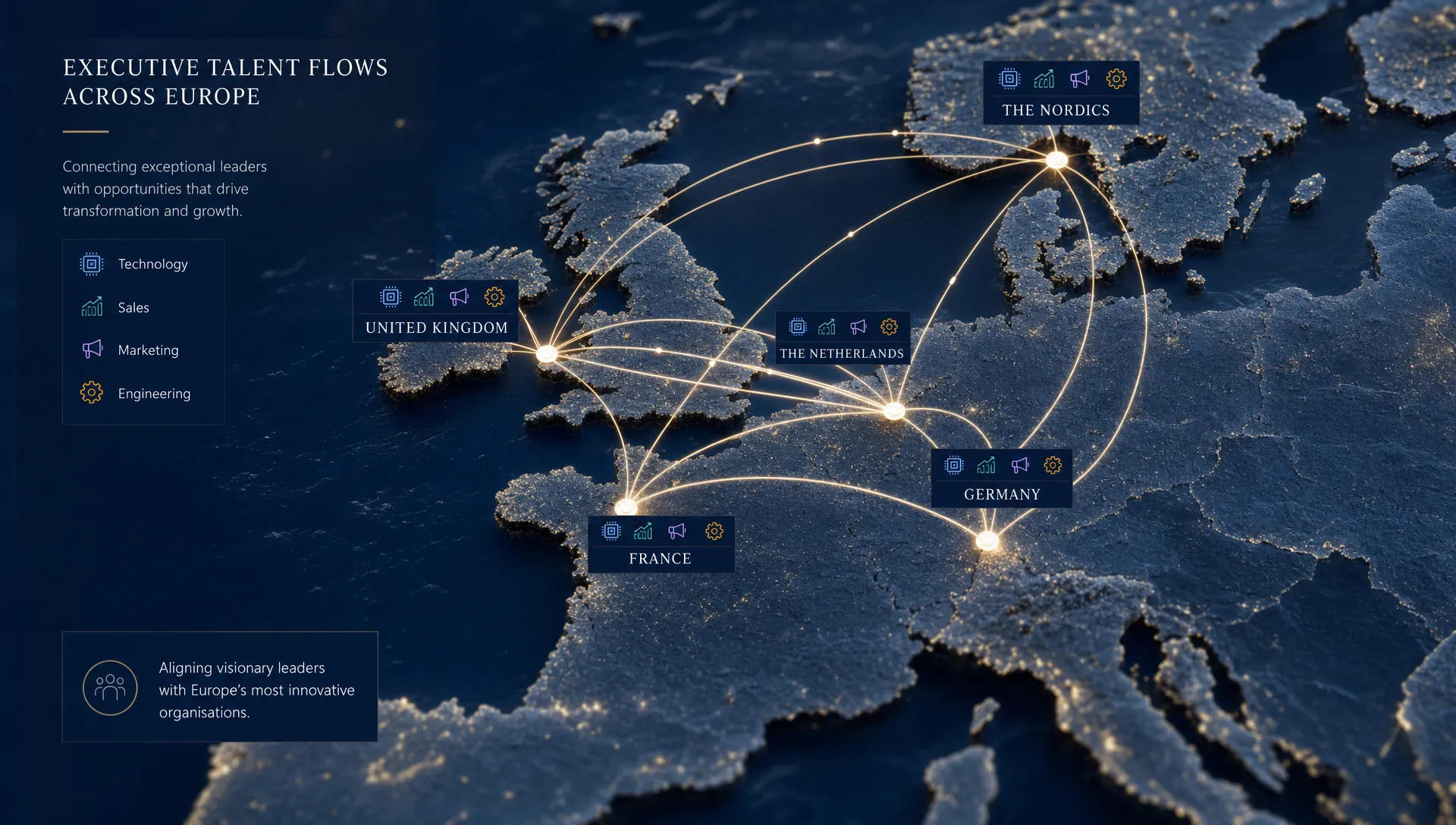
A pan-European executive search agency must understand these differences before outreach begins. The same VP Sales profile may require different messaging in London, Amsterdam and Munich. The same CTO search may need different language assumptions, notice planning and compensation framing depending on whether the mandate is local, regional or global.
Summary: European executive search requires country-level judgement. The UK offers depth and speed, Germany offers technical and industrial strength with longer notice periods, the Netherlands offers international accessibility, France offers strong local leadership talent and the Nordics offer high-quality cross-border candidates with selective mobility.
Executive Search Fee Structures in Europe
Executive search agencies in Europe charge 25-33% of first-year base salary on a retained basis, paid in three stages to ensure full commitment throughout the search process.
The standard retained search fee structure is usually split across three milestones: engagement, shortlist and placement. The engagement payment funds research, market mapping and direct outreach. The shortlist payment reflects delivery of assessed candidates. The final payment is made when the appointment is completed. Exact terms vary by role level, exclusivity, geography and complexity.
For a senior appointment on a €160,000 base salary, typical European executive search fees are commonly structured as follows:
- VP / Director: Typical fee of 25-28%, equal to approximately €40,000-€44,800 on a €160,000 base salary.
- C-suite: Typical fee of 28-33%, equal to approximately €44,800-€52,800 on a €160,000 base salary.
- Board / Chair: Typical fee of 30-35%, equal to approximately €48,000-€56,000 on a €160,000 base salary.
The fee covers more than candidate introduction. It funds research capability, consultant time, access to passive candidates, candidate assessment, compensation benchmarking, market intelligence, process management and offer negotiation. For confidential mandates, it also protects the client from public market signalling. A senior search that exposes strategic change, fundraising pressure or leadership succession too early can create avoidable commercial risk.
Retained search generally outperforms contingency recruitment for senior roles because it creates commitment on both sides. The client commits to one partner with a clear mandate. The search partner commits research and delivery resources before a candidate is guaranteed. Contingency models can work for mid-level hiring, but they often fail at C-suite and VP level because passive candidates require careful engagement, not transactional CV submission.
The cost should also be compared with the value of the vacant role. A vacant VP Sales position can delay regional revenue growth. A missing CTO can slow platform decisions, security maturity or engineering hiring. A weak CMO can misallocate demand investment for multiple quarters. In that context, the search fee is usually a risk-control mechanism rather than a procurement line item.
Placement guarantees should be reviewed carefully. A standard 3-6 month replacement commitment is useful, but only if the original assessment process is rigorous and the client follows a disciplined onboarding plan. Guarantees do not compensate for unclear mandates, slow interview processes or misaligned stakeholder expectations.
Summary: European executive search fees are typically 25-33% of first-year base salary, with Board and Chair mandates sometimes reaching 35%. The retained model funds research, outreach, assessment and process control, and is usually more effective than contingency recruitment for senior leadership appointments.
What Makes a Strong Executive Search Agency in Europe
The difference between a strong and a weak executive search agency in Europe is not the size of the firm, it is sector specialisation, passive candidate network depth, and the commitment that comes from a retained engagement model.
Sector specialisation
Sector specialisation means recruiting exclusively within defined industry verticals, producing deeper candidate networks and better market intelligence than generalist firms. A specialist partner understands which companies produce relevant leaders, which profiles are overvalued, what compensation is realistic and which career patterns predict success. Optima Europe focuses across seven technology verticals: Marketing Technology SaaS, Cloud Platform Engineering, Data Analytics and AIOps, AI Infrastructure and Responsible AI, Cybersecurity Governance and Risk, Digital Health, MedTech and Biotech, and Smart Manufacturing and Industrial AI.
Fill rate
Fill rate is a practical measure of search quality. Difficult senior mandates handled by generalist or low-commitment agencies can operate close to a 30% success level, particularly where the role is niche, confidential or cross-border. Specialist retained firms should operate at 80% or above. Optima Europe’s retained search methodology is designed to deliver an 85-90% placement success rate across business-critical and senior executive roles.
Transparent process
A strong agency defines timelines, reports weekly progress, explains market response and gives honest feedback on compensation, role positioning and candidate quality. Weak agencies hide behind activity metrics. Strong firms show the market map, explain who is engaging, identify objections and advise the client when the brief needs refinement.
Cross-border capability
European leadership hiring often crosses borders, especially for VP Sales Europe, CTO, CMO, CISO and regional General Manager roles. A credible partner should show evidence of placements across the UK, Germany, Netherlands, France and beyond. Cross-border capability includes language judgement, compensation benchmarking, right-to-work awareness, relocation considerations and local candidate engagement norms.
Placement guarantee
A placement guarantee signals confidence, but it should not be the main reason to choose a firm. The better indicator is whether the agency can explain why its process reduces failure risk before the guarantee is needed. For senior leadership recruitment in Europe, the guarantee should sit alongside structured assessment, reference discipline and onboarding support.
No internal sales targets
A no internal sales targets policy means consultants are not pushed to maximise CV volume or short-term transaction count. For executive search, this matters. Senior candidates expect considered representation, and clients need judgement rather than activity. Consultants should be measured on placement quality, process integrity and long-term client outcomes.
Optima Europe combines retained executive search with pan-European reach and specialist technology sector depth. For companies hiring in advanced technical markets, Optima’s guide to executive search for AI and deep tech leaders shows how candidate scarcity changes the search strategy at board and VP level.
Summary: A strong executive search agency in Europe is specialised, retained, transparent and cross-border capable. The strongest indicators are sector expertise, passive candidate access, high fill rate, disciplined process, placement guarantee and consultant incentives aligned to quality rather than volume.
Case Study
A retained executive search agency can compress multiple senior leadership appointments when the mandate, market mapping and assessment process are run in parallel rather than sequentially.
A Series B HealthTech company headquartered in Amsterdam needed to expand its European leadership team across three business-critical roles: VP Sales Europe, Marketing Director and VP Engineering. The company had product traction, investor backing and a clear regional expansion plan, but lacked the senior leadership capacity to scale commercial execution, marketing demand generation and engineering delivery at the same time.
The challenge was timing. Hiring the VP Sales first would have delayed marketing alignment. Hiring VP Engineering separately would have slowed product and platform decisions. The board needed all three leaders appointed within 16 weeks, without relying on public advertising or exposing the scale of the leadership build-out to competitors.
The search was run on a retained basis across all three roles simultaneously. The process began with mandate definition for each position, followed by market mapping across the UK, Germany and the Netherlands. Candidate outreach focused on passive leaders in relevant HealthTech, SaaS, software, digital health and regulated technology environments. Assessment was structured around role-specific competencies and shared scale-up requirements: operating under investor scrutiny, hiring teams across Europe and building repeatable processes without excessive bureaucracy.
The VP Sales Europe was placed in week 9, bringing experience in regional revenue build-out and enterprise healthcare sales. The Marketing Director was placed in week 12, with a background in demand generation, product marketing and category positioning. The VP Engineering was placed in week 15, after a more technical assessment process covering architecture, security, team design and delivery cadence.
All three leaders remained in post at the 24-month mark. The key success factor was not speed alone. It was parallel market mapping, clear role scorecards, direct passive outreach and structured assessment across three connected leadership mandates.
Summary: Multi-role executive search works when the client and search partner define the leadership system, not just isolated job descriptions. Running retained searches in parallel can reduce delay, protect confidentiality and create stronger alignment across commercial, marketing and engineering leadership.
Frequently Asked Questions
The questions below cover the five decision points buyers most often evaluate before engaging an executive search agency in Europe: definition, timeline, cost, seniority threshold and selection criteria.
What is an executive search agency and how is it different from a recruitment agency? An executive search agency is a specialist firm that proactively identifies, approaches and assesses senior leaders, usually at Director, VP and C-suite level. A standard recruitment agency often works with active applicants, advertised vacancies and existing databases. Executive search is different because it targets passive candidates who are already employed and unlikely to apply for roles. It also uses retained search, market mapping, confidential outreach and structured assessment. For senior appointments, the value is not simply access to CVs; it is judgement, discretion and the ability to engage leaders who are not visibly available.
How long does executive search take in Europe? A well-run executive search in Europe typically delivers a qualified shortlist within 4-6 weeks and a completed appointment within 10-14 weeks. The timeline depends on role complexity, geography, notice periods, stakeholder availability and compensation alignment. Germany and France can involve longer notice and decision cycles than the UK or Netherlands. C-suite roles may also take longer because board alignment, confidentiality and assessment depth are more demanding. The fastest searches usually have a clear mandate, realistic compensation, one accountable decision group and a search partner with an existing network in the relevant sector.
How much does executive search cost in Europe? Executive search in Europe usually costs 25-33% of first-year base salary on a retained basis, with Board or Chair mandates sometimes reaching 35%. The fee is normally paid in three stages: engagement, shortlist and placement. For a €160,000 base salary, that means approximately €40,000-€52,800 for most VP, Director and C-suite appointments, depending on seniority and complexity. The fee covers research, talent mapping, passive candidate outreach, assessment, compensation advice, interview management and offer negotiation. Clients should evaluate cost against the commercial impact of a vacant or mis-hired senior role.
What seniority level requires executive search rather than standard recruitment? Executive search is usually appropriate for C-suite, VP, Director, Board, Country Manager and other business-critical leadership roles. It is also appropriate for confidential replacements, niche technical leadership, cross-border mandates and roles where the best candidates are unlikely to be actively job-seeking. Standard recruitment may work well for mid-level or high-volume hiring. The threshold is not only job title; it is market scarcity, confidentiality, business impact and candidate availability. If the role requires direct access to employed senior leaders and careful assessment, executive search is usually the stronger model.
How do I choose the right executive search agency in Europe? Choose an executive search agency based on sector specialisation, relevant placement evidence, passive candidate reach, retained process quality and cross-border capability. Ask how the firm maps the market, how many candidates it expects to approach, what shortlist timeline it commits to and how it assesses leadership fit. Check whether it offers a placement guarantee and whether consultants are measured on quality rather than CV volume. For European searches, country knowledge matters: language requirements, notice periods, compensation norms and mobility expectations can materially affect outcome. The right partner should challenge the brief, not simply accept it.
Conclusion & Strategic Positioning
Senior leadership appointments in Europe require a retained, sector-specialist search partner because the strongest VP, Director, and C-suite candidates are usually employed, geographically dispersed, and unavailable through job advertising.
For boards, CEOs, founders, CHROs and functional leaders, the decision to use an executive search agency in Europe is usually triggered by one of three conditions: the role is too important to leave to inbound applicants, the candidate market is too narrow for standard recruitment, or the appointment requires confidentiality and direct access to passive leaders. In all three situations, process quality matters as much as network size.
The strongest searches start with a precise mandate, continue through disciplined talent mapping and confidential outreach, and end with structured assessment, negotiated acceptance and onboarding support. They also reflect European market reality: notice periods, compensation expectations, language requirements and candidate mobility vary significantly by country.
Optima Europe operates as a specialist executive search agency for senior and business-critical hiring across Europe and globally. Its retained methodology, pan-European reach and technology sector depth are designed for VP, Director and C-suite appointments across markets including the UK, Germany, Netherlands, France and beyond. For organisations that need leadership hires to support growth, transformation or international expansion, a focused executive search partner can turn a difficult market into a controlled, evidence-led hiring process.
To discuss a senior leadership mandate or benchmark the available market before launching a search, boards and executive teams can engage Optima Europe for a confidential consultation on role scope, candidate availability and search strategy.

