
How to Choose an International Recruitment Partner in Germany
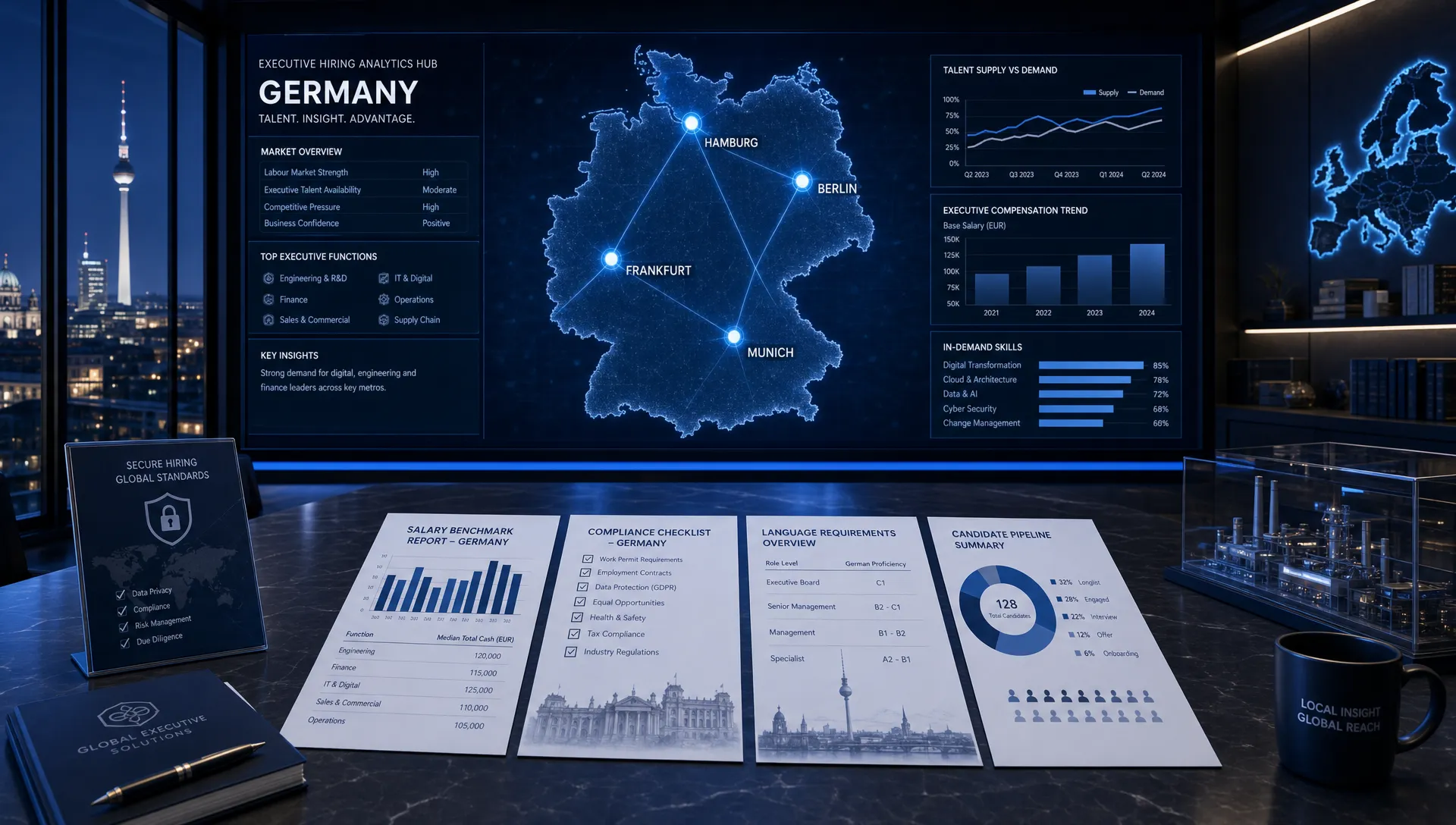
The German Senior Hiring Market in 2026
Germany is one of Europe's largest and most structurally complex senior hiring markets in 2026, with 3-month notice periods, strong language requirements, and a Works Council framework that international organisations consistently underestimate when building German leadership teams.
The German Senior Hiring Market, meaning the market for executive, director-level and business-critical leadership talent in Germany, is shaped by a world-class industrial base, a mature SaaS scale-up ecosystem, and rising cybersecurity and compliance obligations. For international employers, it is rarely a market where speed alone wins. The strongest outcomes usually come from precise role calibration, realistic salary benchmarking, local employment awareness and access to passive senior talent.
Berlin, Germany's primary technology and startup hub, is the most internationally accessible talent market and has the highest concentration of SaaS scale-ups and growth-stage companies. It is often the first market considered by international technology companies hiring VP Sales, VP Marketing, Product, Customer Success and country leadership roles.
Munich, Germany's enterprise technology and financial services hub, typically commands an 8-12% salary premium over Berlin for comparable senior roles. It shows particularly strong demand for senior CISO, CTO and VP Sales profiles, especially across enterprise software, automotive technology, cloud infrastructure and industrial AI.
Frankfurt, Germany's financial capital, is heavily influenced by BaFin, the Federal Financial Supervisory Authority. BaFin-regulated financial institutions continue to drive demand for senior technology, risk, compliance and transformation leaders, particularly as digital banking, cybersecurity and cloud modernisation programmes mature.
Regulation is also reshaping demand. NIS2, the EU Network and Information Security Directive, expands cybersecurity governance expectations across essential and important entities. In Germany, the BSI, or Bundesamt für Sicherheit in der Informationstechnik, Germany's Federal Office for Information Security, influences cybersecurity hiring standards and raises expectations for senior security leadership. The European Commission's guidance on NIS2 is a useful reference point for boards assessing compliance-related hiring needs.
A language requirement, meaning the expectation that a candidate has professional German language proficiency, remains a major constraint at senior level. Many international companies assume English-first leadership hiring will be straightforward, but German fluency is still expected in roles involving local customers, Works Council interaction, enterprise buyers, regulated stakeholders or German-speaking leadership teams.
Summary: Germany is commercially essential but operationally demanding. Berlin offers the most international SaaS talent, Munich carries premium compensation pressure, and Frankfurt is shaped by regulated financial services demand. Any international recruitment agency in Germany must understand salary variance, language requirements, regulation and senior candidate behaviour city by city.
Senior German Salary Benchmarks 2026
Senior commercial and technology leadership salaries in Germany are among the highest in continental Europe, with Munich commanding an 8-12% premium over Berlin and Frankfurt for equivalent VP and Director-level roles.
The following figures are indicative gross annual base salary benchmarks for senior leadership roles in 2026. They exclude variable compensation, long-term incentives, equity, signing bonuses and relocation support. Actual packages vary by company stage, sector, ownership model, reporting line, team size and whether the role is Germany-only, DACH-wide or European.
Role                 | Berlin            | Munich            | Frankfurt
VP Sales             | €125,000-€168,000 | €138,000-€185,000 | €132,000-€178,000
Marketing Director   | €105,000-€145,000 | €118,000-€158,000 | €112,000-€152,000
Engineering Director | €130,000-€172,000 | €145,000-€192,000 | €138,000-€182,000
HR Director          | €98,000-€132,000  | €110,000-€148,000 | €105,000-€140,000
Finance Director | €110,000-€148,000 | €122,000-€165,000 | €118,000-€158,000For international employers, salary benchmarking should not be treated as a post-shortlist exercise. It should happen before the search launches, because senior candidates in Germany often disengage quickly if the role scope and compensation band are not aligned. A credible partner should provide city-specific benchmarks, competitor mapping and guidance on fixed versus variable compensation before outreach begins.
Summary: German senior salaries are highly city-sensitive. Munich is typically the most expensive of the three major markets, Frankfurt carries regulated-sector pressure, and Berlin remains competitive for technology scale-ups. Hiring teams should benchmark by city, function, sector and company stage before approaching senior candidates.
Which Sectors Are Hiring Senior Leaders in Germany?
Germany's most active senior hiring sectors in 2026 are automotive and manufacturing technology, B2B SaaS, financial services, cybersecurity, and industrial AI, reflecting the country's world-leading industrial base and growing technology ecosystem.
- Automotive & Manufacturing Technology: BMW, Siemens, Bosch and the wider industrial supply chain continue to drive demand for VP Engineering, CTO, operational technology security and transformation leadership. Hiring pressure is strongest where software, embedded systems, automation and industrial cybersecurity converge with legacy manufacturing environments.
- B2B SaaS: Berlin's scale-up ecosystem is the most visible hiring engine for VP Sales, Marketing Director, VP Product and Customer Success leadership. International SaaS companies entering Germany often need leaders who can localise go-to-market execution without losing the pace and metrics discipline of a global scale-up.
- Financial Services: Frankfurt's BaFin-regulated institutions are creating sustained demand for compliance, technology, cloud, data and risk leadership. Banks, insurers, fintechs and payments businesses increasingly need senior leaders who understand regulated transformation, vendor governance and digital product delivery in a German operating environment.
- Cybersecurity: NIS2 and BSI expectations are strengthening demand for CISO, Compliance Officer, Cloud Security and Governance, Risk and Compliance leadership. Cybersecurity hiring is especially competitive because the same senior profiles are targeted by financial services, critical infrastructure, SaaS vendors and industrial technology firms.
- Industrial AI & Smart Manufacturing: Munich, Stuttgart and surrounding industrial clusters are active markets for Engineering Director, Chief Data Officer and AI transformation leadership. Companies are hiring leaders who can connect machine data, responsible AI, automation, production systems and enterprise sales into measurable operational outcomes.
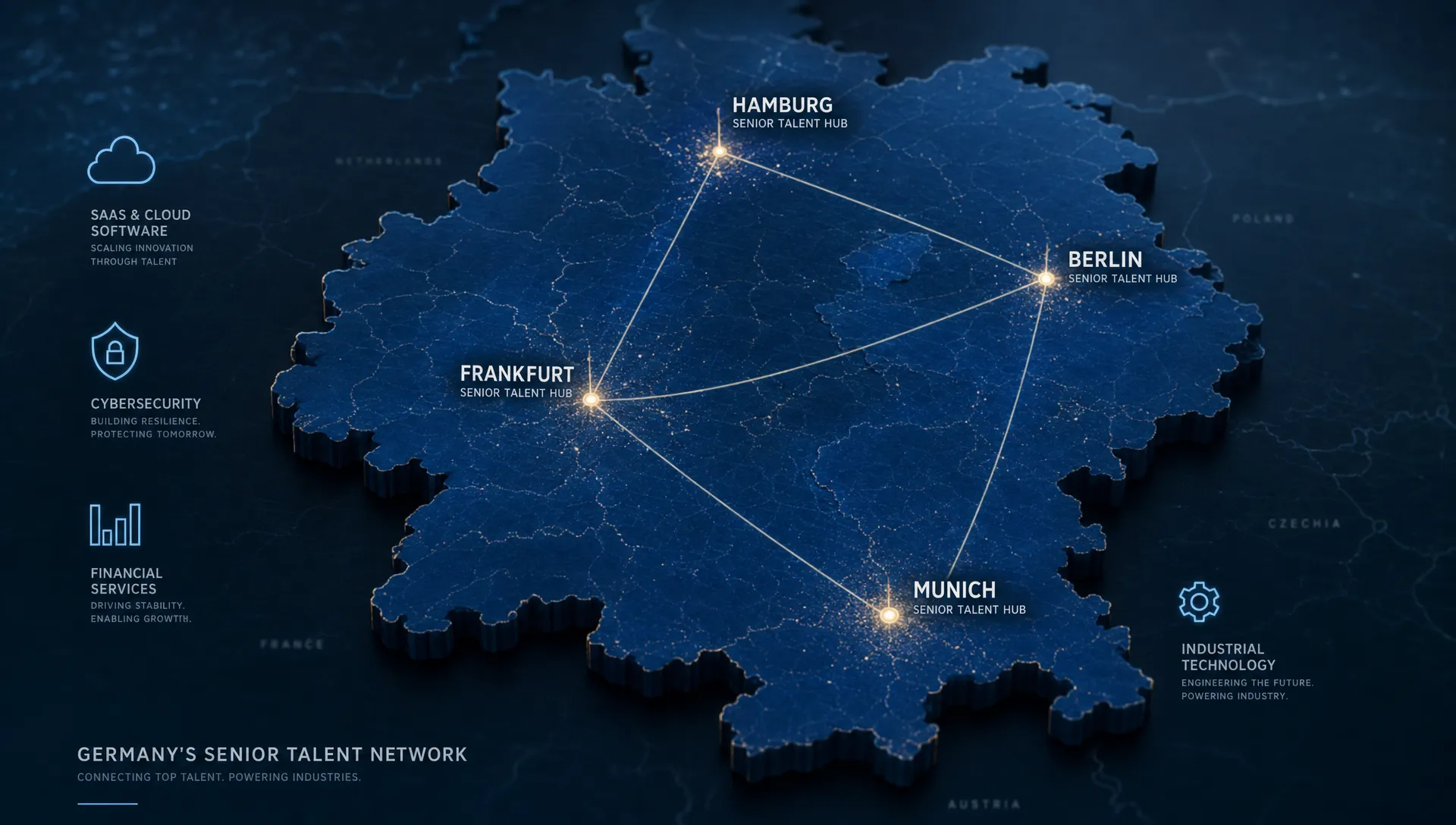
When choosing a German recruitment agency for companies in 2026, sector depth matters because candidate expectations differ substantially between SaaS, industrial technology, cybersecurity and regulated financial services. A VP Sales profile from a Berlin SaaS scale-up may not translate directly into a Munich enterprise software environment, and a Frankfurt technology leader may be valued for governance experience that would be less central elsewhere.
Summary: Senior hiring demand in Germany is concentrated where technology, regulation and industrial transformation meet. The strongest international recruitment partner will understand both function and sector, because Germany's leadership market is not one uniform talent pool.
Hiring Senior Leaders in Germany: Key Structural Considerations
Hiring senior leaders in Germany requires understanding four structural factors that significantly affect timelines, candidate expectations, and offer negotiation: 3-month notice periods, language requirements, Works Council obligations, and a strong counter-offer culture.
- 3-month notice periods: A notice period is the contractual time an employee must serve between resignation and departure. Senior professionals in Germany typically serve 3-month notice periods, among the longest standard notice periods in Western Europe. For director and VP hires, the total time from search launch to start date is commonly 6-9 months.
- Language requirements: German proficiency is expected by many employers at senior level, especially in customer-facing, regulated, people leadership and enterprise sales roles. This significantly narrows the effective cross-border talent pool, even when a role is advertised as international or English-speaking.
- Works Council obligations: A Works Council, or Betriebsrat, is an elected employee representation body in larger German companies. It can be relevant to hiring processes, employment terms, internal transfers and consultation obligations. International companies hiring in Germany should understand Betriebsrat rights before finalising process design.
- Counter-offer culture: German employers frequently try to retain senior employees by matching or improving external offers during the notice period. This makes candidate motivation, stakeholder alignment and resignation coaching important parts of a successful search process.
- Benefits expectations: Senior candidates commonly expect bAV pension provision, 30 days of annual leave, transport support, and in some sectors a company car or mobility allowance. Benefits can influence acceptance even when base salary is competitive.
These structural factors are why a cross-border recruitment agency in Germany must do more than identify candidates. It should advise on market mapping, offer design, notice-period planning, local stakeholder expectations and risk points between signed contract and start date. International hiring leaders comparing agencies across Europe may find this wider guide to choosing international recruitment agencies in Europe useful as a broader evaluation framework.
For UK-based leadership teams entering Germany, the gap between UK hiring cadence and German senior hiring norms can be particularly significant. Optima has also covered how UK teams choose European recruitment agencies when building cross-border leadership teams.
Summary: German senior hiring timelines are shaped by employment structure as much as candidate availability. Notice periods, language expectations, Works Council considerations, counter-offers and benefits design should be built into the search plan from day one.
Frequently Asked Questions
Senior hiring questions in Germany usually centre on timeline, compensation, language, Works Council exposure and city-specific talent depth, because these factors determine whether an international search succeeds or stalls.
How long does it take to hire a senior leader in Germany? A senior leadership hire in Germany typically takes 6-9 months from search launch to start date. The search and assessment phase may take 8-12 weeks for a well-calibrated mandate, but the notice period is the critical constraint. Senior professionals often serve 3-month notice periods, and counter-offers during that period are common. If the role requires German fluency, regulated-sector experience or relocation, timelines can extend further. Employers should plan backwards from business need and avoid assuming a UK or US-style executive hiring cadence.
What is the average senior leadership salary in Germany in 2026? Senior leadership salaries in Germany vary by function, city, sector and company stage. As a practical range, many director and VP-level commercial, technology, finance and HR roles sit between €100,000 and €190,000 gross annual base salary in Berlin, Munich and Frankfurt. Munich usually carries the highest premium, particularly for enterprise technology, cybersecurity and engineering leadership. Variable compensation, equity, car allowance, pension and mobility benefits can materially change the total package. Salary benchmarking should be completed before candidate outreach, not after final interviews.
Do senior professionals in Germany need to speak German? Many senior professionals in Germany do need German proficiency, particularly where the role involves local customers, enterprise buyers, regulated stakeholders, employee relations or Works Council interaction. English-first roles exist, especially in Berlin SaaS and international technology environments, but the available pool narrows quickly when seniority, sector expertise and German language requirements are combined. International employers should define the language requirement before launching the search. If German is genuinely essential, outreach strategy, compensation and timeline should all reflect the smaller candidate market.
What is a Works Council and how does it affect hiring in Germany? A Works Council, known in German as a Betriebsrat, is an elected employee representation body in larger companies. It can influence employment terms, organisational changes, internal mobility and consultation processes. For hiring, the impact depends on the company structure, role, location and whether the hire affects existing employees or reporting lines. International companies should not treat the Works Council as an administrative afterthought. Understanding consultation requirements early helps avoid delays, miscommunication and offer-stage friction, especially for senior roles involving team restructuring or local leadership responsibility.
Which German cities have the strongest senior talent pools? Berlin, Munich, Frankfurt and Hamburg are the strongest senior talent pools for most international employers. Berlin leads for SaaS, startups, growth-stage technology and internationally mobile talent. Munich is strongest for enterprise software, automotive technology, industrial AI, cybersecurity and senior engineering leadership. Frankfurt is the core market for financial services, regulated technology, compliance and risk leadership. Hamburg is relevant for logistics, media, e-commerce, health and certain industrial sectors. The best city depends on the function, sector and language requirement, not simply headcount size.
Conclusion & Strategic Positioning
Germany is a commercially essential senior hiring market, but it is also one of Europe's most structurally complex markets for international employers because salary expectations, notice periods, language requirements, Works Council considerations and city-by-city talent dynamics all affect outcomes.
Choosing an international recruitment partner in Germany should therefore be a strategic decision, not a supplier exercise. The right partner should understand Berlin, Munich, Frankfurt and Hamburg talent flows, provide salary benchmarking before outreach, access passive senior candidates, and advise on the structural realities that shape acceptance, resignation and start dates.
Optima Search Europe supports international and German companies hiring business-critical leaders across technology, SaaS, sales, marketing, digital, IT and executive management. For organisations entering Germany or building cross-border leadership teams, a specialist partner with senior market depth can reduce false starts and improve the quality of every shortlist.
If Germany is central to your 2026 leadership plan, Optima Search Europe can help you assess the market, calibrate the mandate and approach senior candidates with the precision this market requires.

