
How SaaS in Cloud Computing Changes Team Design

SaaS has moved far beyond a delivery model. For CEOs, CROs, COOs and talent leaders, it now reshapes how the entire company is designed, from engineering and product to sales, customer success, finance, security and leadership.
In older software organisations, teams were often built around releases, implementation projects and account ownership. In SaaS, the product is live, usage is measurable, revenue is recurring and customer value is continuously earned. That changes the operating rhythm of the business and, by extension, the roles you need in the room.
When leaders discuss software as a service in cloud computing, they often focus on architecture, hosting costs or subscription revenue. Those matter, but the deeper strategic question is organisational: how should a team be structured when product, data, go-to-market and customer outcomes are all connected in real time?
Why SaaS changes the shape of the organisation
Cloud-based SaaS compresses the distance between what a customer does, what the product team sees and what the commercial team must act on. Usage data, onboarding friction, support tickets, renewal risk, product adoption and expansion signals can all surface quickly if the business is designed to capture and interpret them.
That creates a different management problem. The company can no longer afford isolated functions that only hand work over at fixed milestones. Instead, SaaS companies need teams that can sense, decide and adapt continuously.
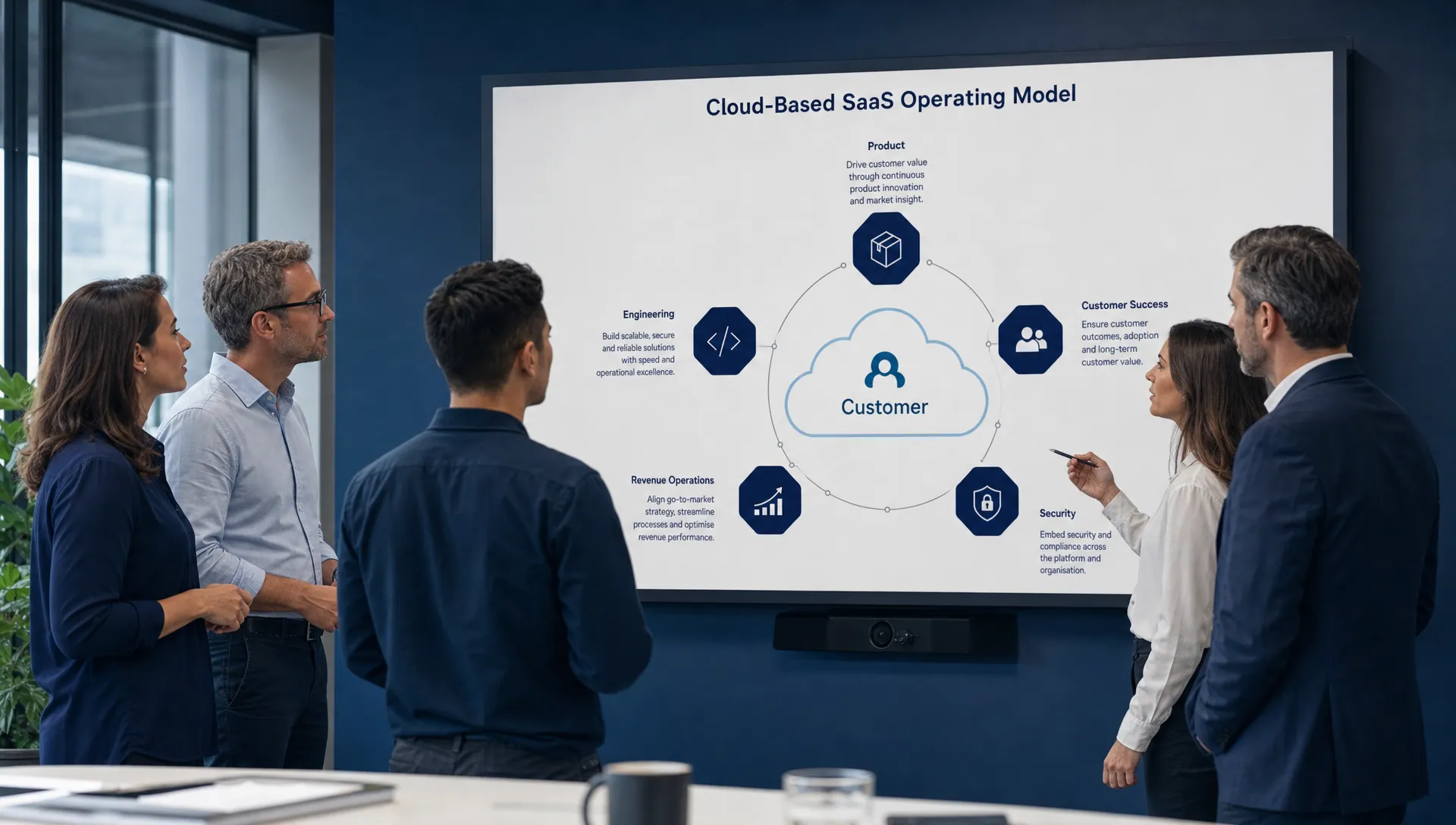
In practical terms, SaaS changes team design in five ways:
- Product and engineering become continuous value teams, not release factories.
- Customer success becomes a revenue protection and expansion function, not only a support layer.
- Sales and marketing need tighter segmentation, data discipline and product feedback loops.
- Security, reliability and compliance become part of the customer proposition.
- Leadership roles become more cross-functional, especially across revenue, product and operations.
This is why SaaS hiring cannot be treated as simply hiring more developers, more account executives or more support staff. The team model itself has to evolve.
From project teams to product-led operating teams
Traditional software businesses often organised teams around major releases or client implementation projects. SaaS changes that. Because the product is continuously improved and delivered through the cloud, companies need teams that own outcomes over time.
A product-led operating team typically combines product management, engineering, UX, data, QA, DevOps or platform capability and customer insight. The goal is not only to ship features. It is to improve adoption, retention, performance and commercial impact.
That changes the profile of senior hires. A VP Engineering in a SaaS environment must think about uptime, scalability, technical debt, developer velocity and customer impact. A product leader must be able to prioritise based on usage patterns, market positioning, commercial goals and customer feedback. A data leader must make product analytics usable for both technical and revenue teams.
For a broader view of the roles needed as a SaaS platform matures, Optima’s guide to key roles to build and scale a Software-as-a-Service platform gives useful context on how hiring priorities shift by stage.
The central point is simple: SaaS teams need ownership of measurable product and customer outcomes, not only departmental activity.
Revenue teams become lifecycle teams
SaaS also changes the design of commercial teams. In a recurring revenue model, the initial sale is only the beginning of the customer economics. Renewal, expansion, usage growth, advocacy and churn prevention all influence enterprise value.
That means the classic sales structure, marketing generates leads, sales closes contracts, support handles issues, is often too linear. Modern SaaS companies need lifecycle revenue teams where marketing, sales, customer success, revenue operations and product marketing are tightly aligned.
This changes role design in several ways. Account executives need to understand use cases, buying committees and long-term value. Customer success leaders need commercial judgement, not only relationship management skills. Product marketing must translate product capability into market relevance. Revenue operations becomes the connective tissue that prevents fragmented data, inconsistent forecasting and poor handovers.
For founder-led B2B SaaS companies, this revenue architecture can be particularly difficult because the founder often still carries key customer knowledge, sales intuition and strategic positioning. External revenue specialists such as Billionaires in Boxers can be relevant where leadership teams need to accelerate revenue systems, clarify growth constraints and professionalise go-to-market execution without losing founder-market insight.
The hiring lesson is that SaaS revenue design is not only about headcount growth. It is about defining which roles own acquisition, activation, retention and expansion, then ensuring incentives and systems support the full customer lifecycle.
Customer success moves closer to product and revenue
In SaaS, customer success is often one of the most misunderstood functions. In weaker team designs, it becomes a catch-all department for onboarding problems, support escalations, renewal firefighting and customer sentiment. In stronger organisations, customer success is a strategic function that links product usage, customer value and recurring revenue.
The difference lies in role clarity.
Customer success managers should not be asked to compensate for weak onboarding, unclear product value or poor qualification. Instead, their role should be designed around measurable outcomes such as adoption, time to value, renewal health, expansion readiness and executive stakeholder engagement.
This requires close alignment with product. If customers repeatedly fail to adopt a feature, the answer may not be more training. It may be poor UX, weak implementation design, unclear messaging or the wrong customer segment. A SaaS organisation needs team structures that make these signals visible and actionable.
Customer success also needs alignment with finance and revenue operations. Metrics such as gross revenue retention, net revenue retention, customer acquisition cost payback and expansion revenue are not abstract board metrics. They should influence how customer-facing teams are staffed and where leadership attention is focused.
Cloud architecture creates new leadership dependencies
SaaS is made possible by cloud computing, but cloud infrastructure also introduces dependencies that influence team design. Reliability, security, data protection, cost optimisation and scalability are not back-office concerns. They directly affect customer trust, margins and enterprise readiness.
This is particularly important for SaaS businesses selling into regulated, enterprise or international markets. A cloud-native product may scale quickly, but it also needs leadership capability around:
- Platform engineering and infrastructure reliability.
- Cloud cost management and commercial margin discipline.
- Security architecture and governance.
- Data privacy and regional compliance.
- Incident response and customer communication.
These responsibilities often sit awkwardly between engineering, operations, finance, legal and customer teams. If ownership is unclear, problems show up as margin erosion, delayed enterprise deals, security concerns or slow product velocity.
The solution is not always to hire a large platform team immediately. It is to understand the company’s stage, risk profile and customer base, then design leadership accountability accordingly. In some businesses, a strong Head of Platform or VP Engineering may be enough. In others, especially those entering enterprise or regulated markets, security and compliance leadership may need to be elevated earlier.
Optima has explored how IaaS, PaaS and SaaS shape modern hiring in tech, including how each model changes the technical and commercial profiles companies need.
The rise of RevOps, DataOps and ProductOps
As SaaS companies scale, operational complexity increases. More customers, more product data, more sales motions, more pricing options and more market segments can quickly overwhelm informal coordination.
This is where operational roles become essential. Revenue operations, product operations and data operations help the company scale decision-making without adding unnecessary bureaucracy.
RevOps creates discipline around pipeline, forecasting, territories, compensation, CRM quality, handovers and revenue analytics. ProductOps helps product teams manage feedback, prioritisation processes, release communication and product data. DataOps ensures that data is reliable, accessible and governed across the business.
These functions are sometimes dismissed as overhead too early in the growth journey. That can be a mistake. Poor operational design causes hidden drag: sales teams chase the wrong accounts, product teams prioritise loud anecdotes, customer success lacks health signals and leaders debate whose numbers are correct.
The best SaaS team designs introduce operational capability before complexity becomes unmanageable. The exact timing depends on stage, but the principle is consistent: as recurring revenue scales, operating systems must scale with it.
Functional silos give way to segment-based teams
Another major shift in SaaS team design is the move from purely functional departments to segment-based or journey-based structures.
A company selling to small businesses, mid-market customers and enterprise buyers may need very different motions for each segment. The product packaging, sales cycle, onboarding model, customer success coverage, pricing structure and support expectations can vary substantially.
If all teams are organised only by function, these segment differences can be hard to manage. Marketing may optimise for lead volume, sales may pursue complex enterprise deals, customer success may be under-resourced for high-touch accounts and product may struggle to prioritise between usability and enterprise controls.
Segment-based design creates clearer ownership. For example, a SaaS company may build a mid-market growth team that includes demand generation, sales, solutions consulting, customer success and product marketing input. An enterprise team may require strategic account executives, security expertise, implementation leadership and executive sponsorship.
The point is not to create unnecessary complexity. It is to match team design to the economic reality of the customer base.
Leadership roles become more hybrid
SaaS in cloud computing has also changed what strong leadership looks like. The most valuable executives are often those who can operate across traditional boundaries.
A modern CRO needs to understand product usage, customer health, pricing, revenue operations and expansion strategy. A COO in a SaaS business may need to connect business operations, customer experience, delivery models and financial discipline. A CTO must balance architecture with commercial urgency, risk and talent development. A CMO must be able to connect category positioning with pipeline quality and product adoption.
This does not mean every leader must be a generalist. It means functional excellence is no longer enough. SaaS leadership requires systems thinking.
For HR and talent leaders, this changes assessment criteria. A candidate’s previous title is less important than their ability to build cross-functional mechanisms, make data-informed decisions and lead teams through different growth stages.
In executive hiring, it is also important to distinguish between leaders who have scaled within an existing system and those who can design the system itself. Both can be valuable, but they solve different problems.
How team design changes by growth stage
SaaS companies do not need the same structure at every stage. Over-hiring senior specialists too early can slow decision-making and burn cash. Under-hiring leadership too late can create execution risk and missed market opportunities.
At early stage, team design often revolves around founder knowledge, product-market fit and rapid customer learning. The priority is a small group of strong builders and commercially sharp operators who can learn quickly.
At growth stage, the company needs repeatability. This is where sales process, customer success coverage, product analytics, onboarding, revenue operations and management layers become more important. Leaders must convert founder-led intuition into scalable systems.
At expansion stage, the organisation needs segmentation, international hiring, enterprise readiness, stronger governance and clearer executive accountability. Team design becomes less about filling immediate gaps and more about building a durable operating model.
Many SaaS companies struggle because they copy structures from later-stage businesses too early, or they keep early-stage informal structures long after complexity has arrived. Both errors can damage growth. Optima’s article on SaaS business model mistakes that hurt growth explores related issues that often emerge when commercial model, hiring and execution are misaligned.
The talent implications for CEOs and HR leaders
For CEOs, COOs, CROs and HR leaders, the practical question is not “How many people do we need?” It is “What operating model are we hiring for?”
Before opening roles, leadership teams should clarify the design logic behind the hiring plan. That includes which outcomes matter most, where accountability sits, which decisions need better data and where the current structure is creating friction.
A useful executive discussion should cover questions such as:
- Which teams own acquisition, activation, retention and expansion?
- Where are product, revenue and customer success handovers breaking down?
- Which roles are compensating for structural problems rather than solving their core mandate?
- Do we have the operational capability to trust our forecasts, product data and customer health signals?
- Are we hiring for the stage we are entering, not only the stage we are in?
The answers often reveal that the next critical hire is not the most obvious one. A company may think it needs more salespeople when it actually needs RevOps discipline. It may think it needs more customer success managers when it actually needs better onboarding design. It may think it needs more engineers when it needs product leadership that can prioritise commercially.
This is where specialist executive search can add value. In SaaS and cloud markets, the strongest candidates are not simply those with recognisable logos on their CV. They are leaders whose experience matches the company’s model, stage, customer segment and growth constraints.
What a well-designed SaaS team feels like
A strong SaaS organisation has fewer handover gaps and more shared ownership. Product knows which customer problems drive revenue. Sales understands which customers are likely to succeed. Customer success can influence product priorities with evidence. Engineering understands reliability as part of customer value. Finance can connect unit economics to hiring decisions. Leadership can see the same truth in the data.
That does not happen by accident. It requires deliberate team design, thoughtful role sequencing and leaders who can build connective tissue across the business.
As SaaS continues to reshape cloud computing markets, the companies that win will not only have good products. They will have organisations designed to learn faster, serve customers better and scale revenue more predictably.
Frequently Asked Questions
How does SaaS in cloud computing affect organisational structure? SaaS shifts organisations from project-based structures to continuous product, revenue and customer lifecycle teams. Because the product is always live and customer usage is measurable, teams need closer alignment between engineering, product, sales, customer success, data and operations.
Which roles become more important as a SaaS company scales? Product leadership, VP Engineering or CTO, customer success leadership, revenue operations, product marketing, data leadership, security and platform engineering often become more important as SaaS companies scale. The right sequence depends on growth stage, customer segment and market complexity.
Why is customer success so central in SaaS team design? Customer success is central because recurring revenue depends on adoption, value realisation, renewals and expansion. In SaaS, customer success should not just respond to problems. It should help identify usage patterns, reduce churn risk and feed customer insight back into product and revenue teams.
When should a SaaS company hire RevOps? A SaaS company should consider RevOps when pipeline management, forecasting, CRM quality, handovers, compensation rules or revenue reporting become inconsistent. Hiring RevOps before these issues become severe can prevent commercial complexity from slowing growth.
How should CEOs avoid overcomplicating team design? CEOs should design teams around customer segments, growth stage and measurable outcomes rather than copying another company’s org chart. The best structure is usually the simplest one that creates clear ownership, reliable data and strong cross-functional execution.
Build the SaaS leadership team your next stage requires
SaaS growth depends on more than product quality or cloud infrastructure. It depends on the leaders who design the operating model, connect teams and scale execution without losing customer focus.
Optima Search Europe supports high-growth and established firms with specialist recruitment for senior executive, GTM, sales, marketing, digital and IT roles across Europe and globally. If your SaaS organisation is entering a new growth stage, expanding into new markets or redesigning leadership capability, Optima Search Europe can help you identify the talent needed to move with confidence.

