
How IaaS, PaaS and SaaS Shape Modern Hiring in Tech

Cloud service models used to be discussed mainly by CTOs and architects. In 2026, they sit just as firmly on the agenda of CEOs, CROs, COOs, HRDs and talent leaders. The reason is simple: IaaS, PaaS and SaaS do not just define how technology is delivered, they define what kind of people a company needs to build, sell, support and scale it.
A business running on Infrastructure as a Service needs different leadership DNA from one building a Platform as a Service. A Software as a Service company selling into enterprise customers needs different GTM capability from an infrastructure provider serving developers, security teams or cloud engineering leaders.
For high-growth companies across Europe and America, the hiring question is no longer “Do we need cloud talent?” It is “Which cloud model are we operating in, where does value sit, and what does that mean for our leadership bench?”
Cloud model is now a talent model
The classic definitions still matter. IaaS gives organisations access to core infrastructure such as compute, storage and networking. PaaS gives developers managed environments and tools to build, test and deploy applications. SaaS delivers complete software applications to end users over the internet.
Those boundaries look technical, but they quickly become organisational. They affect who owns reliability, who manages cost, who speaks to the customer, who controls the roadmap, and how fast the business can experiment. If you want a strategic refresher on how these models map to company growth stages, Optima’s guide to IaaS vs PaaS vs SaaS by growth stage is a useful companion piece.
From a hiring perspective, the key insight is this: the further down the cloud stack you operate, the more you need deep infrastructure, security and operational resilience. The closer you are to the end user, the more you need product, adoption, customer success and commercial execution.
Most modern tech companies now combine all three. A SaaS company may rely on IaaS and PaaS internally. A PaaS vendor may build SaaS-style admin tools and analytics. An IaaS provider may wrap managed services around raw infrastructure. This convergence makes hiring more complex, but also more strategic.
IaaS hiring: depth, resilience and cost ownership
IaaS businesses and infrastructure-heavy technology firms hire for trust. Their customers are often betting core systems on the provider’s availability, security and performance. A weak hire in infrastructure leadership can lead to outages, runaway cloud spend, compliance exposure or slow incident response.
The most valuable IaaS profiles combine engineering depth with operational judgement. They understand distributed systems, cloud architecture, networking, Linux, Kubernetes, automation, observability and security controls. But senior candidates also need commercial awareness. Infrastructure margins can be pressured by under-optimised usage, poor capacity planning and inefficient vendor agreements.
For CEOs and COOs, this changes the senior scorecard. A Head of Cloud Infrastructure or VP Platform should not be assessed only on tools used. They should be assessed on how they have reduced operational risk, improved uptime, built SRE culture, managed multi-cloud complexity and influenced cost governance.
Typical IaaS-aligned roles include cloud infrastructure architects, site reliability engineering leaders, DevSecOps specialists, platform engineers, FinOps leads, cloud security architects and enterprise solutions architects. At executive level, the brief often expands to include CTO, VP Infrastructure, CISO or Head of Engineering candidates who can scale globally without allowing technical debt to quietly become commercial debt.
The hiring mistake is to treat IaaS as a commodity skills market. It is not. The best candidates are not simply “AWS engineers” or “Azure specialists”. They are operators who can maintain confidence under pressure, make risk-based decisions and design systems that customers rarely need to think about because they work.
PaaS hiring: developer experience becomes the product
PaaS companies live or die by adoption among builders. Their customers are usually engineering teams, product teams, data teams or technical founders who want to ship faster without managing every layer of infrastructure themselves.
That means PaaS hiring is not only about engineering power. It is about developer empathy. The platform must feel elegant, well documented, extensible and reliable. A technically strong platform with poor onboarding, confusing APIs or weak support will struggle to build momentum, even if the underlying architecture is sound.
This creates demand for hybrid profiles. PaaS businesses need platform engineers who think like product builders, product managers who understand technical workflows, documentation specialists who can simplify complex concepts, and DevRel professionals who earn credibility with developer communities.
Commercial hiring also changes. Selling PaaS often requires a technical buying journey. The champion may be a principal engineer, platform lead or CTO, while procurement and finance join later. This demands sales leaders who can manage technical evaluation cycles, support proof-of-concept processes and avoid pushing enterprise sales tactics into a developer-led motion too early.
Strong PaaS hiring briefs often include platform product leadership, API product management, developer experience leads, solutions engineering, technical customer success, cloud partnerships, security and compliance leadership, and community-led growth expertise.
The best PaaS candidates usually show evidence of reducing friction. They have improved onboarding time, simplified deployment workflows, increased developer activation, created internal platform standards or built ecosystems around APIs and integrations. In interviews, ask them to explain where they removed complexity rather than where they added functionality.
SaaS hiring: recurring revenue depends on adoption
SaaS businesses are often easier for non-technical executives to understand because the customer sees a complete application. But the hiring model can be deceptively complex. A successful SaaS company needs strong product, engineering, sales, marketing, implementation, customer success, revenue operations, security and finance alignment.
In SaaS, growth is not just about acquiring customers. It is about activation, retention, expansion and measurable outcomes. That shifts the talent profile away from pure “new logo” acquisition and towards lifecycle ownership. The CRO, CMO, VP Sales, VP Customer Success and VP Product must work from a shared view of the customer journey.
This is especially important in 2026, as investors and boards continue to scrutinise efficient growth, net revenue retention, sales productivity and gross margin. SaaS leaders who grew in a low-cost capital environment may not automatically be the right fit for a more disciplined market. Hiring teams need to distinguish between candidates who scaled through headcount and candidates who scaled through systems, segmentation and repeatable execution.
For SaaS platform businesses, role sequencing matters as much as role definition. A company may need a CTO before a VP Engineering, or a RevOps leader before adding more account executives. Optima’s guide to key SaaS platform roles for building and scaling explores this sequencing in more detail.
In practical terms, SaaS hiring should focus on candidates who understand recurring revenue mechanics. They should be able to explain customer health, onboarding risk, product usage, churn drivers, expansion triggers and the difference between a feature request and a market signal.
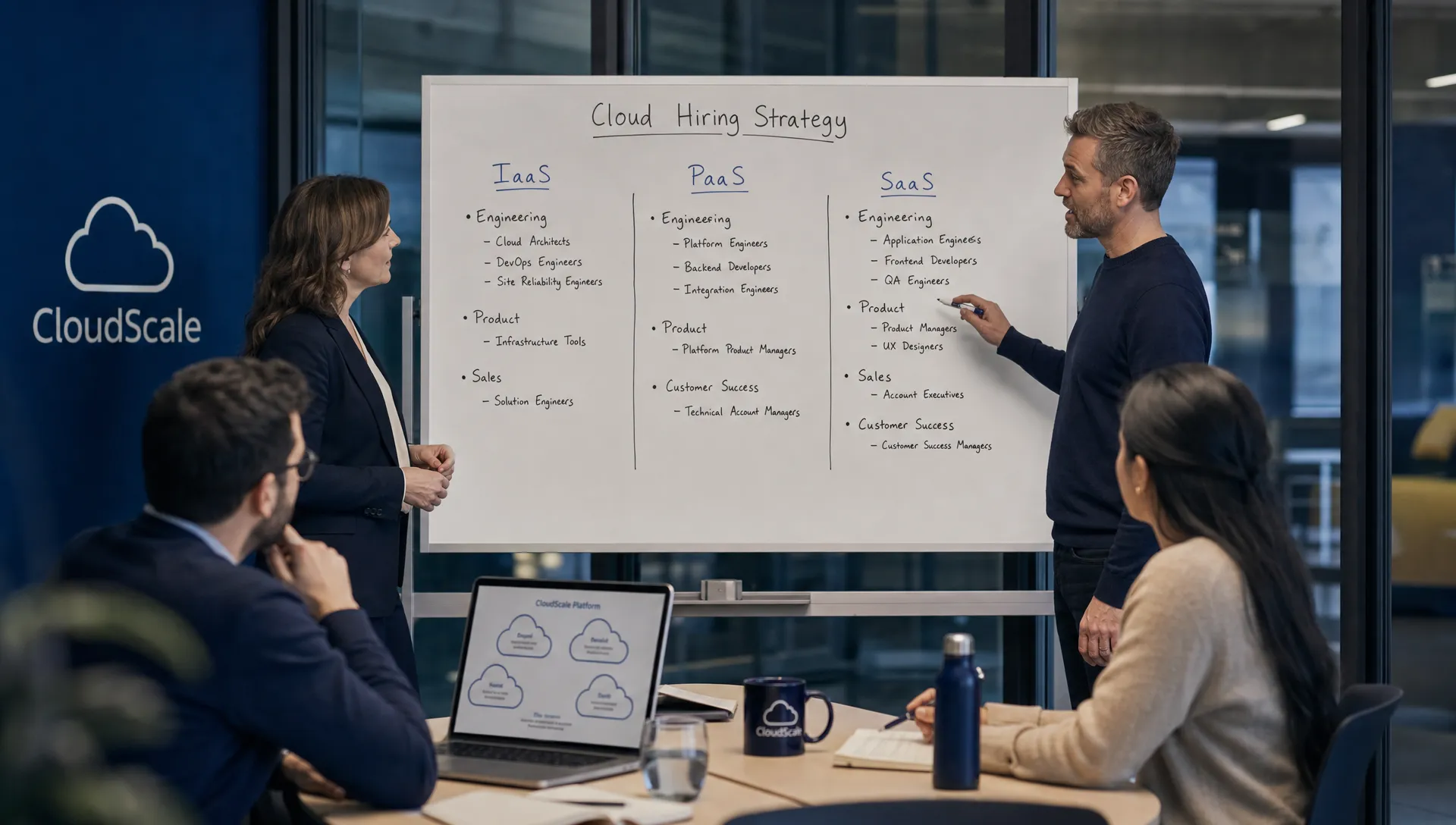
The senior hiring scorecard should change by cloud model
A generic executive search brief will not work well across IaaS, PaaS and SaaS. Each model requires a different blend of technical authority, commercial judgement and operating cadence. Before opening a senior role, leadership teams should agree what the role is truly accountable for.
Useful scorecard questions include:
- Where does the company create value? In infrastructure reliability, developer productivity, workflow automation, data insight, user experience or business outcomes?
- Who is the economic buyer? CTO, CIO, CISO, VP Engineering, CFO, line-of-business leader, procurement team or founder?
- What risk does the customer transfer to us? Availability, security, compliance, implementation complexity, adoption risk or business process dependency?
- What does scale break first? Architecture, support, onboarding, sales efficiency, partner management, compliance, documentation or leadership bandwidth?
- Which metrics define success? Uptime, deployment frequency, usage growth, ARR, retention, cloud margin, net revenue retention, activation or customer expansion?
- What leadership behaviour is non-negotiable? Calm incident management, product discipline, enterprise credibility, developer empathy, commercial pace or cross-functional alignment?
These questions help prevent a common error: hiring impressive candidates for the wrong operating model. A sales leader who thrives in high-volume SaaS may struggle in deep technical infrastructure sales. A brilliant infrastructure architect may not be the right product-minded leader for a PaaS roadmap. A customer success executive from a simple SMB SaaS motion may not be prepared for complex enterprise implementation.
GTM hiring is shaped by the cloud stack too
For CROs and CEOs, the biggest hiring implications often appear in go-to-market roles. The difference between IaaS, PaaS and SaaS changes the buyer journey, sales cycle, partner strategy and marketing narrative.
IaaS sales typically requires credibility with infrastructure, security and procurement stakeholders. Buyers care about resilience, performance, price predictability, regulatory fit and migration risk. Sales teams need patience, technical support and strong enterprise qualification. Marketing must build trust through proof, not hype.
PaaS GTM is more technical and often more community-aware. Developers and platform teams may trial before a formal buying process begins. This makes documentation, education, technical content, solution architecture and developer advocacy central to revenue creation. A CRO in PaaS needs to respect bottom-up signals while still building enterprise discipline.
SaaS GTM depends heavily on segmentation. A product-led SMB SaaS motion needs different leaders from an enterprise SaaS business selling into regulated industries. The same title, such as VP Sales or CMO, can mean radically different things depending on average contract value, implementation complexity, partner influence and customer maturity.
This is where talent leaders should push back against title-led hiring. The question is not “Have they been a CRO before?” The better question is “Have they led this type of cloud revenue motion, at this stage, with this buyer, in markets like ours?”
AI is blurring the boundaries between IaaS, PaaS and SaaS
The rise of AI infrastructure, responsible AI and automation is making cloud hiring even more specialised. AI-native companies often consume IaaS for compute, use PaaS-style tooling for model deployment, and package value through SaaS applications. As a result, they need leaders who can operate across layers.
This is particularly visible in sectors such as data analytics, AIOps, cybersecurity, digital health, industrial AI and AI infrastructure. Hiring managers increasingly look for candidates who understand GPU availability, data pipelines, model governance, security, latency, privacy, observability and enterprise adoption.
The commercial implications are just as significant. Buyers want AI capability, but they also want explainability, compliance and measurable ROI. That means senior GTM candidates need enough technical literacy to sell outcomes without overpromising. Product leaders need to balance speed with governance. Engineering leaders need to manage experimentation without letting cloud costs spiral.
In this environment, the strongest candidates are translators. They can connect infrastructure realities to product strategy, product strategy to customer value, and customer value to revenue quality.
Europe and America require different hiring routes
International hiring adds another layer of complexity. A cloud leader who is highly effective in the US market may need support adapting to European employment norms, privacy expectations, language requirements and regional buyer behaviour. Equally, a Europe-based leader entering the US may need to adjust to different compensation structures, pace of fundraising, equity expectations and competitive hiring cycles.
For European hiring, market fragmentation matters. Salary bands, notice periods, employment law, works councils, language needs and candidate motivations can vary significantly between the UK, Germany, France, the Nordics, Benelux, Spain and Central Europe. In the US, competition for senior cloud, AI and cybersecurity talent remains intense, with compensation often shaped by equity upside and category momentum.
Remote and hybrid work have widened the talent pool, but they have not removed the need for market intelligence. In fact, they have made it more important. A company can now search more broadly, but must be sharper about where the best candidates are, what will persuade them to move, and whether the leadership culture can support distributed execution.
For SaaS and software companies expanding across Europe, working with a specialist SaaS and software recruitment agency can help benchmark roles, refine search criteria and approach senior candidates who are not actively applying.
Retention, resilience and leadership sustainability
Cloud businesses often scale under pressure. Infrastructure teams manage on-call demands. PaaS teams balance developer expectations with enterprise requirements. SaaS teams face quarterly revenue targets, customer escalations and product deadlines. At senior level, this can create a high-risk environment for burnout.
Hiring the right people is only part of the answer. Companies also need operating models that keep leaders effective. That includes clear decision rights, realistic priorities, strong incident processes, sustainable on-call structures, transparent metrics and psychological safety around risk.
Boards and executive teams should treat wellbeing as a performance issue, not a soft benefit. When senior leaders are exhausted, hiring quality, product judgement and customer trust all suffer. For individuals experiencing sustained stress or burnout, confidential external support such as personalised recovery programmes for burnout and stress can form part of a wider duty-of-care approach alongside workplace changes and clinical guidance.
Retention also depends on mission clarity. Top cloud talent wants to know why the work matters, how decisions are made and whether leadership understands the complexity of the operating model. If your company sells SaaS outcomes but runs engineering like a reactive services organisation, strong candidates will notice. If your PaaS strategy claims to empower developers but leadership does not invest in documentation or community, candidates will notice that too.
A practical hiring blueprint for IaaS, PaaS and SaaS companies
The best hiring processes start before the job description is written. Senior teams should align on the operating model, the stage of growth and the leadership gap they are actually trying to close.
A practical sequence looks like this:
- Map the cloud model to value creation: Decide whether the role is primarily about reliability, developer productivity, customer adoption, revenue expansion, governance or market entry.
- Define outcomes before responsibilities: Replace vague requirements with measurable expectations, such as improving uptime, reducing onboarding time, increasing enterprise conversion or building a repeatable partner motion.
- Separate must-have experience from familiar experience: A candidate does not need to have used every tool in your stack, but they may need evidence of operating in a similar risk, scale or buyer environment.
- Build assessment around real scenarios: Use case discussions that reflect your actual challenges, such as managing a major incident, entering a new market, restructuring customer success or reducing cloud cost without damaging product velocity.
- Align compensation with market reality: Senior cloud talent is mobile and well informed. Under-benchmarking compensation can slow searches, but overpaying for the wrong profile is more expensive.
- Test cross-functional leadership: The most effective cloud leaders influence beyond their function. They can work with finance, sales, product, legal, security and customer teams without creating silos.
This approach is especially important when replacing a founder-led function with a professional leadership hire. The incoming leader may need to introduce structure without killing speed. That balance is one of the hardest skills to assess from a CV alone.
Frequently Asked Questions
How do IaaS, PaaS and SaaS affect hiring differently? IaaS hiring prioritises infrastructure reliability, security, automation and cost control. PaaS hiring prioritises developer experience, platform product thinking and technical adoption. SaaS hiring prioritises customer outcomes, recurring revenue, product execution and scalable GTM leadership.
Should a SaaS company hire IaaS or PaaS specialists? Often, yes. Even if the company sells SaaS, it may need infrastructure, platform, DevOps, security and FinOps expertise behind the scenes. The key is to hire those specialists in proportion to the company’s scale, compliance needs and technical complexity.
What is the biggest mistake companies make when hiring cloud leaders? The biggest mistake is hiring by title or vendor keyword instead of operating model. A candidate who has worked with the same tools may still be wrong if they have not managed the same buyer journey, risk profile, scale challenge or growth stage.
Why does GTM hiring change between IaaS, PaaS and SaaS? Each model has a different buyer and adoption path. IaaS often sells to infrastructure and security stakeholders, PaaS often starts with developers and technical teams, while SaaS may sell to business leaders, end users or enterprise buying committees.
How can companies improve senior cloud hiring in Europe and America? They should combine precise role scorecards, market-specific compensation intelligence, proactive search and assessment based on real business scenarios. International hiring also requires sensitivity to local employment norms, candidate motivations and leadership expectations.
Build your cloud hiring strategy around the model, not the title
IaaS, PaaS and SaaS shape far more than architecture. They shape leadership requirements, team design, sales motion, customer success, retention and international expansion. For CEOs, CROs, COOs and HR leaders, understanding these differences is now essential to hiring well.
The strongest companies do not simply recruit cloud talent. They define where their model creates value, identify the leadership capabilities that protect that value, and build a search process around evidence rather than assumptions.
Optima Search Europe supports high-growth and established firms with executive search, business-critical hiring, GTM recruitment, digital and IT search, and market insight across Europe and globally. If your cloud strategy is changing, your hiring strategy should change with it.

