
IaaS vs PaaS vs SaaS: Which Model Fits Your Growth Stage?

Cloud service models are no longer just a CTO decision. For CEOs, COOs, CROs and talent leaders, the choice between IaaS, PaaS and SaaS shapes speed to market, cost structure, security risk, customer trust and the leadership profiles needed to scale.
The mistake is treating the three models as competing options. In reality, most high-growth companies use all three. The strategic question is not whether IaaS, PaaS or SaaS is best in isolation. It is which model should be the default for your current growth stage, and where you should deliberately take on more control.
A seed-stage SaaS company trying to find product-market fit should not build infrastructure capability it does not need. A regulated enterprise selling to banks may not be able to rely only on off-the-shelf platforms. A scale-up expanding across Europe and America may need a hybrid architecture, stronger procurement discipline and a very different leadership team.
The right answer depends on what you are building, what customers expect, what risk you can tolerate and which capabilities are truly strategic.
IaaS, PaaS and SaaS in plain English
Before looking at growth stages, it helps to define the operating responsibility behind each model.
IaaS: maximum control, higher operational burden
Infrastructure as a Service gives your organisation access to cloud-based computing resources such as servers, storage, networking and virtual machines. You do not own the physical data centres, but your team still manages more of the technical stack, including operating systems, applications, security configuration, scaling logic and monitoring.
IaaS is attractive when performance, flexibility, data control or architectural differentiation matter. It can also support complex enterprise environments, multi-cloud strategies and highly tailored security requirements.
The trade-off is capability. IaaS requires stronger cloud architecture, DevOps, security engineering, FinOps and operational leadership. Without that depth, it can become expensive, fragile and difficult to govern.
PaaS: faster development with managed foundations
Platform as a Service gives developers a managed environment for building, testing and deploying applications. The cloud provider handles much of the infrastructure, operating system, runtime and scaling layer, so your engineers can focus more on product logic and user value.
PaaS is often the strongest option when a company needs to move quickly but still owns its product experience. It suits many SaaS companies, digital health platforms, data products and AI-enabled applications where speed, release cadence and developer productivity are critical.
The trade-off is dependency. You gain speed by accepting certain platform constraints. If your architecture becomes too tightly coupled to one provider, migration or deep customisation can become painful later.
SaaS: fastest adoption, least technical ownership
Software as a Service is a complete application delivered over the internet. Your organisation uses the product, usually on a subscription basis, while the vendor manages hosting, maintenance, updates and core security.
SaaS is ideal for capabilities that are important but not differentiating. CRM, HR systems, collaboration tools, finance platforms, marketing automation, customer support systems and analytics tools often fall into this category.
The trade-off is limited control. You may be constrained by vendor roadmaps, integration limits, data portability and licence economics. At scale, SaaS sprawl can also become a major cost and governance issue.
The executive question: what should your company own?
A practical way to make the decision is to ask which capabilities deserve internal ownership.
If a capability creates competitive advantage, supports your intellectual property or influences customer trust, you may need more control through PaaS or IaaS. If a capability is necessary but generic, SaaS is usually the better choice.
For example, a marketing technology company might use SaaS tools for payroll, legal operations and internal collaboration. It may use PaaS to build its customer-facing platform. It may reserve IaaS for workloads that require performance tuning, advanced data architecture or enterprise-grade isolation.
This is why cloud model decisions should include the CEO, COO, CTO, CPO, CRO and CFO. The model affects how fast you sell, how credibly you answer enterprise security questionnaires, how quickly you integrate acquisitions and how much talent you need to hire.
Which model fits your growth stage?
Discovery and seed stage: default to SaaS, use PaaS for the product
At the earliest stage, speed and focus matter more than perfect architecture. The leadership team is testing a market, learning from customers and trying to preserve runway.
For non-core functions, SaaS should be the default. Buying proven tools for CRM, finance, recruitment, support and collaboration is usually cheaper and faster than building anything internally. Even if a tool is imperfect, the opportunity cost of custom work is rarely justified.
For the product itself, PaaS is often the best starting point. It gives the engineering team a managed foundation so they can ship, test and iterate without maintaining unnecessary infrastructure. The aim is to reduce time spent on plumbing and maximise time spent on customer value.
IaaS at this stage should be the exception. It may be justified for deep-tech, AI infrastructure, cybersecurity, smart manufacturing or data-intensive products where infrastructure is part of the product advantage. But if the reason is simply technical preference, it can distract from the commercial mission.
Hiring implication: do not overhire infrastructure leadership too early unless infrastructure is strategic. A pragmatic founding CTO, senior full-stack engineers and product-minded technical leads usually matter more than a large platform team.
Product-market fit and Series A/B: PaaS becomes the scale accelerator
Once demand is proven, the challenge shifts from finding the market to serving it reliably. Customers expect faster releases, better uptime, clearer integrations and stronger data controls.
At this stage, PaaS often becomes the engine of scale. It helps engineering teams standardise deployment, reduce operational complexity and improve developer productivity. SaaS remains essential for go-to-market, people operations, customer success and analytics, but procurement discipline must improve.
This is also when IaaS may start appearing in selected areas. Companies may need more control over data processing, analytics pipelines, AI workloads, networking, disaster recovery or enterprise customer requirements.
The danger is unmanaged complexity. A company can find itself with too many SaaS subscriptions, multiple cloud services, unclear ownership and no single view of cost or security exposure.
Hiring implication: this is when leadership depth starts to matter. You may need a VP Engineering, Head of Product, Head of Security, Revenue Operations leader and Customer Success leader who have scaled before. If SaaS is your core business, Optima's guide to the key roles needed to build and scale a software-as-a-service platform explores how those roles evolve as complexity increases.
Scale-up stage: hybrid by design, not by accident
At scale-up stage, the company is usually expanding segments, geographies, product lines or enterprise accounts. The architecture that helped the business reach product-market fit may now create constraints.
This is when most companies become intentionally hybrid. SaaS remains the best answer for many business functions. PaaS remains valuable for developer speed and product delivery. IaaS becomes more relevant where control, resilience, custom networking, data residency or unit economics require it.
The biggest shift is governance. Decisions that once belonged to individual teams now need cross-functional oversight. Procurement, security, finance, legal, operations and product leaders must align on standards.
Questions become more strategic:
- Which workloads require direct infrastructure control?
- Which SaaS tools are genuinely business-critical?
- Where is vendor lock-in acceptable, and where is it dangerous?
- How do cloud costs map to gross margin and customer profitability?
- Can the current leadership team support enterprise expectations?
A scale-up should not interpret control as maturity. Owning more of the stack is only valuable if the organisation can operate it better than the market can provide it. Otherwise, it becomes technical debt disguised as strategic capability.
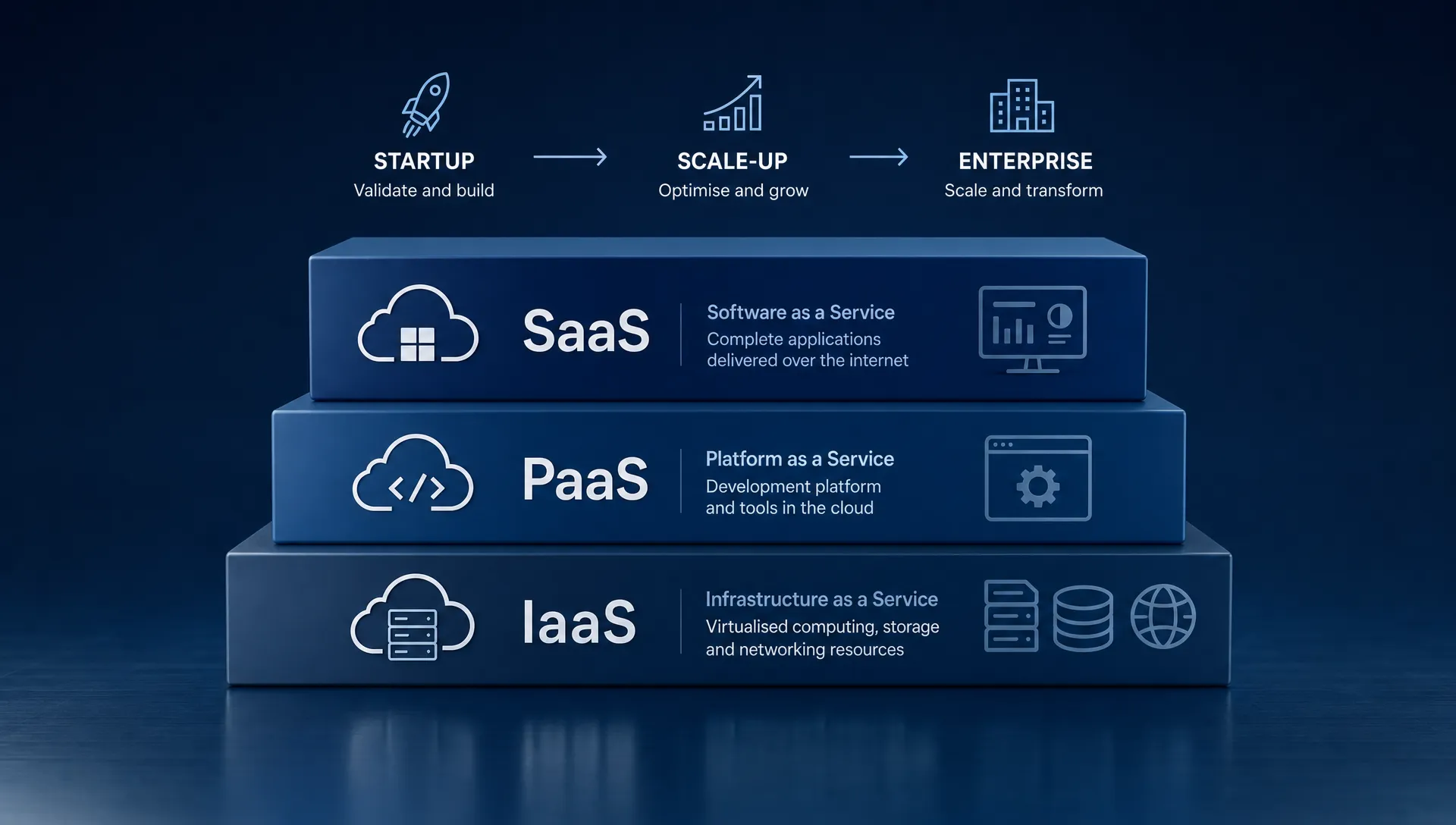
Hiring implication: the company may need leaders with both technical and commercial judgement. A strong CTO or VP Infrastructure can manage resilience and architecture. A CFO or FinOps leader can connect cloud cost to unit economics. A CISO or security leader can support enterprise sales. A CRO needs credible answers for customers who now scrutinise compliance, uptime and data handling before signing.
Enterprise or global stage: control, compliance and resilience dominate
For established companies, especially those serving regulated or mission-critical markets, the decision often becomes less about speed and more about risk, resilience and accountability.
IaaS can become more important where the business needs tailored infrastructure, multi-region resilience, high-volume data processing, advanced security controls or strict regulatory alignment. PaaS remains valuable, but it may be deployed within tighter guardrails. SaaS remains useful, but procurement and data governance become much more rigorous.
At this stage, the board will expect clarity on operational risk. Cloud strategy should be linked to business continuity, customer trust, M&A integration, regional expansion and cyber resilience.
Hiring implication: enterprise maturity demands leaders who can operate across functions. CTOs, CIOs, CISOs, Chief Data Officers, Chief Customer Officers and regional General Managers must understand both the technology choices and the commercial implications. The talent bar rises because mistakes are now expensive, visible and difficult to reverse.
How each model affects hiring and leadership design
Cloud model selection is also organisation design. The more control you take on, the more internal capability you must build.
A SaaS-heavy operating model needs strong vendor management, business systems ownership, integration capability and data governance. The company may not need a large infrastructure team, but it does need leaders who can select tools, control spend and ensure systems support the customer journey.
A PaaS-heavy model needs product engineering maturity. Leaders must know how to improve developer productivity, maintain release quality, manage technical debt and keep security embedded in delivery. The best candidates are not just engineers. They understand platform decisions in commercial terms.
An IaaS-heavy model needs deep operational expertise. Cloud architects, DevOps leaders, security engineers, site reliability engineers and FinOps specialists become more important. Senior executives must be comfortable evaluating resilience, cost optimisation, incident management and compliance trade-offs.
This is where many companies misread the talent market. They choose a more complex cloud model, then try to hire as if they were still operating a lightweight SaaS-first business. The result is delay, burnout and avoidable risk.
Decision framework for CEOs, COOs and talent leaders
The following framework can help leadership teams align cloud strategy with growth stage before committing budget or hiring plans.
Start with customer expectations
Enterprise customers often care about security, uptime, integrations, data residency and auditability. If your buyers are banks, insurers, healthcare organisations or government-related entities, your architecture may become part of the sales process.
For a CRO, this matters directly. A weak answer on security or resilience can slow procurement, extend sales cycles and reduce win rates. A stronger cloud operating model can become a commercial advantage when positioned correctly.
Link cloud cost to unit economics
A model that looks cheap at low volume may become expensive at scale. SaaS licence costs can rise quickly as headcount grows. PaaS usage can increase with customer adoption. IaaS can offer optimisation opportunities, but only when the team has the skill to manage it.
Cloud strategy should be reviewed alongside gross margin, customer acquisition cost, implementation cost and net revenue retention. If technical decisions are disconnected from the economic model, leadership may not see the problem until margins are already under pressure.
This is especially relevant for SaaS companies. Many growth problems are not purely sales or product issues. They come from misaligned pricing, weak retention, poor customer segmentation or rising delivery costs. Optima's article on SaaS business model mistakes that hurt growth covers several of these commercial pitfalls in more depth.
Assess your internal capability honestly
A company should not choose IaaS simply because it wants control. Control without competence creates risk. Equally, a company should not over-rely on SaaS if its customer promise requires differentiated workflow, data intelligence or product experience.
Leadership teams should ask whether they already have the right executives to manage the model they prefer. If not, the cloud decision and hiring plan should be made together.
Consider geographic expansion early
Expansion adds another layer of complexity. Hiring across Europe and America, serving customers in multiple jurisdictions and opening regional hubs can all influence technology and operating model choices.
Data residency, local compliance expectations, support coverage, customer success operations and even office strategy may need to evolve together. For example, a company establishing a hub in the Mediterranean may assess talent pools, tax considerations, customer proximity and workspace availability at the same time. If Malta is on the shortlist, platforms that help businesses compare verified office space for rent in Malta can support the practical side of that expansion planning.
The key point is that cloud strategy should not sit separately from workforce planning. A new market may require different sales leadership, customer success coverage, security posture and operational infrastructure.
Common mistakes when choosing between IaaS, PaaS and SaaS
The wrong cloud model rarely fails overnight. It usually creates friction that compounds as the company grows.
One common mistake is overengineering too early. Technical leaders may build for a future enterprise architecture before the company has validated its market. This consumes capital and slows learning.
Another mistake is staying too lightweight for too long. A company can keep using quick SaaS fixes and unmanaged PaaS services even after enterprise customers require stronger controls. What once made the business fast can later make it fragile.
A third mistake is ignoring ownership. Every platform, application and cloud service needs a clear business owner, technical owner and budget owner. Without that clarity, costs rise and accountability disappears.
A fourth mistake is separating hiring from architecture. If your strategy requires enterprise-grade infrastructure, you need leaders who have operated that environment. If your strategy relies on PaaS speed, you need product and engineering leaders who can maintain quality at pace. If your strategy relies on SaaS systems, you need business operations leaders who can integrate tools around the customer journey.
The practical answer: which model fits best?
For most companies, the answer is stage-specific:
- Seed-stage companies should use SaaS for non-core operations and PaaS for building the product, unless infrastructure itself is the differentiator.
- Series A and B companies should use PaaS to accelerate product delivery, SaaS to scale business functions and selective IaaS where control is commercially justified.
- Scale-ups should move to a deliberate hybrid model, with stronger governance, FinOps, security and platform leadership.
- Enterprise and global companies should use a controlled mix of IaaS, PaaS and SaaS, driven by resilience, compliance, data strategy and customer trust.
The goal is not to own everything. The goal is to own what differentiates the business, control what creates risk and buy what the market can provide better than you can.
Frequently Asked Questions
Is SaaS always the best choice for early-stage companies? SaaS is usually best for non-core functions in early-stage companies because it is fast to deploy and requires limited internal maintenance. For the core product, PaaS is often a better fit because it lets teams build differentiated value without managing unnecessary infrastructure.
When should a company move from PaaS to IaaS? A company should consider IaaS when it needs greater control over performance, security, networking, data residency, resilience or cost optimisation. The move should be driven by business requirements, not by technical preference alone.
Can a scale-up use all three models at once? Yes. Most scale-ups use SaaS for business systems, PaaS for product development and IaaS for selected workloads that require control. The important factor is governance, so each model has clear ownership, cost visibility and security standards.
How does cloud model choice affect executive hiring? The more control a company takes on, the more specialised leadership it needs. SaaS-heavy organisations need strong business systems and vendor management. PaaS-heavy companies need product engineering leadership. IaaS-heavy companies need cloud architecture, security, DevOps and FinOps expertise.
Should the CRO be involved in cloud model decisions? Yes. Cloud strategy can influence sales cycles, enterprise procurement, security questionnaires, implementation timelines and customer confidence. For B2B companies, the CRO should understand how architecture supports or limits revenue growth.
Build the leadership team your cloud strategy requires
Choosing between IaaS, PaaS and SaaS is not only a technology decision. It is a growth-stage decision, a commercial decision and a talent decision.
If your company is moving from founder-led execution to structured scale, the leadership team must match the operating model you are building. That may mean hiring a CTO who has scaled enterprise infrastructure, a VP Engineering who can improve delivery velocity, a CRO who can sell into complex accounts or a CISO who can turn trust into a sales advantage.
Optima Search Europe supports high-growth and established companies hiring business-critical leaders across SaaS, cloud, AI, cybersecurity, data, digital health and industrial technology markets. For organisations scaling across Europe, Optima's experience as an international recruitment agency for SaaS companies in Europe can help align executive search with ARR stage, GTM motion and operating model.
The strongest companies do not choose cloud models in isolation. They build the leadership capability to make those models work at scale.

