
Life Sciences Recruitment Agencies for Regulated Growth Teams

For CEOs, CROs, COOs and talent leaders, life sciences recruitment agencies are most valuable when they understand two pressures at once: growth speed and regulatory consequence. A leadership hire in biotech, MedTech, digital health or AI-enabled healthcare is rarely just another commercial appointment. The wrong VP Sales, General Manager, Regulatory Affairs leader or market access hire can slow approvals, misposition a product, weaken evidence claims or damage trust with enterprise buyers. The right hire can turn scientific credibility into predictable revenue without creating compliance risk. That is the real hiring challenge for regulated growth teams: finding leaders who can scale, sell and operate inside constraints that are not negotiable.
Why regulated growth changes the role of life sciences recruitment agencies
Regulated growth is different from conventional SaaS or consumer technology expansion. Product-market fit is not enough if the team cannot navigate clinical evidence, reimbursement pathways, data privacy, quality systems, post-market surveillance or local market access expectations. In many life sciences businesses, commercial leadership must work closely with medical, regulatory, quality, product and legal teams before a market message reaches buyers.
This changes what a recruitment partner needs to assess. A strong candidate may have delivered impressive revenue growth in enterprise software, but that does not automatically translate into MedTech, diagnostics, biotech tools or digital therapeutics. The interview process needs to test judgement under regulatory ambiguity, not only sales process discipline or team-building capability.
In this environment, the most useful life sciences recruitment agencies build search strategies around evidence, risk and execution context. They clarify whether the role requires launch experience, category creation, hospital procurement knowledge, distributor management, payer engagement, partner ecosystems or regulatory transformation. Without that definition, a search can produce polished candidates who look credible on paper but lack the operating pattern your growth plan requires.
What a regulated growth team needs before going to market
Before approaching candidates, the leadership team should align on what success means in the first twelve to eighteen months. This sounds basic, but it is where many senior searches go wrong. A CRO hired to build a European direct sales organisation needs different experience from one hired to manage channel partners across fragmented local markets. A VP Marketing hired for a pre-commercial biotech platform faces a different task from a demand generation leader in a mature health software company.
A practical brief should define the market stage, buying committee, evidence maturity, sales cycle, regulatory exposure and internal dependencies. It should also state where the company is willing to trade off. For example, does the role require direct experience with EU MDR, or is regulated enterprise healthcare experience enough? Does the candidate need to have sold into the NHS, German hospital groups or US integrated delivery networks? Should they have scaled from Series A to Series C, or operated inside a larger public company environment?
Good life sciences recruitment agencies will push for this clarity because it protects both the client and the candidate. The same principle applies outside healthcare too: structured hiring depends on knowing when to hire, what scorecard to use and how to train people once they join, as this practical guide on building a repeatable hiring process for a growing service business shows in a very different operating context. In regulated sectors, that discipline becomes even more important because onboarding gaps can create expensive delays.
The leadership roles where specialist search matters most
Not every hire requires executive search, but regulated growth teams should be selective about the roles they outsource to a specialist. Search is most valuable when the available candidate pool is narrow, the role is confidential, the wrong appointment carries high downside or the market requires cross-border mapping.
For organisations scaling across Europe and America, the highest-impact searches often sit at the intersection of commercial leadership, regulatory fluency and technical credibility. This includes CROs, VPs of Sales, General Managers, market access leaders, strategic marketing leaders, digital health executives, data and AI leaders, product leaders and senior regulatory or quality appointments.
Specialist life sciences recruitment agencies should be able to explain where each candidate has created growth, not only where they have worked. A logo-heavy CV is not enough. The difference between inheriting demand and building it matters, especially in markets where buyers expect clinical validation, procurement assurance and compliance confidence before they expand a contract.
| Role type | Why it is business-critical | What to test during search |
|---|---|---|
| CRO or VP Sales | Converts scientific or technical value into scalable revenue | Regulated sales cycles, buyer mapping, forecasting discipline, team design |
| General Manager | Owns local or regional performance under market constraints | Country launch experience, P&L ownership, stakeholder management |
| Market Access leader | Shapes reimbursement and adoption pathways | Payer engagement, health economics, evidence communication |
| Regulatory Affairs leader | Protects approvals, claims and market readiness | EU MDR, IVDR, FDA or relevant pathway knowledge, cross-functional influence |
| Product or AI leader | Turns technology into compliant, usable solutions | Clinical workflow knowledge, data governance, responsible AI judgement |
For a deeper look at leadership hiring in biotech and MedTech, Optima Search Europe has also covered biotech recruitment in Europe with a focus on senior talent challenges in 2026.
How to assess whether an agency can represent your market properly
A recruitment partner represents your company before you ever meet a candidate. In life sciences, that first conversation must be credible. Senior candidates will quickly notice whether the consultant understands their world, especially if the role touches regulatory approvals, clinical evidence, hospital procurement, manufacturing quality or healthcare data.
Ask how the agency will map the market. A serious answer should go beyond job boards and database searches. It should cover target companies, adjacent sectors, competitors, scale-up alumni, regional talent pools, passive candidates and potential blockers such as non-competes, relocation constraints or compensation expectations. For confidential roles, it should also explain how the search will protect market sensitivity.
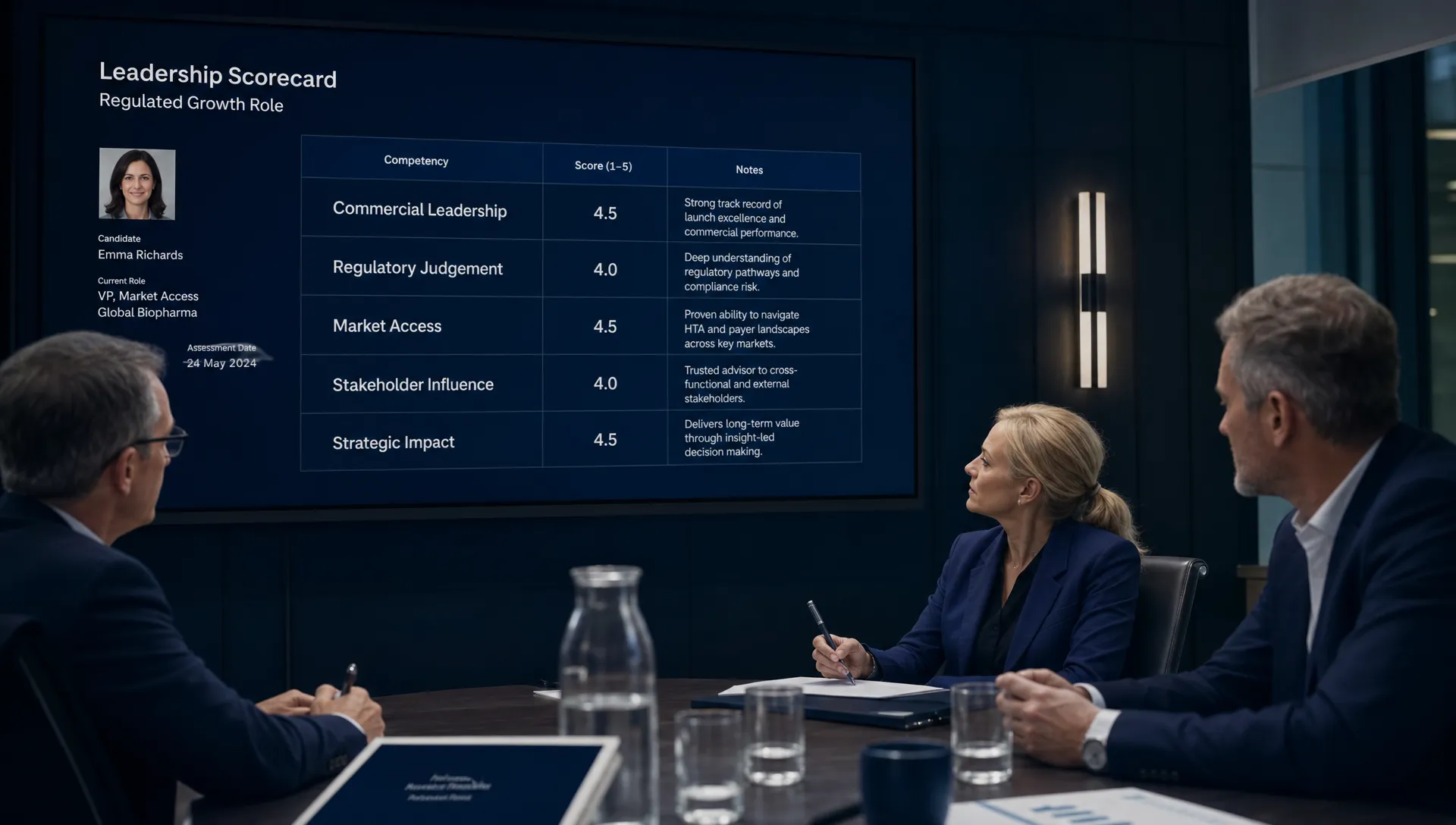
At leadership level, life sciences recruitment agencies also need to qualify motivation with care. A candidate leaving a large pharmaceutical or medical device company may want more autonomy, but may not be ready for the ambiguity of a venture-backed business. A start-up operator may move fast, but may struggle in a listed or highly matrixed environment. The agency’s role is to identify these mismatches before the final shortlist.
What the search process should look like
A high-quality regulated growth search normally begins with a calibration phase. This is where the agency interviews key stakeholders, tests the job brief, defines must-have criteria and identifies comparable talent pools. The first shortlist should not appear before the market has been properly mapped, unless the role is unusually common or the company already has a warm candidate bench.
The assessment stage should combine evidence from career history, structured interviews and reference themes. For commercial leaders, look for proof of sales motion design, hiring quality, pipeline discipline, pricing judgement and board-level communication. For regulatory or product leaders, look for examples of cross-functional influence, decision-making under uncertainty and the ability to communicate constraints without blocking progress.
Strong life sciences recruitment agencies will also help the client avoid process drift. Senior candidates disengage when interview loops are vague, feedback is slow or decision criteria change late in the process. That does not mean rushing. It means agreeing the stages, interview owners and decision points before outreach begins.
For companies comparing search models more broadly, this guide to choosing a specialist recruitment partner in London explains the difference between contingency, retained, boutique and other agency structures.
Common failure points in regulated leadership hiring
The most common mistake is over-indexing on sector familiarity while under-testing growth capability. A candidate can understand life sciences deeply but lack the urgency, creativity or people leadership required to scale. The opposite mistake is just as risky: hiring a high-growth technology executive who has never operated in a market where claims, evidence and compliance shape every commercial decision.
Another failure point is treating Europe as one market. The UK, Germany, France, the Nordics, Benelux, Southern Europe and Central Europe can differ significantly in procurement, reimbursement, distributor reliance and clinical adoption patterns. A leader who succeeds in one country may still need support to succeed in another.
When life sciences recruitment agencies understand these differences, they can advise on realistic talent pools and compensation positioning. They can also help decide whether to hire a regional leader, a country manager or a functional executive first. That sequencing matters because the first senior hire often sets the operating rhythm for the next layer of leadership.
Choosing between a generalist and a specialist partner
A generalist agency may be suitable for volume roles or broad corporate functions, especially when the skills are transferable and the market is active. For senior regulated growth roles, a specialist search partner is usually the safer option because the work requires nuanced candidate assessment, discreet market access and credibility with passive executives.
The right partner should be able to discuss your sector in enough detail to challenge your assumptions. If every candidate profile sounds acceptable, the brief is probably too loose. If the agency cannot explain why a strong candidate from health technology, diagnostics, pharma services, industrial AI or cybersecurity governance might transfer into your role, the search may become too narrow.
Optima Search Europe focuses on business-critical and executive roles across areas including marketing technology SaaS, cloud platform engineering, data analytics and AIOps, AI infrastructure, cybersecurity governance risk, digital health, MedTech, biotech and smart manufacturing. That cross-sector perspective is valuable when a regulated growth team needs candidates who combine technical, commercial and compliance awareness rather than a conventional one-sector CV.
Frequently Asked Questions
What should life sciences recruitment agencies understand before starting a senior search? They should understand the company’s market stage, regulatory exposure, evidence base, sales motion, buyer group, geography, funding context and leadership gaps. Without this, the shortlist may reflect generic seniority rather than the role’s real operating demands.
When should a regulated growth team use executive search instead of advertising directly? Executive search is most useful when the role is confidential, the talent pool is scarce, passive candidates matter or the business needs market intelligence as well as introductions. It is especially relevant for CRO, VP, General Manager, market access, regulatory, product and digital health leadership roles.
How long should a senior life sciences search take? Timelines vary by role complexity, geography and compensation alignment. The more specialised the brief, the more important it is to spend enough time on calibration and market mapping before shortlist interviews begin. A rushed process can create a slower outcome if the first slate is misaligned.
Can leaders from outside life sciences succeed in regulated growth roles? Yes, but only when the transferable experience is carefully assessed. Enterprise healthcare, regulated SaaS, cybersecurity, industrial AI and data infrastructure backgrounds can be relevant, provided the candidate has the judgement to adapt to evidence-led selling and compliance-heavy decision making.
Build a leadership team that can scale without losing control
If you are evaluating life sciences recruitment agencies, look beyond access to CVs. The right partner should improve the quality of the brief, map the market intelligently, represent your company credibly and assess candidates against the realities of regulated growth.
Optima Search Europe works with fast-growing and established firms hiring senior leaders across Europe and globally. If your next appointment is business-critical, from GTM leadership to digital health, MedTech, biotech or AI-enabled growth roles, start by discussing the role with a specialist team that understands executive search in complex markets. You can learn more about Optima Search Europe and explore whether a tailored search approach fits your hiring plans.

