
How Cyber Security in Banking Is Changing Leadership Hiring

Cyber security in banking has moved from a specialist IT concern to a core leadership issue. For CEOs, COOs, CHROs and talent leaders, the hiring question is no longer simply “Can this person stop attacks?” It is “Can this person protect trust, maintain operations, satisfy regulators and enable growth?” In 2026, banks are competing for leaders who understand threat intelligence, cloud architecture, operational resilience, AI governance, third-party risk and board communication. That mix is scarce, so the institutions that define the role clearly and move decisively are gaining an advantage.
Why cyber security in banking is now a board-level hiring issue
Banking has always been a high-value target, but the leadership implications have changed. Digital channels, open banking, embedded finance, cloud migration and real-time payments have expanded the attack surface. A breach can affect customer trust, payment continuity, regulatory standing and market confidence at the same time.
The board’s questions have become more operational: which services are truly critical, how quickly can the bank recover and which suppliers could create systemic exposure? In this environment, cyber security in banking is changing who gets shortlisted for senior technology, risk and security roles. Candidates need the judgement to prioritise investment, translate technical risk into business language and prove that resilience is built into the operating model, not bolted on after launch.
This is why the modern CISO, CIO or cyber risk leader is being assessed less like a technical guardian and more like an enterprise executive.
The leadership profile is shifting from defender to resilience operator
Traditional security leadership focused on prevention, detection and response. Those capabilities still matter, but they are now baseline expectations. Banks increasingly need leaders who can design for continuity when incidents happen, because regulators and customers both assume that disruption will occur.
That is why cyber security in banking increasingly rewards leaders who can work across product, engineering, compliance, legal, procurement and customer operations. A strong candidate will know how to reduce risk without slowing commercial delivery to a crawl. They will also know when to accept, transfer or mitigate risk, rather than defaulting to blanket rejection.
The hiring brief is therefore expanding beyond security certifications and SOC experience. It now includes influence, governance design, supplier oversight, crisis leadership and the ability to build high-performing teams in a competitive talent market.
| Leadership capability | Why it matters in banking | What to assess during hiring |
|---|---|---|
| Operational resilience | Banks must maintain critical services under stress | Evidence of incident planning, recovery testing and service mapping |
| Regulatory fluency | Banking security is shaped by multiple regimes | Ability to brief boards and work with regulators |
| Cloud and platform risk | Core workloads and data increasingly sit in hybrid environments | Experience with cloud controls, identity, encryption and architecture review |
| Third-party oversight | Vendors, fintech partners and managed service providers create exposure | Supplier risk governance and contract-level control awareness |
| Executive communication | Security investment competes with other priorities | Clear business cases, risk trade-offs and board reporting |
Regulation is widening the hiring brief
Cyber security in banking is also being shaped by a denser regulatory environment. In Europe, the EU Digital Operational Resilience Act, published as Regulation (EU) 2022/2554, has applied since January 2025 and places clear expectations on ICT risk management, incident reporting, testing and third-party oversight for financial entities. UK banks also operate under operational resilience expectations from the PRA and FCA, with a focus on important business services and impact tolerances.
For banking groups operating across Europe and America, the challenge is not only compliance with one rulebook. Leadership teams must coordinate cyber controls across jurisdictions, business lines and outsourced providers. That changes hiring because the best candidates can turn regulation into practical operating rhythm, including governance forums, risk dashboards, control owners, tabletop exercises and board packs.
Optima’s broader guide to the NIS2 Directive impact on cybersecurity hiring is useful context for European organisations outside financial services too, because it shows how regulatory pressure is increasing demand for cyber leaders across the wider economy.
AI, automation and third-party ecosystems are raising the bar
Banks are using AI for customer service, fraud detection, software development, risk analysis and internal productivity. At the same time, attackers are using AI to improve phishing, social engineering, malware development and reconnaissance. This does not mean every cyber leader must be an AI engineer, but it does mean they must understand model governance, data leakage, access controls, human review and the security implications of AI-enabled workflows.
The next leadership test in cyber security in banking is managing AI adoption without creating unmanaged risk. That includes asking which teams are using AI tools, what data is being processed, how outputs are validated and whether controls match the sensitivity of the work. For established companies looking to embed AI responsibly into existing workflows, AI adoption specialists such as Founder Engine offer a useful example of how transformation can be structured around real business processes rather than abstract experimentation.
Third-party risk is equally important. Banks rely on cloud platforms, SaaS vendors, fintech partners, data providers and managed security services. Leaders must know how to evaluate supplier concentration risk, audit rights, exit plans, service continuity and data residency requirements.
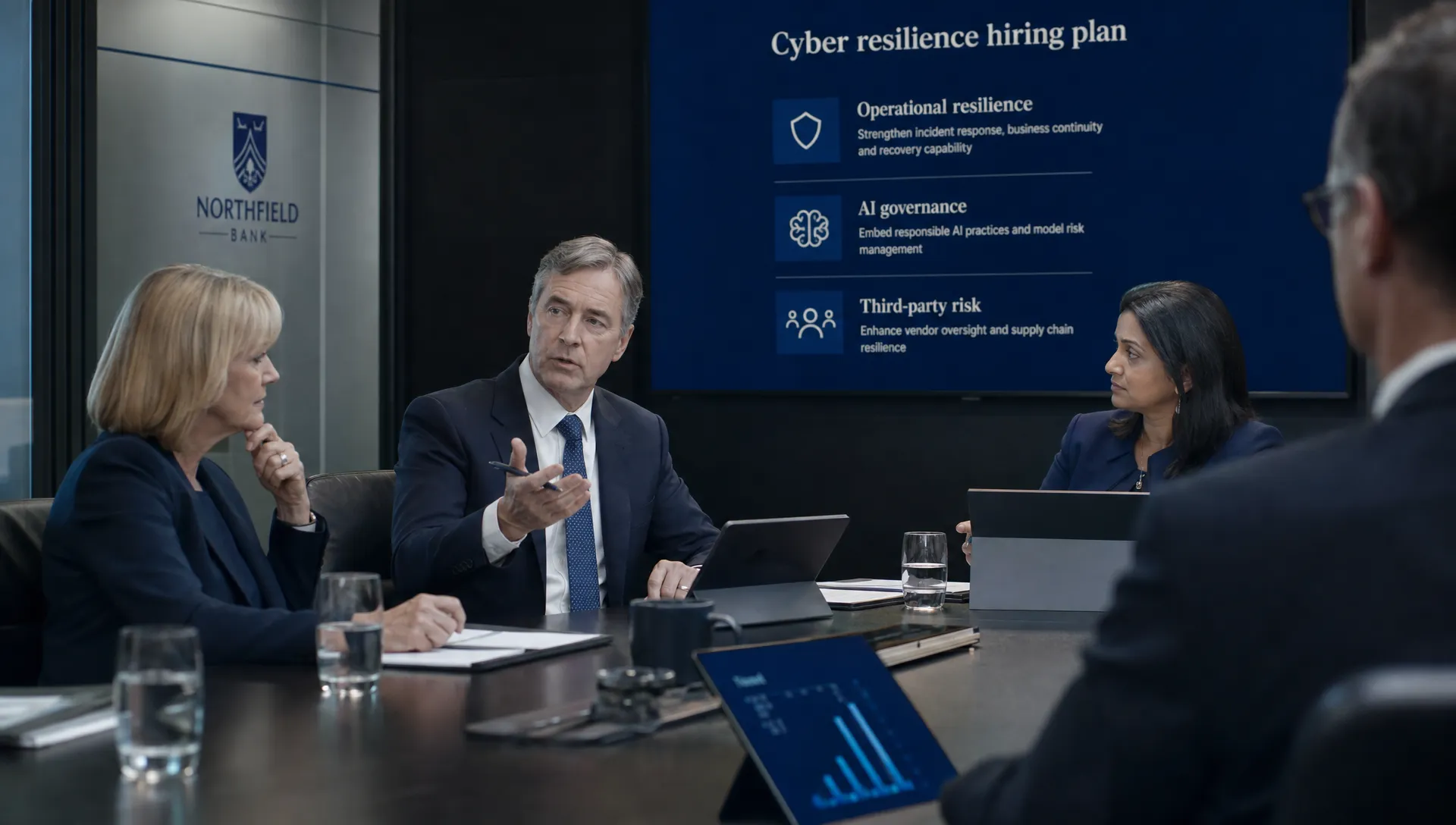
What banks now need from CISOs and cyber executives
The most effective cyber leaders in financial services are commercially fluent without becoming complacent. They understand why product velocity matters, but they also know where speed creates unacceptable exposure. In leadership hiring, that balance is often more valuable than a narrow technical specialism.
A strong leader for cyber security in banking must be credible with engineers, risk committees and regulators. That is a demanding combination. The candidate has to challenge architecture decisions, guide executive teams through incident scenarios and keep investment focused on the highest-impact risks. They also need to build teams that can attract and retain scarce specialists in cloud security, identity and access management, application security, detection engineering and cyber risk.
For organisations benchmarking the wider European talent market, Optima’s analysis of cybersecurity recruitment trends in Europe outlines why demand is rising for AI-aware, compliance-literate and remote-capable security talent.
Banking-specific leadership capabilities to prioritise
A generic CISO profile is rarely enough for a bank. The role must reflect the institution’s regulatory footprint, risk appetite, technology stack and transformation roadmap.
Key capabilities include:
- Board-level cyber risk communication that avoids jargon and links controls to business outcomes
- Experience with incident command, crisis communications and post-incident remediation
- Knowledge of cloud security models, DevSecOps and secure software delivery
- Strong partnership with risk, compliance, audit, legal and procurement teams
- Ability to assess third-party exposure across critical suppliers and fintech partners
- A track record of hiring, developing and retaining specialist security teams
These requirements should be built into the scorecard before the search begins. Otherwise, the process can drift towards the loudest technical profile rather than the leader who can manage enterprise risk.
How leadership hiring needs to change
Banks often lose strong candidates because the hiring process is too slow, too vague or too internally fragmented. Senior cyber leaders are usually in post, well paid and cautious about reputation risk. They need a compelling reason to move, and they will scrutinise whether the bank is serious about security investment.
To compete for cyber security in banking leaders, banks should treat hiring as a strategic search rather than a reactive vacancy process. The role should be sponsored by the CEO, COO or another executive with authority to remove obstacles. The brief should define the mandate, reporting line, decision rights, budget influence and expected outcomes in the first 12 to 18 months.
| Hiring stage | Common banking mistake | Better approach |
|---|---|---|
| Role definition | Combining several unresolved problems into one job description | Separate must-have leadership outcomes from nice-to-have technical depth |
| Market mapping | Looking only at direct competitors | Include fintech, cloud, payments, cyber vendors and regulated technology firms |
| Assessment | Overweighting certifications | Test judgement, influence, crisis decision-making and regulatory fluency |
| Interview process | Multiple panels asking similar questions | Use a coordinated scorecard and reduce repetition |
| Offer stage | Moving slowly after final interview | Pre-align compensation, flexibility, reporting line and mandate |
This is also where external search support can be valuable. A specialist partner can confidentially map passive candidates, test motivation early and benchmark what comparable leaders are asking for in mandate, package and working model. Optima’s guide to working with a cybersecurity recruitment agency in Europe explains why security hiring requires deeper calibration than general technology recruitment.
Signals of a leadership-ready candidate
Not every technically impressive candidate is ready for a bank’s senior cyber role. The strongest profiles show evidence of structured decision-making under pressure. They can explain what they changed, why they prioritised it and how they measured improvement.
For cyber security in banking, the strongest candidates are often those who have worked through complexity rather than only growth. Look for people who have inherited fragmented systems, improved resilience without unlimited budget, handled regulator scrutiny or built operating models across several geographies. A candidate who can describe trade-offs clearly is often more valuable than one who presents a perfect but unrealistic target state.
Useful interview prompts include asking how the candidate would respond to a material third-party outage, how they would brief the board after a ransomware attempt or how they would reduce identity risk across a hybrid cloud environment. The answers should reveal judgement, pace, communication style and comfort with imperfect information.
Compensation and mandate now matter as much as title
Banks sometimes assume that brand alone will attract senior cyber talent. That is less true today. Cyber leaders with financial services experience are being approached by fintechs, cloud providers, AI companies, cyber vendors and private equity-backed software businesses. Many of those organisations offer broader scope, faster decision-making or equity upside.
Cyber security in banking candidates will therefore evaluate the full proposition. They will ask whether security has executive sponsorship, whether investment is realistic, whether technical debt is acknowledged and whether the role has enough authority to influence product and platform decisions. A title without mandate is a warning sign for experienced leaders.
Flexibility also matters. Not every bank can offer the same hybrid model as a software company, but rigid policies can narrow the market. For senior appointments, the best approach is to decide where physical presence genuinely matters, such as board meetings, regulator engagement and crisis exercises, then build a working pattern that reflects the role rather than legacy norms.
A practical hiring framework for banks
Leadership hiring should begin with business risk, not a recycled job description. A bank that is modernising payments infrastructure needs a different cyber leader from one integrating acquisitions, moving workloads to cloud or responding to regulatory remediation. The search strategy should be shaped around the next chapter of the institution.
A practical framework is to define the following before going to market:
- The critical business services the leader must protect
- The highest-risk technology changes planned in the next 24 months
- The regulatory commitments already in flight
- The team structure, budget influence and reporting line
- The leadership behaviours needed to work across risk, technology and commercial teams
Once those points are clear, assessment becomes more reliable. Candidates can be evaluated against the bank’s actual context rather than a generic view of what a CISO should be.
Frequently Asked Questions
Why is cyber security in banking changing leadership hiring? Banks now need leaders who can manage resilience, regulation, cloud risk, AI governance and third-party exposure. The role has expanded beyond technical defence into enterprise leadership.
What should banks look for in a modern CISO? A modern banking CISO should combine security depth with operational resilience, board communication, regulatory fluency, supplier risk oversight and the ability to lead specialist teams.
Are banks competing with non-banking employers for cyber leaders? Yes. Fintechs, AI companies, cloud providers, cyber vendors and private equity-backed technology firms are all competing for senior cyber talent with regulated-sector experience.
How can HR leaders improve cyber executive hiring? HR leaders can improve outcomes by building a precise scorecard, aligning stakeholders before interviews, testing leadership judgement and moving quickly once a preferred candidate is identified.
Building the next generation of banking cyber leadership
The institutions that win senior security talent will be those that treat the role as a business-critical leadership appointment. Cyber security in banking now touches customer trust, regulatory confidence, digital transformation and operational continuity. That requires executives who can lead across functions, not just manage controls.
For banks planning their next CISO, cyber risk, cloud security or resilience appointment, the priority is clarity. Define the mandate, understand the candidate market and build an assessment process that reflects the real pressures facing financial services. In a market where the best leaders are rarely active jobseekers, precision and credibility make the difference.

