
Cybersecurity Recruitment Trends Europe 2026

The Defining Trends Shaping European Cybersecurity Hiring in 2026
European cybersecurity recruitment in 2026 is being shaped by five converging forces: NIS2 compliance hiring surge, AI-augmented security role evolution, accelerating nearshore adoption, the shift to retained search for specialist roles, and the growing acceptance of skills-based hiring as formal qualification supply falls short of demand.
Cybersecurity Recruitment Trends are the directional shifts in how European organisations find, hire, and retain cybersecurity professionals, shaped by regulation, technology, talent supply, and market dynamics. In 2026, these shifts are occurring against a Talent Shortage, meaning Europe faces a deficit of over 300,000 cybersecurity professionals, the structural backdrop against which all recruitment decisions must be understood. Optima Europe’s broader analysis of the cybersecurity talent shortage in Europe examines this deficit in greater depth.
The five defining trends are clear:
- NIS2 is converting cybersecurity from a technical function into a board-governed compliance obligation.
- AI-augmented security is creating hybrid roles that combine security expertise with AI governance capability.
- Nearshore and remote hiring are moving from tactical workaround to strategic workforce model.
- Retained search is replacing contingency recruitment for senior and specialist appointments.
- Skills-based hiring is widening access to capable candidates where formal qualification supply is too limited.
These trends are not independent. They are mutually reinforcing and collectively creating the most competitive cybersecurity talent market in European history. Organisations that understand and adapt to these changes will hire faster, reduce failed searches, and make stronger workforce investment decisions than those still operating on 2023-era assumptions.
Summary: The cybersecurity recruitment outlook in Europe is defined by regulation-led demand, AI-driven role change, scarce senior talent, cross-border hiring, and a more practical approach to assessing capability.
Trend 1: NIS2 Is Reshaping the Demand Side Permanently
NIS2 is not a temporary hiring spike, it is a permanent structural shift in European cybersecurity demand that has created entirely new role categories and elevated existing ones to board-level priority.
The NIS2 Directive is EU regulation effective from October 2024, and in 2026 it remains the single most significant regulatory driver of cybersecurity hiring demand. Approximately 160,000 EU organisations now fall within its scope, with ongoing obligations around risk management, incident reporting, supply chain security, and governance accountability.
This has changed the demand profile. Roles such as NIS2 Compliance Officer, Supply Chain Security Manager, and Incident Response Lead did not exist at scale before 2024. They are now recurring requirements across critical infrastructure, digital services, manufacturing, logistics, healthcare, and B2B technology businesses.
Board accountability is also changing the senior market. Mid-market firms that previously relied on IT leadership or outsourced providers are now appointing CISOs, Deputy CISOs, and security governance leaders. In financial services, DORA, the Digital Operational Resilience Act applying to EU financial entities and their technology providers, is running in parallel, doubling compliance hiring pressure in banking, insurance, payments, and fintech.
Summary: NIS2 has permanently expanded cybersecurity hiring beyond technical security operations into governance, compliance, supply chain assurance, and board-level leadership.
Trend 2: AI Is Creating New Cybersecurity Profiles and Changing Existing Ones
AI-augmented security tooling is changing what cybersecurity professionals need to know, creating demand for hybrid profiles that combine traditional security expertise with the ability to operate, tune, and govern AI-powered detection, response, and compliance systems.
AI-augmented Security is the integration of artificial intelligence into cybersecurity tooling and workflows. It is already visible in SIEM platforms, meaning Security Information and Event Management systems that collect and analyse security data, and SOAR platforms, meaning Security Orchestration, Automation and Response tools that automate triage and response workflows.
The immediate effect is not the disappearance of security roles. It is a shift in seniority and skill mix. AI-powered SIEM and SOAR tools are reducing low-complexity Tier 1 SOC volume, where SOC means Security Operations Centre. Demand is moving toward Tier 2 and Tier 3 analysts who can validate detections, refine rules, investigate ambiguous alerts, and improve AI-driven workflows.
New attack surfaces are also emerging. Prompt injection, model manipulation, and large language model security are becoming specialist areas with very limited supply. Organisations deploying an AI-enabled cloud, endpoint, or network security solution increasingly need professionals who can assess whether automated recommendations are explainable, reliable, and safe to operationalise.
Threat intelligence is changing as well. AI can accelerate cyber threat intelligence production, but human analysts remain essential to validate sources, interpret attacker intent, and convert findings into action. For adjacent hiring dynamics, Optima Europe’s report on cloud security hiring trends in Europe shows how AI, multi-cloud complexity, and security engineering demand are converging.
Summary: AI is raising the value of security professionals who can combine technical investigation, judgement, automation governance, and risk interpretation.
Trend 3: Nearshore and Remote Hiring Is Becoming Standard Practice
Remote and nearshore cybersecurity hiring has shifted from an exception to a standard practice in European organisations, driven by talent shortage, cost pressure, and the operational compatibility of most cybersecurity roles with distributed working.
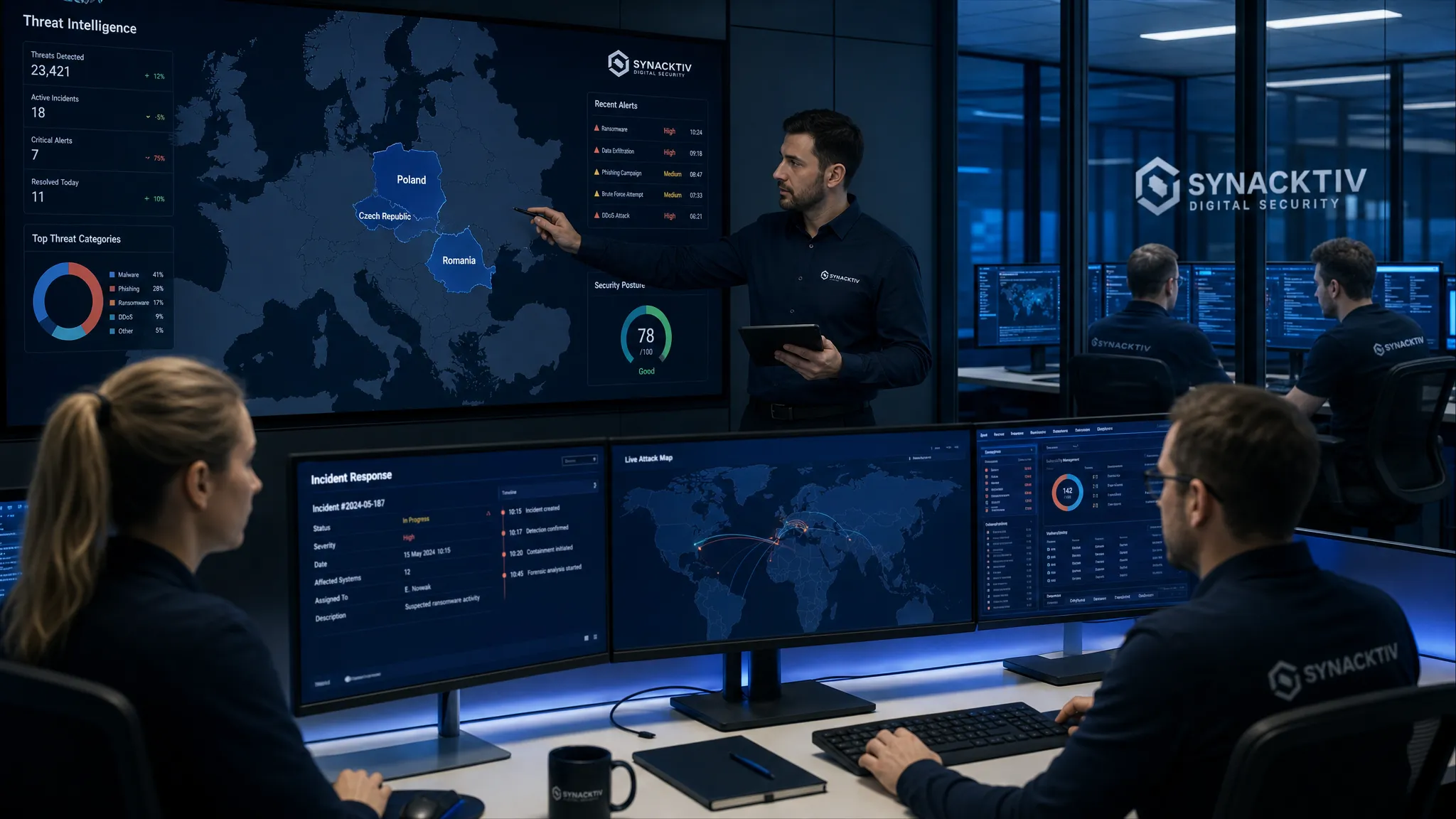
Nearshore Hiring means recruiting cybersecurity talent from geographically proximate markets. In 2026, Poland, Czech Republic, and Romania are the primary nearshore destinations for Western European organisations. These markets offer established technical education pipelines, strong engineering cultures, and experienced security professionals often available at 30 to 40 percent below equivalent Western European salary levels.
Remote-first roles are now a standard expectation for many cybersecurity professionals. Organisations that mandate full on-site attendance for roles that can be performed securely and effectively in a distributed model are consistently losing candidates at offer stage. The strongest candidates compare flexibility, tooling quality, incident rota expectations, and career development before compensation alone.
Cross-border hiring does introduce complexity. Employer of Record, or EoR, models are becoming more common because they allow organisations to employ nearshore talent without immediately establishing a local legal entity. Western European premium offers for Central and Eastern European candidates are highly attractive locally while remaining below London, Amsterdam, Munich, or Paris market equivalents.
Retention also extends beyond salary. Distributed security teams face alert fatigue, incident pressure, and irregular working patterns, so employers are paying closer attention to workload design, mental health, and localised wellbeing support. For Greek-speaking employees, for example, organisations may signpost relevant health and wellbeing information alongside formal benefits and employee assistance resources.
Summary: Nearshore hiring is no longer only a cost lever. It is becoming a core talent acquisition strategy for organisations that need specialist cybersecurity capability at speed.
Trend 4: Retained Search Is Replacing Contingency for Specialist Roles
The contingency recruitment model, where agencies are paid only on placement, is proving structurally inadequate for senior and specialist cybersecurity roles in 2026's shortage conditions, and retained search is becoming the standard for CISO, Cloud Security Lead, and Head of Threat Intelligence appointments.
Contingency recruitment can work for active candidate markets, but cybersecurity is dominated by the Passive Candidate, a qualified cybersecurity professional not actively job-seeking but open to the right opportunity. At senior and specialist levels, passive candidates are increasingly the only route to the best talent.
Retained Search is an exclusive, fee-based search engagement. It gives the search partner the mandate and commercial structure to map the market, approach candidates discreetly, test motivation, benchmark compensation, and manage long-cycle conversations. That matters when hiring a CISO, application security leader, cloud security architect, or threat intelligence head who is not applying to advertised roles.
The issue with contingency is incentive design. It rewards speed and volume, not necessarily depth, discretion, or precision. In a market where wrong hires can create operational, regulatory, and reputational risk, that trade-off is increasingly unacceptable. Organisations that have experienced failed contingency CISO searches are now moving to retained models earlier in the process.
For organisations assessing when specialist support is appropriate, Optima Europe’s guide to working with a cybersecurity recruitment agency in Europe explains how security hiring differs from general technology recruitment.
Summary: Retained search is becoming the preferred model for hard-to-fill cybersecurity appointments because it is better aligned with passive candidate engagement, market mapping, and executive-level risk.
Trend 5: Skills-Based Hiring Is Gaining Ground in Cybersecurity
With formal cybersecurity qualification supply unable to meet demand, European organisations are increasingly moving toward skills-based hiring, assessing demonstrated competency through practical exercises, CTF performance, and portfolio evidence rather than relying solely on degree credentials.
Skills-based Hiring is an emerging approach that prioritises demonstrated competency over formal qualifications. Its relevance in cybersecurity is growing because many capable practitioners have non-linear backgrounds, including systems administration, software engineering, military service, open-source security research, bug bounty participation, or self-directed learning.
CTF, or Capture the Flag, competitions are structured cybersecurity challenges that test skills such as exploitation, reverse engineering, forensics, cryptography, and web application security. The CTF community is producing technically strong practitioners, particularly in Poland, Czech Republic, and the UK. Bug bounty track records are also gaining credibility because they provide measurable evidence of real-world vulnerability discovery.
Practical assessment is replacing CV-first screening in many engineering-led hiring processes. Structured exercises, scenario-based interviews, code review, detection logic reviews, and incident simulations are more predictive than a degree requirement alone. Certifications still matter, but weighting is changing. OSCP, AWS Security Specialty, and CRTO are increasingly valued above university degrees for hands-on engineering, offensive security, and cloud security roles.
Summary: Skills-based hiring gives employers access to a wider and often more capable candidate pool, provided assessment is structured, relevant, and respectful of candidate time.
Frequently Asked Questions
The most important cybersecurity recruitment questions in 2026 are centred on regulatory demand, AI role change, nearshore workforce models, search strategy, and practical skills assessment.
What are the biggest cybersecurity recruitment trends in Europe in 2026? The biggest cybersecurity recruitment trends in Europe in 2026 are NIS2-driven compliance hiring, AI-augmented security role evolution, nearshore and remote hiring, retained search for specialist appointments, and skills-based hiring. These trends are connected by one structural fact: Europe has a cybersecurity talent shortage of more than 300,000 professionals. Demand is no longer limited to security operations or engineering. It now includes governance, incident response leadership, supply chain assurance, AI risk, and board-level security accountability. Employers that adapt job design, compensation, flexibility, and assessment methods will compete more effectively.
How is AI changing cybersecurity hiring in Europe? AI is changing cybersecurity hiring by shifting demand away from repetitive alert handling and toward professionals who can govern, tune, validate, and improve AI-powered security systems. AI-enabled SIEM, SOAR, threat intelligence, and compliance tools reduce some manual work, but they increase the need for experienced analysts who can judge context and risk. New hiring demand is also emerging around prompt injection, LLM security, model behaviour assessment, and AI governance. The strongest candidates combine traditional security foundations with automation literacy, investigative judgement, and the ability to challenge machine-generated outputs.
Why are European organisations increasingly using retained search for cybersecurity roles? European organisations are using retained search because the best cybersecurity candidates are usually passive, highly selective, and difficult to reach through advertised roles or contingency recruitment. Senior roles such as CISO, Cloud Security Lead, Head of Threat Intelligence, and Security Engineering Director require market mapping, discreet outreach, compensation benchmarking, and long-cycle candidate engagement. Retained search gives the recruitment partner exclusive commitment to the assignment, which supports deeper research and stronger candidate qualification. In a shortage market, failed searches are costly, so hiring leaders are prioritising precision over volume.
What is skills-based hiring and how does it apply to cybersecurity recruitment? Skills-based hiring prioritises demonstrated capability over formal credentials such as university degrees. In cybersecurity, this means assessing candidates through practical exercises, incident scenarios, CTF performance, bug bounty evidence, code review, detection logic tasks, or cloud security architecture discussions. It is becoming more important because formal qualification supply cannot meet European demand. Many strong practitioners come from non-traditional backgrounds and can prove competence through real-world outputs. For employers, the key is to design assessments that reflect the actual role, avoid excessive unpaid work, and compare candidates consistently.
How is nearshore cybersecurity hiring changing talent acquisition strategies in Europe? Nearshore cybersecurity hiring is changing talent acquisition by making cross-border workforce planning a standard option rather than an exception. Western European employers are increasingly hiring in Poland, Czech Republic, and Romania to access strong technical talent at salary levels often 30 to 40 percent below Western European equivalents. This allows organisations to build SOC, cloud security, application security, and security engineering capacity faster. It also requires stronger remote management, secure onboarding, employment compliance, and retention planning. Employer of Record models are becoming common where companies want nearshore talent without creating local entities.
Conclusion & Strategic Positioning
The strategic implication for 2026 is clear: cybersecurity workforce planning in Europe must be built around regulation-led demand, AI-enabled role change, nearshore capability, passive candidate engagement, and evidence-based skills assessment.
For CISOs, CTOs, HR Directors, and founders, the central question is no longer whether the cybersecurity hiring market is competitive. It is how to design a hiring strategy that reflects the market as it actually operates. NIS2 and DORA have made security leadership more urgent. AI has changed the skill mix. Nearshore hiring has expanded the available map. Retained search has become the more reliable route for specialist and senior roles. Skills-based hiring is widening access to talent that traditional filters miss.
Optima Europe works with organisations hiring business-critical cybersecurity, cloud, digital, and technology leaders across Europe and globally. For hiring leaders planning 2026 workforce investment, a structured conversation about role design, market availability, compensation, and search strategy can materially improve speed, accuracy, and hiring outcomes.

