
International Recruitment Agency vs Internal Hiring in Europe
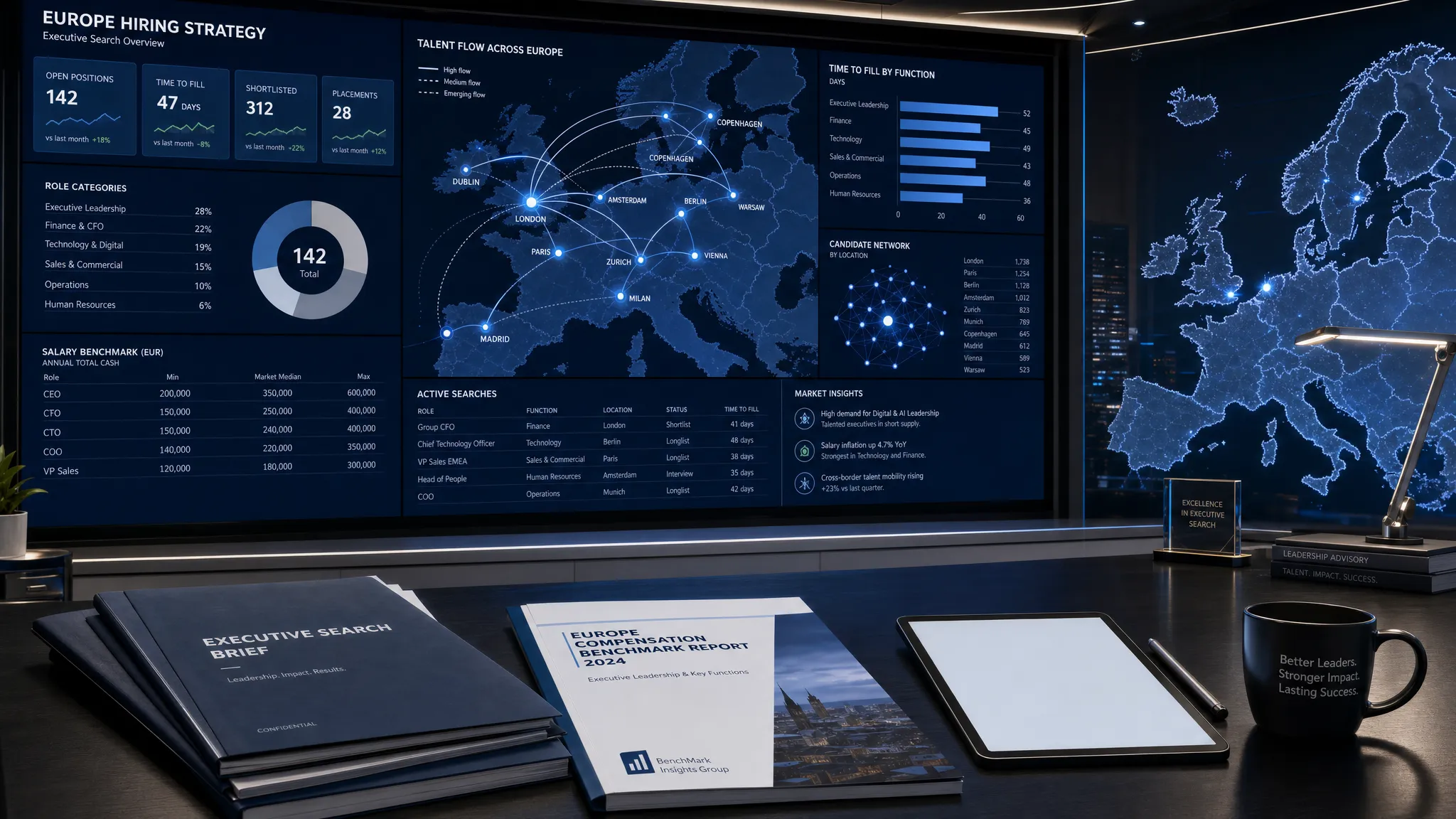
Internal Hiring vs. Recruitment Agency: The Core Trade-off
The choice between internal hiring and a recruitment agency in Europe is not about cost - it is about capability. Internal teams excel at mid-level and volume hiring. Specialist agencies access the passive senior talent pool that internal teams cannot reach.
Internal hiring is the practice of recruiting candidates through in-house HR or talent acquisition teams, without engaging an external agency. An internal recruiter is an in-house HR or talent acquisition professional responsible for managing the hiring process, usually across sourcing, screening, interview coordination, offer management, and reporting.
An international recruitment agency is a specialist firm sourcing and placing senior professionals across borders, combining passive candidate access, sector expertise, and cross-border hiring knowledge. That distinction matters because senior hiring is rarely solved by posting a vacancy and waiting for relevant applications.
A passive candidate is a qualified professional who is not actively job-seeking. At VP, Director, and C-suite level, this is often the dominant candidate profile. The best commercial, product, engineering, cyber, AI, or digital health leaders are usually employed, well-compensated, and not browsing job boards.
Time to fill is the number of days from search launch to accepted offer, and it is one of the clearest measures of whether the chosen hiring model is working. For mid-level roles with active candidates, an internal team can move quickly. For senior cross-border roles, the same team may spend 16-24 weeks building a weak shortlist, only to restart the search.
Summary: Internal hiring is best for repeatable roles, junior to mid-level hiring, and markets where employer brand generates inbound demand. A specialist international recruitment agency is stronger when the role is senior, confidential, cross-border, or dependent on passive candidate outreach.
The True Cost of Internal Senior Hiring in Europe
The true cost of filling a senior role internally in Europe, including HR time, tool costs, advertising, and the opportunity cost of the vacancy, typically exceeds the fee of a specialist recruitment agency for VP and Director-level searches.
Cost per hire is the total cost of filling a vacancy, including HR time, advertising, tools, interview time, and the cost of the vacancy itself during the search period. For senior roles, the visible spend is rarely the full cost. The largest cost is often the opportunity cost, which is the business cost of a senior role remaining vacant, including lost revenue, delayed decisions, and team attrition caused by leadership gaps.
A realistic senior internal search cost in Europe often includes:
- HR team time: 40-80 hours per senior search, including sourcing, screening, coordination, follow-up, reporting, and offer administration.
- Hiring manager time: 15-25 hours pulled from core responsibilities, often from the CEO, CRO, CTO, VP, or regional leader.
- LinkedIn Recruiter licence: £8,000-£12,000 per year, before the cost of outreach, response management, and data cleaning.
- Job board advertising: £2,000-£5,000 per role for senior visibility across relevant markets.
- Opportunity cost of vacancy: 15-25% of annual revenue impact for commercial leadership roles, especially VP Sales, CRO, regional MD, or strategic account leadership positions.
- Average time to fill internally: 16-24 weeks for senior roles where passive outreach, cross-border evaluation, and compensation benchmarking are required.
A vacant VP Sales role, for example, does not only create a recruitment problem. It can delay forecast ownership, enterprise pipeline progression, sales hiring, partner strategy, and regional expansion. If the role is tied to a £5m-£10m revenue target, even a 12-week delay can outweigh the apparent saving from avoiding an agency fee.
Summary: Internal senior hiring looks cheaper when only direct cash spend is measured. Once cost per hire includes recruiter time, executive interview time, tools, advertising, and vacancy impact, the economics shift. For VP and Director roles, speed and certainty often matter more than the headline fee.
Internal Hiring vs. Recruitment Agency: Comparison Table
For roles below Director level with strong active candidate pools, internal hiring is often faster and more cost-effective. For VP, Director, and C-suite appointments, a specialist agency consistently outperforms internal teams on speed, quality, and placement success rate.
Retained search is an exclusive agency engagement with a partial upfront fee, designed for senior, confidential, or business-critical appointments. It is usually the appropriate model for VP+ and C-suite hiring because it gives the search partner accountability for market mapping, passive outreach, assessment, shortlist quality, and offer management.
Comparison factors for internal hiring vs specialist recruitment agency:
- Passive candidate access: Internal hiring: Low. Specialist recruitment agency: High.
- Typical time to fill for senior roles: Internal hiring: 16-24 weeks. Specialist recruitment agency: 6-12 weeks.
- Sector market intelligence: Internal hiring: Limited. Specialist recruitment agency: Deep.
- Cross-border capability: Internal hiring: Low. Specialist recruitment agency: High.
- Cost for a senior role: Internal hiring: £15,000-£35,000 total before full vacancy impact. Specialist recruitment agency: 25-33% of base salary on a retained basis.
- Fill rate for senior roles: Internal hiring: 40-60%. Specialist retained agency: 80-90% where the brief, compensation, and decision process are aligned.
- Placement guarantee: Internal hiring: None. Specialist recruitment agency: 3-6 months typical, depending on engagement terms.
- Suitable for: Internal hiring: Mid-level and volume roles. Specialist recruitment agency: VP, Director, and C-suite appointments.
The comparison is not a universal argument for outsourcing recruitment. It is an argument for matching the model to the role. A senior internal recruiter can deliver excellent results in known markets with clear demand. A specialist agency adds more value when the target market is hidden, senior, international, or competitor-sensitive.
Summary: Internal hiring wins on repeatability and control. Specialist agencies win on access, market intelligence, and execution for senior searches. The correct decision is driven by role seniority, scarcity, geography, and the cost of delay.
Where Internal Hiring Works Well in Europe
Internal hiring teams are most effective for mid-level and below roles, recurring profiles with strong active candidate supply, and markets where the company has strong employer brand recognition.
Internal recruiters are valuable because they understand the company, the culture, the hiring managers, and the internal approval process. For a European technology company hiring 20 account executives, 15 customer success managers, or 10 software engineers in an established location, an in-house team can often outperform an external recruiter on speed and cost.
Internal hiring works particularly well for:
- Junior to mid-level roles: Candidate volume is higher, salary expectations are easier to benchmark, and active applicants are more responsive.
- High-volume hiring programmes: Repeatable roles allow internal teams to refine scorecards, interview loops, and conversion metrics.
- Roles with strong active candidate pools: If qualified candidates are already applying, an agency may add limited value.
- Markets with strong employer brand recognition: A known company in London, Berlin, Amsterdam, Paris, or Dublin may generate enough inbound interest for non-executive roles.
Internal hiring tends to fail at senior level for three reasons. First, passive candidate access is limited because senior leaders are not applying. Second, cross-border complexity increases when compensation, notice periods, employment expectations, and relocation preferences differ by country. Third, sector specialism becomes critical when the role demands deep knowledge of AI infrastructure, cybersecurity governance, marketing technology SaaS, or digital health.
A practical rule is simple: if the business already knows where to find the candidates and can attract them directly within 30-45 days, internal hiring is appropriate. If the shortlist depends on competitor mapping, confidential outreach, and senior-level persuasion, external search is usually the stronger model.
Summary: Internal hiring is effective when the talent pool is visible, active, and local enough for the company to access directly. It underperforms when candidates are senior, passive, scarce, or spread across multiple European markets.

Where a Specialist Recruitment Agency Outperforms Internal Hiring
A specialist international recruitment agency consistently outperforms internal hiring for VP and above appointments, cross-border searches, and any role where the best candidates are employed and not looking.
This is the operating zone where international placement agencies add measurable value. The agency is not simply sending CVs. It is mapping the market, identifying relevant leaders, approaching passive candidates, testing motivation, benchmarking compensation, managing risk, and keeping the search moving when the internal process competes with daily operational priorities.
Specialist agencies outperform internal hiring in several common scenarios:
- VP, Director, and C-suite appointments: The passive candidate pool dominates, and credible outreach from a specialist search partner can produce conversations that internal messages do not.
- Cross-border European searches: Local market knowledge, salary norms, notice periods, language expectations, and employment practices can vary significantly between the UK, Germany, France, the Netherlands, the Nordics, and Southern Europe.
- Sector-specialist roles: Cybersecurity, AI infrastructure, responsible AI, digital health, medtech, biotech, data analytics, AIOps, cloud engineering, and SaaS leadership require vertical network depth, not generic sourcing.
- Time-critical hires: Specialist agencies can compress timelines by 50-60% versus internal teams by running structured market mapping, outreach, screening, and shortlist development in parallel.
- First European hires for US companies: A US business hiring its first European VP Sales, Country Manager, or regional GTM leader needs compensation intelligence, competitor mapping, and local credibility.
Optima Europe focuses on senior and business-critical hiring across technology-led sectors, including GTM, Sales and Marketing, Digital & IT, AI infrastructure, cybersecurity, data analytics, smart manufacturing, and digital health. For companies assessing when an external partner is justified, this guide to using an employment agency for international roles explains the senior cross-border use case in more detail.
Summary: A specialist recruitment agency is strongest when the role is senior, scarce, confidential, cross-border, or commercially urgent. Its value is not only candidate supply. It is speed, access, market intelligence, and a higher probability of completing the appointment.
The Right Model: Internal + Agency Partnership
The most effective talent acquisition model for European technology companies at Series B and beyond is a hybrid approach, with internal recruiters managing mid-level and volume hiring, and a specialist agency engaged for VP+, C-suite, and cross-border searches.
The strongest hiring operating model is not internal versus external. It is internal plus external, with clear ownership. Internal teams should own recurring hiring, employer brand, candidate experience, interview operations, and workforce planning. A specialist agency should own searches where passive access, confidentiality, sector mapping, or cross-border execution is the determining factor.
A company should escalate to an agency when a senior search has passed 30-45 days without a credible shortlist, when the target candidate pool sits mainly inside competitors, when the role spans two or more European countries, or when the role reports directly to the CEO, board, or global executive team.
The agency brief should be commercial, not only functional. A useful brief defines the business outcome, reporting line, mandate for the first 12 months, target companies, compensation range, location flexibility, non-negotiable experience, interview process, decision-makers, and reasons a passive candidate would move. Without that clarity, both internal and external recruiters waste time with misaligned candidates.
Duplication is the main risk in a hybrid model. Avoid it by agreeing target company ownership, candidate ownership, communication rules, feedback timing, and interview responsibilities before outreach begins. If internal and external teams contact the same candidates with different messages, the company looks disorganised and senior candidate trust drops quickly.
For leadership teams building a repeatable senior hiring process, Optima Europe also outlines the stages of an international hiring agency process, from defining the business outcome to shortlist delivery and offer management.
Summary: The best model is not a permanent choice between internal hiring and agency search. It is a role-based operating model. Internal teams handle repeatable hiring. Specialist agencies handle senior, scarce, cross-border, and business-critical appointments where failure or delay carries material cost.
Frequently Asked Questions
The practical decision between internal hiring and agency search depends on seniority, scarcity, time pressure, and the measurable cost of leaving the role open.
Is it cheaper to hire internally or use a recruitment agency in Europe? Internal hiring is cheaper for repeatable mid-level roles because the salary cost of the internal recruiter is already in the business and active candidates can be sourced quickly. For senior hiring, it often becomes more expensive once cost per hire includes 40-80 HR hours, 15-25 hiring manager hours, £8,000-£12,000 in sourcing tools, advertising, and vacancy impact. A specialist retained agency fee of 25-33% of base salary can be lower than a 16-24 week leadership gap, particularly for commercial roles where delayed revenue ownership has measurable cost.
How long does it take to fill a senior role internally vs. using an agency in Europe? Internal senior searches in Europe commonly take 16-24 weeks, especially when the role requires passive candidate sourcing, cross-border comparison, and compensation benchmarking. A specialist recruitment agency typically completes senior retained searches in 6-12 weeks when the brief is clear, the salary range is realistic, and the hiring team gives feedback within 48-72 hours. The difference is driven by focus and access. Internal recruiters often manage multiple roles at once, while a retained search partner runs targeted market mapping, outreach, screening, and shortlist development from the first week.
When should a company use a recruitment agency instead of hiring internally? Use a recruitment agency when the role is VP level or above, when the candidate pool is passive, when the search spans multiple European countries, or when the vacancy has significant commercial impact. Agency support is also justified when a search has been open for more than 30-45 days without a strong shortlist. Internal hiring is suitable when the role is repeatable, mid-level, local, and supported by strong inbound applications. The decision should be based on access and risk, not only the agency fee.
Can an internal recruiter do executive search? An internal recruiter can manage parts of executive search, especially stakeholder alignment, interview coordination, candidate experience, and offer process. The challenge is market access. Executive search requires confidential outreach to passive candidates, competitor mapping, compensation intelligence, and senior-level persuasion. If the internal recruiter has a dedicated executive search mandate and enough time, they can be effective. If they are managing 10-20 open roles while supporting HR operations, a VP or C-suite search will usually move too slowly and produce a narrower candidate pool.
What is the fill rate difference between internal hiring and specialist agencies? For senior roles, internal hiring fill rates often sit around 40-60% when the company relies mainly on inbound applications, LinkedIn outreach, and hiring manager networks. Specialist retained agencies commonly achieve 80-90% fill rates when the brief, compensation, interview process, and decision-making are aligned. The gap comes from disciplined market mapping, passive candidate engagement, and continuous search management. Fill rate also depends on employer brand, salary competitiveness, location flexibility, and speed of feedback. A slow internal process can reduce both models, even with strong candidates.
Conclusion & Strategic Positioning
The winning model for European senior hiring is hybrid: internal teams should own repeatable hiring, while specialist international recruitment agencies should own VP, Director, C-suite, and cross-border searches where passive access and market intelligence determine success.
For growing technology companies, the build-versus-buy decision should be made role by role. If the vacancy is mid-level, local, and supported by active candidates, internal hiring is usually the right answer. If the role is senior, scarce, confidential, international, or tied directly to revenue, product, security, or regional expansion, the cost of delay is too high to rely on internal capacity alone.
Optima Europe is positioned for that second category: senior and business-critical appointments across Europe and globally, with sector focus across SaaS, cloud, data, AI, cybersecurity, digital health, and smart manufacturing. If your team is comparing partners, this guide on how to choose international recruitment agencies in Europe gives a practical framework for evaluating specialisation, process, and market reach.

