
NIS2 Hiring Priorities for European Leadership Teams

NIS2 has turned cybersecurity from a specialist IT concern into a board-level operating risk. For European leadership teams, the most urgent question is no longer whether the organisation needs better security. It is who will own resilience, who will prove compliance, who can manage incidents under time pressure, and who can connect technical risk to commercial reality.
That makes NIS2 hiring priorities different from traditional cybersecurity recruitment. The Directive creates pressure for stronger governance, clearer accountability, faster incident reporting, better supplier oversight and more resilient digital operations. A single compliance hire cannot solve all of that. Leadership teams need to build the right operating model, then hire against the gaps that matter most.
For CEOs, COOs, CROs, Managing Directors, HR leaders and Talent teams, 2026 is a practical execution year. Many organisations have already completed initial legal scoping. The next challenge is building leadership capability before regulators, customers, insurers or investors test whether NIS2 controls exist in practice.
Why NIS2 changes the hiring agenda
The EU NIS2 Directive expands cybersecurity obligations across essential and important entities, including sectors such as digital infrastructure, healthcare, manufacturing, energy, transport and providers of certain digital services. It also places explicit responsibility on management bodies to approve cybersecurity risk management measures and oversee their implementation.
That point matters for hiring. NIS2 is not only about finding technical people who can configure security tools. It requires leaders who can translate regulation into governance, influence business units, hold suppliers to account and make high-stakes decisions during disruption.
In practical terms, NIS2 increases demand for senior and business-facing roles across several areas:
- Cybersecurity leadership with board credibility
- Governance, risk and compliance capability
- Incident response and crisis management
- Supplier and third-party risk oversight
- Cloud, product, identity and engineering security
- OT and industrial security where operational technology is in scope
Optima Search Europe has explored the broader market pressure in its guide to the NIS2 Directive impact on cybersecurity hiring. This article takes a different angle: how leadership teams should prioritise which hires come first.
Start with the leadership risk profile
Before opening roles, leadership teams should define what NIS2 means for their organisation. Hiring without this step often leads to fragmented job descriptions, slow interview processes and candidates who are strong technically but misaligned with the actual risk environment.
A useful starting point is to assess five factors.
First, clarify whether the organisation is likely to be treated as an essential or important entity under relevant national implementation. Second, map the countries where obligations will apply, because enforcement expectations may vary by jurisdiction. Third, identify whether the business operates regulated digital services, critical supply chains, healthcare systems, industrial environments or high-volume customer data platforms. Fourth, assess current maturity across governance, detection, reporting and supplier controls. Finally, decide which gaps require permanent leadership and which can be supported through interim, advisory or managed services.
This framing helps avoid a common mistake: hiring a NIS2 Compliance Officer before deciding who has executive authority to implement change. Compliance documentation is important, but NIS2 success depends on ownership.
Priority 1: Appoint accountable cybersecurity leadership
For many organisations, the first priority is a senior cybersecurity leader who can own the operating model. Depending on company size and structure, this may be a CISO, VP Security, Director of Cybersecurity, Head of Information Security or Head of Cyber Risk.
The title matters less than the mandate. The person must be able to influence technology, legal, procurement, finance, operations and commercial leadership. They should also be able to brief the board in plain business language, not only in technical terminology.
Strong candidates for this role typically combine several qualities: experience building risk-based security programmes, familiarity with EU regulatory environments, incident response leadership, supplier risk awareness and the ability to hire or develop specialist teams. In fast-growth SaaS, cloud, AI infrastructure or digital health businesses, they also need to understand product velocity and customer assurance, because security requirements can affect revenue cycles and enterprise procurement.
Leadership teams should be careful not to under-scope this hire. A senior security leader tasked with NIS2 readiness but denied budget, authority or access to the board is being set up to fail. If the business is not ready for a full-time CISO, an interim or fractional model can be effective, provided ownership remains clear.
Priority 2: Build governance, risk and compliance depth
Once executive accountability is in place, the next priority is governance, risk and compliance capability. This is where many companies focus their initial NIS2 hiring, and for good reason. The Directive introduces expectations around cybersecurity risk management measures, policies, incident handling, business continuity, supply chain security, vulnerability handling and management oversight.
A NIS2-focused GRC leader or compliance officer can help convert those expectations into evidence, controls and routines. Their work may include mapping legal obligations, maintaining risk registers, coordinating audits, documenting security policies, preparing management reporting and ensuring teams can demonstrate compliance when challenged.
The best GRC candidates are not box-tickers. They understand how controls work in a real organisation and can collaborate with engineering, IT, security operations, procurement and legal. They can also prioritise, because leadership teams rarely have unlimited time or budget.
For a deeper role-specific view, Optima Search Europe has covered the process of hiring NIS2 Compliance Officers in Europe, including how responsibilities may vary by country and maturity stage.
Priority 3: Strengthen incident response and reporting capability
NIS2 places strong emphasis on incident handling and reporting. ENISA guidance and the Directive’s reporting structure have reinforced the importance of early warning, notification and follow-up reporting timelines for significant incidents. In practice, leadership teams need people who can detect, coordinate, decide and communicate under pressure.
That creates hiring demand for incident response managers, SOC leaders, detection engineers, security operations managers, threat intelligence specialists and crisis coordinators. In smaller organisations, these capabilities may be combined across internal staff and external partners. In larger or regulated environments, dedicated leadership is increasingly important.
The critical point is that incident response is not purely technical. When an incident occurs, the organisation must understand business impact, legal exposure, customer communication, operational continuity and regulator engagement. A strong incident leader can coordinate technical containment while also supporting executive decision-making.
Leadership teams should test candidates for scenario judgement. Ask how they would manage incomplete information, escalate to executives, work with legal counsel, prioritise affected systems and prepare communications without over-disclosing or under-reporting.
Priority 4: Hire for supply chain and third-party cyber risk
Supply chain security is one of the most underestimated NIS2 hiring priorities. Many organisations have improved internal security controls, but remain exposed through software vendors, cloud providers, outsourced IT, logistics partners, OT suppliers, data processors and specialist service providers.
NIS2 pushes leadership teams to treat supplier risk as a governance issue, not a procurement formality. That may require a third-party risk manager, supplier assurance lead, cyber procurement specialist or GRC professional with strong vendor management experience.
This role should work closely with procurement, legal, security and business owners. The goal is not to slow every vendor decision. It is to segment suppliers by risk, define minimum security requirements, improve contract language, review assurance evidence and ensure business continuity plans include key third parties.
The scope can extend beyond software. For example, a smart manufacturing group or logistics-enabled business expanding operations may need to assess digital and physical resilience across warehouses, field sites, temporary offices and storage infrastructure. In that context, leadership teams may review suppliers ranging from cloud platforms to specialist modular infrastructure providers such as Outback Shipping Containers where they support operational continuity in the wider business environment.
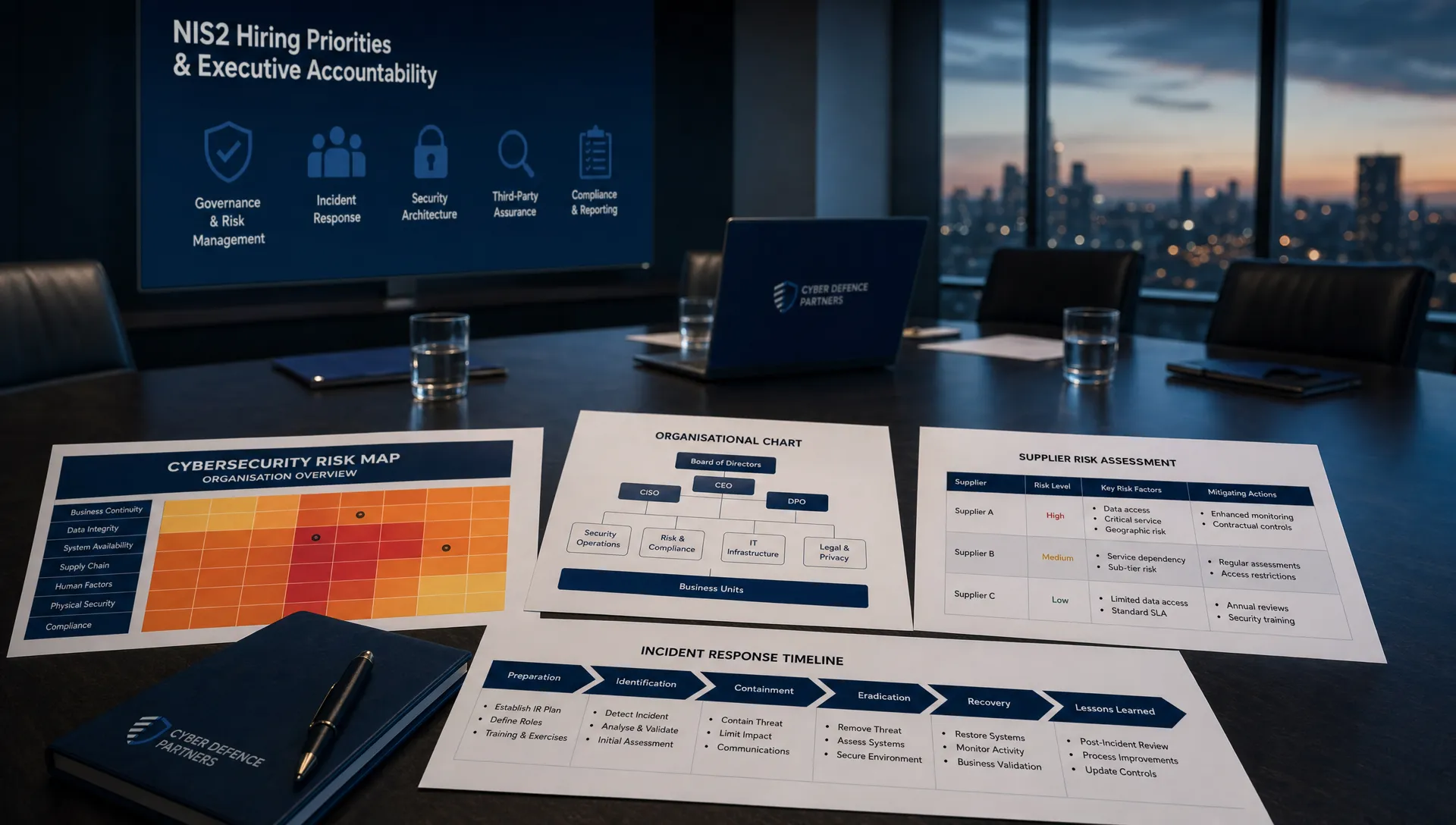
Priority 5: Align cloud, product and engineering security
For technology companies, cloud platforms, digital health providers, data analytics businesses and AI infrastructure firms, NIS2 readiness depends heavily on engineering and architecture. A policy cannot compensate for weak identity controls, insecure pipelines, unpatched systems or unclear ownership of product security.
This is where cloud security architects, application security leaders, DevSecOps engineers, identity and access management specialists and product security managers become central to the hiring plan.
These hires should be judged on their ability to build security into delivery, not just review it after the fact. In high-growth environments, the strongest candidates understand automation, developer experience and commercial urgency. They can introduce controls without paralysing release cycles.
Leadership teams should also pay attention to customer-facing impact. Enterprise customers increasingly ask for security evidence, resilience commitments and incident processes during procurement. Strong product and cloud security leadership can support revenue protection as well as compliance.
Priority 6: Add OT and industrial resilience capability where relevant
NIS2 has particular implications for organisations with operational technology, connected manufacturing, industrial AI, medtech production environments or critical physical processes. In these settings, the risk is not only data loss. It can include production downtime, safety concerns, quality issues and supply chain disruption.
Hiring priorities may include OT security architects, industrial cybersecurity managers, ICS security engineers and resilience leaders with experience across plant environments. These candidates are often harder to find than traditional IT security professionals because they must understand both industrial operations and cyber risk.
A common mistake is to place OT security entirely under corporate IT without enough operational context. Effective OT security leaders can collaborate with plant managers, engineering teams, vendors and safety functions. They know that patching, segmentation and monitoring must be planned around real production constraints.
For leadership teams in smart manufacturing, industrial AI, medtech or biotech, this capability should be considered early. Waiting until after an audit, incident or customer concern can leave the organisation competing for a very limited talent pool.
A practical hiring sequence for 2026
Not every organisation can hire every role at once. The right sequence depends on risk exposure, internal maturity and budget. However, most European leadership teams can use the following order as a practical starting point.
- Accountable cyber leader: Establish executive ownership first, especially if no senior security leader currently owns NIS2 readiness.
- NIS2 GRC or compliance lead: Build the governance, evidence and control framework needed to demonstrate progress.
- Incident response capability: Ensure the organisation can detect, escalate, coordinate and report significant incidents quickly.
- Supplier risk leadership: Address third-party exposure across technology, operations and critical service providers.
- Cloud, product or engineering security: Embed secure practices into platforms, applications and delivery teams.
- OT or sector-specific security: Add specialist capability where manufacturing, healthcare, infrastructure or industrial systems create distinctive risk.
This sequence is not rigid. A cloud-native SaaS company with strong GRC but weak application security may move product security up the list. A manufacturer with connected plants may prioritise OT earlier. A multinational operating across several EU jurisdictions may need legal, compliance and security leadership to work in parallel.
How HR and Talent teams should brief the market
NIS2-related roles are competitive, and the best candidates will assess the seriousness of the mandate before joining. A vague job description that asks for compliance, security operations, cloud architecture, board reporting and supplier risk in one mid-level hire will not attract the right people.
Talent teams should align with the CEO, COO, CIO, CISO and legal leadership before going to market. The role brief should explain the organisation’s NIS2 exposure, reporting line, decision authority, budget context, current maturity and expected outcomes in the first 6 to 12 months.
Strong briefs also separate must-have experience from trainable knowledge. For senior roles, board influence, change leadership and risk judgement may matter more than a specific toolset. For hands-on roles, technical depth and execution history will carry more weight.
Assessment should include scenario-based interviews. For example, ask candidates to walk through how they would prepare a board update, prioritise control gaps, manage a supplier security failure or coordinate a significant incident. Their answers will reveal whether they understand NIS2 as an operating challenge rather than a paperwork exercise.
Common mistakes leadership teams should avoid
The first mistake is treating NIS2 as a legal project only. Legal interpretation is essential, but implementation requires operational ownership across security, technology, procurement, finance and business units.
The second mistake is hiring too junior. A talented compliance analyst may produce useful documentation, but they may not have the authority to challenge business leaders, reshape supplier processes or influence engineering priorities.
The third mistake is over-indexing on certifications. Certifications can be useful signals, but NIS2 hiring requires judgement, stakeholder management and implementation experience. A candidate who has led a real incident or built a supplier assurance process may be more valuable than someone with an ideal certification list but limited operational exposure.
The fourth mistake is ignoring retention. Senior cybersecurity and GRC candidates are in demand across Europe. If the mandate is unclear, the reporting line is weak or the organisation treats security as a cost centre, strong candidates may leave quickly or decline the opportunity altogether.
What good looks like by the end of 2026
By the end of 2026, leadership teams should aim for a security operating model that can withstand scrutiny. That does not mean every control is perfect. It means accountability is clear, risk decisions are documented, incident processes are tested, suppliers are segmented, and management has regular visibility into cyber resilience.
A mature NIS2 hiring plan should create measurable progress across governance, operations and business resilience. The board should know who owns cybersecurity risk. Executives should understand which risks have been accepted, mitigated or escalated. Security leaders should have the authority to act. HR and Talent teams should understand which capabilities must be permanent and which can be supported through partners.
NIS2 is ultimately a leadership test. Organisations that hire only for compliance may satisfy short-term documentation needs but struggle when disruption occurs. Organisations that hire for accountability, resilience and cross-functional influence will be better positioned for regulatory confidence, customer trust and long-term growth.
Frequently Asked Questions
What are the most important NIS2 hiring priorities for leadership teams? The top priorities are accountable cybersecurity leadership, NIS2 governance and compliance capability, incident response readiness, supplier risk management, cloud or product security, and OT security where operational technology is in scope.
Does every company need a NIS2 Compliance Officer? Not always as a standalone title. Some organisations need a dedicated NIS2 Compliance Officer, while others may assign responsibilities to a GRC leader, cyber risk manager, legal function or CISO-led team. The key is clear ownership and sufficient authority.
Should NIS2 hiring sit under IT, legal, risk or operations? It depends on the organisation, but NIS2 should not be isolated in one function. Cybersecurity leadership may sit under technology or risk, while legal interprets obligations and operations supports resilience. Senior executive sponsorship is essential.
How can companies compete for scarce NIS2 talent? Companies can improve hiring outcomes by offering a clear mandate, board access, realistic scope, competitive compensation, visible executive support and a role brief that distinguishes strategic ownership from administrative compliance work.
Build the leadership capability NIS2 now requires
If NIS2 is reshaping your 2026 hiring plan, the priority is not simply to add headcount. It is to identify the leaders who can turn regulatory pressure into stronger governance, faster response and more resilient operations.
Optima Search Europe supports high-growth and established firms hiring business-critical leaders across cybersecurity governance risk, digital and IT, cloud platforms, AI infrastructure, digital health, smart manufacturing, sales, marketing and executive management. If your leadership team needs to strengthen NIS2 capability across Europe or globally, now is the time to define the mandate and engage the market with clarity.

