
How IT Staffing Companies Build AI Infrastructure Teams

AI infrastructure hiring is no longer a niche engineering problem delegated to a cloud team after the data scientists have finished experimenting. For CEOs, COOs, CROs and talent leaders, it now determines whether an AI roadmap becomes a production capability or remains a series of promising pilots.
This is where specialist IT staffing companies have become more strategic. The strongest firms do not simply search for Python engineers or cloud architects. They help leadership teams define the operating model, sequence the hires, test for production judgement and build a team that can support AI at scale across data, compute, security, reliability and governance.
For high-growth companies in Europe and America, the challenge is not only scarcity. It is precision. AI infrastructure roles overlap with platform engineering, MLOps, data engineering, DevOps, cybersecurity and distributed systems. A generic job description can attract hundreds of applicants and still miss the people who have actually taken models into production.
What an AI infrastructure team is expected to build
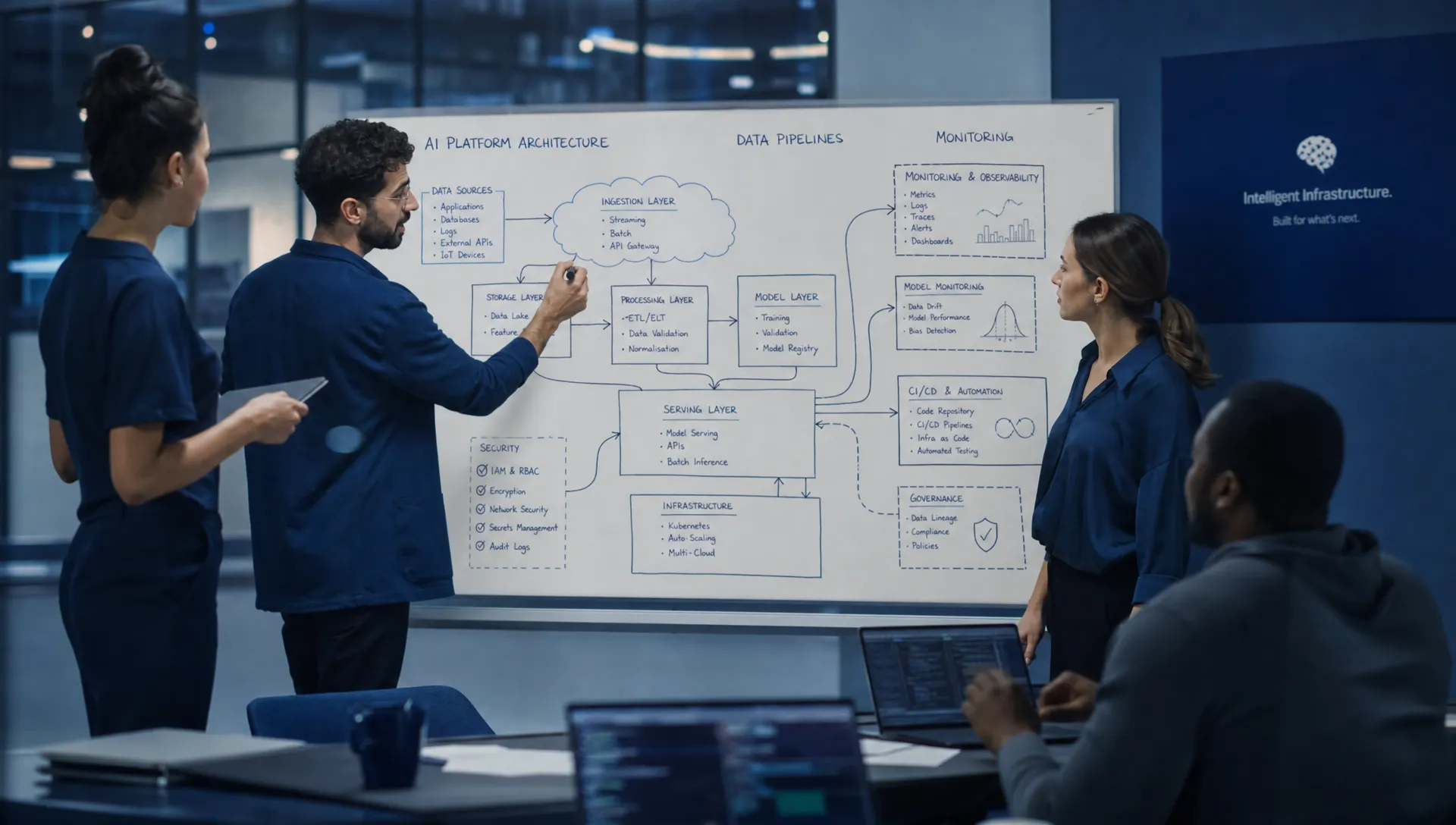
An AI infrastructure team owns the technical foundation that allows AI systems to be developed, deployed, monitored and improved safely. This includes the cloud or hybrid environment, data pipelines, model serving architecture, GPU or accelerator strategy, observability, access controls, governance workflows and deployment standards.
In a mature organisation, this team reduces friction for applied AI teams. Instead of every data scientist building their own fragile deployment path, the infrastructure team creates repeatable patterns for training, testing, releasing and monitoring models. That shift is what turns AI from a research activity into an operational capability.
The core roles usually include:
- AI infrastructure or platform lead: Owns the target architecture, technical standards, build versus buy decisions and alignment with the business roadmap.
- ML platform engineer: Builds shared tooling for model training, feature management, experimentation, deployment and monitoring.
- MLOps or LLMOps engineer: Focuses on reproducible pipelines, versioning, evaluation workflows, model registries and production release practices.
- Data engineer or data platform engineer: Ensures data quality, lineage, availability and performance across operational and analytical systems.
- Cloud or Kubernetes engineer: Manages scalable compute, container orchestration, infrastructure as code, networking and platform security.
- AI security and governance specialist: Designs controls for data privacy, model access, auditability, policy enforcement and regulatory readiness.
- SRE or observability engineer: Builds monitoring, alerting, incident response and reliability practices for AI-enabled services.
Not every company needs all these roles on day one. The value of experienced staffing support is knowing which capabilities must be hired now, which can be covered by contractors or partners and which should wait until the operating model is clearer.
Why general IT recruitment breaks down in AI infrastructure
Traditional IT recruitment often works well for established categories. A hiring manager defines a technology stack, recruiters map the market and candidates are screened against familiar criteria. AI infrastructure hiring is less linear.
The best candidates may not have AI infrastructure in their job title. They may come from high-scale SaaS platforms, cloud-native infrastructure teams, quantitative trading, autonomous systems, cybersecurity, enterprise data platforms or research engineering groups. Their relevance depends on what they have built, not only the keywords on their CV.
This is why specialist IT staffing companies focus on evidence. They look for people who can explain trade-offs around latency, throughput, GPU utilisation, data contracts, model rollback, observability and failure modes. They also test whether a candidate can work with research teams, product leaders, compliance stakeholders and finance teams managing cloud spend.
Optima has explored this role mix in more depth in its guide to engineering staffing agencies for AI infrastructure hiring, especially around MLOps and production AI hiring across Europe.
How IT staffing companies scope the team before sourcing
Good AI infrastructure hiring starts before the first candidate is contacted. The staffing partner should understand the business outcome, the production environment and the maturity of the organisation. A startup deploying its first AI-enabled workflow has different needs from a regulated enterprise modernising data platforms across multiple markets.
The discovery process usually covers four questions.
First, what AI systems will reach production in the next 6 to 18 months? A recommendation engine, clinical workflow tool, fraud model, industrial inspection system or generative AI assistant will each place different demands on the platform.
Second, what are the constraints? Some companies need real-time inference, strict data residency, on-premise deployments, high auditability or integration with legacy systems. Others mainly need faster experimentation and standardised deployment.
Third, where are the gaps in the current team? Many organisations already have strong cloud engineers but lack MLOps depth. Others have excellent data scientists but no one accountable for reliability, cost control or governance.
Fourth, which roles need permanent ownership? AI infrastructure becomes a core capability when the business depends on AI-enabled products or internal workflows. In that case, the key platform and leadership roles should rarely sit entirely with contractors.
A specialist partner converts this discovery into role architecture. That means defining the hiring sequence, compensation bands, location strategy, must-have skills, interview scorecards and candidate target markets before sourcing begins.
Sequencing hires by maturity stage
The common mistake is trying to hire a complete AI infrastructure team at once. That slows decisions, confuses the market and often leads to compromise hires. Strong IT staffing companies help leadership teams prioritise sequence.
For companies moving from prototype to first production deployment, the first priority is usually a senior AI infrastructure lead or ML platform engineer. This person should be capable of setting standards, choosing tooling pragmatically and working hands-on. They do not need a large team immediately, but they must be credible enough to prevent architectural debt.
For scale-ups with multiple AI use cases, the next hires often include MLOps engineers, data platform engineers and SRE capability. The goal is to make deployment repeatable, reduce operational incidents and shorten the path from experimentation to production.
For enterprise or regulated environments, security, governance and architecture become more prominent. AI systems may need audit trails, model risk management, policy controls and explainability workflows. Frameworks such as the NIST AI Risk Management Framework are useful reference points for organisations formalising responsible AI practices.
The operating context also matters. A retail, manufacturing or digital health company may depend on data from suppliers, warehouses, delivery partners and fulfilment systems. In practical terms, an AI demand forecasting or returns optimisation project may rely on clean operational feeds from 3PL logistics providers, warehouse management systems and transport tracking rather than idealised internal datasets.
How specialist recruiters identify the right talent pools
AI infrastructure talent is rarely sitting in one obvious market. The search needs to include adjacent technical communities and companies that have already solved relevant scale problems.
A credible staffing partner will map target organisations by architecture similarity, not only by sector. For example, a cybersecurity vendor running high-volume detection models may be a better source of MLOps talent than a famous AI lab with limited production exposure. A cloud platform company may offer stronger distributed systems talent than an enterprise software vendor with a larger brand.
Search strategy can include candidates from:
- Cloud-native SaaS companies with complex deployment and observability environments.
- Data platform vendors and analytics companies managing high-volume pipelines.
- AI product companies with production model serving experience.
- Regulated technology environments where governance and auditability are non-negotiable.
- Industrial, healthtech and cybersecurity firms where AI must operate under real-world constraints.
This is where executive access and referral networks matter. Senior AI infrastructure candidates are often not active applicants. They respond to credible outreach that explains the technical mission, leadership mandate, resourcing plan and why the opportunity is worth considering.
How IT staffing companies assess AI infrastructure candidates
Assessment has to go beyond a checklist of tools. Kubernetes, Terraform, PyTorch, Spark, Kafka, Databricks, AWS, Azure and GCP can all matter, but tool familiarity does not prove production judgement. A candidate who has inherited, stabilised and improved a messy platform may be more valuable than one who has only worked in a perfectly resourced engineering environment.
A strong assessment process tests for several dimensions. Technical depth comes first, including architecture, data flow, scaling, deployment and monitoring. Systems thinking follows, because AI infrastructure decisions create second-order effects in cost, reliability, security and developer productivity. Stakeholder communication is also essential, especially when platform decisions affect research velocity, product timelines and compliance obligations.
For leadership hires, the process should go further. Candidates need to show how they build teams, set standards, influence C-suite stakeholders and manage trade-offs between innovation and control. If the role sits close to board-level AI strategy, a more formal search process may be required. Optima covers that angle in its work on executive search for AI and deep tech leaders.
Practical assessment methods can include architecture walkthroughs, production incident discussions, system design interviews and structured scorecards. The aim is not to create an exhausting process. It is to give hiring teams a consistent way to compare candidates and reduce the risk of selecting someone who interviews well but has never operated AI systems under pressure.
Managing cross-border hiring across Europe and America
AI infrastructure hiring across Europe and America adds another layer of complexity. Compensation expectations vary sharply between markets. So do notice periods, employment models, remote working norms and candidate motivations.
For senior candidates, relocation may be less attractive than it was before widespread hybrid work. Many leaders want access to meaningful technical problems, strong peers, executive sponsorship and flexible working models. Employers that insist on narrow location requirements can reduce their candidate pool before the search starts.
At the same time, not every role should be fully distributed. Platform teams often benefit from overlap with product, security and engineering leadership. Specialist IT staffing companies help employers decide where remote hiring expands the pool and where proximity improves execution.
They can also advise on the difference between permanent, interim and contract hiring. Permanent hires are usually best for platform ownership, technical leadership and governance. Contractors can be valuable for migrations, tooling implementation, audits or short-term acceleration, provided knowledge transfer is built into the plan.
What good IT staffing companies do differently
The best staffing partners bring structure to a market that can otherwise feel noisy. They challenge vague requirements, calibrate the role with real candidate feedback and help hiring teams move quickly without lowering the bar.
For a CEO or talent leader, useful signals include:
- They can explain the infrastructure layer clearly: If a recruiter cannot distinguish MLOps from data engineering or platform engineering, they will struggle to assess the market.
- They advise before sourcing: Good partners question the job description, sequence and compensation before launching the search.
- They understand passive candidate motivation: Senior AI infrastructure specialists need more than a salary uplift. They need technical challenge, mandate and organisational credibility.
- They build evidence into the process: Scorecards, structured interviews and market calibration reduce subjective decision-making.
- They protect candidate experience: In a scarce market, slow feedback and unclear processes lose strong candidates quickly.
The right partner should also understand commercial context. AI infrastructure does not exist for its own sake. It should support revenue growth, operational efficiency, customer experience, risk reduction or product differentiation. Recruiters who can connect technical hiring to business outcomes will produce better shortlists.
Retention starts during the hiring process
Building the team is only half the challenge. Retention begins when the role is designed. Senior AI infrastructure talent is unlikely to stay if the organisation has no executive commitment, unclear budgets or unrealistic expectations about what production AI requires.
Candidates will assess whether the company understands the work. They will ask about data quality, cloud spend, deployment ownership, leadership support, technical debt and whether AI is central to the strategy or just a marketing priority. If those answers are vague, the strongest candidates will move on.
A robust staffing process surfaces these risks early. It helps leadership align on mandate, reporting lines, decision rights and success measures before offers are made. That preparation improves close rates and gives new hires a stronger foundation for impact.
Frequently Asked Questions
What roles are essential in an AI infrastructure team? Most teams start with an AI infrastructure lead, ML platform engineer or senior MLOps engineer. As production use cases grow, data engineering, cloud platform, observability, security and governance roles become more important.
How do IT staffing companies find AI infrastructure talent? Specialist firms map adjacent talent pools, including cloud-native SaaS, data platforms, cybersecurity, AI product companies and regulated technology environments. They focus on production evidence rather than relying only on job titles.
Do AI infrastructure teams need PhD-level AI researchers? Usually not. Research expertise can be valuable for some organisations, but AI infrastructure teams mainly need engineers who can build reliable, scalable and secure systems for model development and deployment.
Should companies hire permanent employees or contractors for AI infrastructure? Core platform ownership, technical leadership and governance are usually best held by permanent employees. Contractors can help with migrations, implementation projects or short-term capacity when there is a clear knowledge transfer plan.
What should executives look for in an AI infrastructure staffing partner? Look for technical fluency, access to passive candidates, market calibration, structured assessment methods and the confidence to challenge unrealistic role designs. The partner should understand both engineering depth and business impact.
Building the team that makes AI production-ready
AI infrastructure hiring is now a board-level capability for companies that want AI to improve products, operations and decision-making. The right team creates the foundation for reliable deployment, controlled risk and faster innovation.
If you are planning AI infrastructure hires across Europe or America, Optima Search Europe can help you define the role architecture, map specialist talent and engage senior candidates with the technical and commercial judgement needed for production AI.

