
How Marketing Executive Recruiters Identify High-Impact Leaders

Marketing executive recruiters are usually engaged when a marketing hire has to change the trajectory of the business. The need might be repositioning a brand, increasing pipeline quality, entering the US, reducing customer acquisition cost or professionalising a marketing organisation that has outgrown founder-led growth.
At this level, CV screening is a poor proxy for future impact. A candidate may have recognisable logos, large budgets and a polished transformation story, yet still be wrong for the specific growth stage, sales motion or cultural reality of the company. The real question is not whether a leader has done impressive things. It is whether they can create measurable advantage in your environment.
High-impact marketing leaders combine commercial judgement, market insight, operating discipline and leadership range. Specialist recruiters identify those signals through structured discovery, market mapping, evidence-led assessment and discreet access to leaders who are rarely active applicants.
Start with the business outcome, not the marketing title
Weak searches begin with a job description. Strong searches begin with the result the board, CEO or CRO needs the next marketing leader to deliver.
A CMO for a Series B SaaS company entering North America is a different hire from a VP Marketing hired to rebuild demand generation after a failed international expansion. A marketing director in digital health may need to navigate clinical credibility, regulation and complex buying committees, while a marketing leader in cybersecurity may need to translate technical differentiation into board-level urgency.
This is why experienced marketing executive recruiters first pressure-test the mandate. They clarify whether the hire is expected to create a category, strengthen positioning, build enterprise pipeline, upgrade product marketing, improve sales enablement, integrate acquisitions or scale a team across markets. Each outcome requires a different leadership profile.
This early alignment also reduces stakeholder drift. If the CEO wants brand elevation, the CRO wants pipeline and the CFO wants stronger payback discipline, the search can quickly become inconsistent unless those expectations are translated into one scorecard. The same principle applies to broader senior appointments, where great recruiting firms define leadership success before approaching the market.
Translate company context into a leadership profile
A senior marketer is never assessed in isolation. Recruiters look at the environment in which the leader created results and compare it with the environment they would inherit.
The key variables include company stage, market maturity, sales motion, average deal size, buyer complexity, budget discipline, data quality, team capability and board appetite for change. A leader who thrives in a founder-led, high-velocity environment may struggle in a matrixed enterprise. A brand-led leader from a mature consumer category may not be suited to a technical B2B platform with long sales cycles, unless they can prove they have adapted successfully before.
| Hiring context | High-impact leadership signal |
|---|---|
| Founder-led growth now needs structure | Builds process without slowing entrepreneurial speed |
| Enterprise B2B with long sales cycles | Links positioning, account strategy, sales enablement and buying committee insight |
| Product-led SaaS moving upmarket | Connects usage data, lifecycle marketing, product marketing and enterprise demand |
| European company expanding into America | Adapts messaging, channels and hiring assumptions across regions |
| Mature brand losing relevance | Refreshes the narrative while protecting trust and margin |
Context also includes category nuance. A marketer scaling enterprise cybersecurity will not use the same motions as a leader building a direct-to-consumer food proposition, such as shelf-stable meals designed for eating well anywhere. The recruiter’s task is to identify transferable judgement beneath the surface detail, not to assume that a familiar sector label is enough.
Separate activity from impact
Senior marketing CVs are often filled with transformation language. Recruiters need to distinguish genuine ownership from proximity to success.
A high-impact leader can explain what changed because of their decisions. They can describe the baseline they inherited, the choices they made, the trade-offs they accepted and the commercial effect that followed. They do not claim full credit for revenue growth if pricing, sales headcount or a product release carried most of the result.
Recruiters test impact by asking for evidence across several dimensions:
- Business effect: How did marketing influence revenue quality, pipeline conversion, retention, pricing power or market perception?
- Operating conditions: What budget, team, data and technology did the leader inherit?
- Decision quality: What did they stop doing, not just what did they launch?
- Cross-functional contribution: How did their work improve sales productivity, product insight or customer experience?
- Durability: Did the improvement last after the initial campaign, rebrand or restructuring?
This distinction matters because marketing impact is often indirect. A stronger narrative can improve win rates. Better segmentation can reduce wasted spend. Product marketing can shorten sales cycles by helping sales teams handle objections earlier. For companies focused specifically on revenue contribution, Optima has explored how marketing recruiters identify leaders who drive revenue in more depth.
Look for strategic thinking that survives pressure
Polished presentations can hide weak judgement. Recruiters therefore assess how a candidate thinks when conditions are constrained, ambiguous or politically sensitive.
A useful conversation might explore how the candidate would enter a new region with limited local brand awareness, how they would reallocate spend after two quarters of weak pipeline quality or how they would rebuild trust between sales and marketing after missed targets. The content of the answer matters, but so does the reasoning. High-impact leaders frame the problem clearly, identify what they do not yet know and make practical decisions without pretending that every variable is certain.
Structured assessment is especially important at executive level because confidence can be mistaken for competence. Harvard Business Review has highlighted the value of structured interviews in reducing inconsistency and bias. In executive search, that means each candidate should be assessed against the same outcomes, leadership behaviours and contextual risks rather than whatever topic happened to dominate the meeting.
Assess leadership range across the executive table
Marketing leaders do not create impact through campaigns alone. They operate across the executive team.
The CEO needs clarity on market narrative and growth priorities. The CRO needs marketing to improve pipeline quality and deal progression, not simply deliver leads. The CFO needs confidence that spend is disciplined. Product leaders need market insight that shapes roadmap decisions. Regional leaders need messaging that works locally without fragmenting the brand.
Recruiters assess whether a candidate can influence all of those stakeholders without losing the core marketing agenda. The strongest leaders can challenge sales constructively, translate brand investment into commercial language and make marketing more accountable without reducing it to short-term demand generation.
They also look at team leadership. A high-impact executive hires well, develops successors and raises the calibre of the function. They know when to build in-house, when to use agencies and when to simplify an overbuilt technology stack. This is often where a leader’s real ceiling becomes visible. A candidate who personally solves every problem may impress in interview, but scale requires building an organisation that performs without constant intervention.
Search the market, not just the applicant pool
The best senior marketing leaders are often not applying for roles. They are delivering results elsewhere, selectively open to the right mandate and cautious about reputational risk.
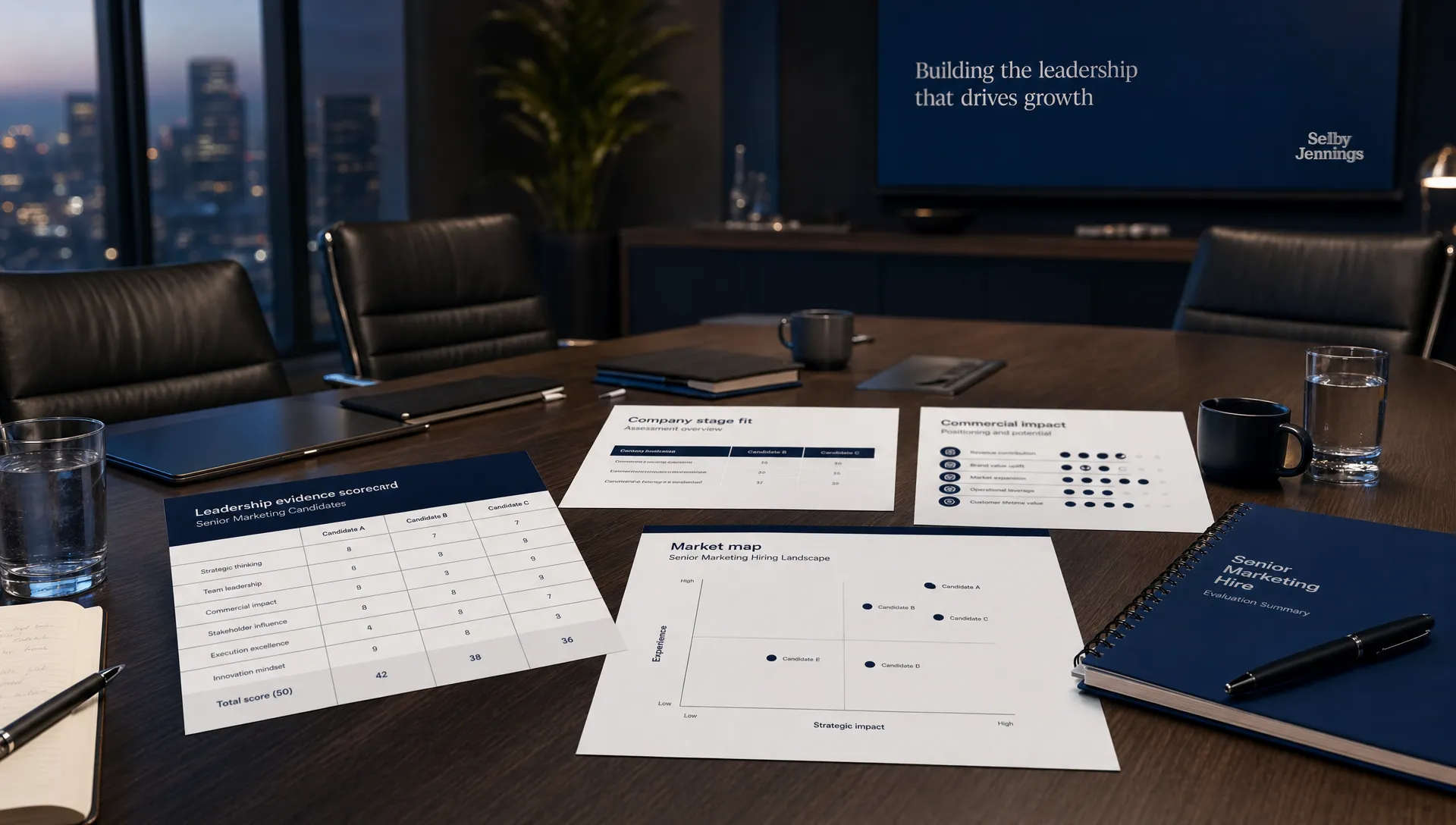
Marketing executive recruiters therefore build a market map before a shortlist. They identify companies with similar growth challenges, adjacent sectors with transferable operating models and hidden leaders who may sit one level below a high-profile CMO but own much of the execution. In some searches, the best candidate is not the obvious public-facing marketing executive. It may be the regional VP who led expansion, the product marketing leader who rebuilt positioning or the demand leader who scaled a repeatable enterprise engine.
This matters in Europe and America, where hiring across regions adds complexity. Compensation expectations, notice periods, relocation appetite, language capability and go-to-market maturity can vary widely. A recruiter who only posts a role and waits for applicants will miss much of the market.
Discreet outreach also changes the quality of the conversation. Passive candidates need to understand the strategic mandate, reporting line, decision rights and realistic constraints before they will engage seriously. Overselling the opportunity may create short-term interest, but it damages trust later in the process.
Test modern marketing fluency without chasing buzzwords
High-impact marketing leaders in 2026 need fluency in data, AI-enabled workflows, privacy expectations, attribution limits and the changing relationship between brand and performance. That does not mean the best candidate is the person who names the newest tool in every answer.
Recruiters look for practical technology judgement. Has the candidate used AI to improve content operations, research, segmentation or reporting in a governed way? Can they explain where automation improved productivity and where human judgement remained essential? Do they understand the limits of last-click attribution, especially in enterprise buying cycles where brand trust, analyst influence, communities and partner ecosystems all shape demand?
In specialist sectors such as AI infrastructure, cybersecurity, digital health and marketing technology SaaS, modern marketing fluency also means understanding technical buyers. High-impact leaders can simplify complex propositions without stripping away credibility. They know when to educate the market, when to create urgency and when to equip sales teams with sharper commercial proof.
Verify reputation through structured referencing
Referencing should not be a polite formality at the end of the process. For senior marketing appointments, it is a way to verify patterns of behaviour that interviews cannot fully reveal.
A structured reference explores how the leader performed under pressure, how they handled disagreement, whether they built trust with peers and whether the results described by the candidate match the experience of colleagues. The focus is not gossip. It is evidence.
| Reference area | What recruiters are trying to verify |
|---|---|
| Decision quality | Whether the leader made sound calls with incomplete information |
| Executive influence | Whether peers trusted their judgement and followed their lead |
| Team impact | Whether they hired, developed and retained strong people |
| Commercial credibility | Whether sales, finance and product teams saw marketing as a growth partner |
| Resilience | Whether performance held up during missed targets, change or ambiguity |
The best references are specific. A vague endorsement is less useful than a clear example of how the candidate handled a difficult board meeting, reallocated budget or rebuilt a struggling team.
Judge shortlist quality, not candidate volume
A strong executive shortlist is not a stack of similar CVs. It is a carefully reasoned comparison of leaders who can credibly deliver the mandate, with clear evidence, risks and trade-offs.
For example, one candidate may be strongest on category creation, another on enterprise demand generation and another on international team scaling. The hiring team should understand why each person is included, what conditions would help them succeed and where deeper assessment is needed.
This is where search discipline becomes visible. A quality shortlist reflects the original scorecard, the market map and the evidence gathered through assessment. If candidates feel interchangeable, the search has not gone deep enough. Hiring leaders can apply similar principles when evaluating shortlist quality from marketing recruitment agencies.
Warning signs recruiters watch for
High-impact leadership has recognisable patterns, and so do poor-fit appointments.
Recruiters become cautious when a candidate relies heavily on one playbook, especially if the hiring company’s context is different from their previous employer. They also test for overclaiming, vague metrics, weak peer relationships, limited team development or a tendency to describe marketing success only through activity volume.
Another warning sign is a lack of local sensitivity. A leader who succeeded in one region may not automatically understand buying behaviour, channel economics or talent expectations in another. For companies hiring across Europe and America, adaptability is often as important as past scale.
Finally, recruiters watch how candidates engage with constraints. Strong leaders ask intelligent questions about budget, data, decision rights and company appetite for change. They do not need a perfect situation, but they do need enough clarity to judge whether they can succeed.
What CEOs, CROs and talent leaders should expect
The best marketing executive recruiters make the hiring process sharper before they make it faster. They challenge vague requirements, expose stakeholder misalignment and help the business distinguish between impressive candidates and suitable leaders.
For CEOs, that means defining the commercial and strategic change the hire must lead. For CROs, it means clarifying how marketing should influence pipeline quality, sales productivity and market confidence. For HR and talent leaders, it means building a process that is structured enough to compare candidates fairly but flexible enough to engage senior passive talent.
A high-impact marketing hire is rarely obvious from a job title. The strongest recruiters identify patterns of judgement, context fit and leadership behaviour that predict future performance, then bring those insights into a decision process the executive team can trust.
Frequently Asked Questions
What do marketing executive recruiters look for in a senior marketing leader? They look for evidence of commercial impact, strategic judgement, context fit, executive influence, team-building capability and adaptability across markets or growth stages.
How is executive marketing recruitment different from standard marketing hiring? Executive recruitment focuses less on channel execution and more on leadership impact. The assessment covers board-level communication, cross-functional influence, organisational design, market strategy and the ability to deliver outcomes through other people.
Why do recruiters assess company context so closely? A leader who succeeds in one environment may fail in another. Company stage, sales motion, buyer complexity, budget maturity and regional expectations all affect whether a candidate’s experience will transfer.
How many candidates should be on a senior marketing shortlist? There is no fixed number, but quality matters more than volume. A strong shortlist usually contains a small group of credible leaders, each with a clear rationale, evidence base and known trade-offs.
When should a company use marketing executive recruiters? Use specialist recruiters when the role is business-critical, confidential, senior, difficult to benchmark or unlikely to attract the best passive candidates through advertising.
Build a stronger marketing leadership search
Hiring a senior marketing leader is a strategic decision, not an administrative process. The cost of a mis-hire can show up in missed revenue, confused positioning, team churn and lost market momentum.
Optima Search Europe supports executive and business-critical hiring across Europe and America, with specialist experience in GTM, sales, marketing, digital and technology sectors. If your next marketing appointment needs to create measurable impact, start by defining the outcome, then build a search process capable of proving who can deliver it.

