
How to Hire Machine Learning Engineers in Germany (2026 Guide)
How to Hire Machine Learning Engineers in Germany (2026 Guide)
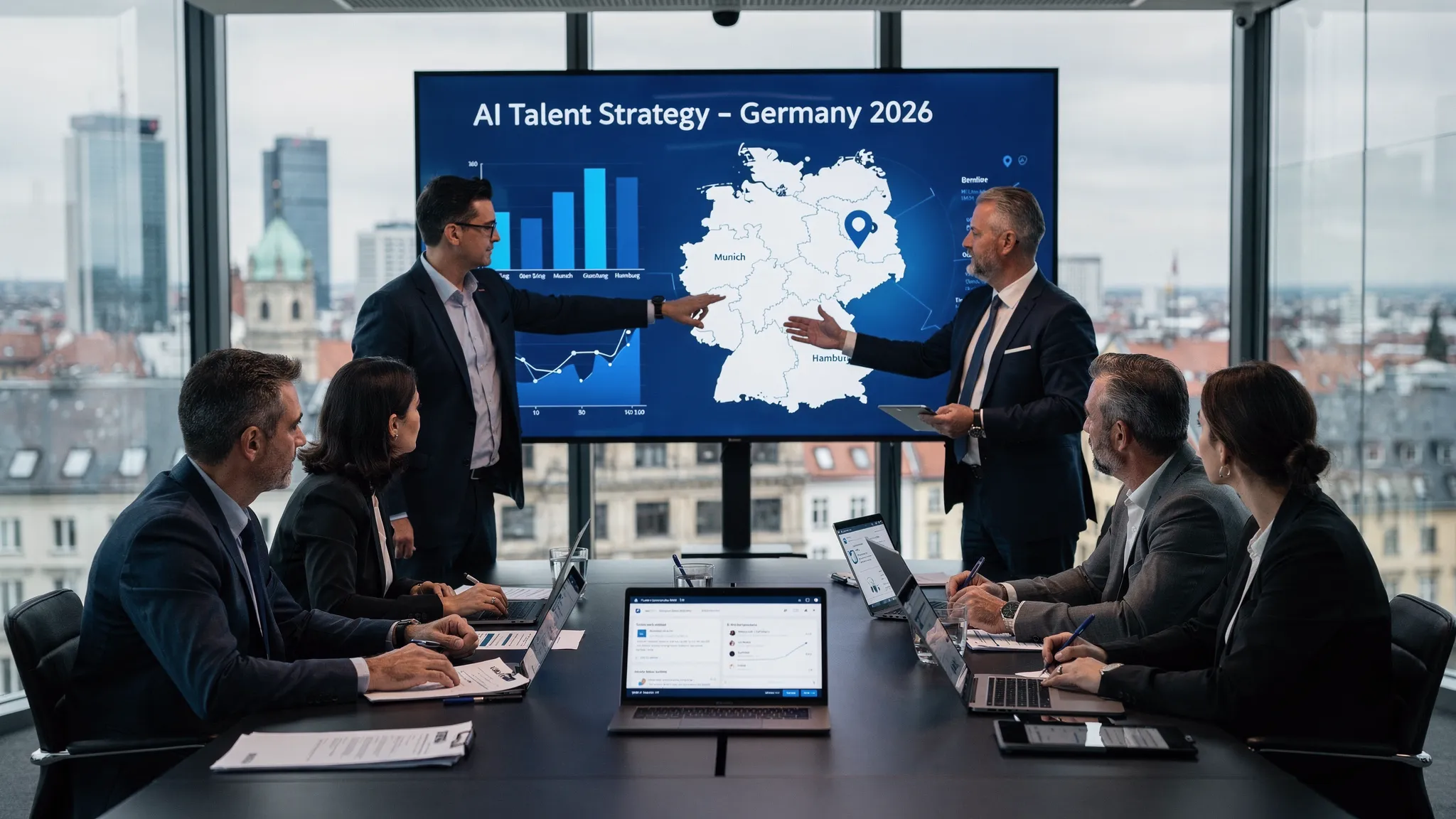
Hiring machine learning engineers in Germany in 2026 is less about “finding CVs” and more about running a fast, evidence-based process in a market where strong candidates have options. Berlin’s AI ecosystem keeps producing new startups and scaleups, Munich’s tech hub continues to absorb applied ML talent into enterprise and deep tech, and Hamburg’s tech scene is growing steadily across logistics, media, and commerce. The outcome is predictable: high demand, limited supply, and very little tolerance for slow hiring cycles.
This guide is written for CTOs, VP Engineering, HR Directors and AI Product Leads who need to hire machine learning engineers in Germany while keeping time-to-hire under control, positioning offers accurately (in gross annual salary, or Bruttojahresgehalt), and staying compliant with German employment law and EU rules. If you are building across borders, this also connects to the reality of cross-border recruitment, including the EU Blue Card.
If you already know you will need access to passive Artificial Intelligence talent across multiple European markets, it can help to benchmark your approach against a specialist AI recruitment agency in Europe that can map the market and engage off-market candidates.
Why Germany Is a Strategic Market for Machine Learning Talent
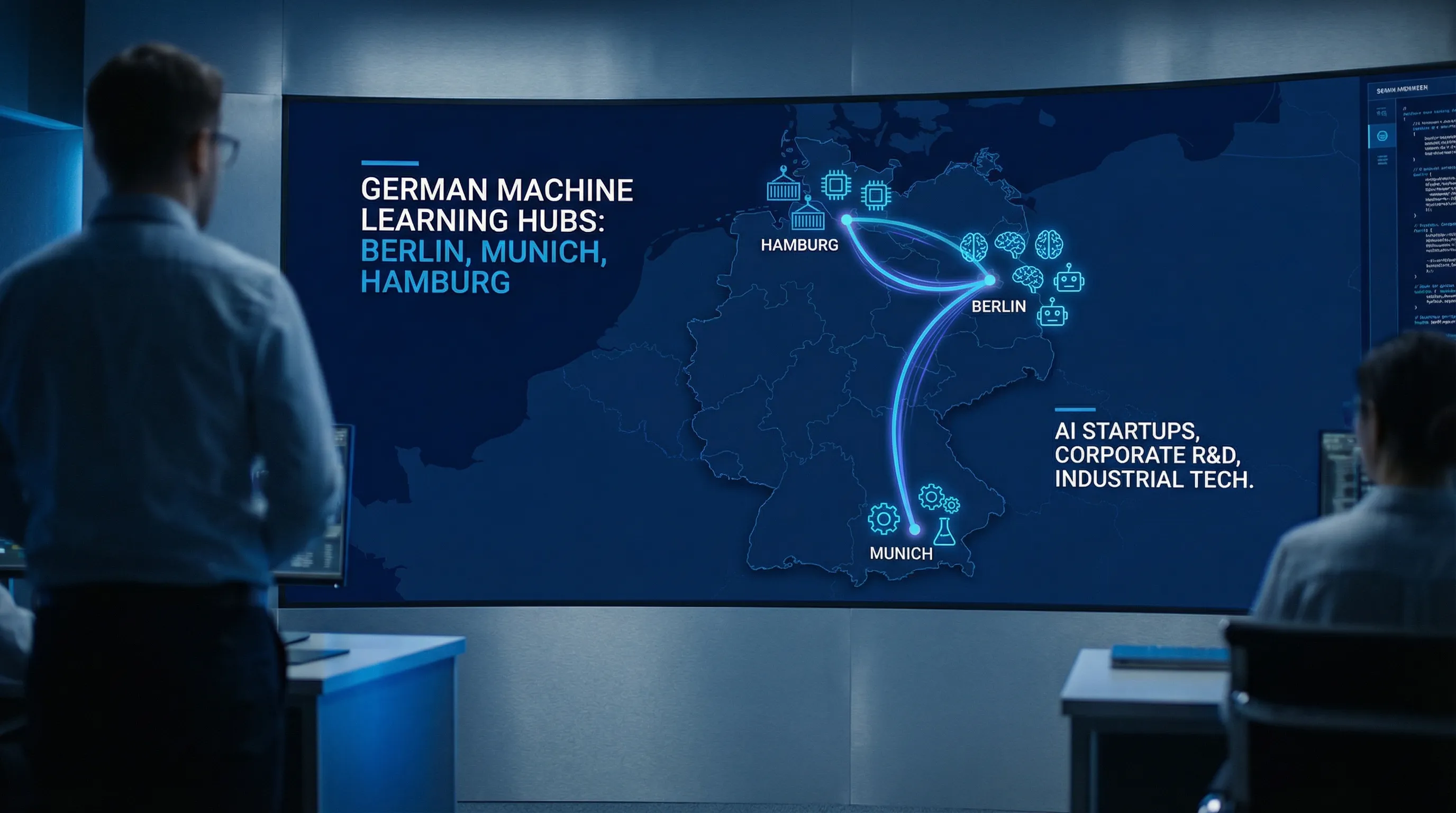
Germany is one of Europe’s most strategically important markets for machine learning talent because it combines three ingredients that rarely coexist at scale: world-class applied engineering, strong industrial demand, and a dense research network that produces ML-capable graduates and researchers.
Berlin as an AI startup hub
Berlin continues to attract venture-backed product companies and international tech firms building European teams. The city’s hiring environment tends to favour:
- Product-focused Machine Learning Engineers who can ship models into real user workflows
- Full-stack ML profiles that sit between data, engineering, and experimentation
- Candidates with startup signal, meaning ownership, speed, and pragmatic trade-offs
Berlin is also where many candidates compare offers aggressively. A “good” role can still lose if the process feels slow, the mission is unclear, or remote flexibility is weaker than peers.
Munich corporate and deep tech ecosystem
Munich remains Germany’s most concentrated hub for corporate R&D and deep tech. Demand is driven by automotive, manufacturing, insurance, and large-scale platform engineering. You will often find a higher share of:
- Production-grade ML and MLOps experience
- Safety and reliability mindset (especially where models interact with physical systems)
- Strong academic pedigrees from nearby universities and research groups
The Munich tech hub also tends to pay higher fixed compensation than Berlin, but may trade off on equity upside compared with startups.
Research institutions and AI innovation
Germany’s research landscape is a major reason ML capability runs deep. Institutions and networks such as Fraunhofer, Max Planck institutes, and leading technical universities help keep a pipeline of candidates who are comfortable with research methods, statistics, and modern ML frameworks.
For employers, this creates an opportunity and a risk:
- Opportunity: hire candidates with strong fundamentals who can adapt as the tooling changes.
- Risk: some candidates have research-heavy profiles but have not shipped models into production with real reliability constraints.
Government AI investment
Germany and the EU have continued to prioritise AI as a competitiveness lever, alongside stronger regulatory frameworks. In 2026, many AI teams must build with compliance in mind from day one, particularly for privacy, auditability, and (depending on product scope) EU AI Act readiness.
Summary (strategic market): Germany offers a rare combination of applied engineering strength, research output, and enterprise demand. Berlin drives startup-style product ML, Munich concentrates corporate and deep tech, and Hamburg is rising in applied use cases, creating sustained hiring pressure.
Demand and Talent Shortage for ML Engineers in Germany
The biggest practical challenge in machine learning recruitment in Germany is not a lack of interest in AI. It is the supply versus demand imbalance for engineers who can build, deploy, and operate ML systems in production.
Supply is constrained at the “production ML” level
Many candidates can prototype models. Far fewer can own end-to-end delivery:
- Data pipelines and feature stores
- Training, evaluation, and monitoring in production
- CI/CD patterns for ML (MLOps)
- Incident response and drift management
This gap is where time-to-hire typically blows out, because companies realise late that they are screening for “ML skills” rather than “production ML outcomes”.
Competition from US and enterprise firms
A second pressure is international competition. Strong candidates in Berlin and Munich are visible to US-headquartered firms and global platforms hiring remotely or via German entities. Even when salary bands look similar on paper, candidates may be influenced by:
- Brand signal (who will this impress in 2 years?)
- Ability to publish or speak externally
- Access to modern compute and tooling
- Scope of ownership and speed of decision-making
Remote hiring pressure and EU-wide options
Remote and hybrid norms are now baked into candidate expectations. Even when a role is “Germany-based”, candidates frequently compare it to remote EU roles or multi-country teams. That shifts the negotiation from location to mission and growth.
AI migration trends and cross-border recruitment
Germany continues to attract skilled immigration, but practical friction remains: visa timelines, relocation complexity, and family considerations. The EU Blue Card is a major enabler for hiring internationally, but it is not instantaneous and thresholds change over time. Employers who can plan this early reduce risk and accelerate start dates.
For broader context on structural scarcity across the region, see Optima’s perspective on the AI talent shortage in Europe.
Scarcity is sharpest in Berlin and Munich
Berlin’s scarcity shows up in startup-ready engineers who can own ML features end-to-end. Munich’s scarcity is often in production ML engineers with strong MLOps and reliability skills, especially those who have operated systems at scale.
Summary (talent shortage): Demand for ML engineers in Germany is growing faster than supply, especially for production-grade profiles. Competition comes from local scaleups, enterprise, and international remote hiring, while immigration can help but adds process and compliance complexity.
Machine Learning Engineer Salary in Germany (2026 Overview)
Salary expectations in 2026 vary widely by seniority, city, sector, and whether the role is research-led or product-led. For hiring teams, the goal is not to find a universal number, but to position an offer credibly against local comparables and the candidate’s realistic alternatives.
A useful way to communicate internally is to anchor comp in gross annual salary (Bruttojahresgehalt) and then separate:
- Base salary
- Variable bonus (where applicable)
- Equity or virtual shares (more common in startups and some scaleups)
- Benefits (pension contributions, mobility budgets, learning budgets)
Typical salary ranges by level (gross annual)
In many 2026 searches, the following ranges are common starting points for total fixed compensation (base, sometimes plus a small fixed allowance), before bonus or equity:
- Junior ML Engineer (0 to 2 years): roughly €55k to €75k
- Mid-level ML Engineer (3 to 5 years): roughly €75k to €105k
- Senior ML Engineer (6+ years): roughly €105k to €140k+
Some specialised profiles (for example, strong MLOps, high-scale infrastructure, or safety and governance experience) can push beyond these ranges, especially in Munich or in highly competitive international environments.
Berlin vs Munich vs Hamburg
City differences are real, but they show up differently depending on company type.
- Berlin AI ecosystem: strong startup and scaleup demand, equity can be meaningful, base salaries may be slightly lower than Munich at the same level, but competition is intense.
- Munich tech hub: higher tendency toward strong base pay, more enterprise roles, and demand for production reliability.
- Hamburg tech scene: competitive mid-market packages, often strong in applied ML for logistics, commerce, and media, with slightly less “auction-style” competition than Berlin for some niches.
Startup vs enterprise compensation
Comp structure differs as much as comp level:
- Startups often offer lower base with higher equity potential, but candidates will scrutinise credibility (funding runway, product traction, team quality).
- Enterprise firms more often offer higher predictability (base, bonus, job security), but candidates may worry about velocity, bureaucracy, and whether ML will truly be productionised.
Remote compensation adjustments
Many employers still apply location-based bands, but candidates increasingly benchmark against EU-wide remote roles. If you hire “remote from Germany” you may need to pay close to top-of-market German rates. If you hire “remote from a lower-cost EU location”, you may adjust, but be careful: top ML candidates often prefer fewer compromises on comp because they have alternatives.
If you want deeper benchmarks and role-by-role breakdowns, use this reference point on AI engineer salary benchmarks in Germany and validate against your niche, your stack, and your city.
Key Challenges When Hiring ML Engineers in Germany
Even well-run teams struggle to hire AI engineers in Germany because the market punishes small process weaknesses. The challenges below are where most searches derail.
Intense competition and short decision windows
High-quality ML engineers usually have multiple processes running in parallel. In practice, that means:
- Your process must be designed for speed, not “extra rounds”
- Stakeholder alignment must happen before you meet candidates
- Feedback loops must be tight, ideally same day or next day
If you wait for a weekly hiring committee to approve each step, you will lose candidates who want momentum.
Slow hiring cycles caused by misalignment
The most common reason searches slow down is internal misalignment:
- The hiring manager screens for research depth, the team needs production delivery
- The business wants “AI transformation”, but cannot articulate the first use case
- The role is labelled “Machine Learning Engineer” but is actually data engineering or analytics engineering
The fix is a success profile tied to measurable outcomes (what must this person deliver in 90 days, 6 months, 12 months?).
EU Blue Card and visa process
If you hire internationally, the EU Blue Card is often a key route for non-EU nationals, but timelines and requirements depend on role, salary threshold, and documentation. Thresholds are updated, and processes can vary by local authority.
Use official guidance early, for example from the German government-backed portal Make it in Germany and plan start dates realistically. Your recruitment plan should include:
- Whether the candidate needs visa sponsorship
- Expected processing timelines
- Relocation support and onboarding design
German employment structures (Festanstellung vs contract)
Hiring in Germany often comes down to the right engagement model:
- Festanstellung (permanent employment): best for long-term platform ownership, core ML systems, and sensitive IP.
- Contracting: can be effective for time-bound projects (for example, model migration, MLOps uplift) but requires careful compliance and classification.
The wrong model can create delivery risk or compliance exposure.
German employment law, GDPR, and hiring compliance
Germany has a strong employee-protection framework. Hiring teams should be aware of the basics of German employment law (contract terms, probation periods, notice periods, and works council considerations where relevant). Additionally, candidate data handling must align with GDPR, especially when using assessments or AI-enabled screening tools.
If you use automated scoring or store candidate data across borders, ensure you have clear legal basis, retention policies, and vendor due diligence. This is not simply “HR admin”, it directly affects your ability to run a fast process without later risk.
Technical assessment difficulty
Machine Learning Engineers are hard to assess because the surface-level signals are noisy. A GitHub profile may not show real production work. A paper list does not show operational competence. And a take-home can be gamed or over-optimised.
A good assessment strategy blends:
- Stack-fit evaluation (Python, TensorFlow or PyTorch, MLOps patterns)
- Evidence of shipping and operating systems
- Structured interviews anchored to real problems your team is solving
Should You Hire Locally or Internationally for ML Roles?
For many teams, the practical question is whether to compete in Berlin and Munich only, or to expand the search.
When hiring locally makes sense
Local hiring is usually best when:
- You need tight on-site collaboration (for example, regulated environments, hardware integration)
- You have strong employer brand in Germany
- You can run a fast process and pay top-of-market
The challenge is that local-only searches can be slow if you are targeting the same narrow pool as every other employer.
Cross-border hiring advantages
International hiring can reduce time-to-hire if it is planned correctly, because it expands the addressable pool beyond the German bottleneck. Cross-border recruitment is often effective when:
- You can offer remote-first or hybrid flexibility
- You have a strong technical bar but are flexible on city
- You can handle visa and onboarding complexity (or partner with someone who can)
Remote EU hiring as a pressure release valve
Many teams in 2026 build distributed AI teams across the EU. If you can hire from multiple European talent markets, you often gain:
- More candidates per week
- Better leverage in compensation discussions
- Resilience if one market overheats
Compliance considerations you should not “bolt on” later
The compliance model affects speed and candidate confidence. Decide early whether you will:
- Hire via a German entity
- Sponsor via EU Blue Card where needed
- Use an appropriate cross-border employment model
This is where a specialist AI recruitment agency Europe-wide can add value, not just by sourcing, but by helping you design a realistic hiring plan that closes.
How to Structure an Effective ML Hiring Process
A strong hiring process is a conversion funnel for scarce talent. It should create confidence, generate evidence, and move quickly. Below is a practical structure that works well for machine learning recruitment in Germany.
Define the AI Use Case and Business Objectives
ML candidates evaluate ambiguity differently from typical software engineers. If the use case is vague, the best candidates assume the project will die in stakeholder indecision.
Be explicit about:
- The first model or system they will ship
- Where the data comes from and what is missing
- How success will be measured (business KPI, latency, cost, quality)
- What decisions they can make without approval
This also reduces false negatives in assessment because the candidate understands the context.
Evaluate Technical Stack Fit (Python, TensorFlow, PyTorch, MLOps)
A technical stack evaluation should test whether the candidate can deliver in your environment, not whether they can recite theory.
Cover the essentials:
- Python proficiency (clean code, testing discipline, performance awareness)
- Framework depth in TensorFlow or PyTorch (depending on your stack)
- Practical MLOps (model packaging, deployment patterns, monitoring, rollback)
- Data stack touchpoints (batch vs streaming, feature computation, lineage)
A useful analogy is the discipline you see in domains that rely on planned outcomes. In digital healthcare services, for example, digital orthodontics with 3D planning focuses on simulating results before committing to a full treatment plan. ML hiring works best the same way: simulate real work early, then decide.
Assess Research vs Production Experience
Germany has strong research pipelines, so you will see candidates with impressive research exposure. Decide what you truly need.
- If you need a research-forward profile, evaluate publication quality, experimental design, and ability to translate into prototypes.
- If you need production delivery, evaluate ownership of deployments, monitoring, failure handling, and collaboration with platform teams.
The ideal is not “research or production”, it is clarity. Mis-hiring here is expensive.
Optimise Interview Speed and Candidate Experience
Candidate experience is not a “nice to have” in AI hiring Germany 2026. It is how you reduce time-to-hire.
Practical actions:
- Pre-book interview slots for the next 7 to 10 days before you start sourcing
- Use a structured scorecard so interviewers evaluate consistently
- Run a tight debrief within 24 hours of each panel
- Communicate timelines in writing, including decision date
Speed without structure creates risk. Structure without speed loses candidates. You need both.
Structure Competitive Compensation Packages
Comp is not just the number. It is credibility.
To position an offer well:
- Anchor the base salary against local market and city expectations
- Explain equity clearly (what it is, how it vests, what it could mean)
- Be transparent about remote and relocation policies
- Build a closing narrative (why this role, why now, what they will own)
If you get the compensation story wrong, you often lose at offer stage after weeks of work.
Recruitment Agency vs In-House Hiring in Germany
Many CTOs and HR leaders ask whether to run ML hiring internally or engage a specialist partner. The right answer depends on urgency, scarcity, and the cost of delay.
Time-to-hire comparison in practice
In-house teams often perform well when:
- The employer brand is strong in Germany
- The role is well-defined and not overly niche
- The interview process is already optimised
However, for scarce ML roles, internal hiring frequently slows due to competing priorities and limited outbound capacity. A specialist partner can reduce time-to-hire by running a dedicated search motion with weekly market feedback.
Access to passive machine learning talent
The best Machine Learning Engineers are often passive. They are not applying to job ads and may not be actively looking. A specialist tech recruitment agency Germany-focused can:
- Map competitor and adjacent talent pools
- Engage candidates discreetly
- Convert passive interest by reframing the role around outcomes and impact
This is particularly valuable when the role is business-critical and cannot sit open for months.
Market intelligence advantage
A specialist partner brings real-time information about:
- What competing firms are offering in Berlin, Munich, and Hamburg
- How candidates interpret titles (ML Engineer vs Applied Scientist vs MLOps Engineer)
- Which skills are genuinely scarce in the current quarter
This helps with accurate salary positioning and avoids mis-calibrated briefs.
Risk mitigation and compliance awareness
If your search involves EU Blue Card sponsorship, cross-border recruitment, or sensitive data, risk management matters. A specialist partner can help you run a process that is fast but still aligned with German employment law and EU compliance expectations.
When to Work with a Machine Learning Recruitment Partner
A recruitment partner adds the most value when the cost of being wrong, or slow, is high.
Scaling AI teams quickly
If you need multiple hires across ML engineering, MLOps, data engineering, and AI product, a coordinated search approach reduces duplicated effort and improves pipeline quality. You also get consistent assessment, which matters when multiple managers are hiring at once.
Executive AI hiring
Some ML hiring challenges are actually leadership challenges: head of ML, VP AI, or ML platform leads. These searches require confidentiality, deep referencing, and strong stakeholder management. In these cases, working with an executive search firm in Europe can be a practical risk-reduction move.
Confidential hiring
If you are replacing a leader, building a stealth AI initiative, or entering a new German market, confidentiality protects your strategy. Search-led recruitment is usually better suited than open advertising.
Multi-country team building
If you are building across Germany and other European markets, coordination becomes the bottleneck. A partner operating as an AI recruitment agency Europe-wide can help you design consistent role definitions, assessment, and offer strategy across geographies.
Frequently Asked Questions
How much does a machine learning engineer earn in Germany? Salary depends on seniority, city, and whether the role is research-led or production-led. In many 2026 searches, junior profiles often land roughly in the €55k to €75k gross annual salary range, mid-level around €75k to €105k, and senior profiles frequently €105k to €140k+ (Bruttojahresgehalt, excluding equity). Munich tends to push base pay higher, while Berlin can be more equity-heavy in startups. The best approach is to benchmark against the candidate’s real alternatives, not just averages.
How long does it take to hire ML engineers in Germany? A well-run process can close a strong candidate in 4 to 8 weeks, but many companies drift into 10 to 14 weeks due to stakeholder misalignment, too many interview rounds, and slow feedback. The main levers to reduce time-to-hire are pre-aligned scorecards, pre-booked interview slots, and clear decision deadlines. For niche skills (MLOps, high-scale infra, safety and governance), expect longer timelines unless you engage passive candidates through targeted outreach.
Is Germany facing an AI talent shortage? Yes, particularly for production-grade Machine Learning Engineers who can deploy, monitor, and iterate models in real systems. The shortage is not just “more AI jobs”, it is the mismatch between demand for applied ML delivery and the supply of candidates with end-to-end experience. Berlin and Munich feel the tightest for startup-ready product ML and enterprise-scale MLOps. Companies also compete with international employers hiring remotely. Expanding to cross-border recruitment can help, but it adds operational and compliance planning.
What is the EU Blue Card process? The EU Blue Card is a common route for non-EU skilled professionals to work in Germany, typically requiring a recognised qualification, an employment contract, and a minimum salary threshold that is updated periodically. Processing times vary by location and case complexity, so it is important to plan early and confirm requirements using official sources. From a hiring perspective, the key is aligning on sponsorship willingness upfront, building realistic start dates into the offer process, and ensuring documentation is ready to avoid last-minute delays.
Which German cities have the strongest AI talent pools? Berlin, Munich, and increasingly Hamburg are the most cited talent hubs, each with a different profile. Berlin’s AI ecosystem is heavily product and startup-oriented, with strong applied ML and experimentation culture. Munich’s tech hub concentrates corporate R&D, deep tech, and production reliability, often with stronger MLOps presence. Hamburg’s tech scene is growing in applied use cases across logistics, commerce, and media, and can be an effective market for teams that want strong engineering without the same intensity as Berlin’s startup competition.
What skills are most in demand for ML engineers in 2026? The market increasingly rewards engineers who can ship and operate models, not just build notebooks. High-demand skills include Python engineering fundamentals, PyTorch or TensorFlow depth, and strong MLOps (deployment, monitoring, CI/CD for ML). Beyond tooling, teams want evidence of production judgement: evaluation design, handling drift, designing observability, and collaborating with platform teams. Domain exposure matters in regulated or safety-critical contexts (health, industrial AI, governance risk). Communication skills are also critical, because ML delivery crosses business and engineering.
Can ML engineers work remotely from outside Germany? It depends on your company’s employment model, compliance posture, and how you structure cross-border work. Some employers hire remotely within the EU with local employment arrangements, while others require candidates to be employed in Germany. If the person is outside the EU, remote work alone may not solve work authorisation. Practically, you should decide whether the role is truly location-dependent and then design the contract, payroll, and data-access policies accordingly (especially under GDPR and security constraints).
What is the difference between hiring an ML Engineer and an AI Engineer in Germany? Titles vary by company, but ML Engineer usually implies ownership of modelling and the path to production, while AI Engineer can range from applied ML to LLM integration and AI platform work. In Germany, this title ambiguity is a common source of mis-hiring. The best way to avoid it is to define outcomes and scope: what will they build, deploy, and own, which data and platform constraints exist, and what “good” looks like in 6 to 12 months. Then assess against that success profile.
Conclusion
To hire machine learning engineers in Germany in 2026, you need to treat recruitment as a strategic, time-sensitive system. Berlin, Munich, and Hamburg each offer strong talent pools, but the market is shaped by a real talent shortage Germany-wide for production-grade ML, increasing cross-border competition, and rising expectations around compensation, flexibility, and candidate experience.
A structured hiring process reduces time-to-hire without lowering standards: define the AI use case, evaluate technical stack fit (Python, TensorFlow, PyTorch, MLOps), assess research versus production experience, and close quickly with credible compensation aligned to gross annual salary realities.
If you are building business-critical AI capability, expanding internationally, or need access to passive candidates, it can be worth speaking with a specialist partner. Optima Search Europe supports machine learning recruitment Germany-wide and across the region, combining market mapping, candidate assessment, and compliance-aware cross-border recruitment. If you want additional context on regional scarcity, revisit the European AI talent shortage analysis and consider whether a search-led approach fits your hiring urgency and risk profile.


