
Recruitment services: choosing retained vs contingent

Hiring for revenue leadership, client services, digital and executive management roles rarely fails because of a lack of CVs. It fails because the search method does not match the role’s risk, urgency, and market reality.
If you are weighing retained vs contingent recruitment services, you are really deciding how you want to manage three things:
- Certainty of delivery (especially in scarce markets)
- Control of process and messaging (especially for senior or sensitive hires)
- Speed vs depth (especially when your business is scaling across regions)
This guide breaks down what retained and contingent search are, when each model makes commercial sense, and how to choose a partner that can flex across both across Europe and North America.
Retained search vs contingent recruitment: what is the difference?
What “retained” recruitment services typically mean
Retained search is a partnership model where you engage a recruiter (often an executive search firm) on an exclusive basis to run a structured search. The work usually includes market mapping, proactive outreach to passive candidates, rigorous qualification, and a tightly managed process.
Retained search is most associated with business-critical and senior executive roles, where you are optimising for quality, risk reduction, confidentiality, and stakeholder alignment rather than simply “more applicants”.
In practice, a retained engagement tends to include:
- A detailed role and success profile (often deeper than a job description)
- Target market mapping and competitor intelligence
- Proactive headhunting and calibrated candidate approach messaging
- Longlist, shortlist and structured interview management
- Referencing and offer support, sometimes including onboarding check-ins
What “contingent” recruitment services typically mean
Contingent recruitment is success-based: the recruiter is paid when a candidate is hired. This model is often non-exclusive, and multiple agencies may work on the same vacancy.
Contingent recruitment can be highly effective when:
- The role is well-defined and interview decisions can be made quickly
- There is a large and visible candidate pool
- Speed is the dominant factor
- Your employer brand and compensation are already pulling applicants
The key trade-off is that contingent recruitment can naturally prioritise speed and volume, because recruiters carry the delivery risk until the hire is made.
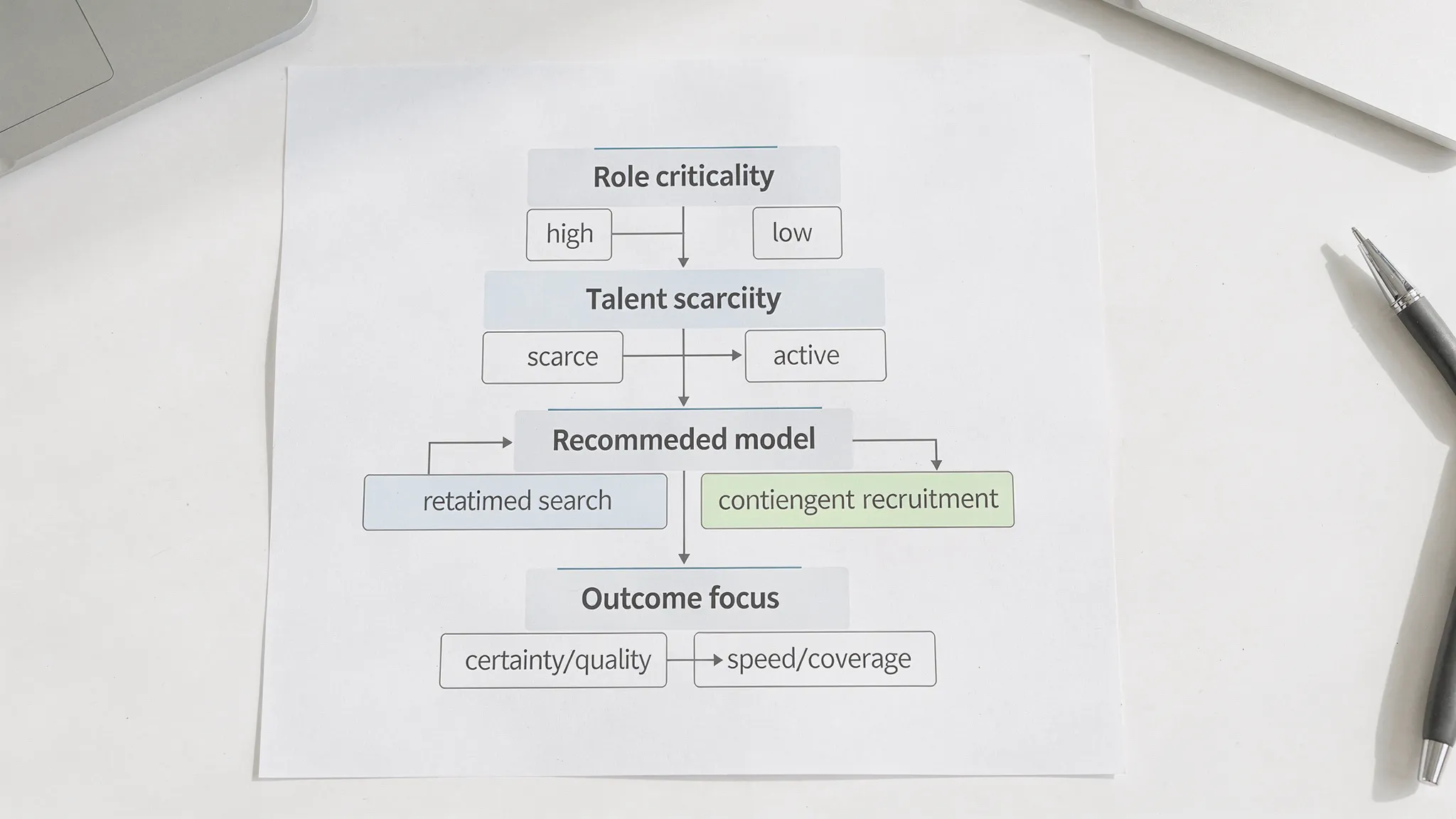
The real decision: match the search model to role risk and market scarcity
For HR and talent leaders, the retained vs contingent choice is best made by looking at the downside risk of a “miss” and the reality of the candidate market.
Choose retained search when the cost of the wrong hire is high
At senior levels, a mis-hire is not just an inconvenience. It can set back a go-to-market plan, damage key accounts, or stall a transformation.
For example, retained search is usually a strong fit when you are hiring:
- A VP or Director-level Sales leader to build or reset a revenue engine
- A strategic Marketing leader tied to pipeline creation, brand repositioning, or category creation
- A Client Services leader managing renewal risk and enterprise relationships
- An executive hire that requires stakeholder management across regions (Europe and North America)
These roles are often hard to “test and learn” quickly. A retained approach creates a more controlled selection process and typically brings deeper market mapping.
Choose contingent recruitment when the market is active and you need speed
Contingent can work brilliantly when your hiring process is tight and your proposition is competitive. It can also support bursts of hiring where you need multiple similar profiles quickly.
It is often a good fit when:
- You need pace and have fast feedback loops
- There are plenty of qualified candidates applying actively
- The role is not highly confidential
- The hiring manager can interview and decide decisively
The trap is using contingent recruitment for a role that requires deep persuasion, discreet outreach, or months of pipeline nurturing. In those cases, contingent incentives and timelines may not match the reality of the search.
A practical framework to decide: retained vs contingent
Instead of relying on labels, ask these operational questions.
1) How “searchable” is the talent?
If the best candidates are not actively applying, you need proactive headhunting. That leans retained.
If the best candidates are already in motion (for example in a hot local market with high candidate activity), contingent may be sufficient.
2) How confidential is the hire?
Confidential replacements, pre-funding leadership hires, or sensitive restructures generally require controlled messaging and a limited outreach circle. That strongly favours retained search.
3) How aligned are your stakeholders?
Senior hiring often fails due to internal misalignment (different views of what “great” looks like). Retained search typically provides more upfront discovery and a clearer success profile, which reduces late-stage churn.
4) How quickly can you make decisions?
Contingent recruitment performs best when you can:
- Respond quickly to CVs
- Interview within days, not weeks
- Give feedback after each stage
- Close decisively
If your process is complex, global, or involves multiple senior stakeholders, retained search can protect momentum with structured cadence and active pipeline management.
5) What is the commercial risk of leaving the seat open?
If vacancy cost is high (lost revenue, stalled product launch, churn risk), it can be rational to invest in a retained search that is optimised for delivery certainty and market reach.
How retained and contingent differ across the hiring lifecycle
The biggest differences show up in the parts of the process you do not see on a CV.
Discovery and role definition
Retained engagements tend to start with deeper discovery: success outcomes, stakeholder landscape, target companies, and deal-breakers.
That extra rigour matters when hiring for leadership roles in fast-growing companies, where the job description often lags behind what the business truly needs in the next 12 to 18 months.
Market mapping and passive candidate access
A retained search is usually built around mapping and approaching passive talent. Passive candidates often need:
- A credible narrative (why move now)
- Proof of mandate and process seriousness
- A recruiter who can handle nuanced concerns around scope, compensation, equity, and reporting lines
This is where boutique retained partners can compete strongly with larger “brand-name” firms: speed of execution, senior attention, and tailored outreach.
Process management and candidate experience
Senior candidates assess you as much as you assess them. A structured process, realistic timelines, and high-quality communication affect acceptance rates.
Retained search typically includes more hands-on process management, particularly across multiple time zones (common in Europe and North America searches).
Shortlisting quality vs CV volume
Contingent recruitment can drive fast candidate flow, especially when a role is attractive and easy to explain.
Retained search tends to drive fewer candidates, but with higher alignment against the success profile and stronger motivation to engage.
Cost and commercial structure: avoid false comparisons
It is tempting to compare retained vs contingent purely on fee model. In reality, the real cost is total hiring cost, including time, opportunity loss, and mis-hire risk.
To ground your decision, it helps to look at credible cost-of-vacancy thinking. Organisations like CIPD regularly publish research and guidance on resourcing and workforce planning, which reinforces that hiring outcomes depend on process quality, not only sourcing.
Key point: contingent can look cheaper if a hire happens quickly. Retained can be better value if it reduces time-to-hire for hard searches, increases offer acceptance, and protects quality.
Common pitfalls when choosing retained vs contingent
Pitfall 1: Using contingent for roles that require persuasion
If your target candidate group is fully employed and high-performing, you are selling opportunity, not advertising a vacancy. That usually needs deeper mapping, careful outreach, and persistence.
Pitfall 2: Choosing retained but not committing to a process
A retained search works best when clients commit to:
- A clear, agreed success profile
- Interview availability and prompt feedback
- Stakeholder alignment on must-haves vs nice-to-haves
Without that, even the best search partner will struggle to maintain momentum.
Pitfall 3: Treating Europe as one market
Cross-border hiring in Europe is not a single playbook. Compensation norms, notice periods, non-competes, and candidate expectations vary widely.
If you are hiring across Europe and North America, you also need a partner who is comfortable operating across time zones, cultural expectations, and different candidate decision drivers.
For practical employer guidance on cross-border considerations, resources like the European Labour Authority can be useful for high-level context, especially around mobility and labour market coordination.
When a hybrid approach works best (and why many high-growth firms use it)
Many organisations do not need a single model. They need a partner who can flex between retained and contingent depending on the role.
A hybrid approach is often effective when:
- You are scaling revenue teams (contingent for some hires, retained for pivotal leadership seats)
- You have a confidential leadership search running alongside high-volume hiring
- You want one partner to own critical roles while supporting broader talent pipelines
This is where a boutique “one stop” partner can be valuable. The advantage is consistency in messaging, market intelligence, and candidate experience across levels, while still using the right commercial model for each hire.
What to look for in a recruitment partner (retained or contingent)
The best partner is not the one with the loudest brand. It is the one with evidence of repeatable execution in your market.
Sector and functional depth where you hire most
For many fast-growing and mature businesses, business-critical hiring clusters in:
- Sales leadership and commercial execution
- Marketing and growth
- Client services and customer outcomes
- Digital and IT leadership
- Executive management
If you are searching across borders, ask how the firm sources and assesses candidates in each region, not just whether they “cover” it.
Access to an exclusive, relevant candidate network
For senior hires, the strongest shortlist often comes from relationships built over years. A partner with an established executive network can reduce time lost to cold starts.
Evidence of process discipline
Ask about the mechanics:
- How the success profile is built
- How candidates are assessed and benchmarked
- How you will receive market feedback (comp, availability, title calibration)
- How the firm manages candidate care and keeps searches warm
Clear communication and cadence
Regardless of model, hiring leaders need transparency: what is happening, what is changing in the market, and what decisions unlock progress.
Retained vs contingent in practice: examples of “best fit” scenarios
Scenario A: You need a transformational sales leader in Europe
If you are entering a new European region or rebuilding enterprise motion, the candidate pool is limited and the hire affects revenue architecture.
Retained search is usually the better fit because it supports:
- Market mapping across competitor sets
- Confidential outreach to passive leaders
- Careful calibration of scope, reporting line, and package
Scenario B: You need to hire quickly for a growth spike in North America
If you have clear profiles and a proven interview process, contingent recruitment can help you move quickly, especially when candidates are active.
The key is operational readiness: tight turnaround on feedback and offers.
Scenario C: You are hiring a senior Client Services leader with churn risk exposure
This role often requires a specific combination of customer leadership, renewal ownership, and internal influence. Retained search can reduce mis-hire risk through deeper referencing and structured assessment.
Where Optima Search fits (and how to engage effectively)
Optima Search Europe is a boutique international recruitment agency based in London, supporting organisations across Europe and North America. As a specialist search and selection partner since 2013, Optima supports business-critical and senior hires across functions including Sales, Marketing, Client Services, Digital and IT, and executive management.
Crucially for hiring leaders, Optima operates across both retained and contingent recruitment services, so you can choose the right model per role rather than forcing every vacancy into a one-size approach. For high-growth and mature businesses, this “one stop” flexibility can simplify vendor management while keeping delivery aligned to the reality of each search.
If you are currently deciding between retained vs contingent for an upcoming hire, a useful first step is a short calibration conversation: role criticality, target markets (Europe, North America, or both), timeline, and the likely sourcing strategy needed to reach the best candidates.

A simple way to make the decision confidently
If you want a quick rule of thumb:
- Use retained search when the role is senior, scarce, sensitive, or business-critical.
- Use contingent recruitment when the market is active, the role is clear, and speed is paramount.
- Use a flexible partner when your hiring plan includes both leadership appointments and scale hiring across Europe and North America.
To discuss which model best fits your next role, you can explore Optima’s approach at Optima Search Europe and align on a search plan that matches your risk, timeline, and target market.

