
Top Cybersecurity Startups in Europe: Hiring Needs 2026
The European Cybersecurity Startup Ecosystem in 2026
Europe's cybersecurity startup ecosystem is one of the most active and well-funded in the world in 2026, with the UK, Israel-linked companies operating European HQs, Germany, and the Netherlands producing the highest concentration of VC-backed cybersecurity companies, all competing aggressively for a limited pool of specialist talent.
A cybersecurity startup is an early to growth-stage company building cybersecurity products or services, typically venture-backed and hiring aggressively to capture market share ahead of profitability. VC-backed means venture capital funded, indicating that a company has received institutional investment and is operating with a defined growth mandate and investor return expectations.
For hiring leaders, the most relevant top cybersecurity startups in Europe are not simply the most visible brands. They are the companies with funding, enterprise customer traction, product-market urgency and hiring velocity. In 2026, that concentration is strongest across cloud security, identity and access management, threat intelligence, application security, and AI-driven security.
The NIS2 Directive, an EU regulation creating significant new market demand for cybersecurity products and services, is directly fuelling startup growth and hiring. Expanded obligations across essential and important entities are increasing demand for vendor products that help organisations improve resilience, reporting, governance and security operations.
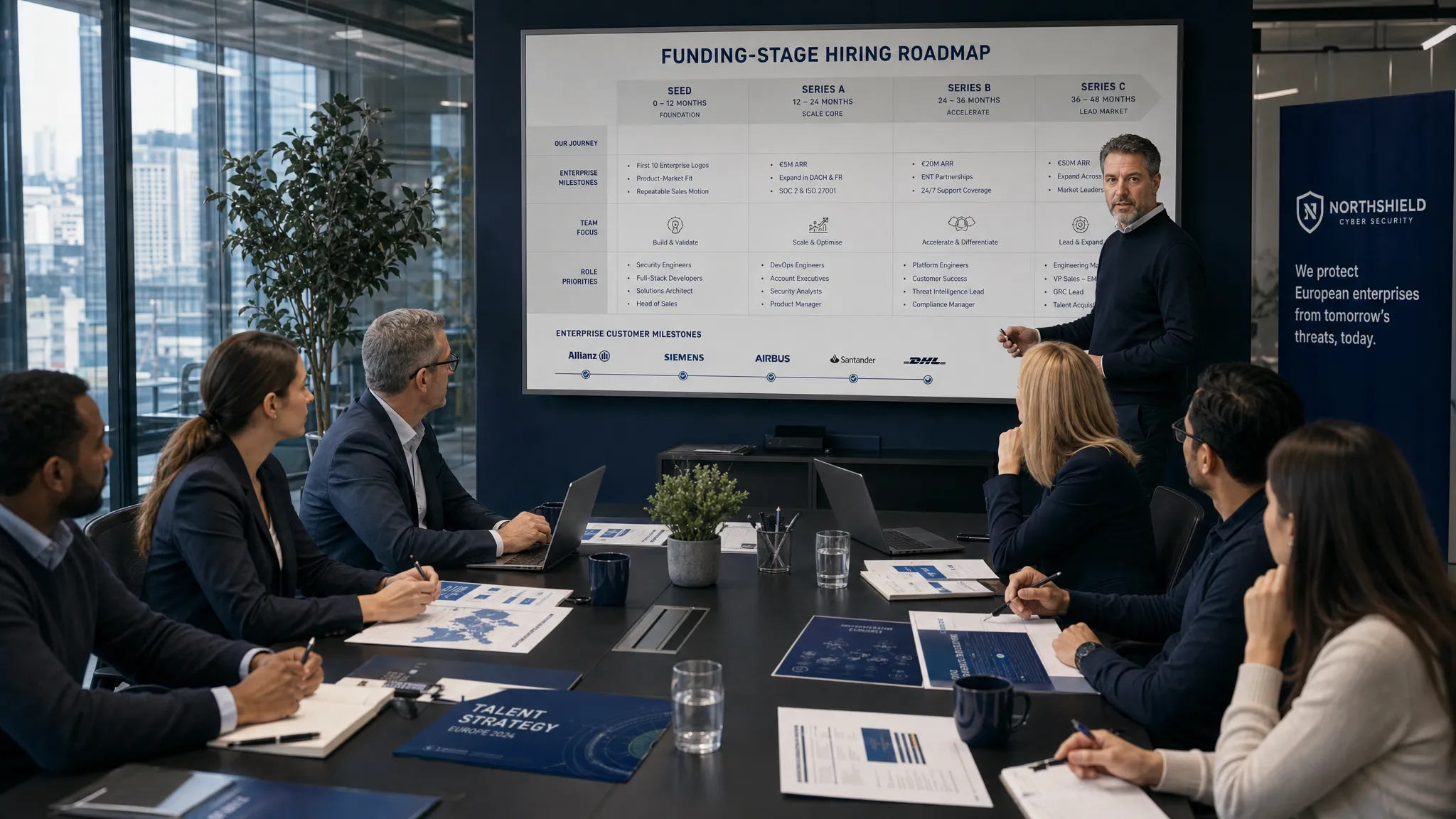
Hiring activity is most concentrated at Series A and Series B. Series A is a growth funding round, typically €5M–€25M, that commonly triggers first significant security engineering and go-to-market hiring at cybersecurity product companies. Series B is a scaling round, typically €20M–€80M, requiring full engineering, sales engineering and security operations functions.
Summary: European cybersecurity startup hiring in 2026 is driven by regulation, enterprise demand and venture-backed growth mandates. The UK leads in investment depth, London and Tel Aviv-linked European HQs dominate commercial hiring, and Series A to Series B companies are the most active recruiters.
What Roles Are European Cybersecurity Startups Hiring For?
European cybersecurity startups are hiring across product security, research, DevSecOps, technical pre-sales, customer success engineering and first internal security leadership roles, with demand highest where product maturity meets enterprise sales pressure.
- Security Engineers (Product): A Product Security Engineer is an engineer embedded within a cybersecurity product company responsible for the security of the product itself, distinct from a customer-facing security role. These profiles work on secure architecture, threat modelling, code review, exploit resistance and product hardening. They are among the deepest technical hires at Series A and Series B, especially for cloud-native, identity, AppSec and AI security companies.
- Security Researchers: Security researchers identify vulnerabilities, analyse attacker techniques and create the technical insight that differentiates serious cybersecurity products. They may come from academia, bug bounty programmes, threat intelligence teams, government backgrounds or a managed security service provider, meaning an outsourced provider operating security monitoring and response for clients. This is a niche profile with limited active availability, so passive search is usually required.
- Sales Engineers (Security): A Sales Engineer (Security) is a technical pre-sales professional at a cybersecurity vendor who demonstrates product capabilities to enterprise prospects. This role bridges product, security architecture and commercial communication. Demand rises sharply at Series B, when startups need repeatable enterprise sales motions. The best candidates can handle technical objections from CISOs while supporting account executives through complex procurement cycles.
- DevSecOps Engineers: DevSecOps engineers integrate security into the product development pipeline, including CI/CD, infrastructure as code, container security, secrets management and cloud controls. Demand is high across cloud-native cybersecurity startups because enterprise customers expect evidence that the vendor’s own development process is secure. These hires often sit between platform engineering, security engineering and compliance readiness.
- Customer Success Engineers (Security): Customer Success Engineers in security support onboarding, technical implementation, renewals and adoption after the sale. They become critical at Series B and beyond, when customer count rises and founders can no longer personally manage enterprise deployments. Strong candidates understand security workflows, APIs, integrations and stakeholder management, making them valuable for retention and expansion revenue.
- CISO / Head of Security: A first CISO or Head of Security is usually hired when enterprise customers begin demanding internal security leadership, audit readiness and evidence of governance. This role protects the company’s own infrastructure, supports SOC 2 or ISO 27001 activity, and reassures buyers during procurement. At Series B, it can become a revenue-enabling hire as much as a risk management appointment.
Summary: Cybersecurity startups hire differently from enterprise security teams because the roles must support product credibility, customer trust and commercial scale simultaneously. Product security, research and security sales engineering are the most competitive profiles because they directly influence differentiation and revenue.
Cybersecurity Startup Compensation Benchmarks Europe 2026
Cybersecurity startup compensation in Europe in 2026 is defined by total package, not base salary alone: Series A companies compete with meaningful equity, while Series B companies usually raise base salaries and narrow equity ranges.
In the UK, EMI Options (Enterprise Management Incentives) are the primary equity vehicle used by UK-incorporated cybersecurity startups to attract and retain talent. Outside the UK, local option schemes, VSOPs or equivalent instruments are more common. Candidates increasingly ask for strike price, latest valuation, runway, dilution assumptions and vesting terms before accepting offers.
Role                         | Base Salary (Series A) | Base Salary (Series B) | Equity (Series A) | Equity (Series B)
Security Engineer (Senior)   | €85,000–€115,000       | €95,000–€130,000       | 0.10%–0.30%       | 0.05%–0.15%
Security Researcher          | €90,000–€125,000       | €100,000–€140,000      | 0.10%–0.35%       | 0.05%–0.18%
Sales Engineer (Security)    | €80,000–€110,000       | €90,000–€125,000       | 0.08%–0.25%       | 0.04%–0.12%
DevSecOps Engineer           | €80,000–€108,000       | €90,000–€122,000       | 0.08%–0.22%       | 0.04%–0.10%
CISO (first hire)            | €130,000–€175,000      | €145,000–€195,000      | 0.30%–0.80%       | 0.15%–0.40%
OTE means on-target earnings, usually base salary plus commission. For Sales Engineers, typical OTE at Series B is €140,000–€200,000, depending on enterprise deal size and sales productivity expectations. Equity vesting is usually a 4-year vest with a 1-year cliff across European cybersecurity startups, although senior hires may negotiate acceleration or refresher grants.
Summary: The strongest offers combine competitive base salary, credible equity and full transparency. In cybersecurity scale-up recruitment across Europe in 2026, vague equity explanations are now a common reason for offer rejection.
Hiring Challenges Specific to Cybersecurity Startups
The hardest cybersecurity startup hiring challenges in 2026 are compensation competition, niche profile scarcity, cross-border complexity and retention after the first equity vesting cycle.
- Competing with enterprise and large vendor base salaries: Palo Alto Networks, CrowdStrike and Microsoft can offer significantly higher base salaries, stronger brand security and mature benefits. Startups must lead with equity, mission, technical challenge, speed of impact and proximity to strategic decisions.
- Speed of scaling: Post-funding hiring can move from 0 to 20 roles in 12 months. Without a structured talent acquisition function, hiring quality drops, interview feedback slows and founders overcompensate by opening too many poorly defined searches at once.
- Niche profile scarcity: The talent shortage, meaning the gap between demand for qualified cybersecurity professionals and available supply, affects startups as much as enterprises. Security researchers and Sales Engineers are especially scarce, and standard inbound channels rarely reach them.
- Geographic distribution: Many European cybersecurity startups operate across multiple countries from day one. Cross-border hiring introduces differences in salary norms, employment law, notice periods, equity taxation, language expectations and remote-work compliance.
- Retention post-vest: Professionals approaching the end of a 4-year vest become attrition risks. A refresher grant, meaning an additional equity award designed to retain employees after their original grant matures, is essential for critical engineers and commercial leaders.
- Employer brand: Early and growth-stage cybersecurity companies are less visible than global vendors. To attract passive talent, they need credible technical thought leadership, community presence, conference participation and clear evidence that the product solves a serious security problem.
Summary: Cybersecurity startup talent acquisition in Europe requires more than outreach volume. The companies that win scarce candidates define roles tightly, move fast, benchmark compensation accurately and make the risk-reward profile of joining a startup explicit.
Which European Cybersecurity Startup Hubs Are Most Active in 2026?
The most active European cybersecurity startup hubs in 2026 are London, Tel Aviv-linked European headquarters, Munich, Amsterdam and Paris, each with different talent depth, compensation pressure and customer access.
- London: London is Europe’s largest cybersecurity startup hub, with the deepest investor network, strongest enterprise customer access and highest concentration of Series B and Series C cybersecurity companies. The UK market is also supported by a mature cyber ecosystem documented in the UK Government’s cyber security sectoral analysis. Compensation pressure is high, especially for security researchers, CISOs and security sales engineers.
- Tel Aviv / European HQs: Many Israeli cybersecurity companies operate European headquarters in London, Amsterdam or Munich. These firms bring strong product maturity, aggressive expansion plans and competitive compensation expectations. Their hiring often focuses on EMEA sales leadership, security sales engineering, channel partnerships, customer success engineering and regional marketing rather than core R&D alone.
- Munich: Munich is Germany’s strongest cybersecurity startup hub because of enterprise customer proximity, industrial demand, automotive security needs and a deep engineering base. It is particularly relevant for cloud security, OT security, governance risk and compliance, and AI infrastructure security. German notice periods and compensation expectations require early planning.
- Amsterdam: Amsterdam’s cybersecurity startup scene benefits from fintech overlap, strong English-language working norms and access to international talent. It is attractive for go-to-market teams, security customer success and cloud security engineering. The city also functions as a practical European headquarters for US and Israeli vendors entering the EU market.
- Paris: Paris has a growing cybersecurity startup base supported by Station F, national cyber initiatives, ANSSI influence and demand from government, defence, financial services and critical infrastructure customers. Hiring often requires French-language capability for customer-facing roles, while technical teams increasingly compete internationally for AppSec, threat intelligence and AI security talent.
Summary: European cyber hiring is hub-led but increasingly cross-border. London provides the broadest market, Tel Aviv-linked companies raise compensation expectations, Munich offers enterprise depth, Amsterdam supports international scaling and Paris brings strong regulated-sector demand.
How to Hire for a Cybersecurity Startup in Europe: Step-by-Step
To hire for a cybersecurity startup in Europe, founders and CTOs need a precise role definition, a credible equity narrative, passive sourcing, a fast process and transparent total compensation from first serious conversation to offer.
- Define the role with precision: Startup roles are broad by nature, but searches fail when everything is labelled must-have. Define the business outcome first, then separate required technical skills from trainable preferences. A Product Security Engineer, DevSecOps Engineer and Customer Success Engineer may all understand cloud security, but each solves a different problem. Precision improves sourcing, interview design and candidate conversion.
- Build a compelling equity narrative: Candidates need to understand valuation, runway, funding stage, investor quality, growth trajectory and realistic exit scenarios before evaluating equity. A Series A offer must explain upside and risk, while a Series B offer must explain scale, dilution and progression. If equity is presented as a vague bonus, experienced security candidates will discount it heavily.
- Access the passive talent pool: The best security engineers, researchers and Sales Engineers are rarely browsing startup job boards. They are employed, selectively responsive and often sceptical of generic outreach. Effective search requires market mapping, technical credibility, direct engagement and a clear reason why this startup is worth career risk. Passive candidates need evidence, not slogans.
- Move fast: Strong cybersecurity startup candidates are commonly in several processes at once. Interview plans should be agreed before sourcing begins, with defined decision-makers, evaluation criteria and feedback deadlines. A process that takes weeks between stages signals operational immaturity. For Series A and Series B companies, speed is not a compromise on quality; it is part of candidate conversion.
- Lead with mission and technical challenge: The strongest candidates join cybersecurity startups for what they will build, secure or prove. Compensation matters, but high-calibre talent also wants difficult problems, strong peers, direct product influence and proximity to customers. Explain the threat model, product roadmap and technical ownership clearly. This is especially important when competing with large vendors on base salary.
- Structure the offer with total compensation transparency: Present base salary, equity, vesting terms, commission where relevant, benefits, location expectations and review cycles at the same time. Avoid forcing candidates to decode equity after salary negotiation. Transparent offers reduce late-stage friction and protect trust, especially in cross-border hiring where candidates compare packages across different tax and employment systems.
Summary: Cybersecurity startup hiring is won before the first interview. Clear role design, credible compensation, passive candidate access and rapid decision-making are the operating disciplines that separate the best cybersecurity companies to work for in Europe from those losing candidates late in process.
Frequently Asked Questions
The most common questions from cybersecurity startup hiring leaders concern role prioritisation, enterprise salary comparison, equity norms, hub selection and the impact of NIS2 on demand.
What cybersecurity roles do European startups hire most frequently? European cybersecurity startups most frequently hire senior product security engineers, security researchers, DevSecOps engineers, Sales Engineers, Customer Success Engineers and first Heads of Security or CISOs. The exact sequence depends on funding stage. Series A companies usually prioritise product depth, research credibility and early go-to-market support. Series B companies add sales engineering, customer success engineering and internal security leadership because enterprise customers begin demanding proof of operational maturity, compliance readiness and scalable support.
How do cybersecurity startup salaries compare to enterprise in Europe? Cybersecurity startup salaries in Europe usually sit below the highest enterprise and global vendor base salaries, especially when compared with Microsoft, CrowdStrike, Palo Alto Networks or major banks. The difference is offset through equity, faster career progression, broader ownership and access to harder technical problems. Senior candidates will still expect market-aligned base pay, particularly in London, Munich and Amsterdam. If a startup is materially below benchmark on salary and cannot clearly explain equity value, offer acceptance becomes difficult.
What equity should a security engineer expect at a European cybersecurity startup? A senior security engineer at a European cybersecurity startup should typically expect 0.10%–0.30% equity at Series A and 0.05%–0.15% at Series B, depending on seniority, funding, valuation and scarcity of skills. Very early founding-level hires may negotiate more, while later-stage hires usually receive less equity but higher base salary. Candidates should ask about strike price, vesting, dilution, latest valuation and whether refresher grants are available after strong performance or after the first vesting cycle.
Which European cities have the most active cybersecurity startup hiring scenes? London is the largest cybersecurity startup hiring market in Europe, followed by Tel Aviv-linked European headquarters in London, Amsterdam and Munich. Munich is especially strong for German enterprise, industrial and engineering-led security hiring. Amsterdam attracts international go-to-market and cloud security talent, while Paris benefits from government, defence and regulated-sector demand. Hiring leaders should choose hubs based on function: London for commercial scale, Munich for enterprise and engineering depth, Amsterdam for international expansion, and Paris for French regulated-sector access.
How has NIS2 affected cybersecurity startup growth and hiring in Europe? NIS2 has increased demand for cybersecurity products by expanding regulatory obligations across sectors such as energy, transport, health, digital infrastructure and other essential services. For startups, this creates stronger enterprise demand for compliance, monitoring, risk, incident response and governance-related products. The hiring impact is direct: companies need more product security talent, sales engineers, compliance-aware customer success teams and internal security leaders. It also increases competition for candidates who understand regulation, enterprise procurement and practical implementation across European markets.
Conclusion & Strategic Positioning
Cybersecurity startup hiring in Europe in 2026 is a strategic growth constraint because the same specialist candidates are being targeted by VC-backed scale-ups, global security vendors and regulated enterprises at the same time.
The fastest growing cybersecurity startups in Europe are not only competing on product. They are competing on the quality of their first technical, security and go-to-market hires. Compensation benchmarks, equity clarity, process speed and cross-border execution now have a direct impact on revenue milestones, customer trust and investor confidence.
Optima Search Europe supports founders, CTOs, CISOs and HR leaders hiring business-critical cybersecurity, GTM, sales, marketing, digital and executive roles across Europe and internationally. For VC-backed cybersecurity companies, that means structured market mapping, access to passive candidates, compensation benchmarking and cross-border search discipline.
If you are planning Series A or Series B hiring, building an EMEA security team, or replacing a critical leader confidentially, a specialist conversation can help clarify the market before the search begins. You can explore related guidance in our Cybersecurity Recruitment Agency in Europe guide or speak with Optima Search Europe about your hiring plans.

