
EU AI Act: Healthcare Applicant Screening Rules
How Does the EU AI Act Affect AI Tools Used to Screen Job Applicants in Healthcare?
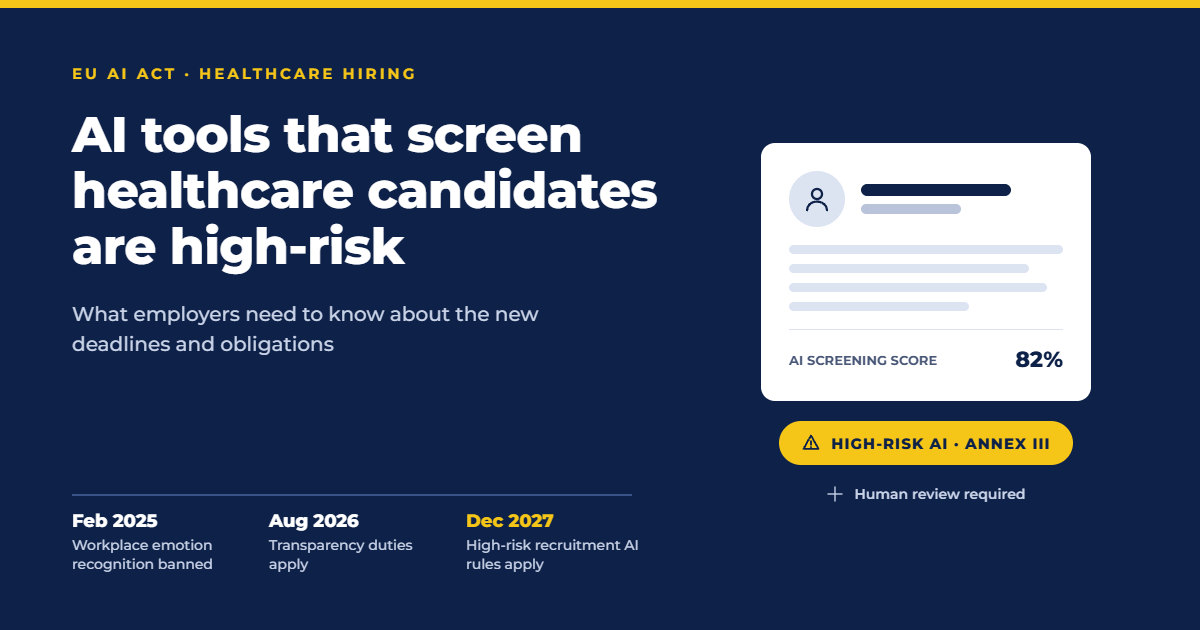
How does the EU AI Act affect AI tools used to screen job applicants in healthcare? The answer matters to hospitals, clinics, and other employers using software to rank CVs, filter applications, or assess candidates. These tools are generally classified as high-risk AI, bringing specific duties for providers and employers.
In this article
- Key takeaways
- How the EU AI Act applies to AI tools used to screen job applicants in healthcare
- Why AI CV screening in healthcare is usually considered high-risk
- What high-risk recruitment obligations mean for healthcare employers
- How to manage bias, privacy, and candidate transparency
- What the AI Act Digital Omnibus delay could mean for hiring compliance
- What healthcare organizations should do before using AI hiring tools
- Frequently asked questions
- Conclusion
This article explains how the rules apply to healthcare recruitment, what high-risk obligations mean in practice, and how to address bias, privacy, and candidate transparency. It also covers the Digital Omnibus delay adopted in 2026 and outlines practical steps healthcare organizations can take before adopting or continuing to use AI hiring tools..
Key takeaways
- AI systems that materially screen, rank, or evaluate job applicants are generally high-risk under the EU AI Act.
- Healthcare employers must oversee recruitment AI and remain responsible for hiring decisions.
- Bias testing, candidate transparency, data protection, and meaningful human review are central compliance measures.
- The Digital Omnibus (Regulation (EU) 2026/1744) has pushed high-risk recruitment obligations to 2 December 2027, but recruitment AI remains high-risk and preparation should start now.
How the EU AI Act applies to AI tools used to screen job applicants in healthcare

The EU AI Act classifies systems according to their intended purpose and potential risk, not simply because they use AI. A tool that helps draft a job advert may be treated differently from one that ranks applicants or recommends who should advance. The key question is what the system is designed to do in the hiring process and how its outputs are used.
Under the Act, AI systems intended to recruit or select people are generally considered high-risk employment AI. This can include tools that analyse applications, filter or rank CVs, evaluate candidates, or support selection decisions. A system does not need to make the final hiring decision to fall within this category: shortlisting recommendations or candidate scores can influence who gets an interview.
For example, a healthcare employer using software to rank nursing applicants by predicted suitability is using AI for recruitment, even if a human recruiter reviews the rankings. The system’s role in assessing or filtering candidates is what matters, not whether it operates automatically or is marketed as an administrative aid.
Recruitment AI is different from clinical AI
AI used to support diagnosis, treatment, or other clinical tasks has a different intended purpose from AI used to assess job applicants. A hospital’s clinical decision-support system is not a recruitment tool merely because the hospital uses it; conversely, an applicant-screening system is not exempt from employment rules because its users work in healthcare.
Healthcare organizations should therefore assess each system by its specific function and intended use. A tool used to schedule interviews may have a different risk classification from one that scores candidates, while a system repurposed from another task for applicant screening should be assessed in light of that recruitment use. The healthcare sector does not, by itself, change the rules that apply to AI used in hiring.
Why AI CV screening in healthcare is usually considered high-risk
AI CV screening in healthcare is usually considered high-risk because it can shape who gets access to employment. A system that ranks applicants, assigns candidate scores, analyses recorded interviews, or automatically shortlists candidates may determine which people progress and which are excluded before a recruiter reviews their application.
That influence matters across healthcare roles, from nurses and clinical specialists to laboratory staff and hospital administrators. Some positions require specific licences, credentials, or experience with particular patient groups; screening errors can therefore disadvantage qualified applicants and affect an organization’s ability to fill important roles. The consequences for candidates may be significant, especially when an automated assessment is difficult to challenge or its criteria are unclear.
The relevant distinction is not simply whether a tool uses AI. Its intended purpose and actual impact matter: a system designed to evaluate or filter candidates is different from software that only supports routine administration without materially influencing hiring decisions.
Tool usePotential effect on hiringCV ranking or candidate scoringCan determine which applicants recruiters review first or at all.Interview analysisMay affect evaluations or progression based on analysed responses or other signals.Automated shortlistingCan exclude applicants from later stages without an initial human assessment.Administrative support, such as organizing applicationsMay have a more limited role if it does not assess candidates or materially affect selection.
For example, software that sorts applications by submission date may have a limited administrative function. But if its ranking determines which CVs a recruiter sees, it may influence access to the role even if the employer describes it as a time-saving aid. Healthcare employers assessing an AI tool should examine what it does in practice, how staff use its outputs, and whether those outputs affect selection.
For more details, visit Services | Optima Europe.
What high-risk recruitment obligations mean for healthcare employers
For high-risk recruitment systems, the EU AI Act separates duties between the system’s provider and the organization that uses it. A healthcare employer should establish who holds each role, since responsibilities do not disappear when screening is outsourced or supplied as a software service.
What providers must build and document
Providers must operate a risk-management process throughout the system’s lifecycle and use appropriate data-governance practices for training, validation, and testing data. They must prepare technical documentation, enable automatic logging, provide instructions for use, and design the system to meet requirements for accuracy, robustness, and cybersecurity. The system must also support effective human oversight, including safeguards that help reviewers recognize limitations and intervene when needed.
Transparency is practical as well as formal: employers need enough information to understand the system’s intended purpose, capabilities, and limits.Also, approaches to Cybersicherheits-Governance-Risiko | Optima Europe.
What healthcare employers must do as deployers
Organizations using AI CV screening tools in healthcare must follow the provider’s instructions, assign oversight to people with suitable competence, training, authority, and support, and monitor the system’s operation. They should retain relevant logs under their control, document how the tool is used, and act if monitoring identifies risks or serious incidents. Where applicable, employers must also inform affected workers’ representatives and candidates that a high-risk AI system is being used in the recruitment process.
- Define which roles may review, override, or escalate an AI-generated result.
- Check performance against real recruitment outcomes and investigate unexpected patterns.
- Keep records of system settings, material changes, human reviews, and decisions.
- These controls do not transfer accountability for hiring decisions to the vendor or algorithm. A recruiter or hiring manager should assess relevant evidence, consider context the system may miss, and document the reasoning behind the decision. Automated scores or rankings should inform, not replace, meaningful human review.
How to manage bias, privacy, and candidate transparency
Bias controls should test whether an AI screening tool disadvantages applicants because of patterns in its training data or the features it uses as proxies for suitability. In healthcare recruitment, a system may unfairly penalize career gaps linked to caregiving or illness, non-standard career paths, accents or language differences, and qualifications gained through less familiar routes. Disability-related information or assistive technology use can also create unfair signals, while applicants with limited access to reliable devices or high-speed internet may be disadvantaged by digital assessments.
Before deployment, ask the provider what data and criteria the system uses, then test outcomes across relevant candidate groups where lawful and appropriate. Review false rejections, not just overall accuracy, and provide a route for human review when an applicant believes the system has overlooked relevant experience or a reasonable adjustment. Keep monitoring after launch: changes to roles, applicant populations, or model versions can alter outcomes.
Coordinate AI Act controls with GDPR
The EU AI Act does not replace GDPR. Employers still need a valid lawful basis for processing candidate data, must explain the purpose, and should collect only information necessary for the recruitment decision. Avoid feeding sensitive personal data—such as health information, disability details, or other special-category data—into screening tools unless a specific legal condition permits the processing and suitable safeguards are in place. Do not assume that consent is automatically an appropriate basis in an employment context.
Applicants retain GDPR rights, which may include access to their personal data, correction of inaccurate information, and—in applicable cases—objection or a request for human intervention concerning decisions based solely on automated processing. Document the tool’s role, retention periods, access controls, and how requests or complaints will be handled.
Make the process understandable to applicants
Tell candidates early that AI is used, identify the stage it supports, and explain what information it evaluates and how a human recruiter uses its output. For example, clarify whether the tool ranks CVs for review or can affect progression, and provide a contact route for questions, accessibility needs, or corrections. Clear communication and consistent review procedures can be developed with HR & Recruitment Consulting Services | Optima Europe.
What the AI Act Digital Omnibus delay could mean for hiring compliance

The proposed AI Act Digital Omnibus changes could affect when some obligations apply, including requirements relevant to high-risk recruitment systems. However, a proposal is not a change to the law: employers should not assume that an extension or delay will take effect until the relevant measures are formally adopted and their scope and dates are clear.
Before changing a compliance plan, check the latest European Commission and national authority guidance. Confirm which version of the rules applies, the dates relevant to your organization and system, and whether any transitional provisions cover tools already in use or contracts already signed. Record the sources and dates you relied on, and seek legal advice where the position is uncertain.
In the meantime, prepare on the basis of the requirements that may apply rather than relying on a possible delay. Practical steps include:
- Governance: assign an accountable owner and document how the screening tool is selected, used, monitored, and challenged.
- Vendor checks: ask suppliers for information about the system’s intended purpose, limitations, documentation, updates, and support for your compliance duties.
- Impact assessments: assess likely effects on applicants, including risks of unfair outcomes, and coordinate AI Act work with applicable data-protection assessments.
- Human review: define when a qualified recruiter must review or override a recommendation, and make sure staff can do so meaningfully rather than simply accepting automated rankings.
- Records and training: keep evidence of decisions, testing, and staff training so the process can be reviewed if guidance or legal deadlines change.
Healthcare employers should also consider the people affected by recruitment decisions. Where a hiring process leads to rejection or redeployment, clear communication and appropriate support matter; for example, Individuelles Outplacement | Optima Europe describes an individual outplacement service.
A possible delay may give organizations more time, but it does not remove the value of sound controls. Building these measures now can make it easier to adapt when final rules, national guidance, or transitional dates are confirmed.
What healthcare organizations should do before using AI hiring tools
Before deploying an AI hiring tool, define what it is intended to do: for example, rank applications for a particular nursing role, identify required qualifications, or support—not make—shortlisting decisions. Record the tool’s risk classification, the vendor’s responsibilities, and your organization’s role as the deployer. Confirm who is responsible for oversight, decisions, and keeping the required documentation up to date.
Test the system with representative data and real recruitment workflows before relying on its outputs. Assess accuracy, potential bias, accessibility for candidates with disabilities, and suitability for the specific healthcare roles being recruited. A tool that performs acceptably for one job family may miss relevant experience or qualifications in another, so document test methods, results, limitations, and any changes made in response.
Agree on practical controls with the vendor and internal teams. Staff should know how to interpret outputs, challenge recommendations, and make decisions with meaningful human oversight. Candidates should have a clear route to ask questions, provide feedback, or raise concerns about an AI-assisted assessment.
- Set accountability: name the person or team responsible for monitoring the tool and approving changes.
- Escalate incidents: define how to report inaccurate or discriminatory outcomes, system failures, and other concerns.
- Review periodically: check performance, candidate feedback, and suitability after deployment and when roles, data, or system versions change.
- Train users: provide role-specific guidance before staff use the tool and refresh it when processes change.
Keep records of testing, training, reviews, incidents, and corrective actions so decisions can be examined later. For organizations building teams to develop and implement healthcare AI responsibly, Hire the people who take Healthcare AI from innovation to adoption.
Frequently asked questions
Are AI CV screening tools used by healthcare employers high-risk under the EU AI Act?
Generally, yes. AI systems used to recruit or select candidates—including tools that filter CVs, rank applicants, or evaluate them—are classified as high-risk under Annex III of the EU AI Act. The classification depends on the system’s intended purpose, not on whether the employer is a healthcare provider. Narrow administrative tools that do not influence decisions may be treated differently.
Does the EU AI Act ban AI tools from screening healthcare job applicants?
No. The EU AI Act does not generally prohibit AI-assisted recruitment. It allows high-risk screening tools when providers and employers meet applicable requirements, including risk management, documentation, human oversight, and transparency. Employers should also check whether a particular system involves a separately prohibited practice, such as certain forms of emotion recognition in the workplace.
What must healthcare employers do when using high-risk AI for recruitment?
Employers using high-risk recruitment AI must follow their obligations as deployers. These include using the system according to its instructions, assigning competent human oversight, monitoring its operation, and retaining required logs. Before using a high-risk system to make decisions about people, employers must also conduct a fundamental rights impact assessment where required and inform workers’ representatives and affected workers as applicable.
Do applicants have to be told when AI is used to assess their job application?
Yes. Under the AI Act, deployers must inform people when they are subject to decisions or assistance from a high-risk AI system used for recruitment or selection. Applicants should receive clear, accessible information that AI is being used and how it affects the process. Other notice duties may also apply under data protection and employment laws.
How does the EU AI Act interact with GDPR when screening candidates?
The AI Act and GDPR apply alongside each other. The AI Act sets requirements for high-risk AI systems, while the GDPR governs personal-data processing, including lawful basis, transparency, data minimisation, accuracy, security, and data-subject rights. Employers must assess both regimes, particularly where screening involves profiling or solely automated decisions with significant effects under GDPR Article 22.
Has the AI Act Digital Omnibus delayed recruitment AI compliance deadlines?
Yes. The Digital Omnibus on AI (Regulation (EU) 2026/1744) entered into force on 27 July 2026 and moved the application date for stand-alone high-risk AI systems, including recruitment and selection tools, from 2 August 2026 to 2 December 2027. The delay does not change the classification: recruitment AI is still high-risk, and transparency duties, prohibited practices and GDPR already apply.
Conclusion
AI tools that screen healthcare job applicants can influence access to employment, so they are generally treated as high-risk under the EU AI Act. The Digital Omnibus delay to December 2027 should not be taken as a reason to postpone preparation: employers still need to address bias, data protection, transparency, human oversight, and the responsibilities of both providers and users.
Before adopting or continuing to use an AI hiring tool, assess its intended purpose and risks, verify the vendor’s compliance documentation, and establish clear procedures for human review and candidate communication. Start by involving your HR, legal, data protection, and clinical stakeholders in a documented review of the tool.

