
AI Radiology Companies in Germany: Hiring Market Overview
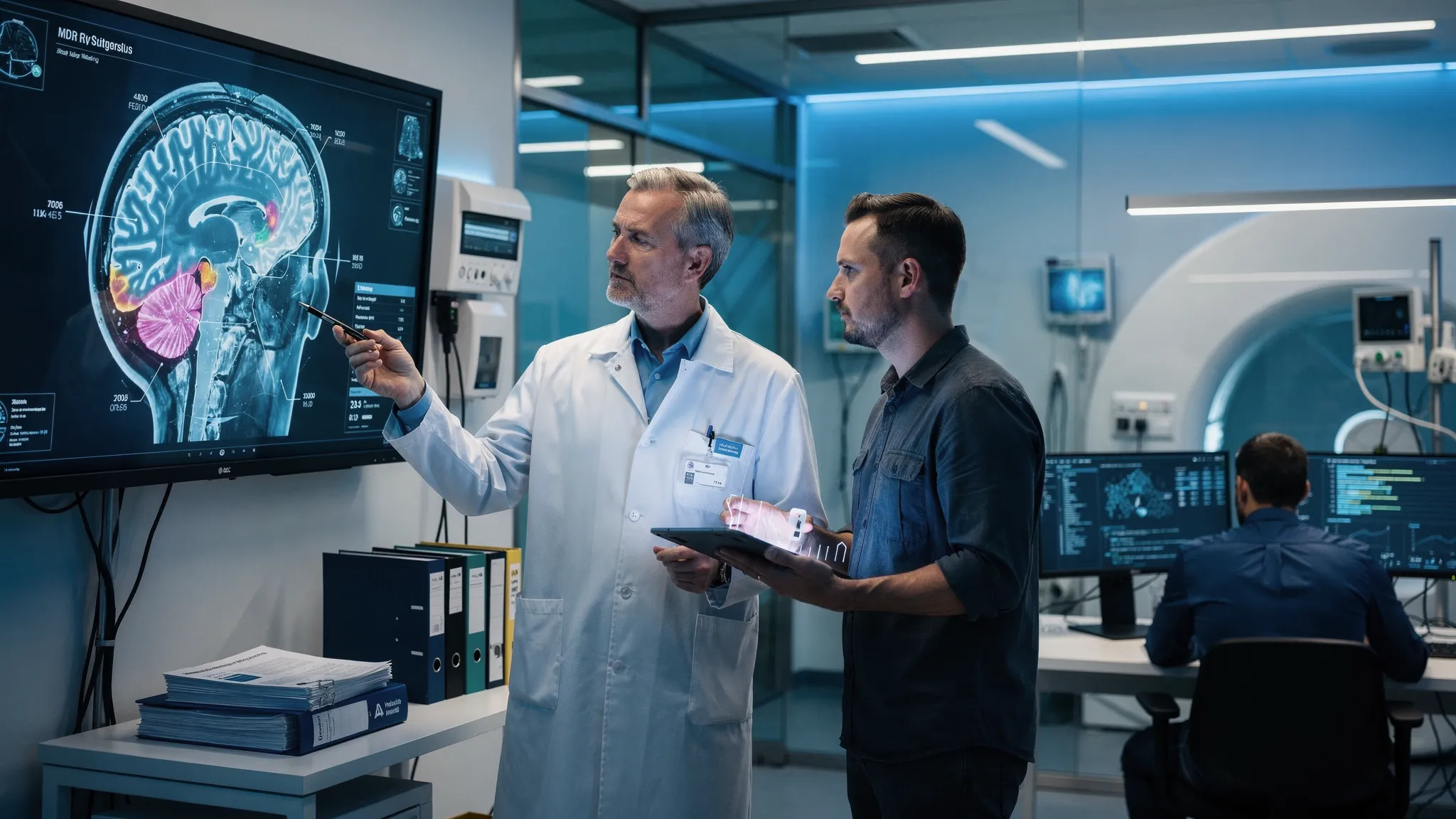
Germany is one of the most attractive European markets for AI radiology companies, but it is also one of the hardest to hire into. The opportunity is clear: a large medtech base, strong university pipelines, world-class imaging companies and a sophisticated hospital market. The constraint is equally clear: scarce senior AI talent, strict employment norms, EU MDR compliance pressure and Betriebsrat works council processes that international companies often underestimate.
For CTOs, HR Directors, COOs, founders and board members, ai radiology companies germany hiring strategy in 2026 is no longer a standard technical recruitment exercise. It sits at the intersection of computer vision, DICOM workflows, MRI reconstruction, radiomics, structured reporting, clinical validation, regulatory affairs and German employment law.
This overview maps the Germany AI radiology ecosystem, the companies shaping demand, the salary benchmarks Germany employers should expect, and the hiring tactics needed to compete for passive senior talent.
Why Germany Is Europe's Largest AI Radiology Market
Germany is widely recognised as Europe's largest national medical technology market. MedTech Europe identifies Germany as the leading European medtech market by revenue, which matters because AI radiology adoption is closely tied to imaging equipment, hospital procurement, regulatory readiness and clinical workflow integration.
Siemens Healthineers remains the anchor institution. Its AI-Rad Companion suite has set an enterprise benchmark for AI-assisted radiology workflows. For smaller companies, Siemens creates both a talent challenge and a talent source: it raises compensation expectations, but its alumni network supplies engineering, product, clinical and regulatory leaders to German scaleups.
The market is not concentrated in one city. The Munich AI radiology hub combines medical AI startups, enterprise buyers and automotive AI talent. Berlin's medtech cluster brings digital health, international product talent and venture-backed AI companies. Heidelberg life sciences provides oncology, quantitative imaging and regulatory depth. Hamburg and Aachen add specialist diagnostics, radiology services and RWTH-linked engineering strength.
Regulation is also shaping demand. The European Commission's medical device framework makes EU MDR compliance Germany hiring a priority for AI radiology companies, even where transitional certificate timelines still apply. Technical documentation, clinical evidence, post-market surveillance, software lifecycle management and risk management are now hiring drivers, not back-office tasks.
Summary: Germany is the largest and most complex AI radiology hiring market in Europe because enterprise imaging, specialised startups, clinical depth and regulation converge there. The opportunity is substantial, but hiring requires market mapping across multiple hubs, not simple job advertising.
Key AI Radiology Companies in Germany and Their Hiring Profiles
Germany medical imaging AI companies hiring in 2026 tend to fall into four groups: enterprise imaging divisions, venture-backed AI radiology startups, structured reporting and workflow platforms, and imaging-adjacent medtech companies that compete for the same technical and regulatory talent.
- Siemens Healthineers, Erlangen: The AI-Rad Companion portfolio and wider digital imaging business create demand for ML engineers, computer vision specialists, clinical AI specialists, regulatory affairs leaders, software quality engineers and product managers who understand hospital deployment at enterprise scale.
- Merantix Healthcare and Vara, Berlin: Berlin AI radiology recruitment is heavily influenced by the Merantix ecosystem and breast screening AI activity through Vara. Typical hiring profiles include computer vision engineers, data platform engineers, product managers, clinical affairs specialists and market access talent.
- mint Medical, Heidelberg: Known for oncology imaging workflows and quantitative assessment, mint Medical draws on Heidelberg life sciences talent. Hiring demand is strongest for ML engineers, computational oncology profiles, clinical workflow specialists, DICOM-aware software engineers and EU MDR regulatory specialists.
- Smart Reporting, Munich: Structured radiology reporting, clinical informatics and NLP radiology are central to its market position. Smart Reporting-style hiring profiles include NLP engineers, clinical informatics specialists, product leaders, interoperability specialists and enterprise sales leaders for hospital systems.
- DeepSpin, Munich: MRI reconstruction, scanner innovation and physics-aware AI require a specialised blend of ML, signal processing and medical imaging physics. The hardest profiles to find are MRI specialists, reconstruction engineers and applied ML engineers with research-to-product experience.
- Precisis and Heidelberg imaging-adjacent employers: Heidelberg's medtech and therapy-planning ecosystem competes for medical physics engineers, regulatory affairs managers, software quality profiles and clinical validation specialists. These candidates often overlap with AI radiology talent pools.
- Jung Diagnostics, Hamburg: Hamburg's diagnostics and radiology services market creates demand for ML engineers, radiologist consultants, clinical operations leaders and workflow automation talent with direct exposure to imaging operations.
- Radiomics-focused organisations in Aachen: Aachen benefits from RWTH's engineering base and radiomics research in oncology and neurology. Hiring profiles include ML engineers, clinical researchers, imaging biomarker specialists and translational data scientists.
Summary: The German market is not a single AI startup scene. It is a layered ecosystem led by Siemens Healthineers and supported by specialist companies across Munich, Berlin, Heidelberg, Hamburg and Aachen. Each cluster hires differently, so role design and sourcing strategy must be company-specific.
German AI Radiology Talent Landscape in 2026
The strongest technical pipelines come from TU Munich, RWTH Aachen, Heidelberg University, TU Berlin and related applied research institutes. These institutions supply computer vision, medical image analysis, robotics, data science, biomedical engineering and clinical research talent.
A distinctive feature of Germany radiology AI engineer jobs 2026 is the automotive-to-healthcare transition. Engineers from BMW, Mercedes-Benz, Bosch, Continental and supplier ecosystems bring production ML, perception systems, sensor fusion, safety engineering and embedded software experience. They do not always understand DICOM, clinical validation or MDR documentation on day one, but they can become high-value hires when paired with clinical product leadership.
The Siemens Healthineers alumni network is another major source. Candidates leaving enterprise imaging often bring hospital procurement understanding, regulatory discipline, quality systems experience and credibility with clinical stakeholders. This is particularly valuable for startups moving from research prototypes into regulated deployment.
Regulatory talent is more concentrated than engineering talent. EU MDR and IVDR expertise is strongest around Munich, Erlangen and Heidelberg, where medtech companies, notified body experience and life sciences networks overlap. These profiles are often passive, risk-aware and selective.
Summary: Germany has deep AI and engineering capability, but the scarce profiles are hybrid: ML plus clinical imaging, regulatory plus software, product plus hospital workflow, and leadership plus regulated scaling. Effective hiring depends on converting adjacent talent, not only searching for perfect CV matches.
Hiring Challenges Specific to German AI Radiology Companies
The first challenge is process complexity. A Betriebsrat works council is not present in every German company, but where one exists, it can affect job descriptions, hiring processes, internal posting rules, onboarding steps and changes to employment conditions. International companies entering Germany often build hiring plans without factoring this into timelines.
German labour law also shapes candidate behaviour. Notice periods of three to six months are common for senior employees. Indefinite employment contracts are the norm for permanent roles. Probation periods, termination rules and contract wording need to be handled correctly from the start.
Language requirements must be calibrated by function. English is usually sufficient for many engineering, data science and platform roles. German becomes more important for clinical affairs, regulatory affairs, customer-facing product roles, hospital sales, implementation and any role involving documentation or direct communication with German clinical sites.
The most acute scarcity is EU MDR and IVDR expertise. Regulatory specialists who understand software as a medical device, clinical evaluation, ISO 13485 environments and AI lifecycle documentation are in high demand across medtech, digital health and radiology AI.
Compensation is another pressure point. Siemens Healthineers and other established employers set strong salary and benefits expectations. Smaller companies cannot always compete on cash, so they need clearer missions, faster decision-making, equity, senior scope and credible regulatory infrastructure.
Summary: The talent shortage Germany employers face is not only technical. It is a combined shortage of senior AI, regulatory, clinical and leadership profiles, made more difficult by works council processes, notice periods, language requirements and enterprise salary benchmarks.
AI Radiology Salary Benchmarks in Germany 2026
The following salary benchmarking Germany ranges are indicative gross annual base salaries for permanent employees in AI radiology and medical imaging AI. Actual offers depend on company stage, city, regulatory exposure, leadership scope, bonus, equity and remote flexibility.
- Mid-level ML or computer vision engineer: €70,000 to €95,000, with higher offers for DICOM, 3D imaging, segmentation, MRI reconstruction or production MLOps experience.
- Senior ML or computer vision engineer: €95,000 to €130,000, rising to €140,000 for rare medical imaging specialists with deployment experience.
- Principal engineer, Head of ML or Head of AI Radiology: €130,000 to €180,000+, especially where the role owns clinical performance, platform architecture and regulatory evidence.
- Regulatory affairs and clinical AI specialists: €85,000 to €130,000 for experienced individual contributors, and €130,000 to €180,000 for senior managers or heads of regulatory with EU MDR software expertise.
- Contractors and consultants: Senior medical imaging ML contractors often command €800 to €1,200 per day. Niche regulatory, clinical validation or medical physics consultants can exceed €1,300 per day for short, high-risk projects.
City differences matter. Munich usually carries the strongest premium, often 5 to 12 percent above national benchmarks for scarce AI and regulatory roles. Berlin can be slightly lower on cash but more competitive on equity and international culture. Heidelberg is strong for life sciences and regulatory talent. Hamburg is competitive for diagnostics and operations profiles. Aachen can be more cost-efficient but may require stronger relocation or hybrid flexibility.
Compared with the UK and Netherlands, Germany is competitive for senior AI radiology engineering. London can exceed German cash packages for top AI leaders, but Germany often offers stronger stability, clearer medtech career paths and deeper imaging infrastructure. The Netherlands is close on senior engineering salaries, especially around Amsterdam and Eindhoven, but Germany has broader medtech scale.
Summary: AI radiology salary benchmarks in Germany are being pulled upward by enterprise medtech, regulatory scarcity and cross-border competition. Companies that benchmark against generic software engineering ranges will miss senior candidates.
How to Hire AI Radiology Talent in Germany
Navigating Works Council and Betriebsrat Requirements
Before launching a hiring programme, confirm whether a Betriebsrat exists and how it must be consulted. Align HR, legal and hiring managers on role descriptions, selection criteria, salary bands, interview stages and onboarding steps. A works council-aware hiring process is not slower by default, but late consultation can create avoidable delays.
Accessing the Munich and Berlin AI Radiology Ecosystems
Munich AI radiology companies hiring compete for candidates across Siemens Healthineers, Smart Reporting, DeepSpin, automotive AI and applied research. Berlin AI radiology recruitment requires a different message: international teams, venture-backed product growth and digital health mission. Treat the two markets separately, with different outreach narratives and compensation assumptions.
Leveraging Automotive AI Talent Pivoting to Healthcare
Automotive AI candidates can be strong hires for perception, signal processing, safety-critical ML, embedded systems and production engineering. The assessment should test transferability: can the candidate reason about clinical constraints, noisy imaging data, explainability, regulatory documentation and patient risk? Do not screen them out for lacking radiology vocabulary if the core ML foundations are strong.
EU MDR Regulatory Talent: Where to Find It in Germany
The best EU MDR regulatory talent is often found in Munich, Erlangen, Heidelberg and established medical device networks rather than pure software markets. Search for candidates with software as a medical device, ISO 13485, clinical evaluation, post-market surveillance, risk management and technical file experience. Passive outreach is usually required.
Compensation Strategy for Competing with Siemens Healthineers
Startups rarely beat Siemens on perceived security or benefits. They can compete by offering broader ownership, faster impact, stronger equity participation, flexible work, visible clinical mission and direct access to founders or boards. Offers should be pre-benchmarked before final interviews, not improvised after candidate selection.
Summary: To hire ai radiology talent Germany employers need segmented market mapping, precise role design, fast but compliant process management and credible compensation. The winning strategy is not volume sourcing. It is targeted access to passive candidates who match the regulatory and clinical reality of the role.
International Companies Entering Germany: Key Hiring Considerations
Cross-border hiring Germany projects often fail because the company applies UK, US or Dutch assumptions to a German employment market. The first requirement is legal and operational readiness. Candidates will ask whether the German entity exists, whether employment contracts are local, whether data protection processes are mature and whether EU MDR compliance infrastructure is credible.
Works council consultation may be required before significant hiring programmes if a Betriebsrat is in place. German language expectations should be defined role by role. Engineering and research can often operate in English; hospital-facing and regulatory roles may require German fluency or at least professional working proficiency.
Relocation packages are important for international AI radiology talent entering Germany. Support usually needs to cover visa guidance, Blue Card eligibility where relevant, family relocation, temporary accommodation and practical onboarding. Senior candidates also expect clarity on indefinite contracts, probation periods, holiday allowance, pension contributions and remote work rules.
Summary: International entrants can hire successfully in Germany, but only if employment structure, compliance credibility, compensation and local hiring norms are addressed before outreach begins. In senior AI radiology searches, candidate confidence is part of the offer.
Case Study Scenario: US AI Radiology Company Establishing a Munich Subsidiary
A representative scenario: a US-based AI radiology company establishes a Munich subsidiary and needs four hires within 60 days: Head of AI Radiology, two Senior ML Engineers and one Regulatory Affairs Manager.
The hiring challenge is not just speed. The Head of AI Radiology needs credibility with German clinical stakeholders, the ML engineers need DICOM and production ML experience, and the regulatory hire needs EU MDR software knowledge. The company also needs a process that accounts for German employment norms and potential Betriebsrat consultation.
A structured search would begin with German AI radiology talent mapping across Munich, Erlangen, Berlin, Heidelberg and Aachen. Passive outreach would target Siemens Healthineers alumni, medical imaging startups, automotive AI engineers with transferable imaging skills and MDR specialists in established medtech firms.
In this scenario, first placement is achieved in 36 days. All four roles are closed within the 60-day window, the Munich subsidiary becomes operational, and Betriebsrat consultation is completed without disrupting onboarding. The lesson: speed in Germany comes from preparation, not shortcuts.
Frequently Asked Questions
Which German cities have the strongest AI radiology talent pools? The strongest pools sit in Munich and Erlangen, Berlin, Heidelberg, Hamburg and Aachen. Munich combines Siemens Healthineers proximity, Smart Reporting, DeepSpin and automotive AI spillover from BMW and suppliers. Berlin offers the Merantix ecosystem, digital health founders and international product talent. Heidelberg is strongest for life sciences, oncology imaging, clinical research and EU MDR regulatory profiles. Hamburg has radiology service and diagnostics talent, while Aachen benefits from RWTH engineering, radiomics research and cross-border access to the Netherlands and Belgium. For leadership hiring, search across all five rather than anchoring to one office.
How does Betriebsrat affect AI radiology hiring timelines in Germany? A Betriebsrat can influence hiring timelines when it has consultation or co-determination rights over role definitions, internal postings, selection procedures, onboarding processes or changes to working conditions. It does not automatically block hiring, but it can add steps that international companies may not expect. The practical risk is late discovery: a search reaches offer stage and then HR realises works council input was needed earlier. The better approach is to define the process, documentation and approval points before outreach starts. For senior hires, this can protect candidate confidence and reduce last-minute delay.
How do German AI radiology salaries compare to the UK and Netherlands? Germany is broadly competitive with the Netherlands and often stronger than UK regions outside London for senior medical imaging AI roles. London can exceed German packages for top AI leaders, especially where US-backed companies compete aggressively. The Netherlands is close for senior ML engineers in Amsterdam, Eindhoven and Utrecht, but Germany has greater medtech depth and more enterprise imaging employers. German packages also need to be assessed through total employment value: stability, benefits, pension, holiday allowance, relocation, equity and long-term career access to the medtech ecosystem all affect candidate decisions.
Which AI radiology companies are based in Germany? Key German AI radiology and imaging-adjacent employers include Siemens Healthineers in Erlangen, Merantix Healthcare and Vara in Berlin, mint Medical in Heidelberg, Smart Reporting in Munich, DeepSpin in Munich, Jung Diagnostics in Hamburg and radiomics-focused organisations around Aachen. Heidelberg also hosts medical device and therapy-planning talent pools that overlap heavily with AI radiology hiring. Not every employer is a pure-play AI radiology startup; some are enterprise divisions, workflow platforms, diagnostics groups or imaging-adjacent medtech companies. For hiring purposes, the overlap in ML, DICOM, clinical validation and regulatory talent is what matters.
How can international companies navigate German labour law when hiring AI radiology talent? Start with legal and HR readiness before candidate outreach. Confirm whether you will hire through a German entity, an employer of record, a contractor model or relocation into an existing European structure. For permanent senior roles, German candidates usually expect local contracts, clear probation terms, holiday allowance, notice periods and social contribution handling. If a Betriebsrat exists, build consultation into the process. Also clarify language requirements, remote work rules, IP assignment, data protection and EU MDR compliance responsibilities. Specialist recruitment support is most valuable when it combines talent access with local process discipline.
Conclusion & Strategic Positioning
Germany is Europe's largest AI radiology hiring market and one of its most complex. The companies that succeed in 2026 will understand the full system: Siemens Healthineers' benchmark effect, Munich and Berlin ecosystem differences, Heidelberg regulatory depth, automotive AI transferability, Betriebsrat realities and EU MDR-driven hiring demand.
For AI radiology companies scaling in Germany, the priority is not simply to find more candidates. It is to identify the right passive and senior-level candidates, benchmark compensation accurately, design compliant processes and execute cross-border hiring without losing momentum.
Optima Search Europe supports specialist recruitment across AI, medical imaging, digital health and regulated technology markets. For boards, founders and HR leaders entering or scaling in Germany, the right search partner should bring both talent access and market judgement.

