
Cloud Computing Security Roles Every Scale-Up Needs

For a scale-up, cloud computing security is no longer a back-office IT concern. It is part of product trust, enterprise sales, regulatory resilience and investor confidence. The challenge for CEOs, COOs, CROs and talent leaders is not simply finding “security people”, but knowing which roles matter first, which can be combined temporarily and which must be hired before growth exposes gaps.
Fast-growing companies often reach the same inflection point: cloud usage has expanded across product, engineering, data and customer operations, but ownership is fragmented. Developers manage permissions, infrastructure teams approve changes, compliance prepares evidence manually and commercial teams handle security questionnaires under pressure. That model works until the first major enterprise deal, regulated-market entry, audit cycle or security incident.
This guide breaks down the cloud security roles a scale-up needs, how to sequence them and what credible candidates should be able to prove in interview.
Why cloud computing security hiring changes at scale-up stage
Early-stage companies can often rely on a strong infrastructure lead, external penetration testing and sensible engineering discipline. At scale-up stage, the risk profile changes. The company has more customers, more employees, more cloud services, more third-party integrations and more privileged users. Attack surfaces widen just as expectations from customers, regulators and insurers increase.
For leadership teams, the first sign that cloud computing security needs dedicated ownership is usually commercial rather than technical. Enterprise buyers ask for ISO 27001 or SOC 2 evidence. Financial services clients want detailed controls around identity and logging. Healthcare customers scrutinise data residency, access management and incident response. In Europe, GDPR, NIS2 and sector-specific rules shape the conversation. In the US, customer due diligence, cyber insurance requirements and board scrutiny can be equally demanding.
A scale-up does not need to copy a large enterprise security organisation. It needs a lean, senior and commercially aware function that protects growth without creating unnecessary friction. That means hiring people who can design controls into the business, not bolt them on after a problem.
The core roles every scale-up should consider
The exact team shape depends on sector, product complexity, cloud maturity and regulatory exposure. A B2B SaaS company selling into banks will need a different profile from a digital health platform or an AI infrastructure vendor. Still, most scale-ups eventually need versions of the following roles.
Security leader: CISO, VP Security or Head of Security
The first senior security hire should translate risk into business decisions. Titles vary, but the remit is consistent: set security strategy, build the roadmap, advise the board, prioritise hiring, handle customer assurance and make sure engineering teams know what good looks like.
At scale-up stage, a full enterprise CISO may be too heavy if the company is still below a certain size. A hands-on Head of Security or VP Security can be a better fit, especially if they have built functions before. The strongest candidates can speak credibly with engineering, procurement, customers and investors. They know how to prioritise, because they have operated with limited budget and imperfect systems.
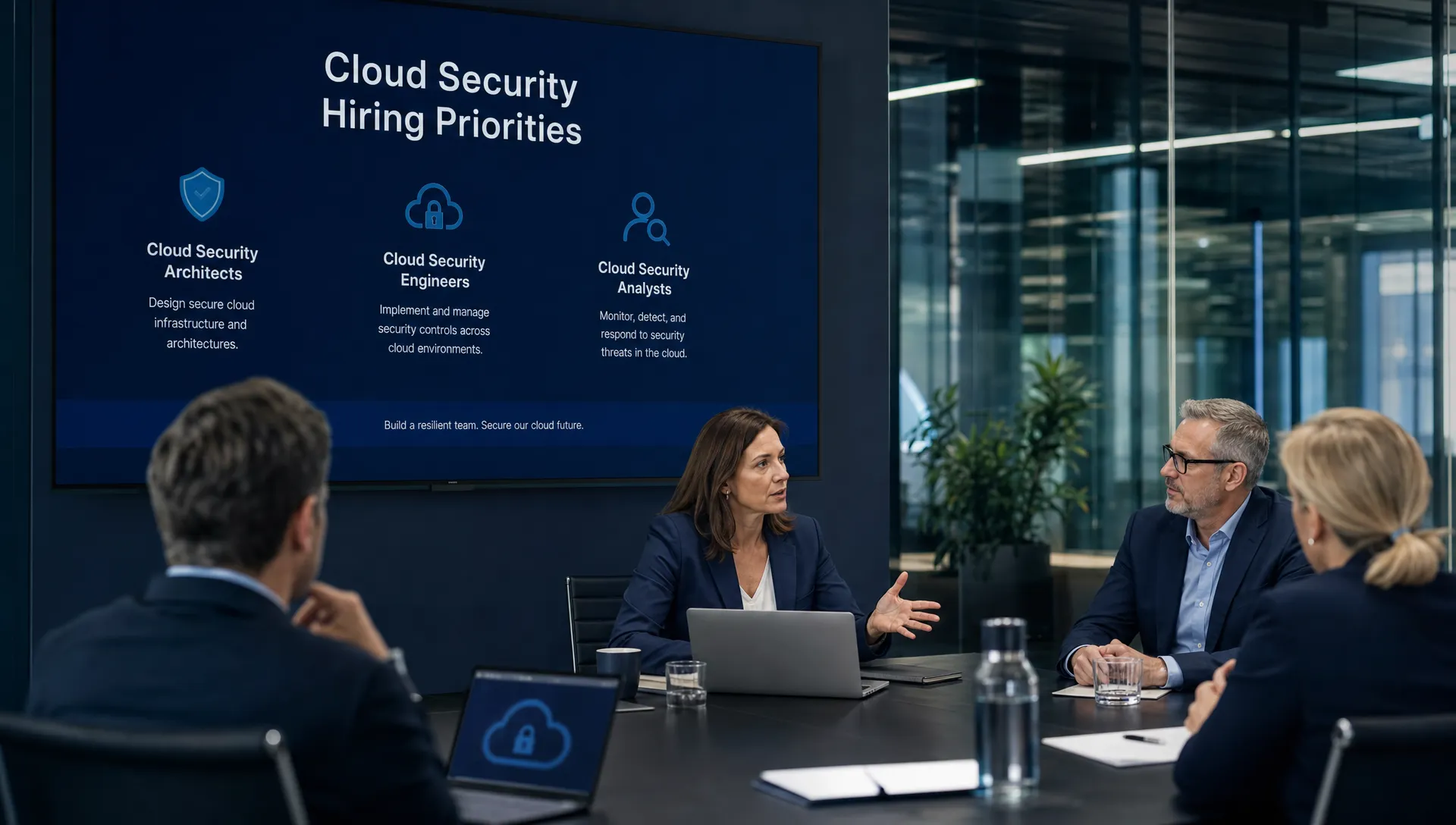
Cloud security architect
A cloud security architect designs secure cloud environments across AWS, Microsoft Azure, Google Cloud Platform or a multi-cloud estate. Their work includes network segmentation, workload protection, encryption patterns, key management, secure landing zones, logging architecture and policy guardrails.
A strong architect turns cloud computing security from a set of reactive fixes into repeatable design decisions. They reduce the need for manual review by creating approved patterns that engineering teams can reuse. This role is particularly important when a company is expanding internationally, modernising infrastructure or moving from a single cloud account into a more complex cloud operating model.
The interview evidence to look for is practical. Ask candidates to talk through a cloud architecture they improved, the trade-offs they made and the controls they automated. Generic answers about “best practice” are less valuable than examples of specific design choices under real constraints.
DevSecOps or product security engineer
DevSecOps and product security roles sit close to engineering. They embed security into software delivery, CI/CD pipelines, infrastructure as code, dependency management, container security and developer workflows. For a scale-up, this role can have an outsized impact because it prevents security from becoming a late-stage blocker.
The right candidate understands both risk and velocity. They should be comfortable reviewing Terraform, Kubernetes configurations, GitHub Actions, container images or API authentication flows. They should also know when to automate a control and when to coach teams directly.
This is often one of the most commercially valuable hires for SaaS businesses. If security checks happen earlier in the development cycle, enterprise releases become easier to approve and sales teams face fewer last-minute objections.
Identity and access management lead
Identity is one of the biggest pressure points in a growing cloud environment. As headcount increases and teams adopt more tools, permissions can sprawl quickly. An identity and access management lead owns single sign-on, multi-factor authentication, privileged access, joiner-mover-leaver processes, service accounts and role-based access design.
In practical terms, IAM work reduces insider risk, limits the blast radius of compromised accounts and supports audit readiness. It also improves operational discipline. When identity processes are clear, HR, IT, engineering and security stop working from different versions of the truth.
Scale-ups hiring for this role should look for candidates who can balance usability and control. Overly rigid access models slow the business. Loose access models create risk that becomes expensive to unwind later.
Cloud detection and response engineer
Prevention is never enough. A cloud detection and response engineer builds the capability to spot suspicious behaviour, investigate incidents and coordinate containment. Their remit may include SIEM tuning, cloud-native logs, endpoint signals, threat detection rules, alert triage and incident playbooks.
This role becomes urgent when the business operates critical customer systems, handles sensitive data or runs across multiple regions. The goal is not to drown the company in alerts. The goal is to know which events matter and how to respond when they happen.
The UK National Cyber Security Centre’s cloud security guidance is a useful reference point for the kind of shared responsibility and configuration thinking these candidates should understand. Good candidates can explain how they have worked with engineering teams to improve telemetry, reduce false positives and shorten response times.
GRC and cloud compliance manager
Governance, risk and compliance work can sound administrative, but at scale-up stage it becomes a revenue enabler. A GRC manager helps the company prepare for audits, maintain evidence, manage policies, support vendor risk reviews and respond to customer security questionnaires.
This role is often needed earlier than founders expect. If the sales team is spending hours answering security questionnaires without a clear evidence base, or if the COO is personally driving certification work, the business is already paying for the absence of GRC capability.
For international scale-ups, the role may also connect European and American expectations. GDPR, SOC 2, ISO 27001, HIPAA considerations, DORA for financial entities and NIS2 exposure can all influence customer conversations depending on the product and sector.
Data security and privacy engineering
Data security becomes more specialised as a company matures. This role focuses on classification, data loss prevention, encryption, retention, anonymisation, data access monitoring and secure analytics environments. It is especially relevant for digital health, fintech, AI, data analytics and B2B SaaS companies handling sensitive customer information.
In AI-led businesses, data security also intersects with model governance and responsible AI. Leaders should look for candidates who understand where sensitive data flows, how it is accessed and how controls can be tested. This is where cloud computing security connects directly to customer trust and product differentiation.
How to sequence cloud security hires by growth stage
There is no universal headcount formula. A 120-person medtech scale-up can have a heavier security burden than a 300-person company in a lower-risk category. Sequencing should follow risk, revenue dependency and operational complexity rather than employee count alone.
The table below shows a practical hiring sequence many leadership teams can adapt.
| Scale-up stage | Typical trigger | Priority security hire | Main outcome |
|---|---|---|---|
| Early commercial traction | First enterprise customers or security questionnaires | Fractional CISO, Head of Security or senior consultant | Strategy, roadmap and customer assurance |
| Rapid product and engineering growth | More cloud accounts, faster releases or infrastructure changes | Cloud security architect | Secure design patterns and guardrails |
| Scaling delivery | More developers, more releases and more third-party code | DevSecOps or product security engineer | Security embedded in delivery workflows |
| International expansion | More employees, entities and SaaS tools | IAM lead | Controlled access and better audit readiness |
| Regulated or critical operations | Sensitive data, uptime obligations or incident exposure | Cloud detection and response engineer | Monitoring, investigation and response capability |
| Enterprise sales acceleration | Certifications, audits and vendor reviews | GRC and compliance manager | Repeatable evidence and sales support |
Sequencing cloud computing security hires is a leadership decision, not just a technical one. If revenue depends on regulated customers, GRC may come earlier. If product velocity is the risk, DevSecOps may be the priority. If the cloud estate has grown without architectural discipline, the cloud security architect should move up the list.
Hiring signals that separate credible candidates from title inflation
Security titles have expanded quickly, and CVs can look deceptively similar. A candidate who has maintained mature enterprise controls may struggle in a scale-up that needs hands-on building. Conversely, a strong engineer may not yet be ready to own board-level risk or customer-facing assurance.
The best interviews test for context. Ask candidates what they inherited, what they changed, how they influenced teams and what they chose not to do. Good scale-up security talent can explain trade-offs in plain English. They are not trying to secure everything equally. They know which controls protect revenue, which reduce operational risk and which satisfy customer requirements without slowing the business unnecessarily.
Because cloud computing security touches architecture, product velocity and commercial trust, credible candidates should show evidence across three areas: technical depth, stakeholder influence and judgement under constraints. For senior roles, they should also be able to brief non-technical leaders without hiding behind jargon.
Useful interview prompts include:
- “Tell us about a cloud control you automated and the business problem it solved.”
- “How would you prioritise security work in your first 90 days here?”
- “Describe a time you disagreed with engineering or product leadership. How was it resolved?”
- “Which security metrics would you report to the board and why?”
- “What would you refuse to compromise on in our current growth phase?”
For a broader perspective on how technical roles evolve as markets mature, Optima has previously explored why the future is increasingly technical across high-growth career paths.
Common mistakes leadership teams make
The most common hiring mistake is waiting until a customer, auditor or incident forces the issue. Reactive hiring creates pressure, narrows the candidate pool and often leads to overpaying for the wrong profile. It also sends a poor message internally: security becomes associated with panic rather than operating discipline.
Another mistake is hiring too senior without the right support. A strategic CISO cannot succeed if there is no one to implement controls, manage evidence or work with developers. In a scale-up, leadership and execution must be connected. The first hire often needs to be senior enough to set direction but hands-on enough to build.
A third mistake is treating cloud computing security as a purely engineering function. Engineering is central, but the function also affects sales, legal, finance, HR, customer success and executive governance. If the role is buried too deeply in infrastructure, the business may miss wider risks and commercial opportunities.
Finally, companies sometimes recruit from famous enterprise brands without testing for build-stage experience. Large-company security professionals can be excellent hires, but only if they are comfortable with ambiguity, limited tooling and influencing without large teams.
Building the function without slowing the business
A mature security culture does not mean every decision becomes a committee. The best scale-up security teams create clear defaults, useful automation and simple escalation routes. They make the secure path the easiest path for engineers, sales teams and operations leaders.
This is also where executive sponsorship matters. If the CEO treats security as a customer trust issue, teams engage differently. If the CRO understands how assurance supports enterprise conversion, sales teams provide better feedback. If HR and IT align on identity processes, access control becomes much easier to maintain.
For talent leaders, the recruitment brief should be precise. Define the company’s cloud estate, regulatory exposure, customer base, engineering culture, tooling maturity and expected first-year outcomes. A vague brief for “a cloud security person” will attract a broad and uneven field. A clear brief attracts candidates who know the problem they are being hired to solve.
If your organisation needs senior or business-critical hiring support across cloud, cybersecurity, digital, AI infrastructure or GTM roles, Optima Search Europe works with high-growth and established firms to identify leaders who can operate in complex international markets.
Frequently Asked Questions
Which cloud computing security role should a scale-up hire first? Most scale-ups should start with a senior security leader, such as a Head of Security, VP Security or fractional CISO, if there is no clear owner. If leadership already exists, the first specialist hire often depends on the biggest risk: architecture, DevSecOps, IAM, detection or compliance.
Can one person cover all cloud security responsibilities? Temporarily, yes, but not indefinitely. Early security hires often cover strategy, architecture, customer assurance and incident response. As the business grows, the workload should be split so that strategic leadership, engineering enablement, operations and compliance each receive proper ownership.
When does GRC become a dedicated hire? GRC should become a dedicated hire when audits, certifications, vendor reviews or security questionnaires are consuming senior leadership time or delaying revenue. For enterprise SaaS, fintech, healthtech and regulated markets, this point can arrive earlier than expected.
Should scale-ups hire permanent talent or use contractors first? Contractors can help with audits, assessments and short-term implementation. Permanent hires are usually better for long-term ownership, cultural influence and repeatable operating models. Many companies use both, but the accountability for security direction should be clear.
How can leaders assess whether a candidate is too enterprise for a scale-up? Ask about situations where the candidate built controls with limited budget, influenced teams without formal authority and made pragmatic trade-offs. Candidates who need large teams, mature processes and long approval cycles may struggle in a high-growth environment.
Turning security hiring into a growth advantage
The right cloud computing security team protects more than infrastructure. It helps the business win enterprise customers, enter regulated markets, reduce operational risk and give executives clearer visibility into decisions that matter.
For scale-ups in Europe and America, the priority is not to build the biggest security organisation. It is to hire the right roles in the right order, with people who understand both technical risk and commercial urgency. That is where security becomes part of the growth engine rather than a brake on it.

