

SaaS Developer Salary Germany (2026 Guide)
For CTOs, VP Engineering leaders, and HR Directors in a SaaS company, salary benchmarking in Germany is no longer a “nice to have”. It is a delivery risk control. The German tech ecosystem remains one of Europe’s deepest engineering markets, but the most employable SaaS developers (especially those shipping cloud-native, microservices-based products in agile development teams) have strong leverage, multiple options, and clear expectations.
This guide provides 2026 salary benchmarks for SaaS developers in Germany across experience levels, roles (backend, frontend, full-stack, DevOps, platform), and major hubs (Berlin, Munich, Frankfurt, Hamburg). It also connects pay ranges to total hiring cost and practical budgeting decisions.
If you are building a compensation plan across Germany and wider Europe, our broader hiring context is covered in the Optima Search Europe pillar on SaaS & Software Recruitment Agency Europe (useful for cross-border recruitment planning and role design).
Overview of the SaaS Developer Job Market in Germany
Germany’s software market continues to split into two parallel tracks: (1) product-led SaaS startups and scale-ups building modern cloud platforms, and (2) large enterprises and established software firms modernising legacy estates into cloud infrastructure, APIs, and microservices architecture.
Growth of SaaS startups: Berlin remains the best-known magnet for SaaS startup formation, but “SaaS density” is increasingly distributed across hubs that combine universities, corporate R&D, and industrial demand. Many startups now compete directly with international employers for the same engineers, even when hiring locally.
Expansion of enterprise software companies: Munich and Frankfurt, in particular, benefit from concentration in automotive, insurance, finance, and industrial technology, all of which continue to invest in platform modernisation, data, and security. Enterprises may hire “SaaS developers” under titles like software engineer, backend developer, or platform engineer, but the capability requirements converge around cloud-native patterns and production reliability.
Demand for experienced engineers: The market rewards engineers who can do more than code. In 2026, the premium is on developers who can own systems end-to-end: designing services, instrumenting observability, handling scaling bottlenecks, and collaborating across product, design, and commercial stakeholders.
Competition for senior developers: Senior backend and platform talent is consistently the hardest segment. They are the profiles who can make microservices work in reality (not just in diagrams), stabilise CI/CD, set engineering standards, and unblock teams. This scarcity shows up in higher salary bands, faster counter-offers, and longer time-to-hire.
In summary, Germany’s SaaS hiring market in 2026 is shaped by strong demand for production-grade software engineers, intense competition for senior developers, and widening variance by city, company type, and cloud-native maturity.
Average SaaS Developer Salary in Germany (2026 Overview)
Below are indicative salary benchmarks for a SaaS developer salary Germany context, expressed as gross annual salary (Bruttojahresgehalt) in EUR. In Germany, base salary is typically quoted as an annual gross figure; bonus and equity vary significantly by company stage.
- Junior SaaS developer (0 to 2 years): €45,000 to €60,000 Bruttojahresgehalt
- Mid-level SaaS developer (3 to 5 years): €60,000 to €78,000 Bruttojahresgehalt
- Senior SaaS developer (6+ years): €78,000 to €105,000 Bruttojahresgehalt
These ranges align closely with how hiring teams often budget for a software developer salary Germany market, but “SaaS premium” tends to appear when the role requires modern cloud infrastructure exposure (AWS, Azure, GCP), microservices, event-driven design, or strong DevOps collaboration.
What “gross annual salary (Bruttojahresgehalt)” means in practice
Bruttojahresgehalt is the gross salary before employee taxes and social security deductions. For employers, the base salary is not the full cost of employment because German companies typically pay additional employer contributions (and frequently fund benefits and equipment). We cover total cost in a later section.
Salary by Developer Role
Job titles in Germany are not fully standardised, so salary benchmarking works best when you anchor ranges to the actual scope: system ownership, cloud maturity, and whether the engineer is expected to operate services in production.
Backend developers
A backend developer salary Germany benchmark for SaaS tends to be highest when the role includes distributed systems responsibility (APIs, data stores, queues), performance work, and production reliability.
Typical 2026 ranges (Bruttojahresgehalt): €65,000 to €100,000, with senior backend engineers in high-demand domains sometimes budgeted above that when scarcity is extreme.
Frontend developers
Frontend pay depends heavily on product complexity (design systems, performance, accessibility), and on whether the role is UI-only or also includes architecture ownership and collaboration with backend on API contracts.
Typical 2026 ranges (Bruttojahresgehalt): €58,000 to €90,000.
Full-stack developers
A full stack developer salary Germany benchmark often reflects breadth rather than depth. Full-stack profiles are most valuable in earlier-stage SaaS environments where teams need engineers who can move between backend services, web clients, and integration work.
Typical 2026 ranges (Bruttojahresgehalt): €62,000 to €98,000.
DevOps engineers
DevOps compensation is driven by operational scope: CI/CD design, Kubernetes, infrastructure as code, incident response, security controls, and the ability to make cloud cost and reliability trade-offs.
Typical 2026 ranges (Bruttojahresgehalt): €70,000 to €110,000.
Platform engineers
Platform engineering is increasingly distinct from DevOps. These roles build internal developer platforms, paved roads, golden paths, and standardised tooling to help product teams ship safely. In a cloud-native SaaS company, platform engineers often carry significant leverage.
Typical 2026 ranges (Bruttojahresgehalt): €80,000 to €120,000.
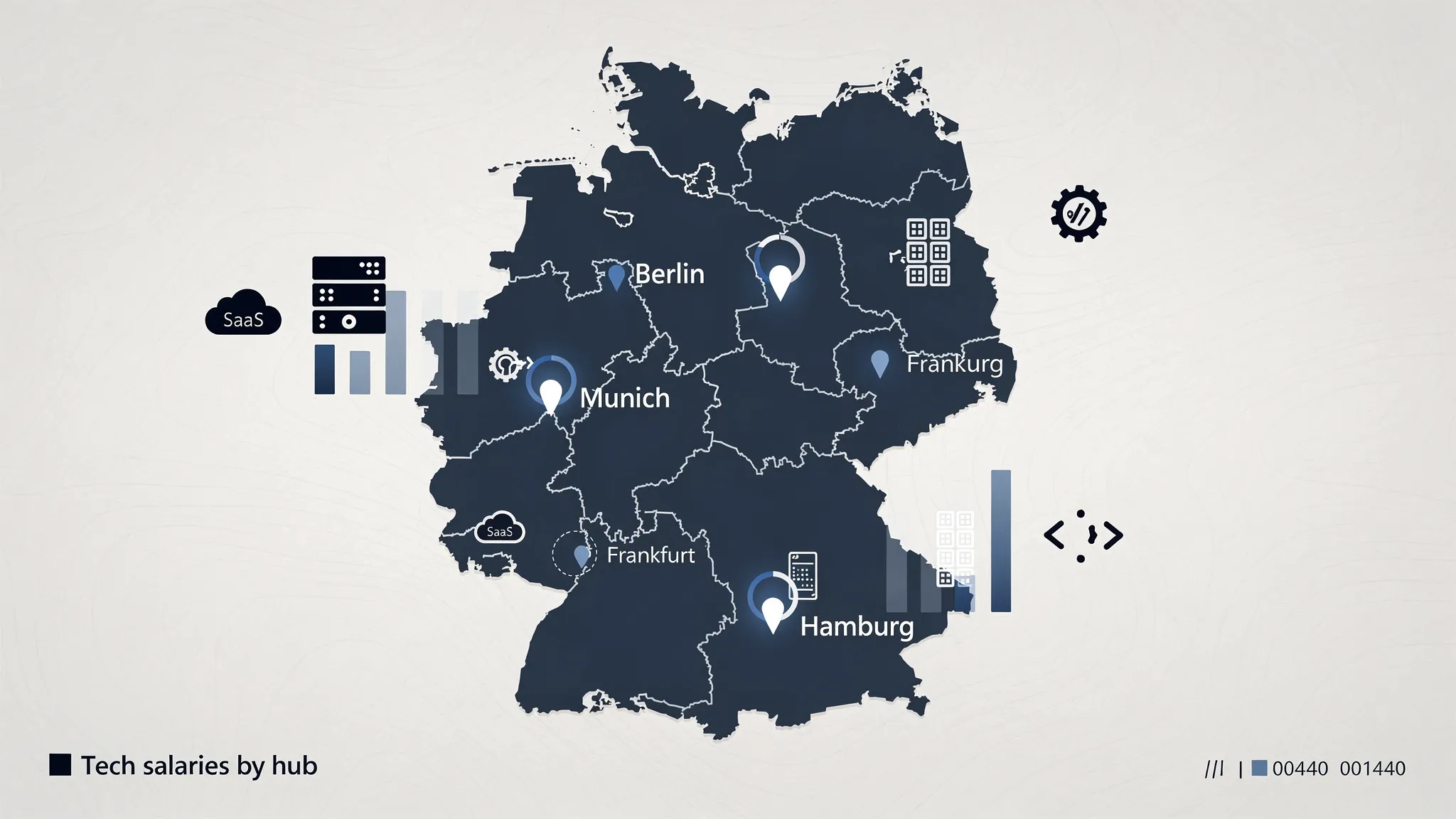
Salary Differences Across German Tech Cities
Germany does not have a single “national tech salary”. The city matters because local employer mix matters: startups vs enterprises, industry concentration, and the local density of senior engineers.
Berlin
The Berlin tech hub is shaped by startups, scale-ups, and international teams. Base salaries can be competitive, but packages often include equity (VSOP-style participation) rather than purely maximising fixed cash.
Indicative SaaS developer salary ranges in Berlin (Bruttojahresgehalt): €58,000 to €95,000, with senior specialists higher depending on domain and urgency.
Munich
The Munich tech industry typically shows the highest and most consistent base salaries, driven by strong enterprise demand, deep capital, and competition with global employers. Munich-based roles also sometimes include more structured bonus schemes and benefits.
Indicative SaaS developer salary ranges in Munich (Bruttojahresgehalt): €70,000 to €110,000.
Frankfurt
Frankfurt salaries are influenced by finance, insurance, and regulated environments, where software engineers are hired to build secure, auditable platforms and modernise legacy systems. Cloud, security, and reliability experience can command a premium.
Indicative SaaS developer salary ranges in Frankfurt (Bruttojahresgehalt): €68,000 to €108,000.
Hamburg
Hamburg has a strong mix of media, commerce, logistics, and growing SaaS pockets. Pay is often competitive for experienced engineers, though the very top-end packages can be slightly less frequent than Munich.
Indicative SaaS developer salary ranges in Hamburg (Bruttojahresgehalt): €62,000 to €100,000.
Factors Driving SaaS Developer Salaries
In 2026, salary movement in Germany is rarely explained by “coding skills” alone. Compensation rises when a candidate reduces delivery risk, improves system resilience, and increases team throughput.
Competition for engineering talent: Companies are not just competing locally. A strong SaaS engineer in Germany can be approached by employers across the EU and, in some cases, US companies hiring into European time zones. This widens the market reference point for senior candidates.
Growth of cloud-native applications: Modern SaaS products are increasingly built around containerisation, Kubernetes orchestration, managed cloud services, and microservices architecture. Engineers who can design for observability, fault isolation, and secure-by-default patterns are valued because they prevent expensive platform rewrites later.
Remote hiring pressure: Remote and hybrid models expand candidate options, but they also expand employer competition. Even when a company prefers local hiring, candidates often compare offers against remote-friendly roles with different compensation norms.
International competition: Germany’s talent pool is global. Many teams operate in English, and cross-border recruitment has become a standard lever for filling scarce roles. The result is that “market rate” is increasingly set by an international, not purely German, comparison set.
Funding-driven hiring growth: When funding cycles improve, salary bands typically move fastest for senior backend, DevOps, and platform profiles because these are the critical bottlenecks to scaling a SaaS product.
Hiring Costs Beyond Base Salary
For budgeting, the base salary is only the starting point. Total cost of employment in Germany includes statutory and operational layers that materially change the business case of a hire.
Employer social contributions: Employers pay additional contributions on top of gross salary (pension, health, unemployment, long-term care), with exact rates depending on thresholds and insurer choices. Many hiring leaders model roughly 20 to 23 percent on top of base salary as a planning assumption, then validate with payroll. For an official overview of how social security works in Germany, see Make it in Germany’s overview of social security contributions.
Benefits packages: Common items include private pension top-ups, public transport subsidies, training budgets, home-office support, and (in some cases) company bonus schemes. Enterprises may offer more structured benefits; startups may offer fewer benefits but offset with equity.
Relocation costs: For hard-to-find SaaS developers, relocation can still be decisive even in a remote-leaning market. Budget can include relocation support, temporary accommodation, and partner support, especially for cross-border recruitment.
Recruitment fees: Specialist search support is often budgeted as a percentage of first-year compensation, particularly for senior and business-critical roles. Even with strong internal talent teams, external partners can reduce time-to-hire when the best candidates are passive and not applying.
Time-to-hire impact: The longer a key software engineer role stays open, the higher the opportunity cost. For SaaS firms, that cost is usually felt as delayed product milestones, slower revenue enablement, and increased load on existing teams (which can create retention issues). A pragmatic way to model this is to define the role’s “delivery leverage” (features shipped, reliability improvements, customer escalations prevented) and attach a monthly delay cost.
If you want a process view on reducing time-to-hire without lowering the bar, see How to Hire SaaS Developers in Europe.
Startup vs Enterprise Compensation Models (What changes in Germany)
In Germany, startup and enterprise compensation often differ less in the middle of the market than people expect, but the structure differs.
Startups and scale-ups:
- Often aim for a competitive base within a defined band, then add upside via equity (commonly structured as virtual shares in Germany).
- May use broader role scope to attract engineers (more ownership, faster progression, more influence over architecture).
- Can be more flexible on remote work and tooling, but may have fewer formal benefits.
Enterprises and established software companies:
- More likely to offer higher fixed cash at senior levels, plus clearer bonus frameworks.
- Often have well-defined role levels, but the hiring process can be slower.
- May provide stronger benefits and job security, which some candidates price into their decision.
For a hiring leader, the practical implication is that “enterprise vs startup” is not just a salary comparison. It is a risk and preference profile comparison, and it changes how you should position the role in outreach.
Salary Trends and Talent Shortage
The most important trend for 2026 is not that “all salaries go up”. It is that variance increases.
Rising salary expectations for seniors: Senior SaaS developers increasingly anchor on (1) scope, (2) engineering quality expectations, and (3) market alternatives. If your stack includes modern cloud infrastructure, microservices, and strong agile development practices, you may attract better candidates, but you will still compete for the same limited senior pool.
Counter-offers remain common: When a backend or platform engineer resigns, many employers respond with counter-offers because replacement risk is high. This pushes offers upward and can compress internal pay bands if compensation governance is not tight.
Retention challenges: Hiring is only half the problem. Retention is often driven by role clarity, engineering leadership quality, on-call sustainability, and credible progression paths. Compensation matters, but “career signal” and delivery environment often decide whether an engineer stays.
Long-term compensation strategies: The most resilient companies treat compensation as a system: salary bands by level, clear levelling criteria, transparent promotion signals, and periodic market calibration. This reduces renegotiation cycles and makes hiring faster because decision-makers know their budget boundaries.
When compensation strategy connects to product strategy, product roles must also be benchmarked correctly. If your roadmap depends on product leadership, you may find this relevant: Product Manager Recruitment for SaaS Companies.
Frequently Asked Questions (Minimum 6)
How much do SaaS developers earn in Germany? Most SaaS developer salaries in Germany are quoted as gross annual salary (Bruttojahresgehalt). In 2026, a common benchmark is €45,000 to €60,000 for junior developers, €60,000 to €78,000 for mid-level, and €78,000 to €105,000 for senior profiles. The real number depends on role scope (backend vs platform), city, and whether the engineer owns production systems in a cloud-native environment.
Which German city pays the highest developer salaries? Munich often leads on base salary consistency because of enterprise concentration and strong competition for experienced software engineers. Frankfurt can also be very competitive for roles tied to finance and regulated environments. Berlin salaries can be slightly more variable, with startups sometimes offering lower base but adding equity. Hamburg is competitive, especially for experienced full-stack and backend talent, but top-end packages appear less frequently than Munich.
Are SaaS developer salaries increasing in 2026? Salaries are not rising uniformly, but senior and scarce skill segments continue to see upward pressure. The biggest drivers are competition for engineers who can operate cloud-native systems, increased international hiring reach, and counter-offers. In practice, companies that run slow processes or under-scope compensation are more likely to experience “forced increases” late in the cycle. Firms with clear bands and fast decision-making tend to control costs better.
What skills increase SaaS engineer salary in Germany? The strongest salary lift usually comes from production-grade skills: designing microservices architecture that scales, building robust APIs, operating services with observability, and collaborating effectively in agile development. Cloud infrastructure competence (AWS/Azure/GCP), Kubernetes, CI/CD, infrastructure as code, and security-by-design also command premiums. For backend developers, distributed systems and data engineering exposure can move compensation upward, especially in regulated or high-availability environments.
Is there a shortage of SaaS developers in Germany? The shortage is most acute at senior levels and in hybrid roles like platform engineering and DevOps, where candidates must combine software engineering with operational ownership. Germany has a strong overall talent base, but the subset of engineers who have built and operated cloud-native SaaS at scale is relatively small. This is why cross-border recruitment is common, and why hiring teams often need sharper role definition and faster processes.
How long does it take to hire software engineers in Germany? Time-to-hire varies by seniority and interview discipline, but senior backend, DevOps, and platform roles often take longer due to scarcity, notice periods, and counter-offers. A frequent failure mode is adding extra interview stages after good candidates are already in motion elsewhere. The highest-performing hiring teams align stakeholders upfront, run structured assessments, and close quickly once evidence is strong. This improves offer acceptance and reduces total hiring cost.
What is the difference between base salary and total employer cost in Germany? Base salary is the gross annual salary paid to the employee. Total employer cost is higher because it includes employer social contributions and additional costs such as benefits, equipment, and sometimes relocation. Many companies model an extra 20 to 23 percent on top of base for planning, then validate with payroll based on statutory contribution rules and caps. For budgeting, you should also account for vacancy cost and recruitment fees.
Conclusion
The SaaS developer salary Germany landscape in 2026 is competitive, especially for senior software engineers who can deliver cloud-native systems, mature microservices architecture, and reliable production operations in agile development environments. Benchmarks vary meaningfully by experience level, role (backend, full-stack, DevOps, platform), and city (Berlin, Munich, Frankfurt, Hamburg), so “one number” is rarely accurate.
For hiring leaders, the key is to treat compensation as part of a structured hiring strategy: clear levelling, realistic ranges, fast decision cycles, and a total-cost view that includes employer contributions and time-to-hire. If you are also hiring adjacent roles in the SaaS growth engine, the Marketing Technology Recruitment Guide can help align commercial tooling and talent planning with engineering capacity.

