
Search recruitment vs headhunting: what’s the real difference?

Hiring for a business critical role often comes down to one question: are you just trying to “find someone good”, or are you trying to de-risk a leadership hire that will shape revenue, culture, and strategy for years?
That’s why the terms headhunting and search recruitment are often used interchangeably, but in practice, they can describe very different approaches, levels of rigour, and outcomes.
Definitions first: why the confusion exists
In day-to-day business language, “headhunting” is frequently used as a catch-all for any proactive outreach to passive candidates. Many people mean: “We need someone, go tap your network and approach them directly.”
Search recruitment, on the other hand, typically refers to a structured search methodology (often associated with executive search) that is designed to deliver a short list of high-calibre candidates for roles where failure is expensive.
To make it clearer:
- Headhunting is usually candidate-led (find a strong person quickly).
- Search recruitment is role-led and outcome-led (define success, map the market, assess deeply, and deliver the right hire).
Both can work, but they are not the same tool.

Search recruitment vs headhunting: the real differences that matter
Below are the practical differences that show up in timelines, candidate quality, stakeholder alignment, and ultimately retention.
1) Starting point: “who do we know” vs “what does success require?”
Headhunting often begins with names. The recruiter identifies a handful of likely candidates (competitors, known performers, people with the right title) and starts outreach.
Search recruitment begins with definition. Before outreach, you typically align on a success profile that goes beyond a job description:
- What outcomes must this person deliver in 6, 12, 24 months?
- What commercial and operational levers will they own?
- What leadership behaviours are essential in your environment (scale-up, turnaround, matrix, regulated, etc.)?
- What are the non-negotiables vs “strong preferences”?
This step matters most in GTM, Sales leadership, and senior functional roles, where the wrong hire can set a region back by quarters.
2) Market coverage: opportunistic outreach vs disciplined market mapping
A classic headhunting approach may focus on the “usual suspects”, a set of target companies, competitor teams, and visible LinkedIn profiles.
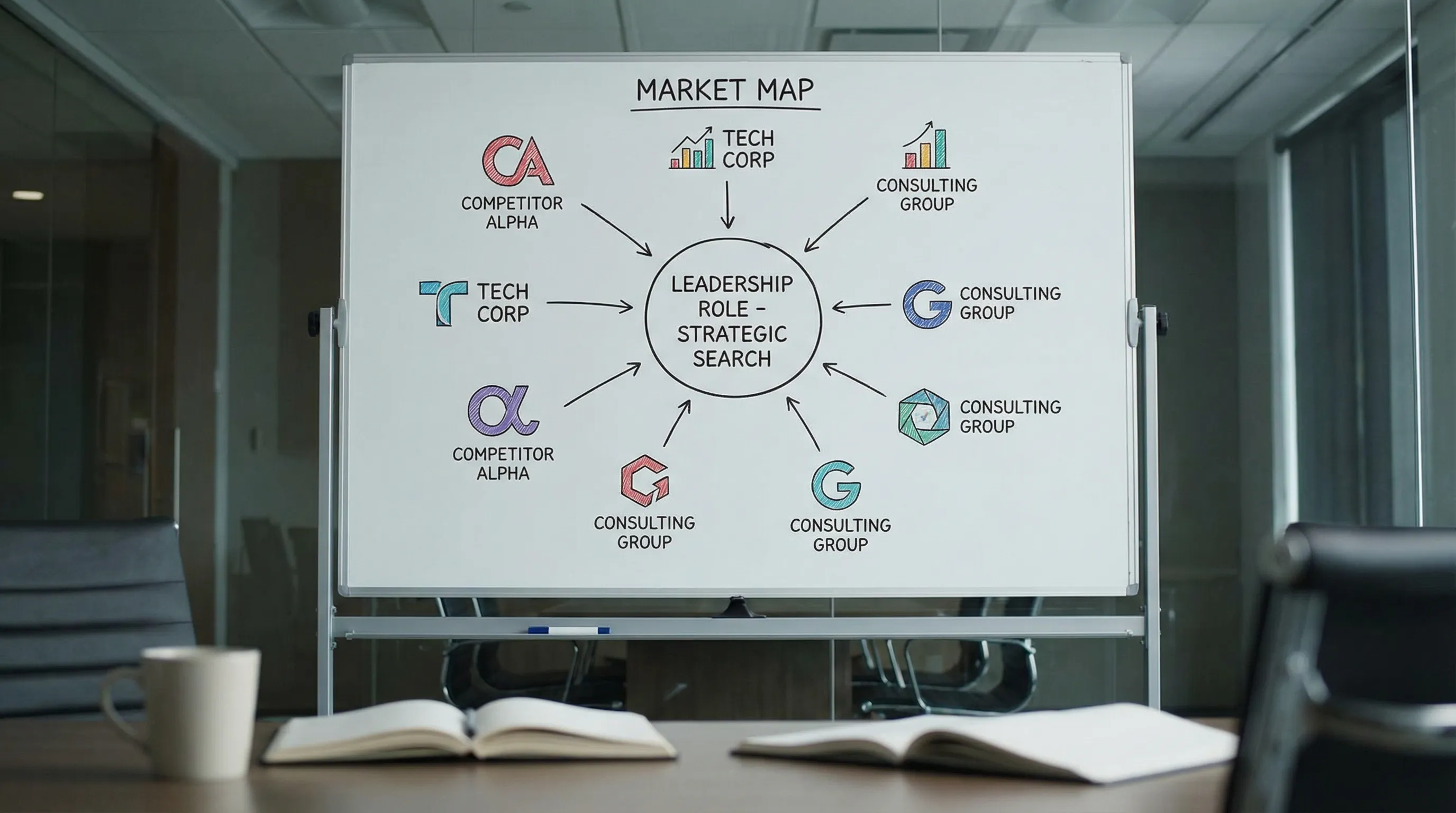
Search recruitment typically includes market mapping to widen the lens:
- Adjacent sectors (for example, taking a revenue leader from MarTech into cybersecurity, or from cloud platform engineering into industrial AI)
- Hidden talent (high performers who are not actively visible or are less likely to respond without a compelling approach)
- Geography strategy (Europe vs US talent pools, relocation feasibility, local leadership requirements)
The result is not just more candidates, but better optionality.
3) Candidate evaluation: “can they do the job?” vs “will they win in our context?”
Headhunting can be effective when the role is clear, the market is liquid, and the hiring team already knows exactly what good looks like.
Search recruitment typically goes further in evaluation, especially for senior hires where context is everything. You will often see:
- Structured competency and leadership interviews
- Evidence-based performance assessment (scope, metrics, deal complexity, stakeholders managed)
- Motive and risk assessment (why move now, what could derail them, what support they need)
- Calibration across stakeholders to reduce “panel drift”
At leadership level, the difference between “impressive CV” and “right executive for this company right now” is where most hiring failures happen.
4) Confidentiality and narrative control
For discreet replacements, sensitive org changes, or strategic builds (new region, new product line, new GM), search recruitment is usually built to manage confidentiality end-to-end.
Headhunting can still be discreet, but it is often faster-moving and less structured, which can increase the risk of mixed messaging in the market.
A good search partner protects:
- Employer brand and rumours
- Candidate privacy (especially for high-profile executives)
- Consistent story across every touchpoint
5) Process governance and stakeholder alignment
In headhunting, the process is often lightweight: identify, contact, send CVs, arrange interviews.
In search recruitment, the process tends to be managed like a project, with clearer governance:
- Agreed milestones and decision points
- Regular progress updates and calibration
- A consistent assessment framework
For CEO, CRO, VP, and country leadership hires, this governance is often the difference between a smooth process and a stalled one.
6) Success metric: speed alone vs quality, longevity, and impact
Headhunting is frequently measured by speed to shortlist.
Search recruitment is typically measured by quality of outcome, for example:
- time-to-impact
- retention and leadership fit
- ability to deliver the strategic outcomes defined at the start
This is why search recruitment is often chosen for roles where the cost of a miss is high, commercially and culturally.
When headhunting is the right approach
Headhunting can be the right choice when:
- The role is well-defined and repeatable (for example, adding capacity in a proven sales segment)
- You already know target companies and profiles
- You need speed and the risk of a miss is acceptable
- The hiring manager can evaluate confidently without heavy process support
In other words, headhunting can work brilliantly when the “who” is relatively obvious and the challenge is getting them engaged.
When search recruitment is the better choice
Search recruitment is typically the better fit when:
- The role is business-critical (P&L ownership, regional leadership, first senior hire in a new market)
- The brief is complex or evolving (new GTM motion, product shift, enterprise move upmarket)
- You need to access passive, high-calibre leaders beyond your immediate network
- Stakeholder alignment is difficult (multiple decision makers, different views of the ideal candidate)
- The hire must succeed in a particular context (high growth, transformation, post-merger, regulated industry)
In these scenarios, “finding strong people” is not enough. You need a method that reliably delivers the right leader.
Where technology fits in (and where it doesn’t)
Modern recruiting can be significantly enhanced by automation, data, and faster response times, especially at the top of the funnel.
For example, some commercial teams use AI-powered prospecting tools like Orsay to identify and engage qualified leads quickly and to ensure inbound enquiries get a rapid first response. The same principle applies in talent: speed and relevance of outreach can raise conversion, but it does not replace rigorous assessment, stakeholder alignment, and closing strategy for senior hires.
Technology can improve efficiency, but for executive hiring, the hard part is still human judgement: motivation, leadership style, influence, and fit for a specific company phase.
A note on Optima Search’s leadership focus
Optima Search has a track record of connecting Visionary Leaders with Innovation-Driven Companies, with a consistent focus on high-impact leadership placements in fast-moving markets.
A good example is this placement case study: VP Sales Analytics at Salesforce, which shows the kind of targeted search approach and long-term impact that matters when hiring at executive level.
How to choose between search recruitment and headhunting (a practical checklist)
If you are deciding which approach to use, pressure-test the role with three questions.
How expensive is the wrong hire?
For senior commercial and executive roles, the cost is rarely limited to fees. It often includes:
- missed revenue targets and slowed pipeline creation
- knock-on attrition (good people leave under poor leadership)
- delayed strategic execution
- reputational impact in a niche market
If the cost of a miss is high, search recruitment tends to be the safer route.
How clear is “good” in your environment?
If your leadership team can clearly define what great looks like (outcomes, behaviours, culture), headhunting may be sufficient.
If “great” depends on nuance (scale-up leadership, complex stakeholder management, cross-border GTM), search recruitment is usually stronger because it forces definition and calibration.
How difficult is the candidate market?
In specialised verticals (AI infrastructure, cybersecurity governance, cloud platform engineering, digital health, industrial AI), talent is often:
- scarce
- heavily networked
- not actively job-seeking
This is where disciplined search can materially change the quality of the shortlist.
Common misconceptions to avoid
“Headhunting is what executive search firms do anyway”
Most executive search involves headhunting activity, but not all headhunting is executive search. The difference is the method around it: definition, mapping, assessment, governance, and closing.
“Search recruitment just means paying more”
Pricing models vary widely, and the right approach is not about cost, it’s about risk management and outcome certainty. If a role is business-critical, a structured process can be cheaper than a failed hire.
“We can assess leadership in a couple of interviews”
You can assess communication quickly. Assessing leadership under pressure, motive, influence style, and context fit usually requires more structure and deeper evidence.
Frequently Asked Questions
Is search recruitment the same as executive search? Search recruitment often describes the executive search style of hiring: structured definition, market mapping, proactive outreach, and deeper assessment. Some firms also apply search methods to senior, business-critical non-executive roles.
Does headhunting only mean poaching from competitors? No. While competitor targeting is common, effective headhunting can also include adjacent industries and non-obvious profiles. The difference is whether that expansion is systematic (search recruitment) or opportunistic.
Which approach is faster: search recruitment or headhunting? Headhunting can be faster to start because it may begin with a short list of names. Search recruitment can still move quickly, but it typically includes upfront alignment and a broader market pass to improve quality and reduce risk.
When should I use search recruitment for a sales leadership role? Use search recruitment when the hire will materially impact growth, for example a CRO, VP Sales, regional leader, or first senior GTM hire in a new market, especially when the GTM motion is changing (mid-market to enterprise, direct to channel, product-led to sales-led).
How do I know if a recruiter is doing real search recruitment? Ask how they define the success profile, how they map the market (beyond a handful of target companies), what evidence they collect to assess performance, and how they manage stakeholder calibration through the process.
Speak to Optima Search about your next leadership hire
If you are hiring for a business-critical role across Europe or the Americas, Optima Search supports organisations with tailored search and selection for senior leadership, GTM, Sales, Marketing, and specialist tech domains.
Explore Optima Search Europe at optimaeurope.com and get in touch to discuss the role, the market, and the best search strategy for the outcome you need.

