
International Recruitment Trends Europe 2026
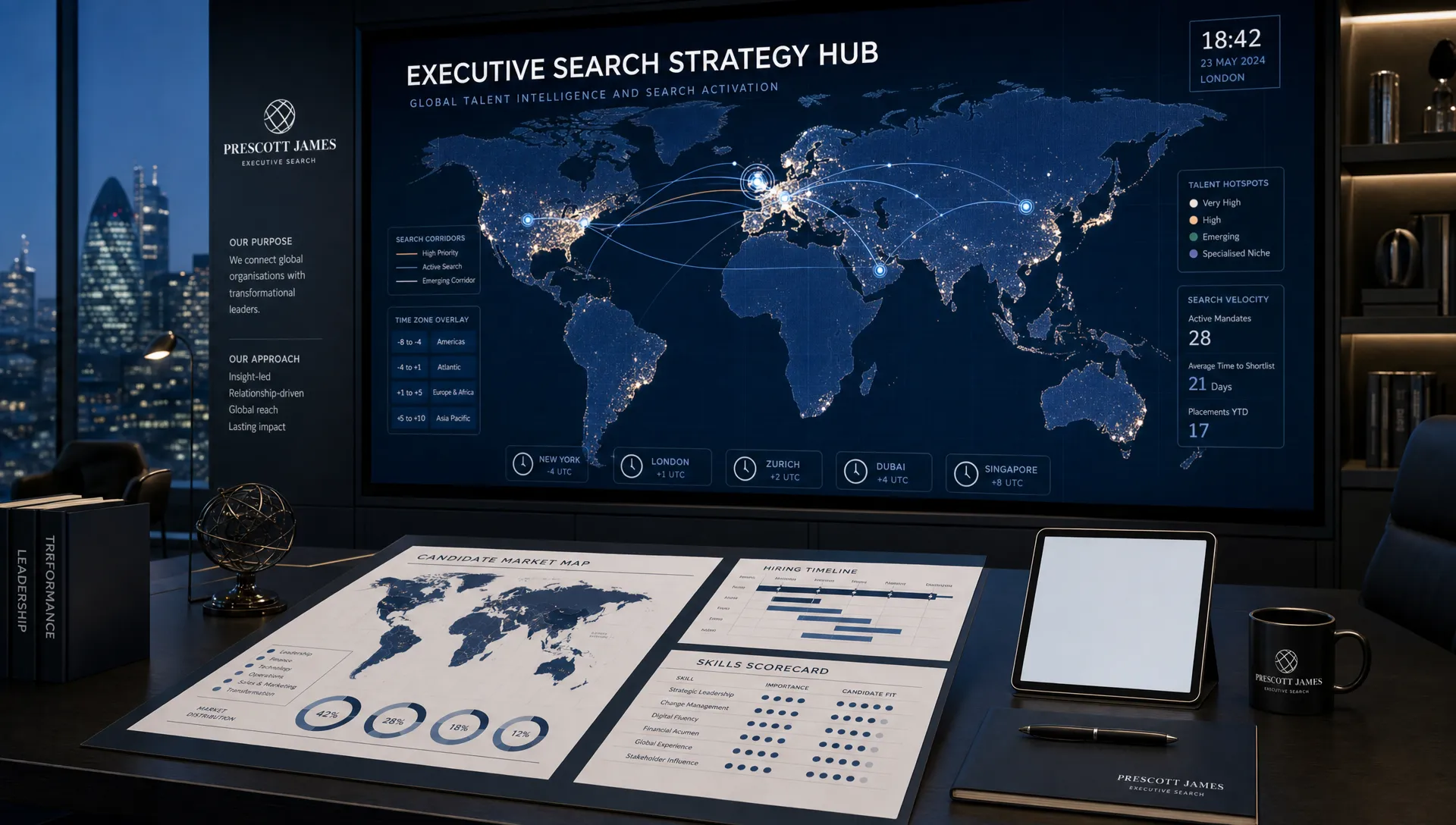
International recruitment trends are the directional shifts in how European organisations find, attract, and hire senior leaders across borders, shaped by regulation, technology, talent supply, and market dynamics. In 2026, those shifts are no longer marginal. They are directly affecting board-level workforce planning, GTM expansion, succession risk, and the time required to secure senior commercial and technology leaders.
The persistent backdrop is a talent shortage, meaning Europe faces a structural undersupply of senior technology and commercial leaders. The pressure is especially visible across cloud platform engineering, AI infrastructure, cybersecurity, data analytics, digital health, smart manufacturing, and marketing technology SaaS. For a deeper view of the structural gap behind these shifts, Optima Europe’s European tech talent shortage report sets out why supply constraints are now a strategic hiring issue, not simply a recruitment challenge.
The Five Trends Defining International Recruitment in Europe in 2026
Five converging trends are reshaping international recruitment in Europe in 2026: the acceleration of retained search for senior roles, the normalisation of cross-border hiring, the rise of AI-assisted candidate identification, the shift to skills-based assessment, and the growing importance of speed as a competitive differentiator in senior hiring.
These trends are mutually reinforcing. Talent shortages are forcing companies to search across borders. Cross-border searches require stronger process discipline, sharper candidate assessment, and better market intelligence. AI is accelerating research, but senior-level hiring still depends on credibility, judgement, and relationship-led engagement. At the same time, passive candidates are less willing to tolerate slow, unclear hiring processes.
The five trends hiring leaders should plan around are:
- Retained search replacing contingency recruitment for VP, Director, and senior executive appointments.
- Cross-border hiring becoming a normal response to constrained local talent pools.
- AI-assisted candidate identification improving market mapping without replacing human assessment.
- Speed becoming a decisive advantage in competitive senior hiring processes.
- Skills-based hiring replacing CV-led screening for leadership appointments.
Summary: European senior hiring in 2026 is more international, more specialist, more data-informed, and less forgiving of slow processes. Companies that adapt their search model, geography, assessment, and decision-making pace will be better positioned to secure high-calibre leaders.
Trend 1: Retained Search Is Replacing Contingency for Senior Roles
The contingency recruitment model, where agencies are paid only on placement, is proving structurally inadequate for VP and Director-level searches in 2026, and retained search is becoming the standard model for senior appointments across European technology and commercial sectors.
Retained search is an exclusive search engagement with a partial upfront fee, increasingly the standard model for senior appointments as contingency models prove insufficient in tight talent markets. The reason is straightforward: senior roles require market mapping, discreet outreach, structured evaluation, and sustained engagement with candidates who are rarely active applicants.
Contingency recruitment often underperforms at senior level because there is no exclusivity, limited incentive to map the entire market, and weak access to passive candidates. A passive candidate is a qualified senior professional not actively job-seeking, now the dominant hiring target at VP and above. In constrained markets, active candidate flow is often too narrow to produce a credible shortlist.
For senior appointments, contingency searches commonly deliver fill rates around 30 percent. Retained search typically performs in the 80-90 percent range because it aligns commitment, process ownership, candidate research, and advisory accountability. The shift also reflects changing decision-maker expectations. CEOs, CROs, CTOs, and HR Directors increasingly want evidence of the market searched, not just CVs sent.
Generalist technology job recruiters may still support volume hiring, but executive and business-critical roles now require deeper sector knowledge, stronger candidate relationships, and a disciplined search methodology. Hiring leaders evaluating external partners can use Optima Europe’s guide to choosing international recruitment agencies in Europe as a practical benchmark.
Summary: Retained search is gaining ground because senior hiring is no longer a vacancy-filling exercise. It is a targeted market engagement process where exclusivity, accountability, and passive candidate access materially improve outcomes.
Trend 2: Cross-Border Hiring Is Accelerating Across Europe
Cross-border senior hiring in Europe has accelerated significantly in 2026, driven by talent shortages in major markets, the normalisation of remote and hybrid working for senior leaders, and the growing willingness of executives to consider international appointments.
Cross-border hiring means recruiting senior leaders across national borders. In 2026, it is increasingly common for a German SaaS company to assess commercial leaders in the Netherlands, for a UK cybersecurity firm to consider talent in Poland, or for a US company to build its first European leadership team across multiple hubs rather than one office location.
The main driver is supply. Major markets such as the UK, Germany, France, the Netherlands, and the Nordics cannot always provide enough senior leaders with the exact sector, stage, and go-to-market experience required. Central and Eastern Europe, often shortened to CEE, is becoming a stronger source of senior technology, engineering, data, and product leadership talent, particularly where companies can offer hybrid or remote-first leadership structures.
Employer of Record, or EoR, platforms have also lowered the operational barrier to engaging senior talent in new countries. They do not remove the need for careful legal, tax, and employment advice, but they can reduce the friction of cross-border engagement. The same cross-border dynamic is visible in compute-heavy sectors adjacent to European AI infrastructure, where leaders benchmark talent against global operators such as UAE-based crypto mining and ASIC hosting operators.
The biggest constraint is no longer willingness to relocate or work internationally. It is notice period planning. Senior candidates across Europe may have three, six, or even twelve-month contractual constraints. Hiring plans that ignore this reality lose time before the search has properly started.
Summary: Cross-border hiring is now a strategic response to European talent scarcity. Companies that widen geography early, plan for notice periods, and build flexible leadership structures gain access to a materially larger senior talent pool.
Trend 3: AI-Assisted Candidate Identification Is Changing Search Methodology
AI-assisted candidate identification tools are changing how executive search firms map talent markets in 2026, accelerating research and widening the candidate universe, but not replacing the human judgement required to assess senior leaders for complex, high-stakes appointments.
AI-assisted recruitment is the use of artificial intelligence tools in the hiring process, covering candidate identification, assessment, and process management. In executive search, the most valuable applications are talent mapping, longlist development, market pattern analysis, and faster identification of people with relevant career signals.
Used well, AI can help search teams identify adjacent talent pools, compare leadership profiles across countries, and detect less obvious candidates who may not sit in a conventional competitor set. This is particularly useful in sectors where role titles are inconsistent, such as AI infrastructure, responsible AI, data analytics, AIOps, or cybersecurity governance and risk.
What AI cannot do reliably is assess executive judgement, cultural context, stakeholder credibility, or the subtle motivations that determine whether a passive candidate will engage. It also cannot replace relationship-based outreach, salary expectation management, counter-offer risk assessment, or final-stage offer negotiation.
The risk for hiring leaders is assuming that AI-only sourcing equals search quality. Faster identification can create longer lists, but not necessarily better shortlists. Specialist agencies create value by combining AI-enabled research with human validation, sector context, and direct candidate engagement. For a broader strategic view, Optima Europe’s analysis of how AI will change international hiring by 2030 explores where automation is likely to deepen next.
Summary: AI is improving the research layer of executive search, but senior hiring remains a human judgement discipline. The strongest outcomes come from combining AI-assisted mapping with specialist market expertise and relationship-led candidate assessment.
Trend 4: Speed Is Now a Primary Competitive Differentiator
In 2026's senior hiring market, the organisations that move decisively, clear brief, fast process, quick offer, consistently win the best candidates over those that run thorough but slow searches, because the best passive candidates are in multiple conversations simultaneously.
Speed matters more at senior level because high-calibre candidates are not waiting for a single process to conclude. They are typically approached by multiple firms, speaking with investors, evaluating internal promotion options, and considering whether any move is worth the disruption. Slow processes signal weak alignment, uncertain leadership, or limited appetite to hire.
Candidate drop-off risk typically rises at these points:
- Beyond 4 weeks: 30 percent drop-off risk as candidate momentum weakens.
- Beyond 6 weeks: 55 percent drop-off risk as competing opportunities advance.
- Beyond 8 weeks: 75 percent drop-off risk as candidates disengage or accept alternatives.
The most common delay points are internal alignment before search launch, interview scheduling across senior stakeholders, unclear scorecards, and late-stage compensation approval. These delays are often avoidable. The strongest hiring teams define the brief before outreach begins, agree assessment criteria, hold interview slots in advance, and secure offer parameters before final interviews.
Specialist agencies compress timelines by clarifying the brief, pre-qualifying motivation, managing candidate expectations, and maintaining momentum between stages. That does not mean rushing judgement. It means removing avoidable friction from the process.
Summary: Speed has become a quality signal in senior hiring. Companies that combine disciplined assessment with fast decision-making are more likely to convert the best passive candidates before competitors do.

Trend 5: Skills-Based Assessment Is Replacing CV-Led Screening
Skills-based hiring, assessing demonstrated competency through structured interviews, practical exercises, and track record evidence rather than CV credentials alone, is gaining significant ground in European senior hiring in 2026, driven by the failure of traditional screening to predict leadership performance.
Skills-based hiring is an approach prioritising demonstrated competency over formal qualifications. At senior level, this matters because CVs can overstate relevance. A candidate may have worked for a well-known company without having built a team, entered a new market, handled board pressure, recovered a stalled pipeline, or scaled a function from one stage to the next.
For VP and Director roles, skills-based assessment focuses on evidence. What commercial motion has the candidate built? What size of team have they led? Which markets have they entered? What complexity have they managed? How did they make trade-offs under pressure? What measurable outcomes can be attributed to their leadership?
Specialist search firms build competency frameworks for each mandate rather than relying on generic interview impressions. A CRO search may assess enterprise sales leadership, forecast discipline, partner strategy, and board communication. A CTO search may assess architecture judgement, platform scalability, cyber risk awareness, and engineering leadership. Structured assessment consistently improves hiring quality because it reduces bias, increases comparability, and links evaluation to the actual business problem.
Summary: CV-led screening is too blunt for senior appointments in 2026. Skills-based assessment gives hiring leaders a clearer view of whether a candidate can deliver the specific outcomes the role requires.
Frequently Asked Questions
Hiring leaders in 2026 should focus their recruitment questions on search model, geography, AI use, process speed, and assessment quality.
What are the biggest international recruitment trends in Europe in 2026? The biggest international recruitment trends in Europe in 2026 are the shift from contingency to retained search for senior roles, faster cross-border hiring, wider use of AI-assisted candidate identification, greater emphasis on hiring speed, and the move towards skills-based assessment. These trends are linked by one underlying issue: Europe does not have enough senior technology and commercial leaders for current demand. As a result, companies are widening search geographies, engaging passive candidates earlier, using better market intelligence, and tightening assessment methods to reduce hiring risk.
Why is retained search replacing contingency recruitment for senior roles? Retained search is replacing contingency recruitment because senior appointments require commitment, exclusivity, and proactive access to passive candidates. Contingency models often prioritise speed of CV submission over full market coverage, which is inadequate when the best candidates are not applying for roles. Retained search gives the agency a mandate to map the market, engage discreetly, assess fit, and manage the process through to offer acceptance. For VP, Director, and executive roles, that structure typically produces stronger shortlists, higher fill rates, and better alignment with board-level hiring expectations.
How is AI changing executive search in Europe? AI is changing executive search by improving the speed and breadth of candidate identification. Search teams can use AI tools to map markets, identify adjacent talent pools, analyse career signals, and build stronger longlists across multiple countries. However, AI does not replace the human elements of senior hiring. It cannot reliably assess leadership judgement, motivation, cultural fit, stakeholder influence, or offer risk. In Europe, the strongest executive search processes use AI for research acceleration while relying on specialist consultants for validation, outreach, assessment, and candidate management.
How has cross-border hiring changed in Europe in 2026? Cross-border hiring has become a mainstream senior hiring strategy rather than an exception. Companies facing shortages in local markets are increasingly considering leaders across the UK, DACH, Benelux, the Nordics, Southern Europe, and CEE. Remote and hybrid leadership models have made this easier, while EoR solutions can reduce some practical barriers to international engagement. The main challenge is still planning. Senior candidates often have long notice periods, local compensation expectations, and country-specific employment considerations, so successful cross-border hiring requires early alignment and realistic timelines.
Why does hiring speed matter more for senior roles in Europe? Hiring speed matters because the strongest senior candidates are usually passive and often involved in several conversations at once. A slow process gives competitors time to build trust, clarify offers, and create momentum. Delays also suggest weak internal alignment, which can reduce candidate confidence in the opportunity. Speed does not mean lowering standards. It means agreeing the brief, interview panel, assessment criteria, and compensation range before outreach begins. In 2026, decisive companies are consistently better placed to secure high-demand senior leaders.
Conclusion & Strategic Positioning
The organisations best positioned for European senior hiring in 2026 will treat these five trends as one coherent operating framework, not as separate recruitment observations.
Retained search improves commitment and market coverage. Cross-border hiring expands access to scarce leadership talent. AI-assisted recruitment accelerates research, while human expertise protects judgement quality. Faster processes improve candidate conversion. Skills-based assessment reduces the risk of hiring impressive CVs that do not match the actual business challenge.
For CEOs, CROs, CTOs, HR Directors, founders, and board members, the practical question is whether the current hiring model is fit for this market. Senior roles across GTM, sales, marketing, digital, IT, AI infrastructure, cybersecurity, digital health, and industrial technology now require sharper market intelligence and more disciplined execution.
Optima Search Europe operates at the intersection of these trends, supporting business-critical and senior executive hiring across Europe and international markets. For organisations planning 2026 leadership appointments, the advantage will belong to those that prepare early, search wider, assess better, and move with conviction.

