
Middle Management Interview Questions for International Hires

Hiring a strong mid-level leader is hard. Hiring one across borders, time zones, and cultures is where even experienced teams get caught out.
Middle managers sit at the point where strategy becomes execution. For international growth, they translate HQ expectations into local realities, manage stakeholders who may never meet in person, and protect your standards while adapting your playbook. That is why middle management interview questions for international hires should be more structured, more evidence-led, and more deliberate than a typical domestic process.
This guide gives you a practical question bank, plus tips on how to evaluate answers consistently, reduce hiring risk, and improve hiring manager alignment.

What’s different about interviewing international middle managers?
International middle management hires usually fail for reasons that do not show up on a CV:
- Context switching: moving between HQ priorities and local market constraints.
- Matrix leadership: influencing without direct authority across functions and regions.
- Communication friction: language nuance, low-context vs high-context styles, and remote collaboration.
- Operational risk: compliance, data handling, customer commitments, and process discipline across jurisdictions.
- Pace mismatch: high-growth environments demand judgement under ambiguity.
So your interview needs to test not only “can they do the job?” but also “can they do the job in our operating model, from this location, with these stakeholders?”
A simple 5-part structure that keeps international interviews consistent
To get signal quickly and fairly, build your interview around five evidence areas:
1) Role outcomes
What results did they drive, how did they measure them, and what trade-offs did they make?
2) Execution in a matrix
How do they prioritise, escalate, and align when dependencies sit in other regions?
3) Cross-cultural leadership
How do they create clarity, trust, and accountability across cultures and distance?
4) Customer and stakeholder credibility
Can they influence internal stakeholders and represent your brand externally?
5) Integrity and risk awareness
Do they recognise compliance, security, and ethical issues early, and act appropriately?
Tip: If you want a quick refresher on interviewing as an evidence-gathering conversation (not a “vibes check”), this short video is a useful prompt for hiring managers: YouTube: interview guidance.
Middle management interview questions for international hires (with evaluation tips)
Use these as a question bank, not a script. Pick 8 to 12 questions per interview and keep follow-ups consistent across candidates.
A. International scope and “local vs global” judgement
1) “Tell me about a time HQ asked for a strategy that didn’t fit your local market. What did you do?” Listen for: specific constraints (regulatory, channel, buyer behaviour), stakeholder mapping, and a clear proposal that preserved the intent while changing the approach.
2) “Which part of our go-to-market would you not copy-paste into your region, and why?” Listen for: thoughtful disagreement, customer evidence, and practical adaptation.
3) “How have you handled pricing, packaging, or positioning differences across countries?” Listen for: collaboration with product/finance, experimentation discipline, and clarity on guardrails.
4) “What’s the biggest misconception people have about doing business in your market?” Listen for: commercial insight and the ability to teach stakeholders.
Tip: Strong candidates avoid stereotypes and speak in observable market mechanics.
B. Leadership across cultures and remote or hybrid teams
1) “Describe a time you led a team where you were not co-located. What did you change about your leadership style?” Listen for: intentional routines (1:1s, documentation, decision logs), clarity on outcomes, and inclusion of quieter voices.
2) “How do you set expectations when communication styles differ (direct vs indirect, fast vs deliberate)?” Listen for: explicit norms, feedback mechanisms, and prevention of misalignment.
3) “Tell me about a time cultural norms created tension in a team. How did you resolve it?” Listen for: curiosity, neutrality, specific actions, and a measurable outcome.
4) “How do you build psychological safety while still holding high standards?” Listen for: balanced examples, not just slogans.
Tip: Ask for one example where their approach did not work at first, then what they changed.
C. Matrix influence and stakeholder management
1) “Who were the three most important stakeholders in your last role and how did you manage each relationship?” Listen for: stakeholder segmentation, communication cadence, and what they did when alignment broke.
2) “Give an example of influencing a decision when you didn’t ‘own’ the final call.” Listen for: logic, coalition building, and clean escalation.
3) “Tell me about a time you had to push back on a senior leader.” Listen for: respectful challenge, evidence, and outcome clarity.
4) “How do you prevent ‘hand-offs’ from becoming ‘drop-offs’ across regions or functions?” Listen for: process ownership, clear definitions of done, and metrics.
Tip: International roles amplify hand-off failure, so probe for operational discipline.
D. Execution, prioritisation, and operating rhythm
1) “Walk me through your weekly operating system.” Listen for: forecasting, pipeline or project hygiene, team rituals, and decision cadence.
2) “Tell me about a time you had too many priorities and not enough resources. What did you cut?” Listen for: principled trade-offs tied to business goals.
3) “How do you ensure consistency of quality when the team is distributed?” Listen for: standards, coaching, playbooks, QA, and feedback loops.
4) “What metrics do you trust most, and which ones can mislead?” Listen for: mature thinking about leading vs lagging indicators.
Tip: If every answer is “we just worked harder,” you are not hearing a scalable operating model.
E. Customer, client services, and commercial judgement
(Adapt based on function, but keep the same evaluation logic.)
1) “Tell me about your most difficult customer situation. What did you do in the first 24 hours?” Listen for: calm triage, internal coordination, and documented next steps.
2) “How do you balance customer happiness with protecting margin and scope?” Listen for: boundaries, negotiation skill, and escalation criteria.
3) “Describe a time you turned a dissatisfied customer into a promoter (or decided to walk away).” Listen for: clear reasoning, not hero stories.
Tip: In international contexts, customer expectations around urgency and escalation often differ, ask candidates to explain how they adapt.
F. Change management and digital maturity
International middle managers often lead the rollout of new tools, processes, or ways of working.
1) “Tell me about a change initiative you led across multiple locations. What did you standardise and what did you localise?” Listen for: a strong backbone plus local flexibility.
2) “Describe a time you improved a process using data. What data, what decision, what result?” Listen for: practical analytics, not just dashboards.
3) “How do you work with product or engineering when priorities conflict with customer needs?” Listen for: structured escalation and customer evidence.
If the role sits close to digital transformation, it can help to pressure-test how candidates collaborate with technical partners. For example, ask how they would brief or manage external specialists such as digital growth and full-stack development teams without losing ownership of outcomes.
G. Integrity, compliance, and risk awareness (especially cross-border)
You are not trying to turn the interview into legal screening. You are testing judgement.
1) “Tell me about a time you spotted a risk (data, compliance, procurement, contractual) before it became an issue.” Listen for: early detection, appropriate escalation, and documentation.
2) “What would you do if a top performer in your team repeatedly crossed ethical lines?” Listen for: consistency, fairness, and courage.
3) “Have you ever inherited a process that was ‘how things are done here’ but felt wrong?” Listen for: grounded action, not virtue signalling.
Tip: International hires may have worked under different norms. Look for the ability to learn and align to your standards quickly.
How to score answers (so your panel stays aligned)
Unstructured interviews are vulnerable to bias and inconsistency. Research evidence has long shown that structured approaches improve predictive value, especially when you score responses against defined criteria (a commonly cited summary is Schmidt and Hunter’s work on selection method validity: American Psychological Association overview).
Practical scoring tips:
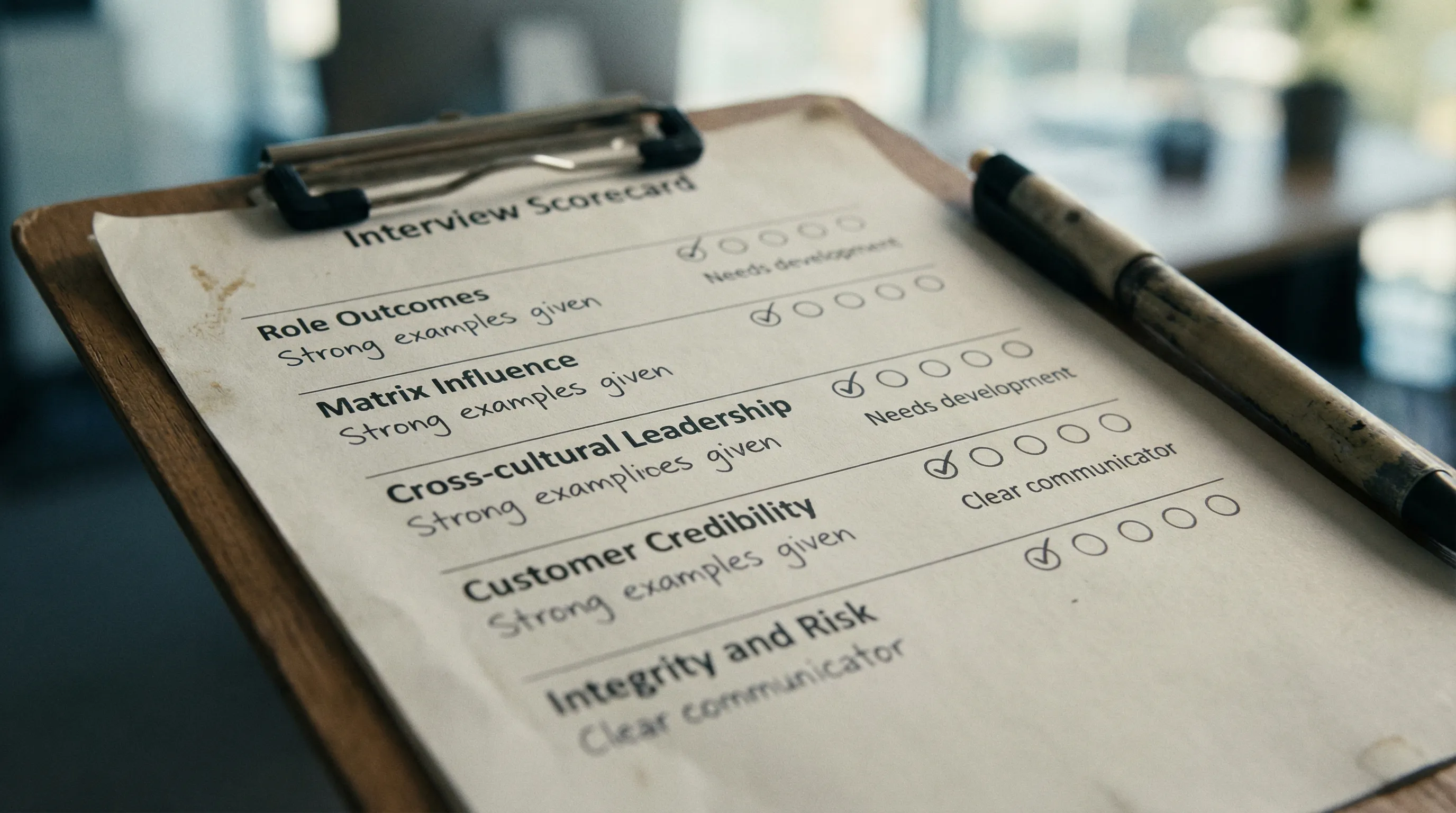
- Use a shared scorecard for the five evidence areas above.
- Define “good” before you interview (what does great look like for this region, team size, and growth stage?).
- Ask for one specific example per competency, then probe for detail (scope, constraints, stakeholders, what they personally did, and measurable outcome).
- Separate “communication style” from “competence”. International candidates may be more reserved or more direct than your local norm.
Common red flags in international middle-management interviews
None of these alone should disqualify a candidate, but they are prompts to probe deeper.
- Vague wins (“we grew a lot”) with no baseline, timeframe, or personal contribution.
- Blaming HQ or “the culture” without demonstrating ownership.
- Overconfidence about relocation or travel without clarity on constraints.
- Low curiosity about how decisions are made across regions.
- Inability to name trade-offs (everything was “top priority”).
Tailor the questions to the function (without reinventing the process)
You can keep the same five-part structure and swap in function-specific prompts.
For Sales leaders and GTM managers
Focus on: pipeline quality, forecasting discipline, territory strategy, partner ecosystems, and multi-country stakeholder alignment.
Add one question: “How do you adjust your sales motion when buying committees and procurement norms differ across countries?”
For Marketing managers
Focus on: localisation strategy, performance measurement, brand consistency, channel mix by market, and cross-functional alignment.
Add one question: “What would you localise first in our messaging, and what would you protect globally?”
For Client Services and Customer Success managers
Focus on: stakeholder mapping, renewal discipline, escalations, service quality, and playbook adoption.
Add one question: “Describe your escalation framework and how you prevent escalations from becoming the default.”
For Digital and IT delivery managers
Focus on: delivery reliability, stakeholder communication, security mindset, vendor management, and operating standards.
Add one question: “Tell me about a time you improved delivery without adding headcount.”
When to involve an international recruitment partner
If you are scaling into a new region or hiring business-critical middle managers across borders, specialist support can reduce risk and time-to-hire. Many leaders use international recruiting firms to:
- Build a realistic target list and compensation picture for each country.
- Access passive candidates with proven cross-border experience.
- Run consistent shortlisting and structured assessment.
- Manage stakeholder alignment, especially with global panels.
Optima Search Europe is an international recruitment agency based in London, focused on business-critical and senior roles across Europe and globally. If your mid-management hire sits at the centre of growth (GTM, Sales, Marketing, Client Services, or digital functions), a structured, region-aware process is often the difference between a fast start and an expensive reset.
Frequently Asked Questions
How many interview stages should we run for international middle management hires? Two to four stages is common, but the key is role coverage, not stage count. Ensure you assess outcomes, matrix influence, cross-cultural leadership, and risk judgement.
What is the best way to compare candidates fairly across different countries? Use the same scorecard and the same core questions, then allow local context in follow-ups. Compare evidence, not confidence or accent.
Should we test language fluency in the interview? Yes, if the job requires it, but do it in a job-relevant way (for example, ask for a stakeholder update, a customer call simulation, or a written summary).
What interview style works best for cross-cultural candidates? Structured behavioural questions with consistent probing. It reduces bias and gives candidates a clear way to demonstrate competence.
How do we assess whether someone can operate in a matrix? Ask for examples where they delivered outcomes without owning resources, then probe how they aligned priorities, handled conflict, and escalated decisions.
Hire international middle managers with confidence
If you are building teams across Europe and America, the fastest way to reduce hiring risk is to combine a clear success profile with a structured assessment process and a strong candidate network.
Optima Search supports organisations hiring business-critical leaders across growth sectors and international markets. Explore Optima Search Europe at Optima Search Europe to discuss role scoping, shortlists, and a streamlined search process for your next international hire.

