
Recruitment solutions that fix offer drop-offs and late-stage churn

Offer drop-offs and late-stage churn are two of the most expensive “silent killers” in executive hiring. You can do everything right on paper, shortlist brilliant leaders, run a rigorous process, and still lose the candidate at the finish line, or worse, watch them leave within the first 90 days.
For CROs, CEOs, COOs and HR leaders in high-growth firms, the impact is not just a wasted fee or a delayed start date. It’s pipeline risk, missed launch windows, leadership vacuum, and internal confidence taking a hit.
This guide breaks down practical, proven recruitment solutions to reduce declined offers and improve post-acceptance retention, without slowing your hiring down.
What offer drop-offs and late-stage churn really signal
Most late-stage failures are not random. They usually point to one (or several) underlying issues:
- Misalignment on the real job: the candidate signed up for one role, then met a different reality (scope, resources, decision rights, expectations).
- Misalignment on the deal: comp, equity, title, location, flexibility, or risk profile was not fully de-risked before offer.
- Misalignment on the organisation: the leadership story did not hold up across interviews, or the candidate detected friction between stakeholders.
- Weak “closure” mechanics: there was no plan to keep momentum, handle counteroffers, or build commitment between verbal yes and day one.
- Onboarding failure: the hire was “sold” during recruitment, then left to figure it out alone once they started.
In other words, offer drop-offs and churn are often symptoms of process design, not candidate quality.
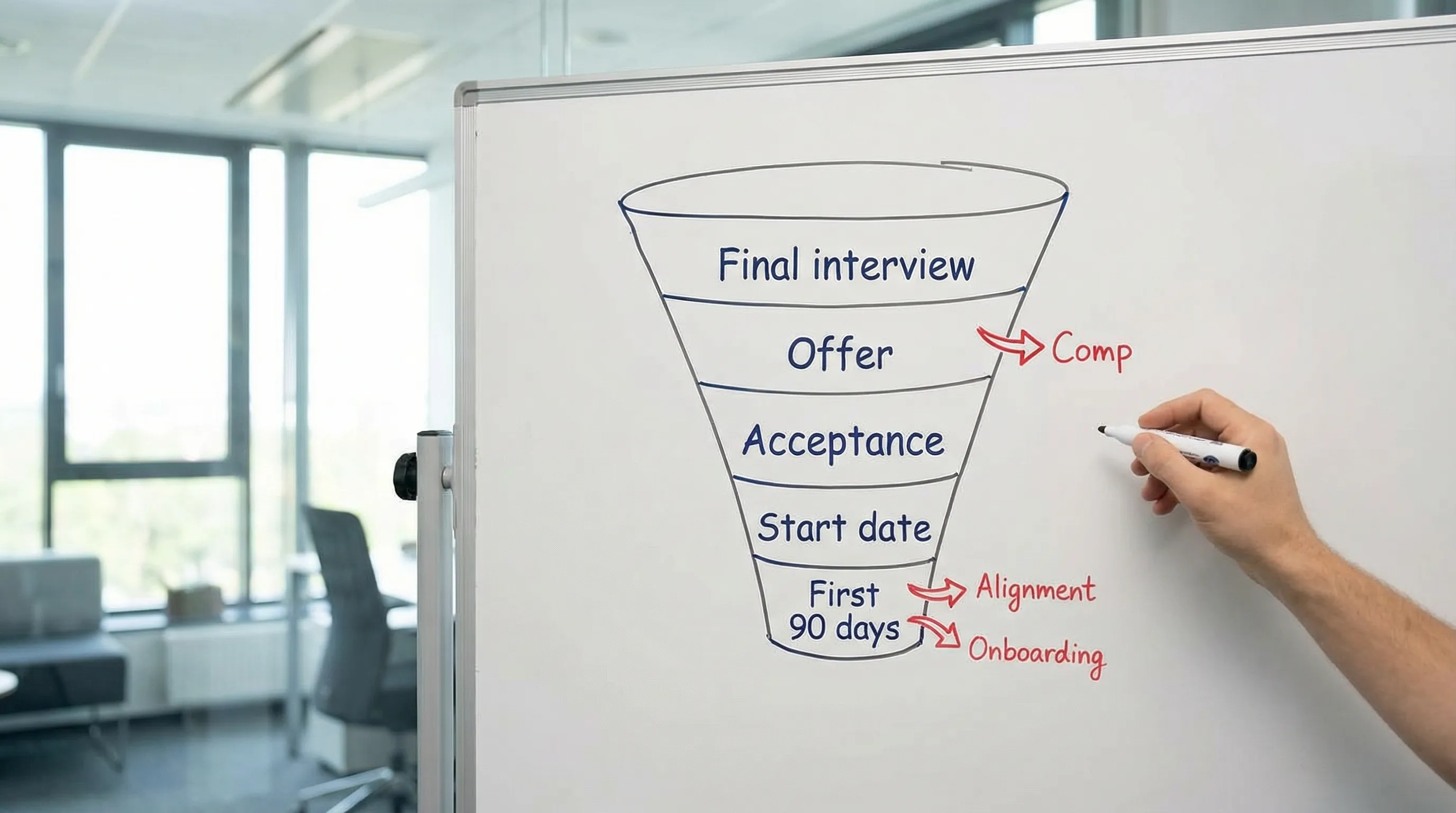
Where the hiring funnel leaks (and what to measure)
If you only track time-to-hire, you will miss the point. To fix late-stage fallout, you need to instrument the journey from finalist to month three.
Key funnel metrics worth tracking for senior hires:
- Final-to-offer ratio (too many finalists can indicate weak alignment internally, too few can indicate thin market mapping)
- Offer acceptance rate (segment by function, geography, compensation band)
- Offer-to-start rate (catches “ghost acceptances” and counteroffer losses)
- 90-day retention rate (especially for GTM and executive leadership roles)
- Time-to-productivity proxy (for example, first pipeline created for a sales leader, first team hires made, first strategic plan delivered)
Also log why people drop. Keep it consistent, even if it’s uncomfortable. Patterns appear fast when you classify reasons like “comp gap”, “scope mismatch”, “stakeholder confidence”, “timing”, “counteroffer”, “relocation”, “family constraints”.
Recruitment solutions that prevent offer drop-offs (before the offer is written)
Align stakeholders on a “success profile”, not a job description
Job descriptions rarely capture what actually drives success in business-critical roles.
A success profile should clarify:
- Outcomes expected in the first 6 to 12 months
- Non-negotiable capabilities (and what is merely “nice to have”)
- Decision rights and interfaces (board, founders, product, finance, regional leadership)
- Cultural and operating style (pace, ambiguity tolerance, conflict style)
This alignment reduces late-stage surprises, inconsistent interviewing, and the classic “we met someone great, but not sure for what” problem.
Build a close plan as early as the first conversation
A close plan is not pressure. It’s risk management.
Practical elements that reduce offer declines:
- Confirm what the candidate must see, hear, and validate to say yes
- Identify likely counteroffer risk early (especially for revenue leaders and in-demand technical executives)
- Agree on decision timing and availability of key stakeholders before the process starts
- Make the interview sequence tell a coherent story (market opportunity, product, team, board, execution plan)
The goal is to remove uncertainty progressively, not to “pitch” harder at the end.
Pressure-test motivation, constraints, and trade-offs
Late-stage churn often happens because the organisation assessed competence, but not commitment.
For senior hires, you should explicitly explore:
- Why this role, why now (and what would make them leave)
- Risk tolerance (high-growth volatility vs established structure)
- Travel, relocation, hybrid expectations, and family constraints
- Compensation trade-offs (cash vs equity, upside vs certainty)
This is where specialist recruiters add value because candidates often disclose real constraints to a trusted third party earlier than they do to the hiring team.
De-risk compensation with ranges and principles, not guesswork
Many offer rejections are avoidable if you establish clear guardrails:
- Confirm the compensation range and equity philosophy upfront (and stick to it)
- Benchmark against the candidate’s real alternatives, not just generic market data
- Avoid “surprise” components late in the process (non-competes, relocation terms, variable plan mechanics)
Even if you cannot share every detail early, you can share principles and boundaries. Ambiguity creates renegotiation, and renegotiation creates drop-offs.
Make references a decision tool, not a box-tick
References done properly reduce both offer drop-offs and churn. They validate working style, leadership patterns, and how the candidate behaves under pressure.
Use structured, role-specific reference questions tied to the success profile, for example:
- How did they build and retain top performers?
- What happens when targets are missed?
- How do they influence peers when authority is limited?
Done well, references also give the candidate confidence that the company is making a serious, thoughtful decision.
Recruitment solutions that reduce late-stage churn (after acceptance)
Offer acceptance is not the finish line, it is the handover point.
A widely cited benchmark from Brandon Hall Group suggests strong onboarding can improve new-hire retention by 82% and productivity by 70% (source). Even if your results are half that, the ROI is enormous for executive hires.
Run a pre-boarding cadence (weekly, short, and intentional)
Between signed offer and start date, the candidate is most vulnerable to counteroffers, doubt, and internal second-guessing.
A simple pre-boarding cadence can include:
- A short weekly check-in with the hiring manager (15 to 20 minutes)
- A welcome message from a senior sponsor (CEO, CRO, board member as appropriate)
- Practical logistics handled early (equipment, contracts, travel expectations)
- A clear first-week agenda shared in advance
This is not “hand-holding”. It’s reinforcing commitment and reducing uncertainty.
Create a 30/60/90 plan that is real, not performative
Candidates are often asked for a 30/60/90 plan during interviews, then left without a real operating plan once they join.
A retention-friendly approach:
- Co-create the plan with the new leader and their manager
- Define what “good” looks like by day 30 and day 90 (and what is unrealistic)
- Identify key relationships they must build early
If you want additional detail on making executive onboarding actually stick, Optima has a dedicated guide on effective onboarding strategies for executives.
Schedule a “stay interview” at week 4 to 6
Many churn events begin silently: a mismatch in expectations, a broken promise, or stakeholder friction. You can catch these early.
A stay interview is a structured conversation focused on:
- What’s better than expected
- What’s worse than expected
- What’s missing to be successful
- What would make you leave
This is especially important in high-growth environments where priorities change quickly.
Treat onboarding as a stakeholder process, not an HR process
For senior hires, churn often comes from stakeholder misalignment, not role difficulty.
Assign clear ownership for:
- The manager (weekly priorities, decision clarity)
- HR/Talent (support, team design, internal navigation)
- Executive sponsor (organisational air cover, acceleration)
This prevents the “everyone assumed someone else was onboarding them” failure mode.
A quick example: why the same role churns in one company and sticks in another
Imagine you are hiring a Head of Commercial for a fast-scaling operational business. One organisation runs a long interview process, delays feedback, and then surprises the candidate at offer stage with a different territory and a stricter on-site requirement.
Another organisation moves quickly, aligns stakeholders early, and uses pre-boarding to connect the hire to product, operations, and finance before day one. That second approach is more likely to win and retain talent, whether you are a software scale-up or a physical product company such as Arcus Apparel Group where delivery timelines, production realities, and cross-functional execution shape leadership success.
The lesson: retention is often designed before the candidate signs.
What strong recruitment solutions look like in practice (especially for business-critical roles)
If you are hiring for GTM leadership, Sales, Marketing, Client Services, Digital, IT, or executive management, the “solution” is rarely a single tactic. It is a joined-up system:
- Accurate market mapping (so you are not negotiating from scarcity-driven panic)
- Structured assessment (so you do not confuse confidence with competence)
- Consistent candidate engagement (so motivation doesn’t decay across a long process)
- Offer strategy (so comp and scope are de-risked early)
- Pre-boarding and onboarding linkage (so acceptance turns into performance)
Optima’s own guidance on best practices for executive candidate engagement is a useful reference point if you want to pressure-test your current process.
Optima Search Europe strengths (and why they matter for drop-offs and churn)
Optima Search Europe brings particular strength in high-stakes, cross-border hiring where late-stage risk is typically highest: 12+ years delivering executive excellence across Europe & America, an emphasis on proven track record and geographic reach, and proven executive search for tech’s fastest growing companies since 2013, reflecting longevity and sustained focus on high-growth environments.
Frequently Asked Questions
What is the difference between offer drop-off and late-stage churn? Offer drop-off is when a candidate declines or withdraws after reaching offer stage (or after verbally accepting but before starting). Late-stage churn is when they start but exit quickly, often within 30 to 90 days.
What causes candidates to reject offers late in the process? The most common causes are misalignment on scope, compensation, flexibility, or confidence in stakeholders, plus counteroffers and delays that allow doubt to grow.
How can we reduce churn for executive hires in the first 90 days? Link recruitment to onboarding: align on a success profile, run structured references, maintain a pre-boarding cadence, and create a realistic 30/60/90 plan with stakeholder support.
Should we move faster to avoid offer drop-offs? Speed helps, but only if you preserve decision quality. The best approach is a well-designed process with committed stakeholder availability, clear evaluation criteria, and early alignment on the deal.
Reduce your late-stage hiring risk with Optima
If your business is repeatedly losing finalists, seeing accepted offers fall through, or dealing with churn shortly after senior hires start, it is usually a process design issue that can be fixed.
Optima Search Europe supports high-growth and established firms with tailored search and selection for business-critical and executive roles across Europe and globally. To discuss your role, your market, and the specific leak points in your hiring funnel, connect with Optima Search Europe.

