
Personalfirmen für Führungskräfte: Preismodelle und was Sie erhalten

Hiring a senior leader is one of the few decisions that can change a company’s trajectory in a single quarter. It is also one of the hardest to price, because the fee from an executive staffing firm is only a small part of the true cost of getting it wrong (lost revenue, missed launches, team attrition, reputational risk).
This guide breaks down the most common pricing models used by executive staffing firms, what you should expect to receive at each price point, and the questions that protect you from surprises once a search is underway.
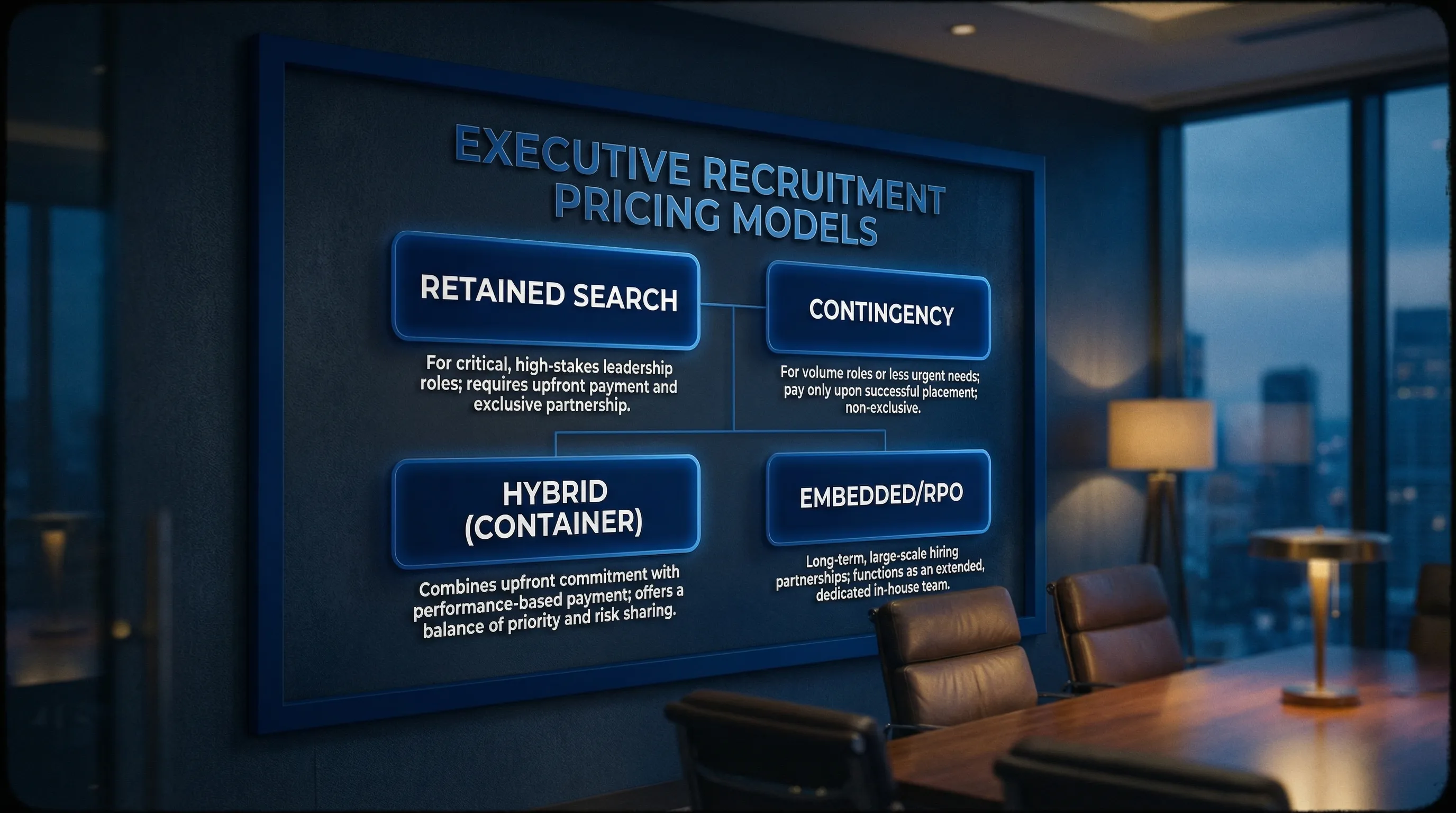
The three core pricing models used by executive staffing firms
Most senior hiring engagements fall into one of three commercial structures. Understanding the trade-offs helps you match the model to the role’s risk level, urgency and scarcity.
1) Retained executive search (retainer)
Best for: C-level, VP and business-critical hires; confidential replacements; new market entry roles; hard-to-find niche leaders.
In a retained search, you are paying for a dedicated search process, not simply for a placement outcome. The firm commits time to upfront discovery, market mapping, proactive outreach and structured assessment, usually on an exclusive basis.
What the fee usually covers:
- Search strategy and success profile (what “good” looks like in your context)
- Market mapping and targeted headhunting
- Longlist to shortlist management with calibrated evaluation
- Candidate care and closing support
- Structured reporting and stakeholder alignment
Why it costs more than contingency: you are buying depth, prioritisation and risk management. For roles where a mis-hire is expensive, retained is often the lowest-risk option.
2) Contingency search (success fee)
Best for: Roles with broader candidate supply; non-confidential searches; situations where multiple agencies are competing.
In contingency, the firm is paid only when a candidate is hired. This can work well for mid-senior roles where speed matters and the talent pool is relatively accessible.
The trade-off: because the commercial incentive is tied to “who gets there first”, you may see less time spent on deep market mapping, and a heavier reliance on existing networks or inbound candidates.
Contingency can be effective when:
- Your process is fast and decisive
- The role is clearly defined and benchmarked
- You can provide strong employer brand pull
3) Hybrid (container) model
Best for: Important roles that need more rigour than contingency, but where you still want some success-based incentive.
Hybrid structures typically combine a smaller upfront commitment with a completion fee when the hire is made. These models can improve prioritisation and process quality without moving to a full retained structure.
If you are comparing hybrids, focus less on the headline percentages and more on what is contractually included (market mapping depth, assessment stages, number of shortlist candidates, replacement terms).
Other pricing structures you may see (and when they make sense)
Project-based talent mapping or competitor intelligence
Sometimes you do not need a full search, you need talent intelligence to make a decision: compensation benchmarks, target company lists, likely candidate motivations, and realistic timelines. A fixed-fee mapping project can be a cost-effective way to validate the business case for a role or to prepare for a confidential replacement.
Embedded recruiter or RPO (Recruitment Process Outsourcing)
For high-growth companies hiring multiple senior roles, an embedded model can work: you effectively “rent” dedicated recruiting capacity (often monthly), supported by the agency’s network and research. This suits repeatable hiring where you want consistent process, employer brand alignment and predictable delivery.
Interim executive / contract leadership
Interim hiring is priced differently, typically via a day rate for the contractor and a margin or fee for the supplier. This model is useful for urgent gaps (turnaround, programme leadership, parental leave cover), but you still want strong assessment given the impact an interim leader can have.
What you should get for the fee (deliverables that matter)
Pricing only makes sense when you know what “good” looks like operationally. Regardless of model, high-performing executive staffing firms deliver more than CVs.
Role discovery that produces a real “success profile”
A proper kickoff goes beyond job description editing. You should expect:
- Clear outcomes for 6, 12 and 18 months
- Non-negotiables vs trainable skills
- Stakeholder alignment on decision criteria
- A compensation and level sanity check against the market
This step is the foundation for quality and speed. If the firm cannot clearly articulate the role’s scorecard, you will pay for it later in rework.
Market mapping and outreach (not just database search)
For senior roles, the best candidates are often not applying. The search partner should be able to explain:
- Which talent pools they will target (company types, adjacent sectors, geographies)
- How they will approach passive candidates and handle confidentiality
- How they will differentiate your opportunity credibly (without overselling)
Structured evaluation, not “vibes”
At executive level, the risk is rarely technical competence alone. You are also assessing judgement, leadership style, change capacity, and fit for your operating environment.
A robust process typically includes:
- Competency-based interviews aligned to the success profile
- Evidence-based probing of results (scope, constraints, impact)
- Calibration calls with the hiring team to reduce inconsistency
- Thoughtful reference checking (ideally beyond provided referees, where appropriate and lawful)
Candidate management and closing support
Senior candidates evaluate you as much as you evaluate them. Strong firms protect your employer brand by:
- Running a crisp, respectful process
- Managing expectations, timelines and communications
- Helping you handle counteroffers, notice periods and relocation considerations
If finalists are travelling for on-sites, plan the candidate experience like you would for strategic customers. Even practical details, like arranging accommodation via a reliable provider of hotel booking deals, can reduce friction and keep momentum.
Onboarding and aftercare
Executive onboarding is where hiring ROI is realised. Many firms include (or can add) structured check-ins during the first 60 to 120 days to help:
- Surface early risks
- Maintain alignment on priorities
- Improve retention
If a firm offers “aftercare”, ask what it actually means in practice (cadence, stakeholders involved, and how issues are escalated).
What is not always included (and can inflate total cost)
Even when an agency fee looks straightforward, the total project cost can change depending on what sits inside or outside the agreement.
Common cost items to clarify upfront:
- Background screening (employment verification, criminal checks, right-to-work checks)
- Psychometrics or leadership assessments (tools, facilitators, reporting)
- Advertising and employer branding support (less common at executive level, but sometimes used)
- Travel and interview expenses (candidate flights, hotels, stakeholder travel)
- Relocation support (logistics, immigration counsel, spouse support)
None of these are inherently bad. The problem is ambiguity. Ask for a clear scope so Finance and HR are not surprised mid-search.
How to compare executive staffing firms beyond “percentage of salary”
If you want a reliable comparison, evaluate the firm on delivery mechanics and risk controls, not just on fee structure.
Questions that reveal how a firm really works
Fragen Sie diese in Ihrem Auswahlgespräch:
- Wie sieht Ihr Marktkartierungsprozess aus und wie schnell werden wir Beweise dafür sehen?
- Wer führt die Recherche und Öffentlichkeitsarbeit durch und wer führt die Bewertung durch?
- Wie gehen Sie mit Tabus um (Unternehmen, an die Sie sich aufgrund anderer Kundenarbeiten nicht wenden können)?
- Wie ist Ihr Kommunikationsrhythmus (wöchentliches Update, Überprüfung der Pipeline, Kalibrierung der Stakeholder)?
- Wie testen Sie die Effektivität von Führungskräften in unserem spezifischen Umfeld (Skalierung, Transformation, Matrix, PE-gestützt)?
Vertragsbedingungen, die es wert sind, geprüft zu werden
Einige Klauseln sind unverhältnismäßig wichtig:
- Exklusivität und Priorisierung: Haben Sie ein engagiertes Team und was passiert, wenn sich die Prioritäten ändern?
- Bedingungen für den Ersatz: Wenn der Mitarbeiter ausscheidet, unter welchen Bedingungen führt das Unternehmen die Suche erneut durch?
- Eigentümerschaft der Kandidaten: Wie lange gelten Kandidaten nach der Einführung als „im Besitz“ des Unternehmens?
- Geografie und Geltungsbereich: Deckt die Gebühr die Suche in mehreren Ländern ab oder ist das ein Add-on?
Wenn etwas unklar ist, fragen Sie schriftlich danach. Ambiguität ist der Punkt, an dem Beziehungen und Budgets kaputt gehen.
Warum die „billigste“ Option die teuerste sein kann
Auf höherer Ebene ist das kommerzielle Risiko asymmetrisch. Die Einsparung von Gebühren kann schnell wieder wettgemacht werden durch:
- Eine längere Vakanz in einer umsatzkritischen Position
- Eine Fehleinstellung von Führungskräften, die zu Fluktuation führt oder die Strategie auf den Prüfstand stellt
- Beschädigte Arbeitgebermarke in einer kleinen, einflussreichen Kandidatengemeinschaft
Eine gut durchgeführte Suche ist im Wesentlichen ein Programm zur Risikominderung: Sie erhöht die Wahrscheinlichkeit, dass ein Mitarbeiter erfolgreich eingestellt wird, und verringert die Wahrscheinlichkeit eines kostspieligen Scheiterns.
Ein praktisches Beispiel: worauf sich Optima Search Europe konzentriert (und wie man Glaubwürdigkeit validiert)
Optima Search Europe ist eine in London ansässige internationale Personalagentur, die seit 2013 maßgeschneiderte Such- und Auswahldienstleistungen anbietet. Der Schwerpunkt liegt auf geschäftskritischen und leitenden Führungspositionen in ganz Europa und weltweit. Ihre Berichterstattung umfasst GTM, Rekrutierung in Vertrieb und Marketing, Digital- und IT-Rekrutierung, Outplacement in Unternehmen, Marktberichte und Einblicke in die Zukunft der Arbeit.
Sie sind auch in Spezialsektoren tätig, darunter Marketing Technology SaaS, Cloud-Plattform-Engineering, Datenanalyse und AIOps, KI-Infrastruktur und verantwortungsvolle KI, Cybersicherheit und GRC, digitale Gesundheit und Medtech/Biotech sowie intelligente Fertigung und industrielle KI.
Wenn Sie ein Unternehmen mit Führungskräften bewerten, ist das Feedback von Drittanbietern neben Fallstudien und Referenzen ein nützliches Signal. Die Meinung unabhängiger Kunden zu Optima finden Sie unter Optima Search Europe auf Trustpilot.

Häufig gestellte Fragen
Wie berechnen Personalfirmen für die Einstellung von Führungskräften Gebühren? Die meisten verwenden Einzelmodelle (Retainer), Notfallmodelle (Erfolgsgebühr) oder Hybrid-/Containermodelle. Einige bieten auch eine Talentkartierung mit fester Gebühr, integriertes Recruiting oder die zeitweilige Beschaffung von Führungskräften an.
Ist einbehaltene Suche immer besser als Kontingenz? Nicht immer. Retained eignet sich in der Regel für vertrauliche, wichtige oder seltene Rollen, in denen Tiefe und Priorisierung am wichtigsten sind. Bei Rollen mit einem breiteren Angebot und schnelleren Prozessen kann die Notfallplanung sinnvoll sein.
Welche Ergebnisse kann ich von einer Personalberatung im Auftrag eines Personalberaters erwarten? Mindestens: ein Erfolgsprofil, Marktkartierung, proaktive Öffentlichkeitsarbeit, strukturierte Bewertung, eine abgestimmte Auswahlliste, Unterstützung durch das Management und irgendeine Form der Nachverfolgung nach der Einstellung.
Welche versteckten Kosten sollte ich bei einem Executive Search einplanen? Zu den üblichen Zusatzleistungen gehören Hintergrundüberprüfungen, Psychometrie, Kandidatenreisen und Unterstützung bei Umzügen oder Einwanderung. Klären Sie, was in der Gebühr enthalten ist und was separat in Rechnung gestellt wird.
Wie kann ich Personalfirmen für Führungskräfte fair vergleichen? Vergleichen Sie die Prozessqualität (Kartierung, Bewertung, Berichterstattung), die Tabubeschränkungen, die Ersatzbedingungen und die Person, die die Arbeit tatsächlich ausführt, nicht nur anhand der prozentualen Gebühr.
Sprechen Sie mit Optima Search Europe über Ihre nächste Einstellung als Führungskraft
Wenn Sie Mitarbeiter für eine geschäftskritische Position in den Bereichen Vertrieb, Marketing, Kundenservice, Geschäftsleitung oder technische Führung in ganz Europa oder den USA suchen, kann Optima Search Europe Sie bei der maßgeschneiderten Suche und Auswahl von Führungskräften unterstützen.
Erkunden Sie ihren Ansatz und beginnen Sie ein vertrauliches Gespräch unter Optima Search Europa.

